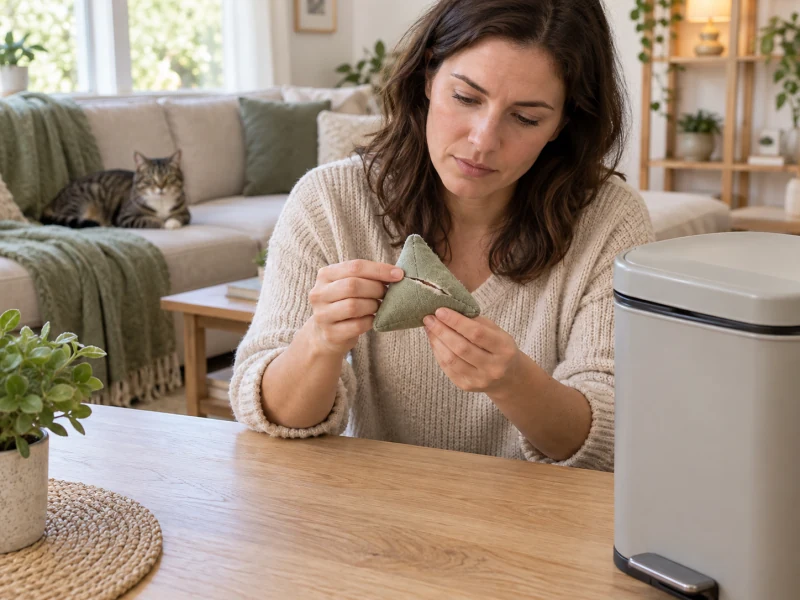
AI-created illustrative scene. The generic triangular fabric toy is not Petstages model 67842 or ASIN B07P6N5B36 and does not demonstrate dental benefit.
Chew cat toys should give a cat something suitable to mouth, bat or carry without leaving small parts behind. The important purchase is not the strongest dental promise on a package. It is a toy whose size, material and condition you can assess while watching how your cat actually plays.
The selected Petstages Toss N’ Flip Chips are textured, catnip-infused rubber toys marketed for chewing and tossing. They are one example for making these checks. A cat that bites pieces off, fixates on an attachment or shows a sudden change in chewing needs a different response from simply offering another toy.
Start with the reason you want chew cat toys
Some cats briefly mouth a toy between batting and chasing it. Others hold a toy to kick it or carry it from room to room. A toy sold as “chewable” can be useful for one of those games without becoming an appropriate object for persistent, forceful biting. Watch an ordinary play session first so you know which behavior you are buying for.
The Oregon Humane Society’s cat-toy guidance says safety and interest depend on a cat’s size, activity and preferences, as well as the environment. It highlights string, ribbon, rubber bands and other small objects that could be ingested. That makes the condition of the whole toy more informative than a label saying it is designed for cats.
Choose an achievable play purpose. A small textured piece may invite a bat, pounce or brief chew; it does not need to entertain the cat continuously or replace interactive time with a person. If a cat ignores a toy, a different movement or play schedule may matter more than adding a stronger scent.
| What the cat does | What to check | Stop-use signal |
|---|---|---|
| Bats or flips a piece | Whole toy remains visible and easy to retrieve from the play area | It disappears into a place where the cat may chew it unseen |
| Briefly mouths a surface | Material springs back without cracks, flakes or loose color | An edge starts to split or a small piece comes away |
| Carries the toy | Size suits the cat without an attached string or removable part | The cat begins to swallow or chew off a feature |
| Chews unusually or persistently | Look for a change from normal eating and play behavior | Drooling, dropping food, pain or reduced appetite warrants veterinary advice |
These are observations, not diagnoses or guarantees. Keep the first sessions short and supervised. When a cat’s behavior changes unexpectedly, a shopping comparison should not delay a veterinary conversation.
Check the material and construction of chew cat toys
A cat toy can be rubber, fabric, rope, plastic or a combination. Look at the specific item in hand: its edges, seams, glued features and anything that might peel or detach. “Soft” is not a material specification, and “non-toxic” does not mean that a swallowed piece can pass safely.
The American Humane Society’s toy-safety guidance advises cat owners to check strings, feathers and bells, avoid loose fabric or embellishments that could be ingested, supervise new toys and replace damaged ones. A one-piece design reduces some attachment checks but still needs inspection for cracks, torn edges or fragments.
On a textured rubber toy, feel around raised ridges and the perimeter before each session. The goal is not to prove its chemistry by touch; it is to find damage that might become a loose piece. If the product page does not identify an exact material grade, do not assume food-contact certification or a particular chemical standard from color or flexibility.
Size is more than a category such as “for cats.” Compare the whole toy with the individual cat’s mouth and style of play. A piece that is easy to bat may also be easy to hide under furniture. Keep the session in an area where you can see and retrieve it, particularly when you are trying a new toy or have multiple cats.
Check the delivered package and current maker instructions for cleaning and age guidance. A general web listing is not a substitute for the exact item label. If the label is unclear about washing a scented or infused toy, avoid inventing a dishwasher or soaking method that could change its material or scent.
Assess the exact Petstages Toss N’ Flip Chips offer
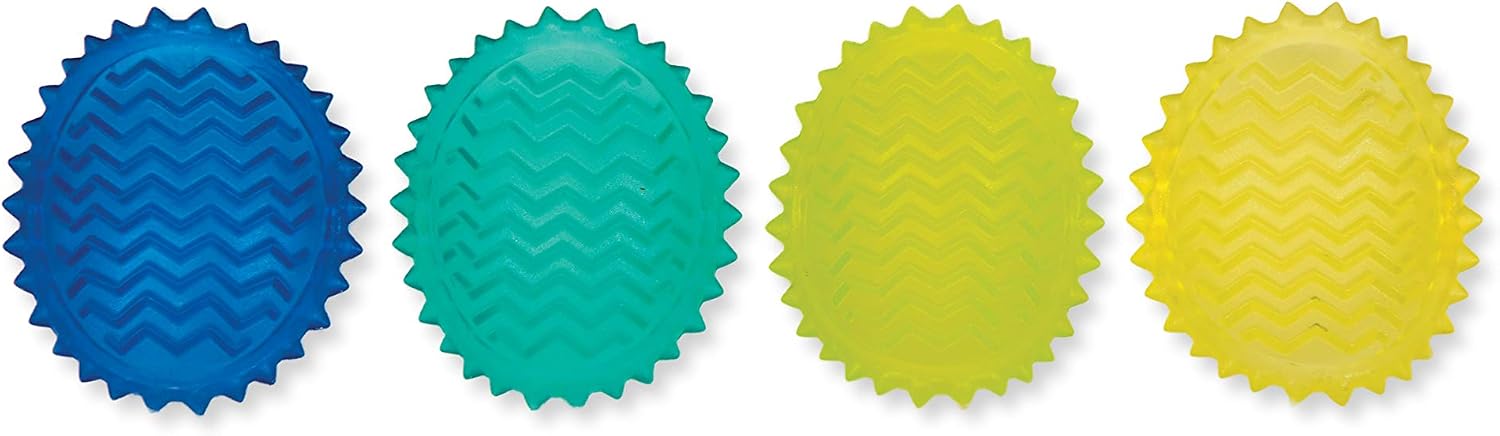
The selected listing is Petstages Toss N’ Flip Chips Catnip Infused Cat Chew Toys, Amazon ASIN B07P6N5B36, item model number 67842. It lists approximately 2.4 × 1.97 × 1.19 inches for the product dimensions and describes pliable rubber with several textures and catnip oil infusion. Its main image shows four brightly colored, ridged oval pieces. Confirm the current package description and delivered contents rather than infer an exact count or material standard from that photo alone.
The retailer describes three intended actions: a person can toss or flip a chip, the cat can bat and pounce, and the textured rubber can be mouthed. It also advertises a tooth-cleaning benefit. Those are listing claims, not independently verified clinical results for these chips. The American Veterinary Medical Association’s dental guidance says dental products with health claims are not all effective and recommends discussing them with a veterinarian.
If this construction fits your cat’s play, check the Petstages Toss N’ Flip Chips offer on Amazon. Match the ASIN and model field at purchase, then check whether the selected offer can be delivered to your address. A stock label for another destination does not establish availability where you live.
Do not describe this toy as a treatment for plaque, tartar, bad breath or pain. A textured object might be part of play, but a photo of ridges and a retail phrase about flossing do not establish how much it cleans any cat’s teeth. Keep the buying decision centered on intact construction and a cat that uses it without damaging it.
PRODUCT MENTIONED
Petstages Toss N’ Flip Chips Cat Chew Toys (67842)
Amazon · Details on the retailer’s website
Treat catnip in chew cat toys as an optional attraction
The listing identifies catnip oil as an attraction feature. Oregon Humane notes that not all cats respond to catnip and that some may become over-stimulated or less active. If your cat seems uninterested, that alone does not make the toy defective. If the scent is followed by rougher, more frantic biting, stop and reassess whether this is a good toy for that animal.
Do not add your own oils, sprays or supplements to “strengthen” the toy. The selected offer is for a finished item, and adding another substance could change the smell, surface or suitability in a way the listing did not evaluate. Let the cat choose whether to interact during a short supervised trial.
A multi-cat household adds another variable. One cat may bat a chip gently while another chews the ridges. Watch each cat separately at first; do not assume the first cat’s response establishes the same size and use pattern for every animal. Put away a toy that one cat is breaking, even if another cat likes it.
Set up a first session you can actually observe
Begin in a clear room where the piece will not disappear immediately under furniture or behind an appliance. Remove packaging and check the whole edge for existing damage. Offer one toy, encourage a gentle toss or bat and watch what the cat chooses to do. The product’s value is what happens in that room, not how animated the promotional copy sounds.
Notice whether the cat mouths the surface briefly, carries it, pins it with paws, or gnaws one point repeatedly. A playful pounce and a focused attempt to tear material call for different decisions. If the cat tries to peel a ridge or bite a corner off, end the session and inspect the toy. Do not keep presenting a damaged piece to test how long it lasts.
American Humane recommends supervising new toys and inspecting them regularly. Supervision means being close enough to notice a small part coming loose and to remove the toy promptly. It is not the same as checking on the cat much later. For a new toy that can roll away, stay present until you have retrieved and inspected it.
Use a predictable stopping point: after play, collect the piece, look for tears, and store it outside the cat’s reach if you are not confident in unsupervised access. You can rotate it with other suitable toys to keep sessions fresh. A short successful trial is information about that session, not a lifetime safety certificate.
Clean and inspect chew cat toys before damage grows
Ridges and edges can collect saliva and household debris. Follow the instructions on the exact delivered package. If it calls only for surface cleaning, do not substitute a hot dishwasher cycle or solvent. If no reliable cleaning instruction is available, ask the maker before applying a method that could damage or deform the material.
Check the surface in good light after cleaning and once it is dry. Look for cracks, peeling, tacky patches, separated layers or a changed shape. A torn edge on a small toy can create a smaller piece that is easier to swallow. American Humane’s general advice is to replace damaged toys right away, not to continue use because the main body still looks intact.
Do not patch a chew toy with glue, tape or string. A repair adds material and another edge to investigate, and there is no verified evidence that a home repair restores the original construction. Retire the damaged item and consider a different design if the same failure repeats.
If you think your cat swallowed part of a toy, contact a veterinarian for individualized advice. Avoid guessing from the size of the missing piece or waiting for a web article to decide whether care is urgent. Keep the remaining toy and packaging available so the veterinary team can identify the material and approximate missing portion.
Keep dental and behavior concerns separate from toy shopping
A cat suddenly chewing harder, dropping food, drooling, eating less or seeming painful around the mouth may need a veterinary assessment. The AVMA lists changes in chewing, drooling, reduced appetite and mouth pain among reasons for an earlier dental check. Another chew toy cannot establish the cause or treat the problem.
The AVMA also identifies regular toothbrushing as the most effective home action for oral health between professional dental care, while noting that cats may need patient training. Ask your veterinarian about any dental product you want to use. A toy marketed as “teeth cleaning” should not replace routine examinations or a plan suited to the individual cat.
Keep observation modest and factual: did the cat bat it, mouth it briefly, break a part, or show a change from normal eating? Those facts help you decide whether to use the toy again and what to tell a veterinarian. Avoid diagnosing boredom, dental disease or nutritional need from a single play session.
Frequently asked questions
Do cats need a chew toy for their teeth?
A cat may enjoy a toy it can mouth and bat, but the selected toy’s dental marketing is not proof of treatment or cleaning effectiveness. Follow veterinary advice for oral health, including examinations and a realistic home-care routine.
Is a rubber cat toy safe to leave out all day?
Rubber is not an unsupervised-use guarantee. Watch the first sessions, check for cracks or loose edges and consider whether the cat hides or forcefully chews the toy. Remove it when its condition or the cat’s behavior makes safe use uncertain.
What if my cat ignores catnip-infused toys?
Individual responses to catnip differ. Try a different safe play pattern rather than adding oils or assuming stronger scent is needed. The toy still has to be appropriate in size and condition whether or not the scent attracts the cat.
When should I replace a chew cat toy?
Replace it when it splits, sheds pieces, develops loose features or changes shape in a way you cannot assess. There is no universal number of play sessions. Inspect before and after use, especially when the cat concentrates its chewing on one edge.
Choose the toy the cat can use intact
Good chew cat toys fit a cat’s observed play and remain whole through supervised sessions. The Petstages chips may suit a cat that bats, flips and briefly mouths a textured piece; a cat that tears off material needs a different option. Treat the catnip and dental wording as features to verify, not assurances of interest or health benefit.
Keep the practical routine simple: check the exact product, supervise the first use, inspect and clean it as directed, and retire damage early. When chewing or eating changes suddenly, bring that observation to a veterinarian instead of trying to solve it through another toy purchase.
View Petstages Toss N’ Flip Chips Cat Chew Toys (67842) on Amazon.
Comments are reviewed before they appear publicly. Please keep questions and feedback relevant to this article.