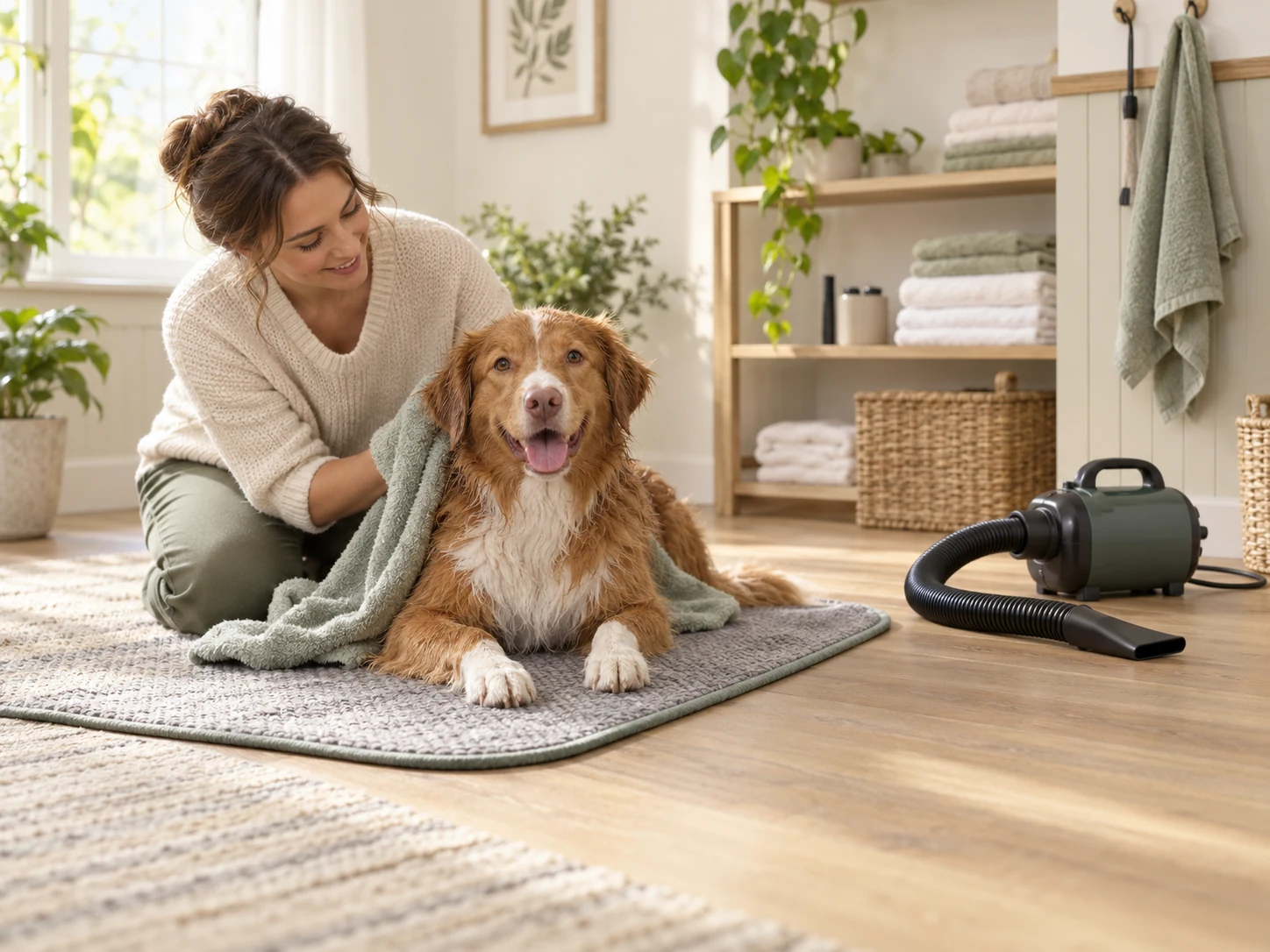
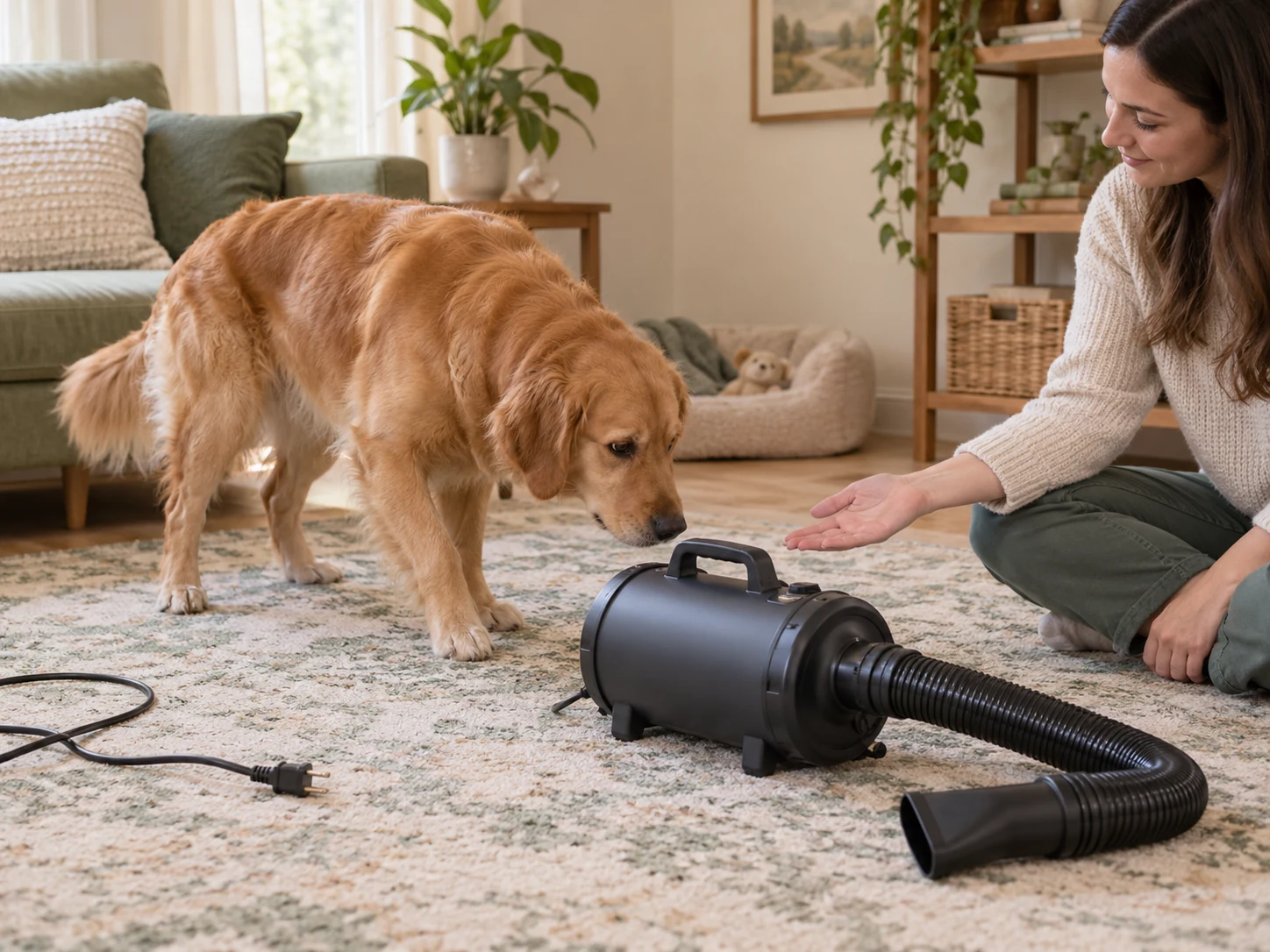
AI-created editorial scene. It does not depict the Flying Pig model, a verified heat setting or a drying-time test.
A dog blow dryer is worth considering when towel drying leaves a coat damp and you can introduce the sound and airflow gradually. Choose adjustable airflow, clear temperature instructions, and a setup you can supervise continuously; buying the most powerful machine does not establish that your dog needs or will tolerate its maximum output.
For many households, the first useful change is simpler: press water out with suitable towels, prepare a comfortable drying space, and learn where moisture remains in the coat. A dedicated dryer adds equipment, noise, cleaning, and electrical demands. Those tradeoffs should be clear before you order one.
Decide whether a dog blow dryer solves your problem
Start with the coat and your current routine. A short, easily towel-dried coat creates a different job from a dense coat that holds water underneath the outer hair. Frequency matters too: occasional wet paws do not create the same equipment need as regular full baths.
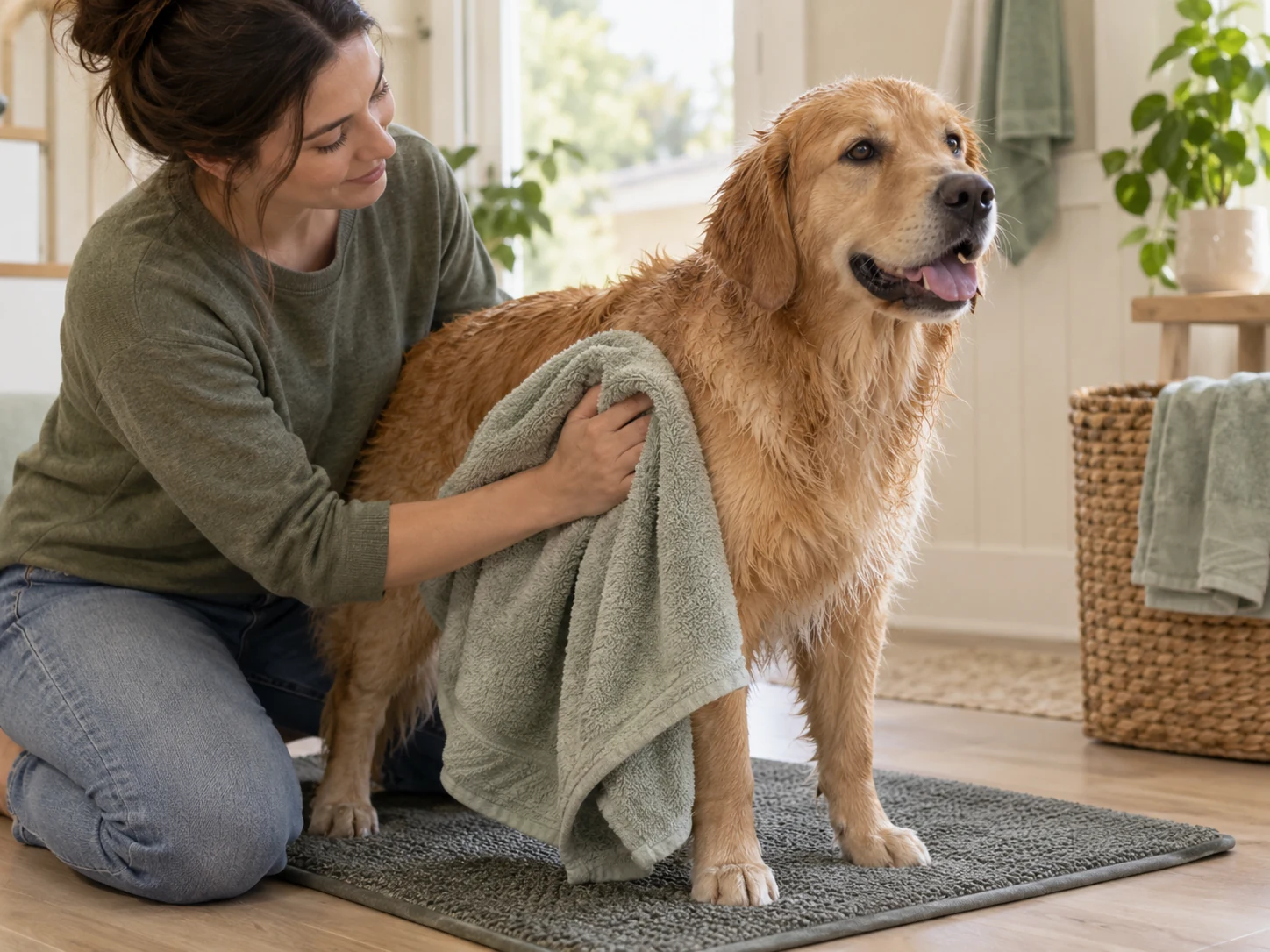
The American Kennel Club’s dog-drying guide distinguishes towel drying for some short coats from towel drying followed by a dog dryer for longer or thicker coats. It also recommends pressing with the towel rather than vigorously rubbing, which can create tangles. That makes towels a preparation step even when you decide to use powered airflow.
Think about handling as well as coat density. If your dog is frightened by a switched-off machine being moved nearby, a new dryer is not an immediate solution. Plan a gradual introduction before bath day, or use a groomer or suitable supervised wash facility while you work out a better routine.
| Your situation | A useful next step | What the dryer does not solve |
|---|---|---|
| Short coat dries comfortably with towels | Improve towel technique and check the finished coat | A purchase may add work without a clear benefit |
| Dense coat remains damp underneath | Ask about suitable forced-air drying and coat preparation | High output does not replace careful handling |
| Dog reacts strongly to noise | Introduce sound gradually in brief sessions | A “quiet” label does not guarantee acceptance |
| Wet, cramped bathroom with limited outlets | Reassess the drying location and electrical setup | A long hose does not make unsafe placement acceptable |
| Painful skin, breathing concerns, or marked distress | Get appropriate professional guidance first | A dryer cannot diagnose or treat the underlying issue |
Compare airflow control before headline power
Look for control at the level your dog can tolerate. A machine’s top output is only one operating condition; it is not the level you should automatically use. Ask what the controls actually do, whether the airflow can be reduced, and how clearly the manufacturer explains nozzle selection and use.
Motor count, wattage, air volume, and nozzle pressure describe different things. Two motors are not proof of twice the useful drying performance, and a large advertised airflow figure cannot be compared fairly with another brand’s figure unless the measurement conditions are known. Hose length, nozzle shape, coat condition, and technique also affect the experience.
For a home purchase, a controllable start and clear instructions are more useful than an unsupported drying-time promise. A timed drying result has not been independently verified for this machine. Do not plan a session around a claim that every dog can be finished within a particular number of minutes.
Check the hose and nozzles as working parts
A flexible hose lets you position the motor away from the immediate handling area, but it still needs space. Plan its route so the dog, your feet, and the power lead do not become tangled. Consider where the hose rests when you pause and whether you can grip it comfortably without pulling the machine.
Nozzles shape the airflow; they are not interchangeable decorations. Confirm which ones are included and follow the exact model’s instructions for attaching and choosing them. Do not invent a universal nozzle-to-skin distance from a product photograph. If the directions are absent or unclear, ask the manufacturer before using the dryer on the dog.
Temperature and noise need separate checks
A dog blow dryer should be assessed for heat exposure as well as air movement. More warmth is not automatically a better setting. The AKC’s drying guide emphasizes airflow and cautions against using heat that could burn the skin; it also advises keeping the nozzle away from the face and ears.
The AKC’s professional grooming educational standards call for low heat, moving airflow, equipment maintenance, and close monitoring of comfort. These are useful principles, not a model-specific operating manual or a reason to leave a home dryer running unattended.
Check whether the product has a heater, which temperature controls are actually provided, and what the supplied instructions permit. Do not interpret an absent heater specification as proof that the outgoing air always stays cool: a page that omits a temperature range has not verified one. Stop if the airflow feels too warm or your dog is uncomfortable, and resolve the cause rather than increasing distance and hoping that is enough.
Noise is another independent issue. No consistent test conditions or comparative sound measurements were established for the selected model. A motor housing, hose, or marketing description cannot prove that a particular dog will find it quiet. Consider your dog’s response and the people sharing the room, and take breaks rather than pushing through a long exposure.
A specific option: Flying Pig Double Motor dryer
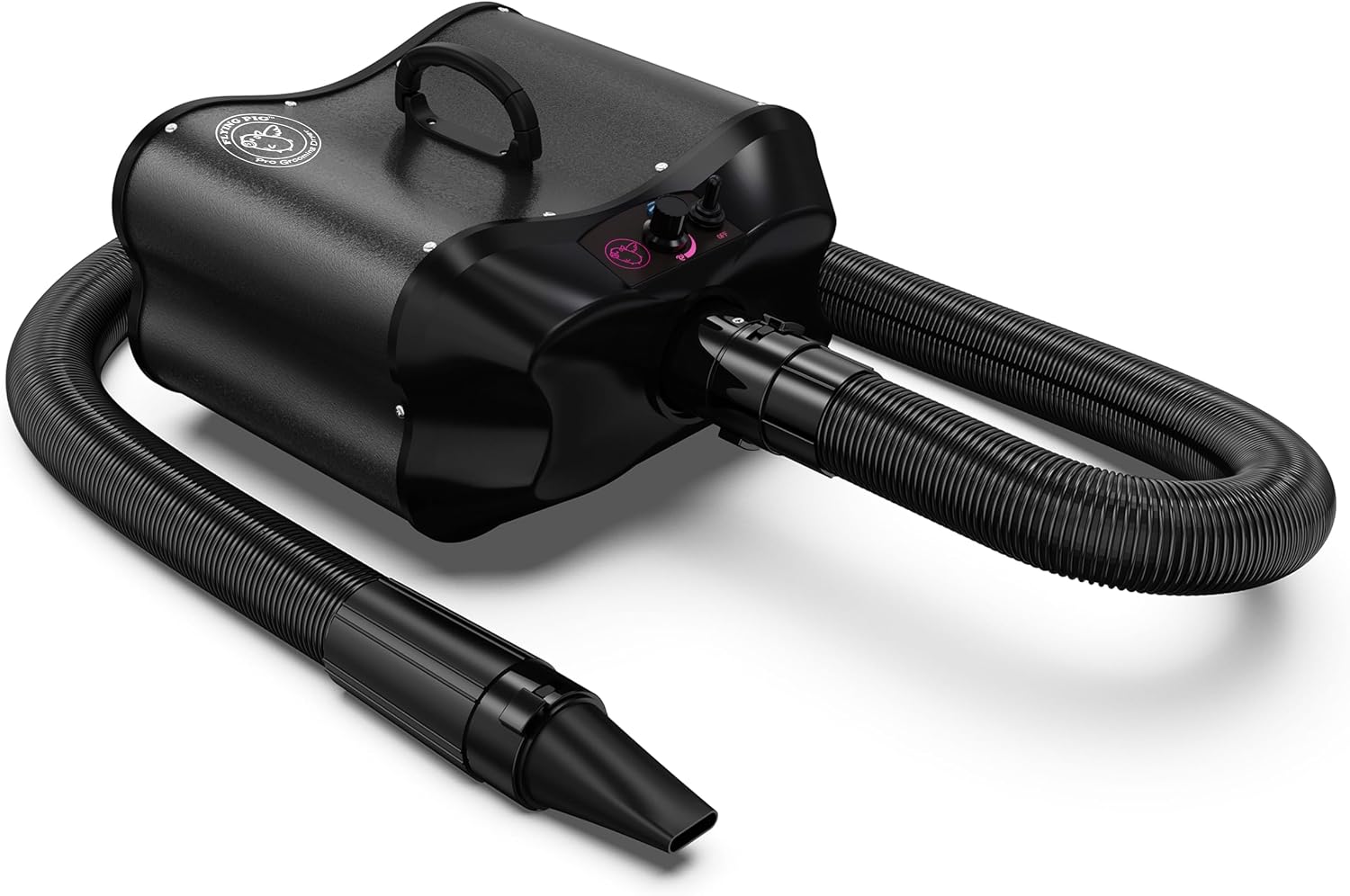
The selected product is the black Flying Pig Double Motor High Performance Dog Pet Grooming Dryer, ASIN B0DR53GTDC. Its Amazon model field reads FP2 Parent. Keep that exact listing identity separate from Flying Pig’s other single-motor, stand, wall-mounted, or digital dryers.
Flying Pig’s Double Grooming Dryer product page describes the same double-motor family, with a steel body, adjustable airflow controls, a 10-foot hose, three nozzles, and two extra filters. Both that page and the selected Amazon listing specify 1,600 watts and 120 volts. The brand page uses the product code BFDRYER; it should not be read as proof that every similar retailer title or color is the same packaged listing.
| Purchase check | Established information | What to confirm before use |
|---|---|---|
| Selected listing | Black; ASIN B0DR53GTDC; retailer model field FP2 Parent | Delivered label and included instructions match the order |
| Electrical rating | Published 1,600 W / 120 V | A suitable outlet and setup following the actual manual |
| Airflow | Dual motors and adjustable airflow are described | Understand each control before introducing the dog |
| Included accessories | 10-foot hose, three nozzles, two spare filters | Package contents and secure, correct attachment |
| Temperature and noise | No operating temperature range or independent noise test established here | Obtain the exact operating instructions; do not infer a guarantee |
Consider this machine only if a powerful standalone forced-air setup fits your coat-care needs, available space, and handling routine. Its double-motor design may be more equipment than a household with an easily towel-dried dog needs. It is not an enclosed drying box, an automatic unattended solution, or a replacement for a groomer’s assessment.
The exact model’s complete operating manual remains unverified. Obtain the correct manual and confirm temperature, attachment, electrical and maintenance instructions before use. A generic drying procedure or temperature setting cannot replace the model-specific instructions.
View the black Flying Pig Double Motor dryer on Amazon.
PRODUCT MENTIONED
Flying Pig Double Motor High Performance Dog Pet Grooming Dryer (Black)
Amazon · Details on the retailer’s website
Plan the dog blow dryer setup before bath day
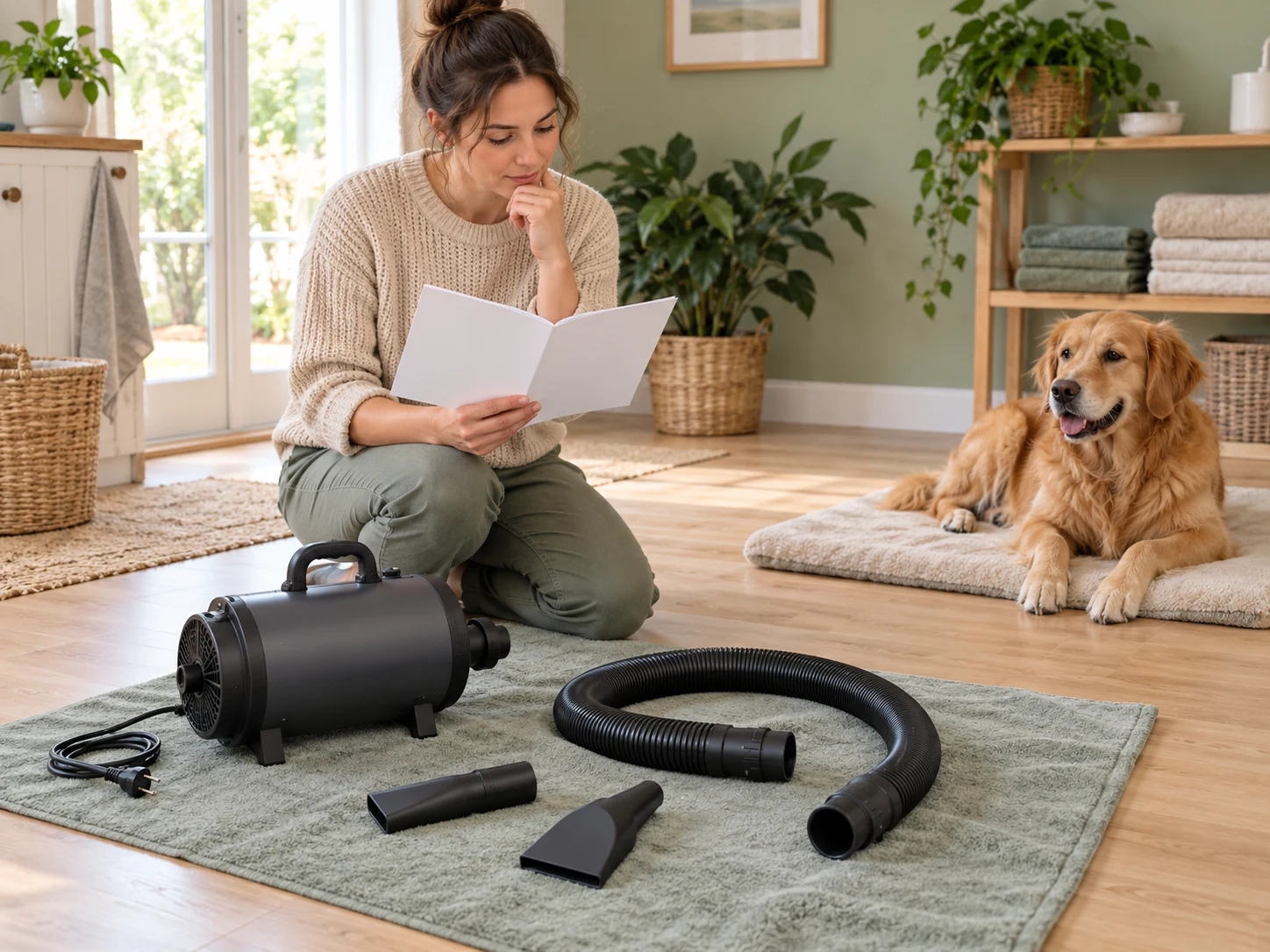
Choose a dry, stable location where you can supervise the dog and reach the controls. Keep the machine, plug, and connections away from splash areas and follow the manufacturer’s placement requirements. If the outlet or electrical arrangement is uncertain, resolve it with a qualified person instead of improvising adapters or extension leads.
Prepare towels, the correct clean filter, and a clear hose route before starting. Check the housing, cable, hose, and attachments for damage. Do not block an intake to reduce noise or cover a motor with fabric; reducing sound is not a reason to obstruct the equipment.
Allow room for the dog to stand or reposition comfortably on a suitable nonslip surface. Avoid a setup that depends on holding a struggling dog still while also controlling a nozzle. If you cannot manage both comfort and equipment safely, change the plan or use professional help.
Introduce sound and airflow without rushing
Practice away from the pressure of finishing a wet dog. The AKC’s drying guidance builds familiarity in stages: exploration while switched off, sound at a distance, then gentle airflow only after the dog is comfortable with the earlier steps.
- Begin without power. Let the dog investigate the stationary equipment and reward calm interest without forcing an approach.
- Introduce sound separately. Start at a distance that the dog can handle. Keep the exposure brief and stop before it becomes overwhelming.
- Follow the permitted low setting. Only introduce airflow after you understand the controls and exact instructions. Keep it away from the face and ears.
- Build in pauses. Monitor body language, breathing, skin comfort, and the equipment throughout. A successful short practice is enough.
- Stop at difficulty. Do not increase restraint or power to get the session over with. Ask for help if the dog cannot remain comfortable.
Do not give sedating products to make a dryer usable without veterinary direction. If your dog has a medical condition, difficulty breathing, or marked heat sensitivity, ask the veterinarian about an appropriate grooming plan before choosing drying equipment.
Include filters, cleanup, and storage in the decision
A dryer needs maintenance even when it has no bag to empty. Hair and dust around the intake, filters, and workspace are part of the routine. Inspect and clean the permitted components as directed, with the unit switched off and disconnected where the manual requires it.
Keep spare filters identifiable by the correct model and check their required care. Do not assume they can be washed, used damp, or replaced with arbitrary foam. Keep the power equipment dry, let the machine reach an appropriate storage condition according to its directions, and store the hose without a damaging bend.
If your real goal is collecting loose hair during brushing, that is a different equipment decision. The Neakasa P2 Pro grooming-vacuum guide covers vacuum-assisted grooming. Suction-based collection should not be mistaken for the directed airflow used to dry a wet coat.
Frequently asked questions
Can a human hair dryer replace a dog blow dryer?
The AKC recommends a dryer designed for dogs rather than a human hair dryer, emphasizing coat and skin considerations. Do not substitute high heat to shorten drying time. The alternative may be appropriate towel drying or professional help, depending on the coat, rather than buying or improvising another hot-air device.
Does a double motor mean I should use maximum airflow?
No. Motor count describes the machine, not your dog’s tolerance or an appropriate starting setting. Learn the controls from the exact manual and introduce sound and airflow gradually. Maximum output is not a required step, and it does not establish a better result for every coat.
How far should I hold the nozzle from my dog?
Follow the model’s instructions and suitable professional guidance rather than relying on a universal drying distance. Temperature, airflow, nozzle choice, and coat condition all matter. Keep the airflow away from the face and ears, keep monitoring comfort, and stop rather than relying on distance alone.
Can I leave the dryer running while I do something else?
No. Handheld drying requires a person to control and monitor the process throughout. A standalone machine is not an unattended system. If you cannot stay with the dog and respond immediately, switch off and pause the task.
Buy for a manageable drying routine
The right dog blow dryer should fit the coat, the room, and the way you can handle your dog. Start by improving towel drying and deciding whether damp coat remains a recurring problem. Then compare airflow control, clear temperature instructions, noise tolerance, electrical requirements, and maintenance instead of selecting by motor count alone.
The black Flying Pig Double Motor listing is a defined option for a household that needs a substantial forced-air setup. Confirm the exact delivered model and obtain its complete instructions before use; its published power rating and accessories do not establish a universal safe setting. If gradual introductions are not comfortable or the coat needs specialist handling, a professional drying plan is the more useful next step.
View Flying Pig Double Motor High Performance Dog Pet Grooming Dryer (Black) on Amazon.
Comments are reviewed before they appear publicly. Please keep questions and feedback relevant to this article.