AI-created editorial scene. Tools are generic; this is not a GLADOG photograph or a cutting demonstration.
Choose dog grooming scissors for a defined finishing job that a groomer has shown you, not as a way to cut out mats or improvise a complete haircut. Rounded tips reduce one pointed-tip hazard, but the cutting edges can still injure skin and a moving dog.
Before buying a set, decide whether the task really needs cutting. Brushing, combing or a professional appointment may be the better next step when the coat is tangled, the skin is hidden or the dog cannot remain comfortable with handling.
Decide which work belongs at home
Home finishing is a limited maintenance task, not a substitute for learning how a particular coat should be groomed. A familiar, calm dog with loose exterior hair that needs tidying is different from a frightened dog or a compacted mat tight against the body.
Blue Cross’s grooming guidance emphasizes that professional groomers undergo substantial training and that untrained clipping can cause injury. It recommends breed-specific instruction and appropriate equipment. Treat a product’s “beginner” label as marketing rather than evidence that the intended job is simple.
Ask a groomer to identify the area you can maintain, the tool to use and the point at which you should stop. Use your actual dog and kit for that demonstration, because another animal in a tutorial may have a different coat and handling response. If you cannot see where the coat ends and skin begins, or the work is near eyes, ear edges, skin folds or an irritated area, leave the cutting to someone qualified.
Do not pull a mat away from the body and cut underneath it. Skin can be concealed within the area you think is only hair. A mat that will not separate gently needs assessment and appropriate professional removal, rather than a sharper pair of scissors.
Dog grooming scissors have different cutting jobs
Match the scissor type to the demonstrated task. Straight, curved and thinning scissors are not interchangeable versions of a safety device. Their shapes change how they remove hair, while judgment and control remain necessary.
| Type | Intended finishing role | Limit to remember |
|---|---|---|
| Straight | Defined straight trimming lines | A straight blade can still meet skin if the dog moves |
| Curved | Shaping a curved outline | The curve does not guide itself around anatomy |
| Thinning | Blending or reducing visible bulk | Toothed blades still cut; repeated passes remove more coat |
| Comb | Checking and arranging loose hair | A snag is a reason to stop, not pull harder |
A kit is useful only if you understand the role of each piece. Buying three cutting tools does not create a reason to use all three during every session. If only one task has been demonstrated, keep the session limited to that task.
Coat type also changes the decision. The ASPCA’s coat-care guidance distinguishes smooth, dense and longer coats rather than offering one cutting routine for all dogs. Do not reduce a double coat or reproduce a breed haircut simply because a thinning scissor is available.
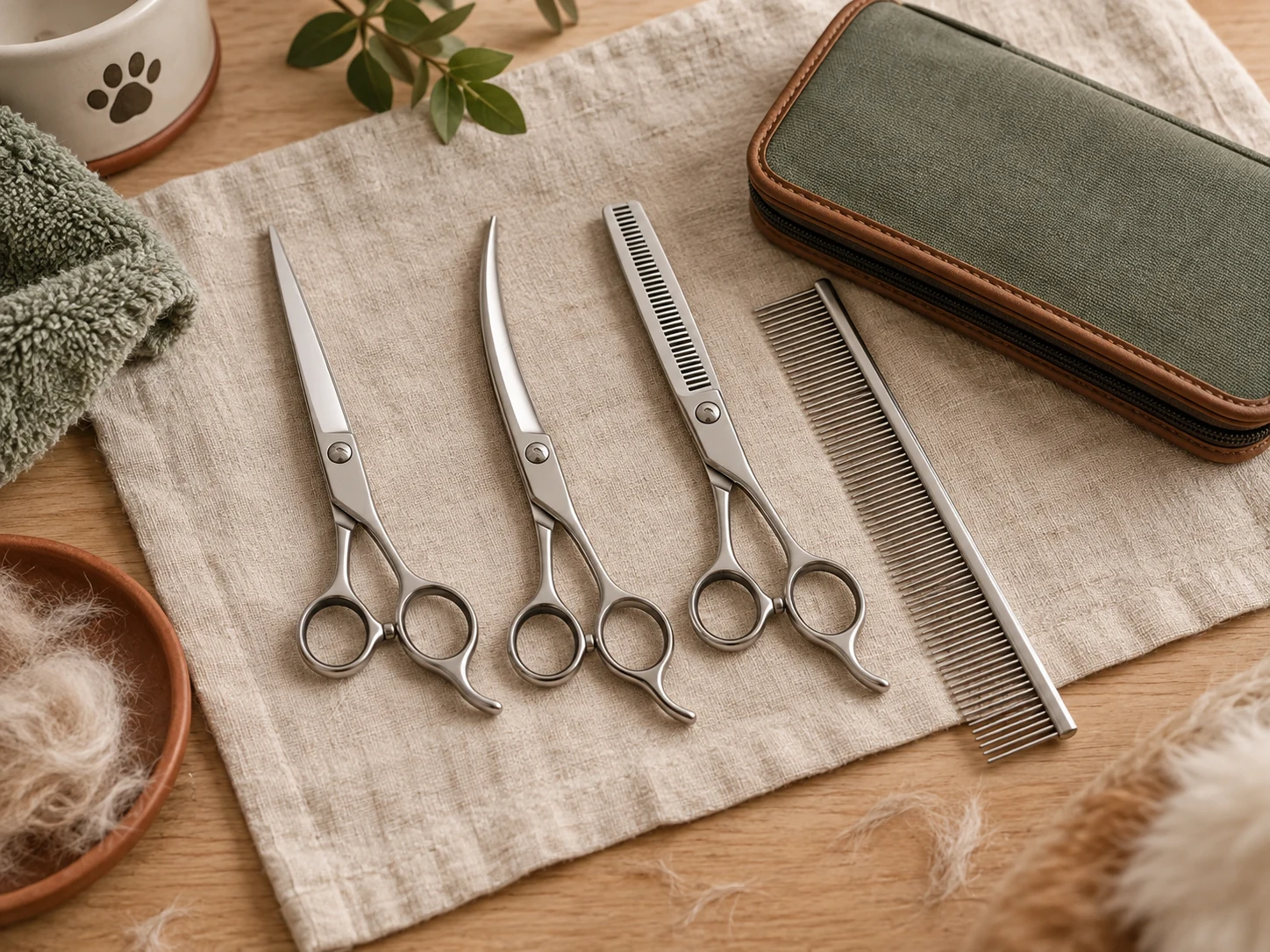
What the GLADOG set contains
The specified GLADOG five-in-one listing describes 6.5-inch straight, curved and thinning scissors, with a comb, cleaning cloth and storage case. “Five-in-one” is a kit description, not five different scissor types. Check the included pieces against the actual retail option rather than assuming a larger kit is being supplied.
For a demonstrated finishing task, check the GLADOG five-in-one dog grooming scissors set on Amazon. The appeal is having the three listed cutting types and a comb together. Confirm that the handle fit and individual tools suit the work you actually intend to do.
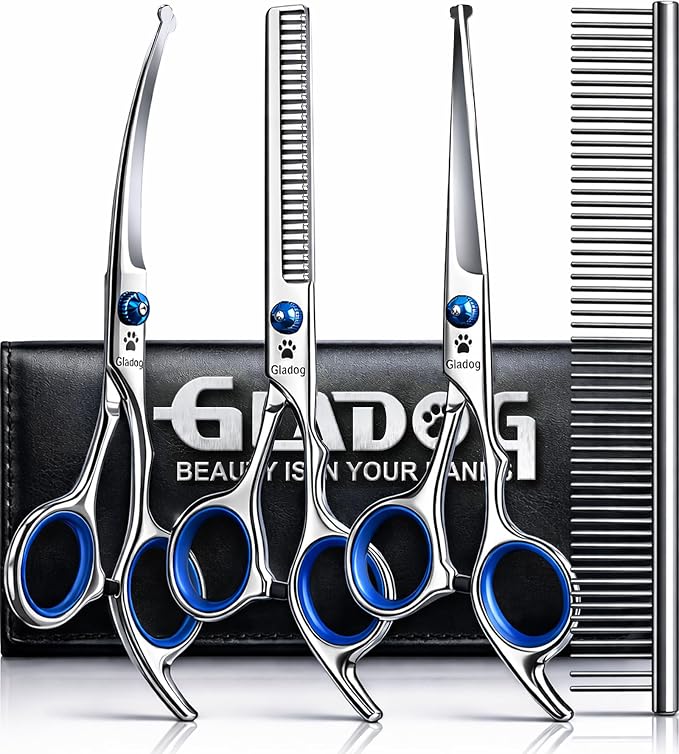
PRODUCT MENTIONED
Professional 5 in 1 Dog Grooming Scissors Set with Safety Round Tips, Sharp and Heavy-duty Pet Grooming Shears for Cats
Amazon · Details on the retailer’s website
The listing describes rounded tips, coated steel and a handle bumper. Those are stated features, not independent proof of injury prevention, stress-free grooming or a professional finish. Sharpness, balance, coating durability and noise have not been independently verified for these scissors.
Its limitations are the same ones that matter for any home cutting set: several tools to learn and maintain, exposed cutting edges, and a fixed size that may not feel controlled in every hand. A longer list of included items cannot compensate for poor visibility or an uncomfortable dog.
Check control before the scissors approach the dog
Start with your own grip and the tool’s condition. You should be able to open and close the scissors deliberately without stretching your hand or changing grip abruptly. Ask the groomer who demonstrates the task to assess whether the size and handle arrangement are appropriate for you.
Inspect each pair for damaged tips, misalignment, looseness or debris. Follow the supplied instructions for tension and maintenance; do not invent an adjustment based on how a different brand feels. A blade that folds or drags hair deserves attention before it is used on the coat.
Set up a quiet, well-lit area with a secure surface appropriate for the dog. Keep loose tools out of reach and choose a point where the work can stop immediately. A dog balancing on an improvised slippery surface is not ready for a cutting session.
Do not test a newly purchased blade on a moving animal to find out whether it is sharp. Confirm tool function separately and get the exact grooming technique demonstrated. If you lack a clear view, a controlled grip or the right instruction, postpone the cut.
Comfort with handling comes before trimming
A dog that stays still because it is worried is not necessarily comfortable. Watch the whole response rather than interpreting the absence of movement as permission to continue. Turning away, tension or repeated attempts to leave are reasons to stop the session and reassess.
Dogs Trust’s handling guidance recommends gradual, positive introductions, short sessions and stopping when the dog becomes uncomfortable. Practise being touched and having grooming equipment nearby before combining those experiences with cutting.
Introduce one manageable part of the routine at a time. Let the dog be comfortable with the location and handling; only progress when that stage remains easy. Food rewards can support the introduction, but distracting a worried dog is not a substitute for a safe cutting situation.
If handling fear is established or the dog growls, snaps or appears painful, seek professional help. A tool described as quiet or rounded cannot resolve the underlying response. Do not hold a resisting dog down to finish a haircut.

Use a clear stop checklist
Agree on stop conditions before starting the demonstrated task. This reduces the temptation to keep trimming because the coat looks uneven or because the set is already out. Appearance is less important than keeping the dog comfortable and the work controlled.
- Stop for hidden skin. A compacted tangle, fold or poorly visible area is outside a simple finishing task.
- Stop for movement or worry. Do not chase the outline with open blades when the dog changes position.
- Stop for skin changes. Redness, sores, moisture, an unexpected lump or pain need assessment rather than cosmetic cutting.
- Stop for poor cutting. Pulling, catching or blade misalignment calls for tool inspection away from the dog.
- Stop when the demonstrated task is done. Do not extend into unfamiliar areas to make the result look more complete.
If an injury occurs, end the session and seek suitable veterinary advice. Do not apply an improvised grooming product or keep cutting around it. Ask the veterinarian how to care for the injury rather than improvising a home treatment.
Keep the set clean and ready to store
Remove loose hair and maintain the scissors according to their supplied instructions. Keep them dry for storage and protect the cutting surfaces from being knocked against other tools. No sterilization method or chemical soaking procedure has been verified for this exact set.
Use the case to organize the tools after they are appropriately cleaned and dry. It is storage, not proof that blades are clean. Keep scissors closed and secured away from children and pets, and do not leave them on a grooming surface while attending to the dog.
A useful record is the task demonstrated, which pair was used, any handling difficulty and any cutting problem. That gives a groomer more useful information than simply saying the scissors were not good enough. It also helps avoid buying a second set when the problem is the task or technique.
Frequently asked questions
Do rounded tips make dog grooming scissors safe near eyes?
They reduce a pointed-tip hazard, but the blades still cut and the dog can move. They do not establish that eye-area grooming is a suitable beginner task. Have a professional assess and perform work near sensitive anatomy rather than relying on the tip shape.
Can thinning scissors remove mats?
Do not use them to cut into compacted mats or hidden skin. They are cutting tools, not a way to make an unsafe area visible. If a tangle cannot be handled gently with the appropriate grooming method, ask a professional to assess it.
Does a complete kit replace a grooming appointment?
No. A kit supplies tools, while a grooming appointment can provide coat assessment, skill and appropriate handling. The useful home role is a specific demonstrated maintenance task between appointments. Buying more tools does not automatically expand that role.
Buy for a skill you can use
Dog grooming scissors are worth considering when a clearly defined finishing task, suitable tool and comfortable dog come together. Choose by the work and the control you need, then keep mat removal, unfamiliar haircuts and sensitive areas with a professional.
The GLADOG set is one specified kit to inspect for that limited role. Its straight, curved and thinning tools offer different cutting functions, while rounded tips and a case do not eliminate risk. Get the task demonstrated, practise handling separately and stop before visibility or cooperation is lost. A smaller maintenance job completed comfortably is preferable to an ambitious haircut that the setup cannot support.
Comments are reviewed before they appear publicly. Please keep questions and feedback relevant to this article.