
AI-created editorial scene. It does not locate the quick, demonstrate a cutting angle or picture the Millers Forge 743C.
Choose dog nail clippers that fit the nail, your grip and the grooming task a professional has demonstrated. A safety stop bar can limit how far a nail enters the cutting area, but it does not locate the quick or choose a safe cut for every nail.
Millers Forge markets the specified 743C manual clipper for small to medium dogs. First check whether the nails need trimming, whether the dog accepts paw handling and whether you can see and control the intended work.
Check the need before choosing dog nail clippers
A clipping schedule is not the same as a nail-care assessment. Exercise, the surfaces a dog walks on and individual nails can affect wear. Do not buy a clipper simply because someone else’s dog needs a monthly trim.
Dogs Trust’s veterinary-reviewed nail guidance notes that some dogs do not need regular clipping and that hearing nails on a floor is not enough to decide. Ask your veterinarian to assess the need and show what normal maintenance looks like for your dog.
Check each paw comfortably, including any dewclaws. Ask a veterinarian to assess a damaged, painful, embedded or unusually changed nail before choosing a tool. Do not begin a cosmetic trim around an unexplained problem.
When the need is clear, ask for a demonstration with the actual nail type and tool. Nail size, visibility and the dog’s response matter more than choosing a product with the longest feature list. If a professional recommends that they perform the work, that is useful information about the task, not a failure to buy the right equipment.
| Question | Useful evidence | Unreliable shortcut |
|---|---|---|
| Does this nail need trimming? | Individual assessment and a demonstrated maintenance plan | Applying a fixed calendar to every dog |
| Can I control the clipper? | Steady grip and deliberate opening and closing | Assuming a safety bar makes grip unimportant |
| Can I see the intended work? | Good light and an unobstructed view | Using the guard to guess through dark or hidden anatomy |
| Is the dog comfortable? | Relaxed, willing paw handling | Finishing by holding a worried dog still |

Dog nail clippers: understand the safety stop bar
The stop bar is a mechanical feature near the cutting opening. It is not a sensor, an anatomical guide or a guarantee against cutting the quick. The quick contains blood vessels and nerves. The gap between the bar and blade does not locate it.
The ASPCA’s nail-care advice explains the importance of avoiding the quick and getting instruction if you are uncertain. Dark nails make visual judgment more difficult. A guard does not remove that difficulty.
Use the exact supplied directions and the technique demonstrated for your dog. Do not assume that filling the opening until the nail touches a stop defines the amount to remove. Different nails on one paw may need different attention.
A storage lock keeps the tool closed during storage. It does not establish that a cutting position is safe, that the blades are sharp or that the dog is ready. Check the tool’s actual movement away from the animal before bringing it near a paw.
Be cautious about product language such as painless, professional or beginner friendly. Those terms do not establish your skill, the nail’s condition or the quality of a particular delivered unit. Buy for a specific demonstrated task rather than an expectation that the tool will make the judgment.
A defined option: Millers Forge 743C
The selected Amazon listing is Millers Forge Steel Pet Nail Clipper 743C with Safety Stop Bar Small Medium Dog Updated Edition, ASIN B08QJRDNDD. Its title identifies 743C; the current product table names Millers Forge as manufacturer and stainless steel as blade material.
For an appropriate small-to-medium-dog maintenance task, check the Millers Forge 743C nail clipper with safety stop bar on Amazon. Match the supplied packaging, model and instructions to that exact listing before use.
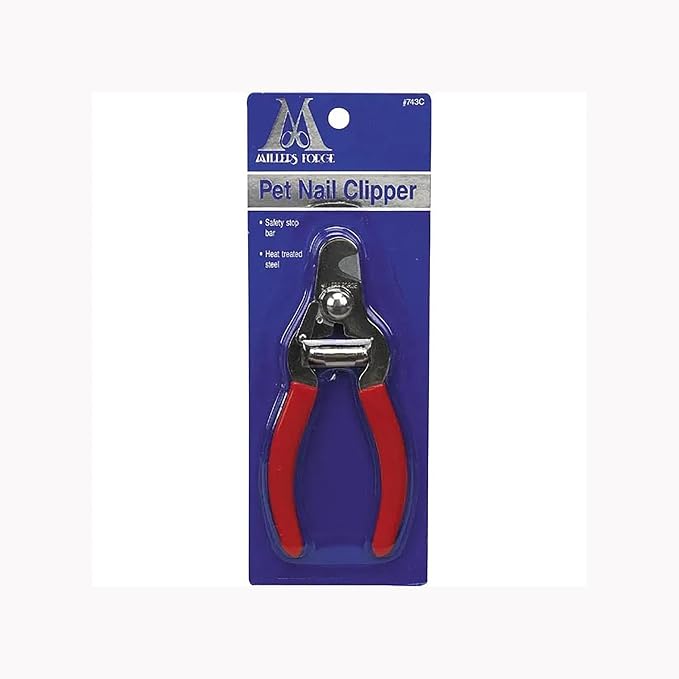
PRODUCT MENTIONED
Millers Forge Steel Pet Nail Clipper 743C with Safety Stop Bar Small Medium Dog Updated Edition
Amazon · Details on the retailer’s website
This is the chosen manual clipper, not a motorized grinder or a recommendation to use the same tool on every large, thick nail. Assess the actual opening, grip and cutting action with a professional. The size label alone does not establish that it fits your particular dog’s nails or your hand.
Its practical attraction is a straightforward manual tool without a motor, charging routine or moving sanding accessory. The trade-off is that a cut happens at the point you choose: there is no automatic identification of the quick and no electronic correction for a poorly positioned blade.
Blade alignment, cutting force, edge durability and guard movement have not been independently verified. An exact manufacturer operating manual remains unverified for this listing. Do not substitute a retailer’s generic trimming directions or instructions for another Millers Forge size.
The current Amazon table lists UPC 674788551124. A separate retailer’s 743C page uses a different UPC. That different-UPC page does not confirm identical packaging or operating instructions for the selected item. Ask for the actual supplied instructions when package details or the stop mechanism are unclear.
Introduce dog nail clippers before a cutting session
A dog may accept gentle paw touch without accepting a held paw while dog nail clippers close nearby. Build those experiences gradually. Comfortable handling remains a separate requirement from tool fit.
Dogs Trust’s handling guidance recommends short, positive sessions and stopping when the dog shows worry. Give the dog time to become comfortable with the location and gentle touch before adding more difficult handling.
Let the switched-off, closed tool be an ordinary object during introduction. For a manual clipper, the sound and movement of opening and closing can still be unfamiliar. Follow the professional’s plan for introducing those experiences away from an actual cut.
Watch for tension, withdrawal and attempts to leave. A dog frozen in place is not necessarily comfortable. Do not use food distraction or restraint to override a response that makes a precise task difficult to control.
If the dog growls, snaps, appears painful or has established handling fear, seek veterinary and qualified behavioral help. Changing from one manual clipper to another does not resolve the reason for that response.
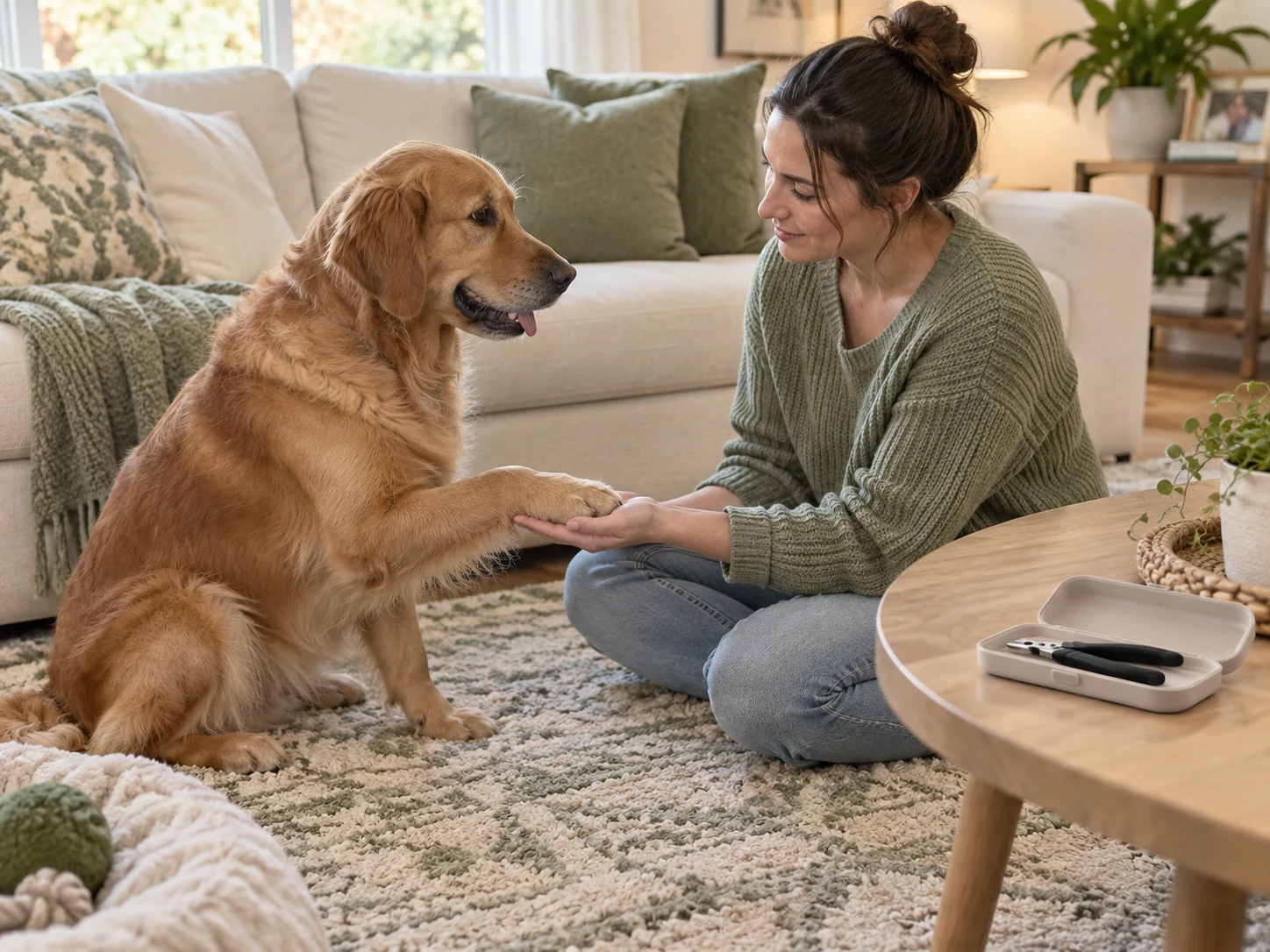
Inspect dog nail clippers and plan a short session
Use good light and secure footing for both of you. Have the demonstrated stopping point and your veterinarian’s advice for an accidental injury clear before starting. Postpone the session if you need to hurry or expect to finish the entire paw at once.
Inspect the tool for loose parts, damage, debris or a cutting action that catches. Follow its supplied care instructions rather than inventing an adjustment or lubricant. Investigate any dog nail clipper blade problem away from the dog.
Keep the work within the task your professional demonstrated on your dog’s actual nails with a suitable clipper. A universal millimeter amount, blade angle or one-cut correction cannot account for the condition of each nail. If you lose visibility or confidence, ask a professional to perform the work instead of guessing a smaller number.
- Confirm that the nail is suitable for routine maintenance.
- Keep the nail and blade position visible.
- Use the demonstrated grip without forcing the paw.
- Stop if the dog moves, the blade catches or the nail appears painful.
- Do not extend a successful small task into unfamiliar nails or damaged areas.
Severely overgrown nails require particular care because a large cosmetic shortening can reach sensitive tissue. An embedded or distorted nail needs a veterinarian. The presence of a stop bar does not turn that situation into ordinary home maintenance.
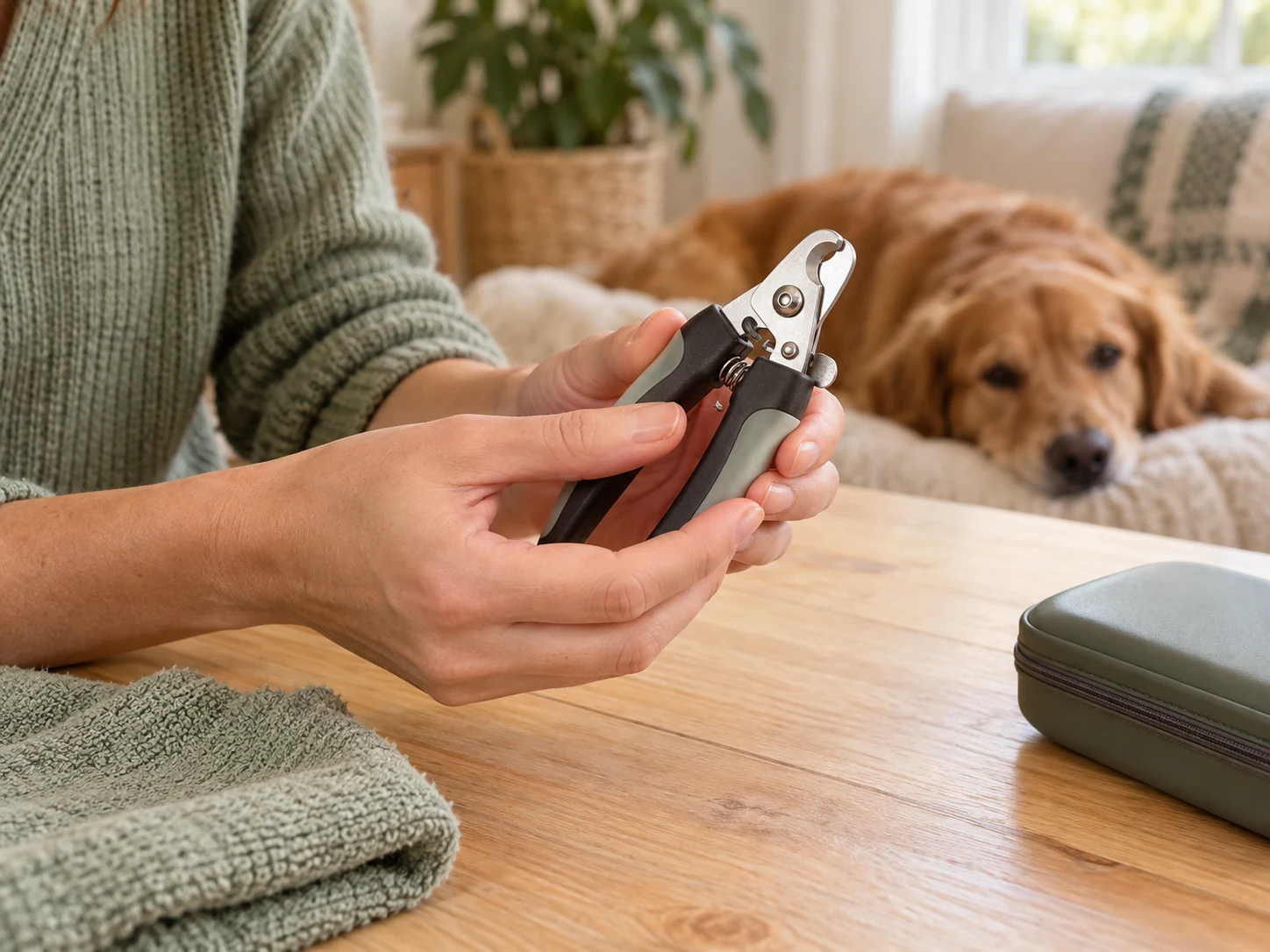
Review the result and maintain the tool
After the limited task, check the paw and the dog’s comfort. Bleeding, a split nail, persistent pain or an unexpected change needs appropriate veterinary advice. Do not continue clipping around a problem simply because the remaining nails look uneven.
Clean and store the clipper according to the supplied directions. A particular disinfectant, soaking method or sharpening service has not been verified for this selected product. Store the closed, secured tool away from children and animals.
Keep a useful record: which nails needed attention, any handling difficulty and any concern about the tool. Share recurring difficulties with the professional who demonstrated the task. That can reveal a need to change the care plan before buying another clipper.
Frequently asked questions
Do dog nail clippers with a guard prevent quick injuries?
A guard does not locate the quick. It can limit entry into the cutting opening, but you still need a demonstrated position, clear visibility and comfortable handling. Do not use the bar as a substitute for identifying whether a cut is appropriate.
Is the 743C suitable for every dog size?
The selected listing describes small and medium dogs. That is not proof of suitability for every nail within those categories, or for large thick nails. Have the actual fit and cutting action assessed rather than choosing solely from the animal’s weight.
Should I finish if only one nail is left?
No. The stopping conditions still apply. A worried dog, poor view, catching blade or uncomfortable nail is a reason to end the task. Completing a full set is less important than preserving control and a workable future handling routine.
Choose a tool for the maintenance you can perform
Dog nail clippers are useful when a necessary task, suitable tool and comfortable handling come together. Start with an individual assessment, ask a professional to demonstrate the technique and keep the work small enough to stop immediately.
The Millers Forge 743C is one specified manual option for an appropriate small-to-medium-dog task. Its safety stop bar does not choose a cut or eliminate injury risk. Check the actual supplied identity and instructions, and use professional help whenever the nail condition, visibility or dog’s response is beyond the routine you have learned.
Comments are reviewed before they appear publicly. Please keep questions and feedback relevant to this article.