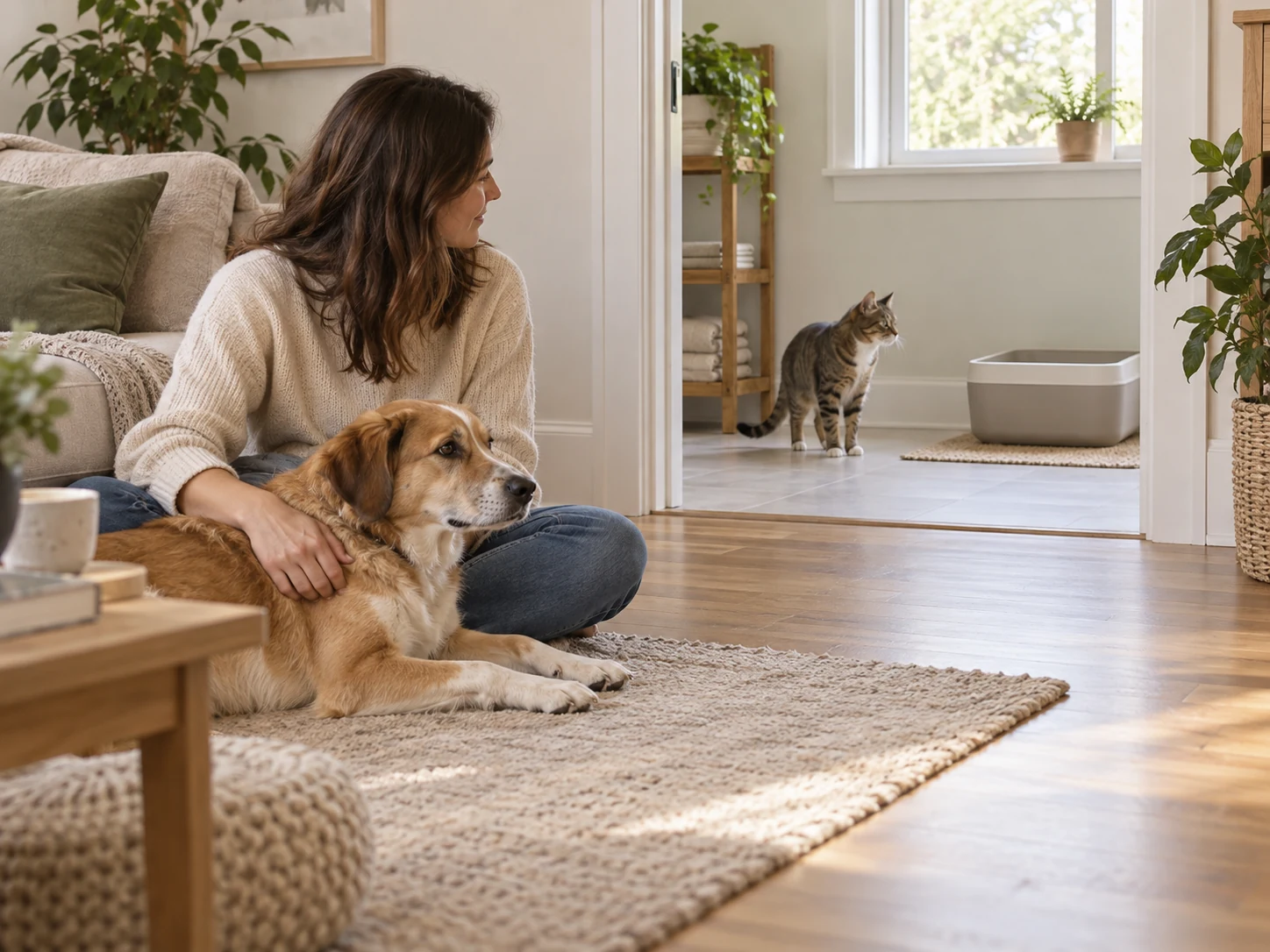
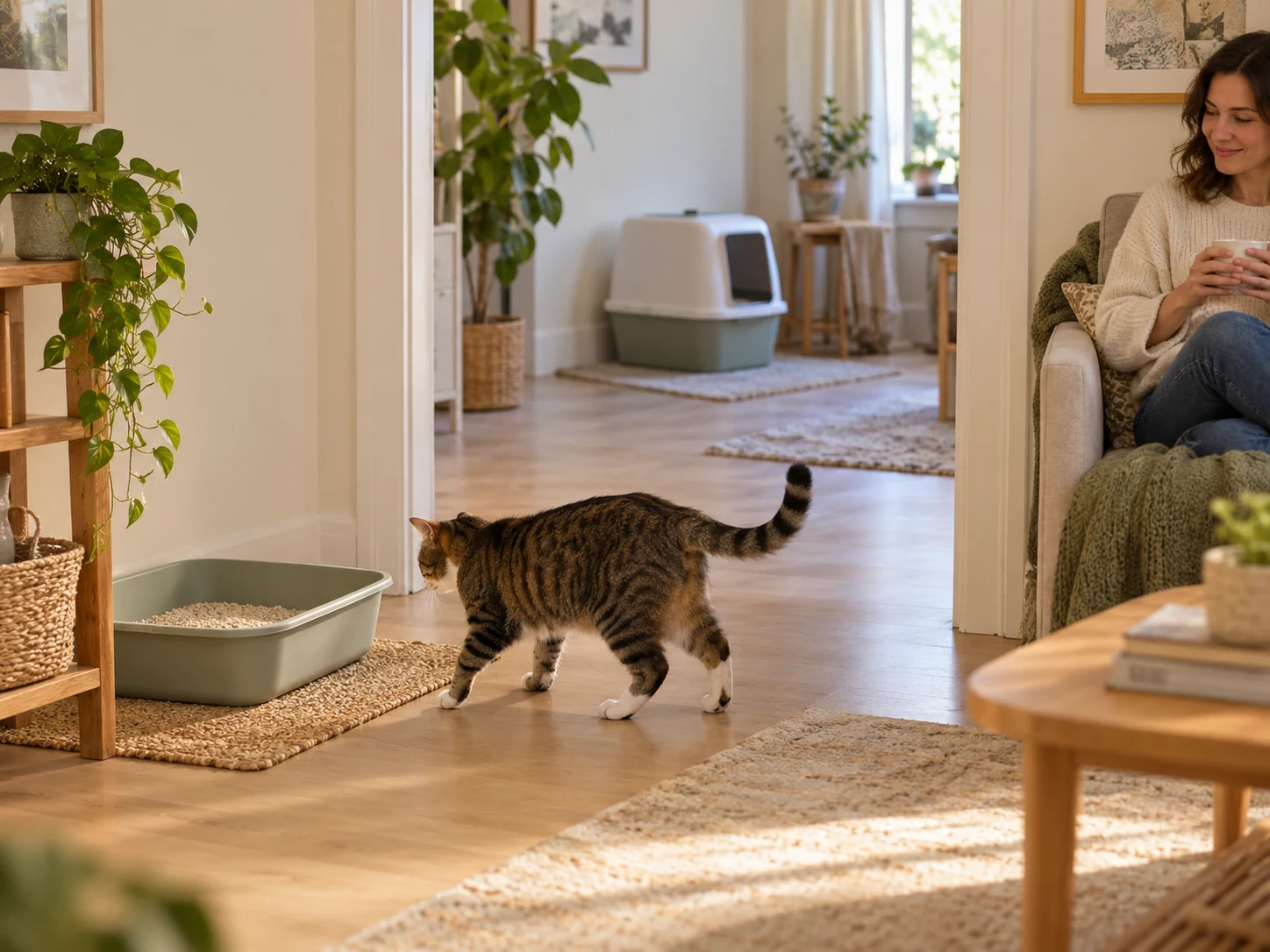
AI-created planning scene. Comfortable cat access and the particular dog's behavior both need checking; this layout is not proof of exclusion.
The best dog-proof litter box setup keeps the dog away from the litter while preserving easy, comfortable access for the cat. A tall wall or top opening can change how an animal reaches the contents, but it cannot establish that every dog is excluded. Start with the two animals’ size, movement and behavior, then assess the box itself.
The IRIS USA Large Top Entry box is one option for a cat that can comfortably use a top entrance and fit inside. Its raised opening may limit some dogs’ access, but the verified dimensions do not prove a dog-proof barrier. A room-access change may be more useful than replacing a box your cat already uses reliably.
What a dog-proof litter box needs to achieve
There are two separate tests: whether the dog can reach the litter and whether the cat can use the setup without difficulty. Passing only the first is not enough. An inaccessible or stressful toilet area can create a new problem for the cat even if it hides the litter from the dog.
| Check | Question to answer | Reason to reconsider |
|---|---|---|
| Dog access | Can this particular dog reach through, climb onto or move the setup? | The dog can still approach the contents. |
| Cat entry | Can the cat enter and leave comfortably? | The opening requires an awkward movement or jump. |
| Usable interior | Is there room to turn, dig and eliminate? | Outside dimensions disguise a small floor. |
| Approach and escape | Can the dog wait at the only route? | The cat can be cornered or blocked. |
| Cleaning | Can you inspect and scoop the whole box daily? | The barrier makes maintenance easy to postpone. |
Treat dog-proof as a goal to verify in your own household. Neither a product title nor a photograph of a cat using the box answers these questions for your animals.
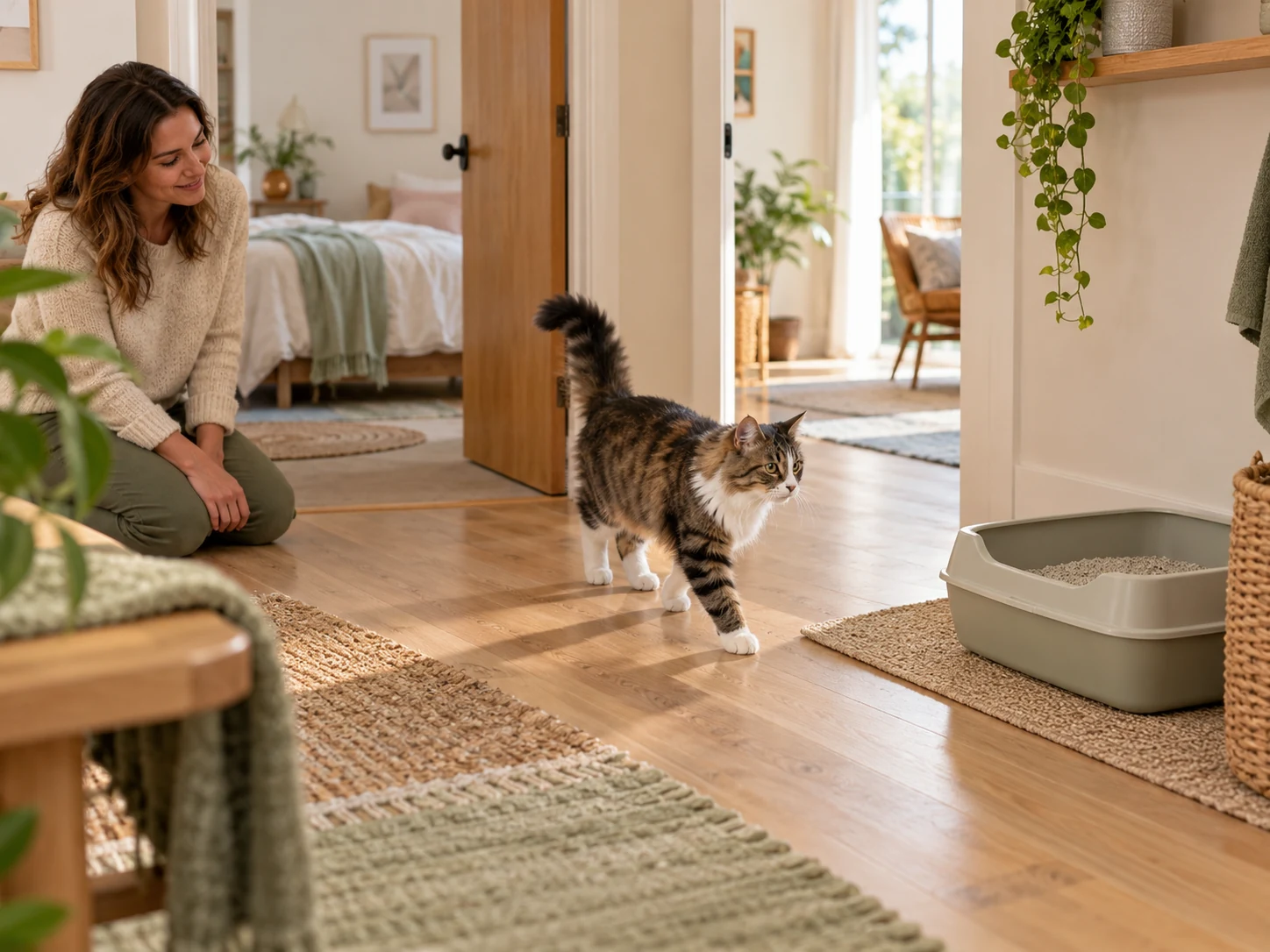
Check room access before replacing the box
If the current litter box suits your cat, first consider whether the dog’s access to its location can change. The relevant arrangement is one that the cat can use freely while the dog cannot follow. This depends on the actual animals and the room, so a generic doorway gap or barrier height is not a reliable prescription.
Inspect the entire route, not just the final opening. A dog excluded from the tray may still wait outside the room or interrupt the cat on approach. Keep food and water away from the litter area and leave enough space for the cat to move without being squeezed into a dead end.
Protect the cat’s route
Cat Friendly Homes advises avoiding locations where a cat can be cornered, blocked off or unable to flee in its litter box guidance. Its examples address feline access and social pressure; the same access question is relevant when evaluating an arrangement in a mixed-pet home.
That does not establish that any particular gate, doorway alteration or top-entry box is suitable. Check the cat’s movement and the dog’s behavior before relying on the arrangement, and keep a workable toilet option available while you assess a change.
Keep resources available for every cat
In a home with several cats, a single dog-excluded room can still create a shared bottleneck. Cat Friendly Homes recommends one box per cat plus an additional box, with boxes in separate locations. Several trays crowded together do not provide the same access choices as appropriately separated sites.
Plan how each cat reaches a suitable box without passing a dog or another cat that blocks the route. The solution may involve more than one accessible location. This is an access-planning decision, not a reason to buy several identical top-entry boxes before confirming that the cats can use that design.
Top entry trades a front doorway for a climb
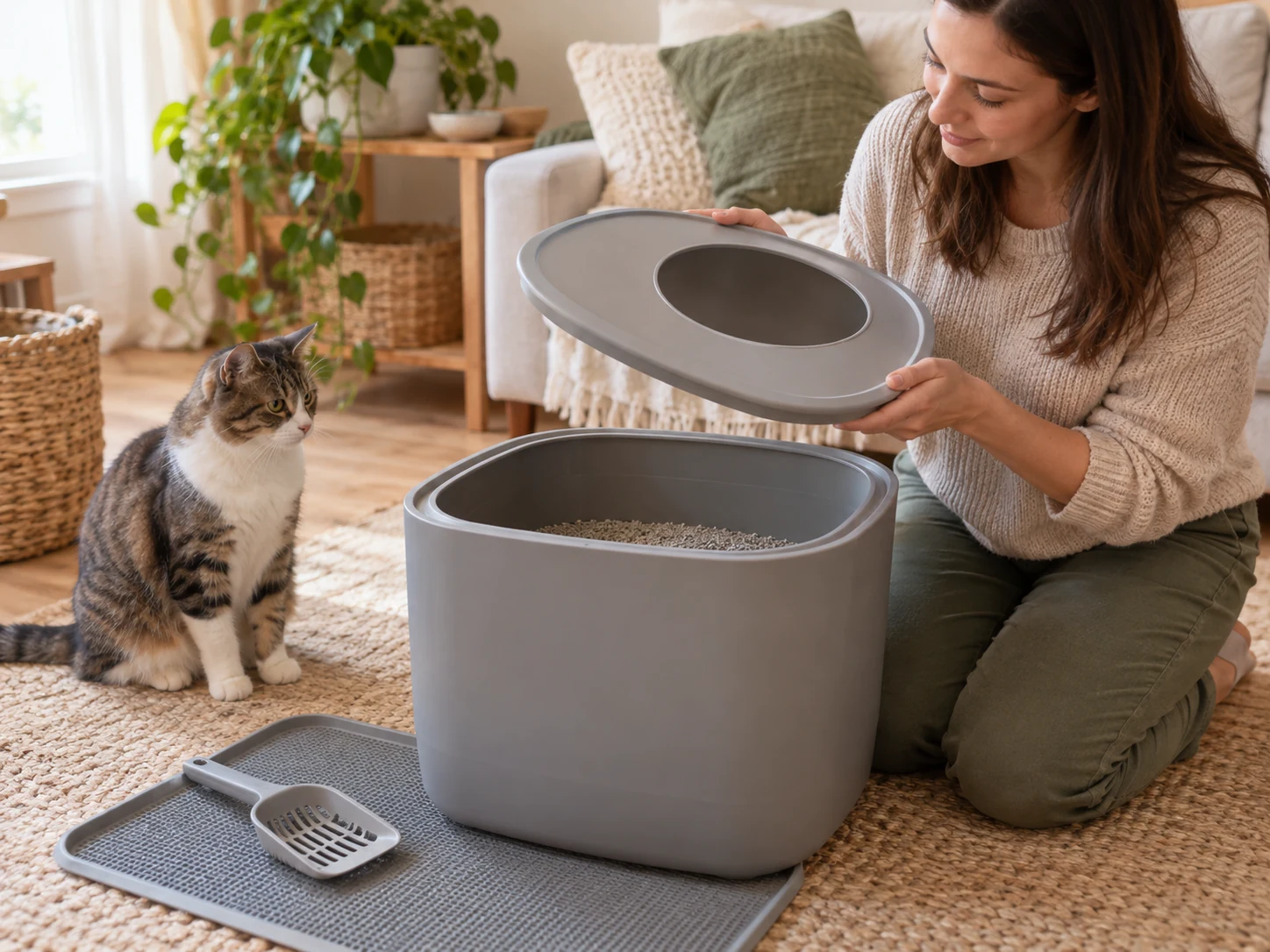
A top-entry box puts the opening above the litter instead of at floor level. It can keep a front-facing opening out of a dog’s direct path, but it also asks the cat to get onto the lid, move through the opening and climb out again. Not every cat will accept that sequence.
A healthy, agile cat’s successful entry does not establish access for a kitten, an older cat or a cat with restricted movement. If your cat struggles with ordinary steps, consult your veterinarian about appropriate toilet access rather than selecting a difficult entrance as a dog deterrent.
Watch the whole visit
Observe voluntary entry, movement inside and exit. A cat briefly standing on the lid has not shown that it can use the interior comfortably. Likewise, fitting through the hole is different from having room to turn and adopt a normal toileting posture below it.
Do not place the cat inside repeatedly or force it through the entrance to demonstrate the product. The practical test is whether it chooses to use the setup reliably while the dog remains unable to interfere.
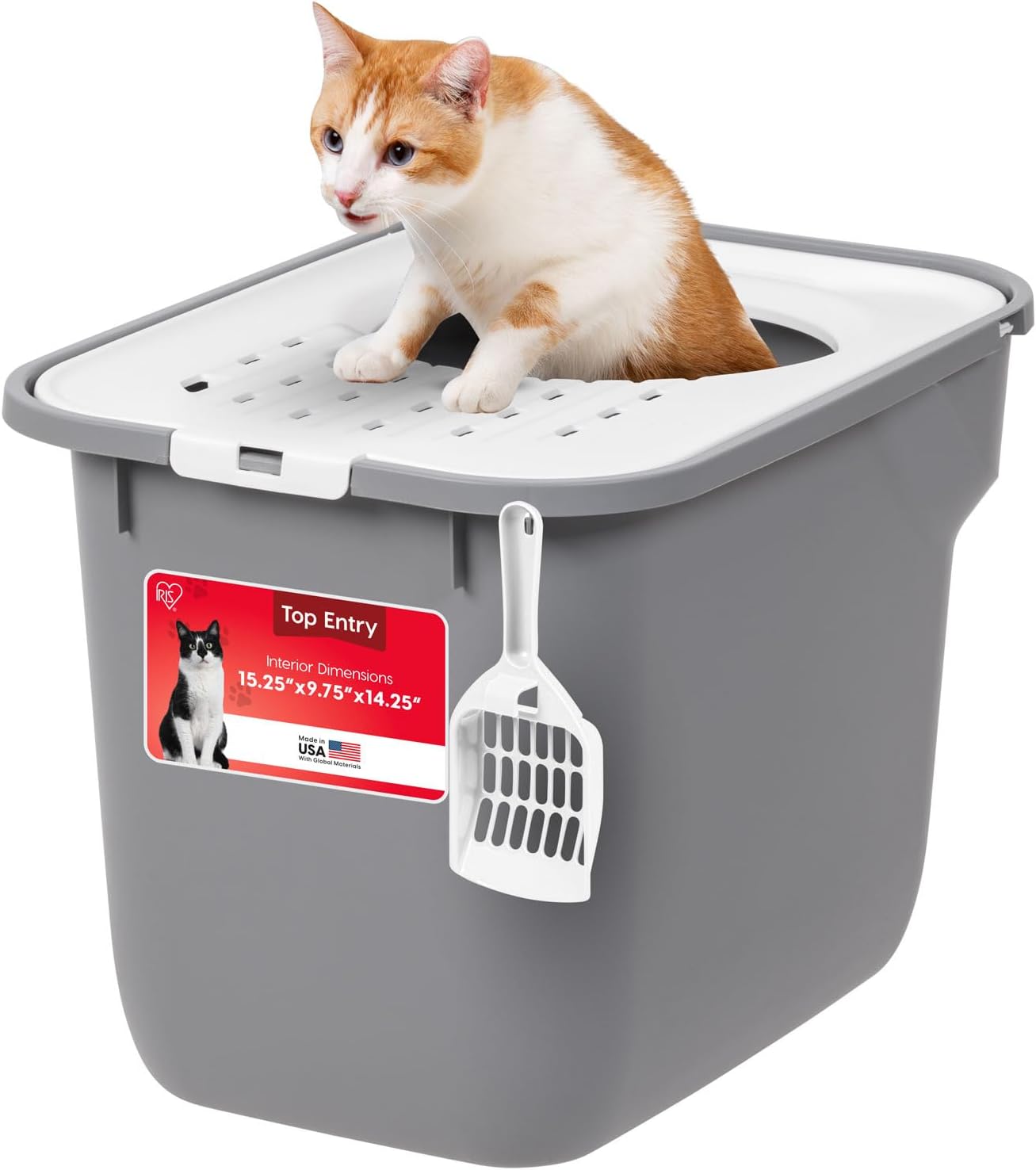
IRIS Large Top Entry: verify the exact size
The selected box is the IRIS USA Large Top Entry Cat Litter Box with scoop, model 500378, ASIN B0DNNQ1FV4. Amazon describes the color as Gray; the IRIS manufacturer page calls the matching model White/Gray. Both identify the same model and UPC 762016502052.
| Verified dimension or feature | What to do with it |
|---|---|
| 20.5 × 14.75 × 14.5 inches outside | Check floor space and room to remove the lid. |
| 9.25-inch diameter entry | Assess the cat’s entrance and the dog’s possible reach; neither is guaranteed. |
| 15 × 9.75 inches at the inside bottom | Use the smaller floor measurement when evaluating usable room. |
| Removable lid | Plan access for scooping, inspection and washing. |
| Grooved lid and included scoop | These support cleanup; they do not establish zero tracking. |
The inside-bottom measurement is especially important. Cat Friendly Homes recommends a box around one and a half times the cat’s nose-to-tail-base length and enough space to enter, turn, scratch and eliminate. A box labeled Large can still be unsuitable for a particular adult cat.
This model is a conditional candidate for a cat that fits the interior and comfortably uses top entry. Skip it if the cat needs a low entrance, the floor space is too small or the dog can still reach the contents. Its dimensions are useful evidence; the words dog-proof in a retail title are not a household guarantee.
Check the IRIS USA Large Top Entry litter box, model 500378 on Amazon
PRODUCT MENTIONED
IRIS USA Large Top Entry Cat Litter Box, Hooded Privacy, Gray
Amazon · Details on the retailer’s website
The best dog-proof litter box still needs cat-sized room
When keeping the dog out becomes the main goal, it is easy to accept a smaller or more enclosed box than the cat would otherwise use. Reverse that decision order. Establish the cat’s usable space and access first, then decide how to prevent dog interference around that setup.
Measure the actual interior rather than borrowing dimensions from another IRIS top-entry variant. Similar names appear across different sizes and lid designs. Confirm the model in the order details, especially if a page changes the selected color or style.
Allow for cleaning clearance too
Leave room above and around the box to remove its lid and reach the far corners. If it fits only under a low shelf or between heavy furniture, ordinary scooping may become awkward. A setup that discourages maintenance undermines the reason for controlling access.
Think about where the removed lid and waste container will go during cleaning. The dog should remain separated from the work area while the box is open; a top entrance offers no barrier once the lid is off.
Introduce a change without removing the fallback
Offer the proposed setup while retaining a litter option the cat already uses. Keep other changes limited where practical so you can observe whether the entrance or location affects use. A new box, new litter and new room introduced together make it harder to understand a refusal.
Watch for hesitation, repeated investigation without use or toileting elsewhere. Do not punish the cat. In its house-soiling guidance, Cat Friendly Homes explains that toileting outside the box can reflect physical, social or medical needs rather than spite.
Respond to a failed trial
If the cat avoids the new entrance, restore reliable access and reconsider the setup. If toileting changes continue, involve your veterinarian rather than assuming the problem is behavioral or that another enclosed box will solve it.
If the dog still reaches the litter, do not declare the trial successful because the tray looks tidier. Reassess access control. Avoid using a more difficult cat entrance as the automatic next step; the cat’s ability to toilet comfortably remains the limiting condition.
Odor and tracking need their own checks
A lid can hide the contents without making them clean. Keep daily waste removal and the litter maker’s maintenance routine in place. Cat Friendly Homes recommends removing waste at least once a day, along with periodic washing and appropriate litter replacement.
IRIS describes grooves in the lid that catch litter from paws. That feature does not prove that no grains leave the box. Check the floor and lid during routine care, and keep the top surface clear enough for the cat to step on and leave normally.
Do not treat reduced visibility or an odor-related marketing phrase as evidence of a hygienic interior. Lift the lid, inspect the box and clean the areas you cannot see from outside. A top-entry box is a different access design, not a self-cleaning machine.
Questions about dog-proof litter boxes
Will this IRIS box keep every dog out?
No universal exclusion has been verified. The dog’s reach, size, ability to climb or move the box and behavior around the entrance matter. Assess your particular household rather than relying on the retail description.
Is the outside size the usable floor size?
No. Model 500378 is listed at 20.5 by 14.75 inches outside, with an inside-bottom area of 15 by 9.75 inches. Use the interior measurement when judging the cat’s room to turn and toilet.
Is top entry appropriate for an older cat?
It depends on the cat’s movement and preferences. A cat that needs a low entrance may be poorly served by climbing through a lid. Discuss movement difficulties with your vet and prioritize accessible toileting.
Should I remove the old box immediately?
Keep a reliable option available while you assess a new setup. Watch actual use and comfort before treating the change as successful. Do not force the cat to use an entrance it is avoiding.
Judge the setup by both animals
The best dog-proof litter box arrangement gives the cat enough room and an unobstructed route while preventing the particular dog from interfering. The specified IRIS top-entry model offers a measurable opening and removable lid, but its small interior floor and elevated entrance are real selection limits.
Verify those limits against your cat first. If they do not fit, preserve the suitable box and reconsider the dog’s access to the area instead. A successful purchase should solve the access problem without making the cat’s toilet harder to use.
View IRIS USA Large Top Entry Cat Litter Box, Hooded Privacy, Gray on Amazon.
Comments are reviewed before they appear publicly. Please keep questions and feedback relevant to this article.