AI-created editorial planning scene. Coat type and condition still require assessment; no rake technique is demonstrated.
A double coat dog brush should remove loose coat without turning routine care into forceful stripping. Match the tool to the actual coat and skin condition first; a dense undercoat, a small loose tangle and a tight mat are different jobs.
The Maxpower Planet PGT-002 is a dual-sided rake with nine- and seventeen-tooth sides. It is one option to assess with a groomer for suitable coat maintenance, not a universal first brush or a reason to keep raking until no hair comes out.
Start with the coat, not the amount of hair on the floor
Heavy loose hair can make a stronger-looking tool tempting. First identify what needs attention: loose undercoat beneath an outer layer, a smoother coat needing a gentler tool, or a tangle that pulls on skin when you touch it.
The ASPCA’s grooming guidance distinguishes smooth short coats, short dense coats and long coats, with different brushing needs. It also notes that normal shedding varies with factors including coat type, health and season. A full collection of hair on a brush does not by itself tell you whether the technique was appropriate.
Ask your groomer to identify the coat layers and demonstrate which existing tool reaches the loose hair comfortably. A tool is a good match when it does the intended job with control, not merely when it removes a dramatic amount for a photograph.
If loose-hair cleanup makes an otherwise comfortable routine difficult, the Neakasa P2 Pro grooming-vacuum guide separates hair collection from coat-tool suitability. Powered collection is a separate decision, with sound introduction and filter maintenance; it does not make a stronger rake suitable for a coat or remove the need for gentle technique.
Check the skin before extending a routine. Redness, sores, bald patches or persistent scratching need veterinary attention rather than more aggressive grooming. Do not label an unexplained change as a seasonal coat blow without assessment.
Choose a double coat dog brush by the job
Several tool categories can play different roles. There is no requirement to own every one or use them in a fixed sequence. Start with the task the coat actually needs and the least disruptive method that works.
| Job | Possible tool role | Check before using it |
|---|---|---|
| Loose surface hair and dirt | A suitable brush already accepted by the dog | Gentle contact and the right coat match |
| Loose undercoat | A matched rake or long-toothed grooming tool | Reaches the intended layer without pulling |
| Checking a finished area | A suitable comb | No force through a snag |
| Tight mat or hidden skin | Professional assessment and removal | Do not treat it as ordinary loose undercoat |
Blue Cross’s tool guidance describes undercoat rakes for loose undercoat and distinguishes them from slickers, rubber brushes and finishing brushes. That category advice supports matching the job; it does not endorse a particular rake for every double-coated dog.
Also match the size and spacing to the actual area. A broad head can be useful over accessible coat but awkward near small contours. Do not infer that a body-sized rake is appropriate for feet, ear edges or tight skin folds.
Choose the tool before choosing a stronger pass
- Surface loose hair or an accepted ordinary brush already meets the job: keep the suitable tool; there is no need to add a rake.
- Accessible tangles in an appropriate medium, long or curly coat: compare the slicker brush coat-fit and gentle-use checks. Fine pins are a different contact surface, not a gentler setting on this rake.
- Identified loose undercoat: ask for a demonstration of the appropriate rake and working depth on your dog’s actual coat.
- Resistance, hidden skin or discomfort: stop the tool comparison and seek assessment; switching sides or buying a second brush does not make the patch suitable.
Double coat dog brush option: Maxpower Planet rake
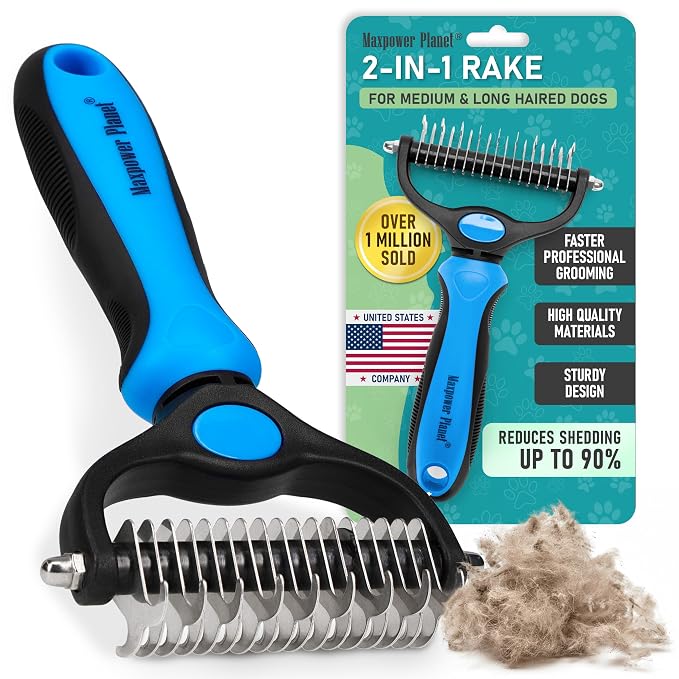
The specified blue Maxpower Planet grooming rake is model PGT-002, ASIN B07P2N8HQH. The current listing describes a nine-tooth side for tangles and a seventeen-tooth side for thinning and loose-coat work. The listing describes sharpened teeth with rounded ends. Handle this double coat dog brush as a rake, not a soft bristle brush.
| Part of the specified blue PGT-002 | Retailer-described role | Boundary before use |
|---|---|---|
| 9-tooth side | Tangles / dematting | Not permission to tackle tight, painful or skin-adjacent mats. |
| 17-tooth side | Thinning / deshedding loose coat | Only for an appropriate confirmed coat task, not repeated passes until shedding stops. |
| Sharpened teeth with rounded ends | Working surface of this dual-sided rake | Rounded ends do not make it a soft bristle brush or establish no irritation. |
For a coat and task your groomer has confirmed, check the Maxpower Planet PGT-002 double-sided grooming rake on Amazon. Consider the two tooth arrangements as different tool settings to learn, rather than instructions to work both sides through every coat.
PRODUCT MENTIONED
Maxpower Planet Dog Grooming Rake, Deshedding Undercoat Brush, Dogs & Cats
Amazon · Details on the retailer’s website
Its appeal is the two-sided arrangement in one handheld tool. Its fixed head and tooth geometry limit where you can work comfortably. Technique matters, and a marketing reference to mats does not justify pulling through a tight or painful patch at home.
Shedding reduction, irritation, coat cutting and durability have not been independently verified for this rake. Do not interpret the percentage reduction printed on retail material as a guaranteed result. Normal shedding is not a problem that a brush can permanently switch off.
If you cannot tell whether the teeth are moving through loose coat or catching attached hair and skin, put the rake down and ask for a demonstration. Buying a second dematting tool will not resolve uncertainty about what you are working on.
Check one accessible area before extending the session
Before using a double coat dog brush, choose a visible body area where your dog accepts gentle touch. Check the skin and confirm that you can guide the rake through the intended loose hair without snagging. Do not begin on the most tangled or sensitive area to see what the rake can do.
Have your groomer demonstrate the appropriate pressure, direction and coat separation on your dog. Use pressure and depth demonstrated for the actual coat; a universal stroke count does not establish either. Coat length and density make a difference, and a demonstration on another animal is not a complete match.
Keep strokes controlled and stop if the tool catches. Do not increase pressure to make the teeth reach farther. If you need to hold the skin away, repeatedly pull or work at a resistant patch, the job has moved beyond a simple loose-coat session.
Check both the coat and the dog as you go. A smoother top layer alone cannot show that a deeper tangle is gone, while an uncomfortable response can be more useful than the amount of hair collected. Keep the dog’s comfort ahead of the appearance of the brush.
Distinguish a tangle from a mat that needs help
A small loose tangle may respond to an appropriate gentle method. A dense clump close to skin is different. When you cannot see the skin or the coat pulls as a solid section, do not use the rake’s sharper side as a way to force it apart.
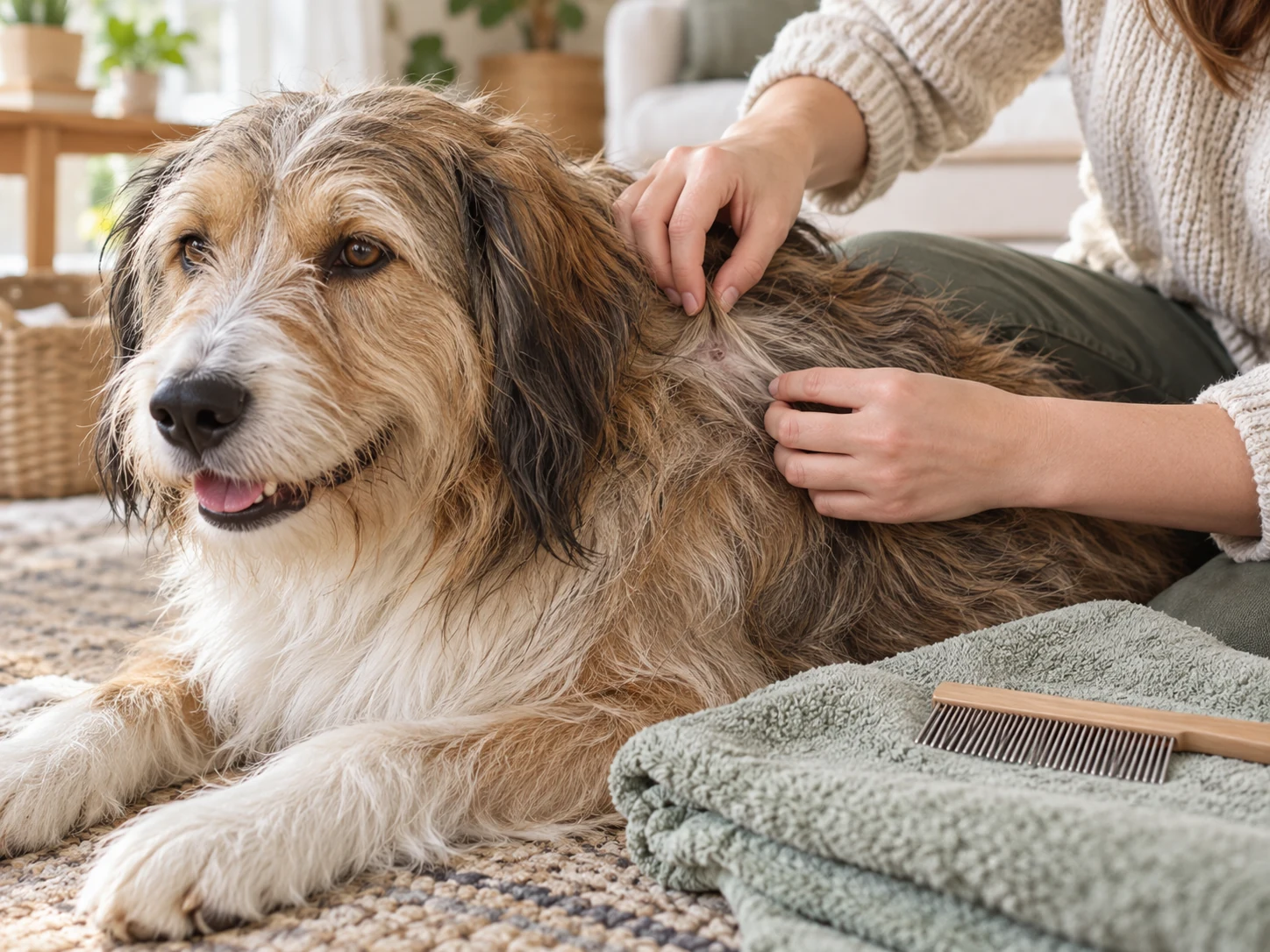
Arrange professional grooming for compacted, extensive or uncomfortable matting. Skin irritation underneath a mat needs veterinary assessment. Avoid scissors under the clump; you cannot assume the gap contains only hair.
Do not try to solve the same resistant patch by alternating the nine- and seventeen-tooth sides repeatedly. Different spacing changes the tool contact but does not establish that the underlying job is safe. Stop when gentle maintenance no longer works.
A useful appointment question is whether the coat needs a preventive brushing routine, professional removal of existing mats or a different tool altogether. Those answers change the care plan more than a “deshedding” label.

Make the handling routine easier, not longer
Introduce the tool gradually and work in short sessions. Dogs Trust’s handling advice recommends gentle positive introductions, stopping for discomfort and returning to an easier stage. An established fear or possible pain deserves appropriate help.
Separate learning to accept the rake from removing loose coat. Let the dog become comfortable with the equipment nearby and with gentle touch before expecting a full body session. A dog that accepted a soft brush may need a fresh introduction to a different working surface. Ask the groomer what that introduction should involve.
End while the dog remains comfortable, even if another area needs attention later. Do not pin down a dog that is trying to leave, or interpret freezing as relaxed cooperation. The aim is a maintainable routine, not finishing every patch in one sitting.
Choose frequency from the coat’s actual condition and professional guidance. Seasonal loose undercoat may change the workload, but it does not create a universal daily rake schedule. Inspect the coat regularly, while reserving the rake for the specific loose-coat task it suits.
Double coat dog brush care between sessions
Remove collected hair and inspect the head and teeth for damage before the next use, following the supplied directions. The selected PGT-002 listing does not establish an exact detergent, disinfectant dilution, soak time or dishwasher method. Obtain the model-specific care instructions before applying a chemical or soaking the rake; a stainless-steel claim alone does not establish a cleaning method. Dry and protect the tool as directed before storage.
Keep the sharpened teeth away from children and pets. Do not leave the rake on a grooming surface where the dog may step on it. A cover or drawer should protect both the tool and anyone reaching for another item.
Record the areas groomed and any catching or discomfort. That is a useful way to show the groomer where the routine needs changing. It also helps you avoid buying another rake just because one difficult patch remains.
Frequently asked questions
Is an undercoat rake the same as a slicker?
No. The tools have different working surfaces and roles. Match the tool to the coat and task rather than treating their names as interchangeable. A slicker may suit some grooming jobs, while a rake targets appropriate loose undercoat. Do not force either tool through a painful mat.
Should I rake until no more hair comes out?
No. Collected hair is not a stopping rule. Normal shedding continues, and repeated passes can become uncomfortable or remove hair you did not intend to work on. Use the demonstrated technique, inspect the coat and stop when the planned maintenance task is complete.
Does the nine-tooth side make mat removal safe?
No. Its advertised role does not make a tight or skin-adjacent mat a suitable home task. If you cannot see the skin or the coat resists gentle work, stop and arrange professional assessment. Do not increase pressure to make a tool’s marketing claim work.
Build a routine for your dog’s coat
A double coat dog brush is useful when it matches the actual layer and job. First separate ordinary loose undercoat from a tangle, a compacted mat or a skin problem. Then choose a tool and technique demonstrated for that coat, rather than ranking choices by how much hair they remove.
The Maxpower Planet PGT-002 is one specified rake option for an appropriate task. Learn the two sides, keep the work controlled and stop when the coat or dog tells you the approach is wrong. A reliable combination of inspection, gentle maintenance and timely professional help is more valuable than an aggressive session with a full brush.
View Maxpower Planet Dog Grooming Rake, Deshedding Undercoat Brush, Dogs & Cats on Amazon.
Comments are reviewed before they appear publicly. Please keep questions and feedback relevant to this article.