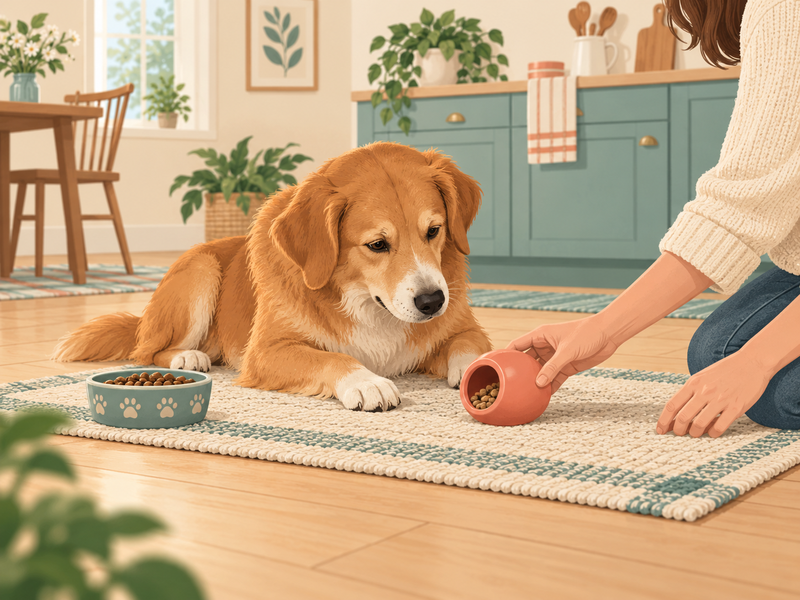
AI-created editorial scene; the generic toy is illustrative, not a photograph of a KONG model.
The most useful KONG stuffing ideas start with food your dog already eats and a filling that is easy to reach. Offer a loosely filled toy first, then try soft layers and freezing only as your dog becomes comfortable getting the food out.
If you already have an intact KONG that suits your dog’s size and chewing style, you do not need a new toy to begin. The important choices are the ingredients, portion, difficulty and cleanup, rather than how many different recipes you can fit inside.
Easy KONG stuffing ideas to start with
Begin with a simple combination you can measure and repeat. Familiar food makes it easier to assess the activity without changing the toy, texture and diet all at once.
KONG’s stuffing tutorial recommends easy-to-remove food for beginners and more challenging textures later. Use these patterns as starting points, with ingredients chosen for your individual dog.
| Filling idea | How to begin | Before using it |
|---|---|---|
| Regular kibble | Put a few small pieces loosely inside so they can fall out. | Take them from the day’s measured meal portion. |
| Familiar wet dog food | Place a small, accessible amount near the large opening. | Use food appropriate to the dog’s normal diet and follow its storage label. |
| Kibble and wet food | Alternate loose pieces with small soft-food layers once easy filling is successful. | Avoid tightly packing the first attempt. |
| An optional soft topping | Use a small amount of a tolerated, diet-appropriate topping. | Check ingredients and calories; peanut butter, plain pumpkin or yogurt are not suitable for every dog. |
You can also change where the familiar food sits instead of adding another ingredient. An accessible taste near the opening gives a different task from food placed deeper inside. Let the dog’s ability to retrieve it guide the next change.
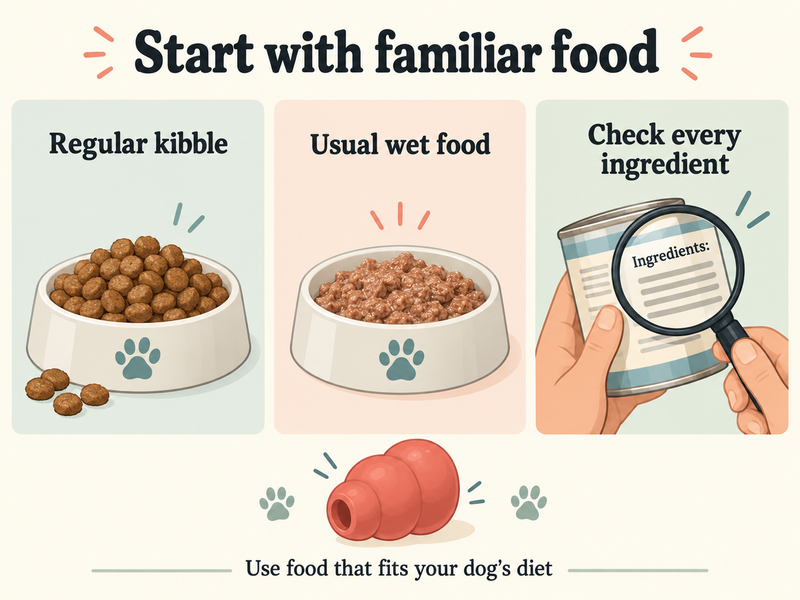
Check ingredients and the day’s food budget
A popular filling still needs an ingredient check. “Sugar-free” and “natural” on the front of a jar do not establish that it is appropriate for dogs.
The FDA’s xylitol warning identifies some peanut and nut butters as possible sources. Xylitol may also be called birch sugar or wood sugar. Read the complete ingredient list every time; if you suspect your dog has eaten xylitol, contact a veterinarian, emergency clinic or animal poison control center immediately.
A xylitol-free label removes that particular concern, but does not make the whole product suitable for every diet. If your dog has food sensitivities, a medical condition or a veterinary-prescribed diet, ask the veterinary team which extras, if any, can be used.
Do not use chocolate, grapes or raisins, or leftovers seasoned with onion or garlic. This is a short exclusion list, not proof that every unlisted food is suitable. Check every added ingredient, including seasonings in ready-made foods, before using the mixture.
The World Small Animal Veterinary Association’s treat guidance recommends keeping treats below 10% of daily calorie intake. That covers extra foods across the entire day, including training rewards, chews and toppings. It is a calorie limit, not 10% of each toy’s volume.
Measure ordinary meal food separately and subtract what goes into the KONG from the food you would otherwise serve. For extras, use label calorie information and account for everything else offered that day. A bigger toy is not an instruction to fill it to capacity.
How to stuff a KONG for an easy first session
The first session should make food retrieval achievable. Keep the filling loose and stay nearby to see how the dog uses the toy.
- Inspect and prepare. Start with a clean, intact toy of an appropriate size. Set aside the measured food before filling.
- Make a small, easy filling. Use loose kibble pieces that fit through the opening, or accessible familiar wet food. Do not begin with a tightly packed, fully frozen mixture.
- Let the dog investigate. Offer the toy where you can supervise comfortably. The goal is to work out how to retrieve the food, not to finish a predetermined playtime.
- Watch the result. If the dog cannot get started, simplify the filling. If food comes out readily and the dog continues willingly, that gives you a basis for a slightly harder attempt.
- Add layers gradually. Alternate some familiar dry food with small amounts of suitable wet food. Change the texture or depth before adding several new ingredients.
For example, move from loose kibble to kibble with a little familiar wet food, then try that same combination deeper inside. These are different difficulty levels using the same foods. You do not need a richer filling merely because the dog learns to retrieve the first one quickly.
If the activity turns into forceful attempts to tear the rubber, stop and inspect the toy. Making the filling harder is not a useful response to damage or frustration.
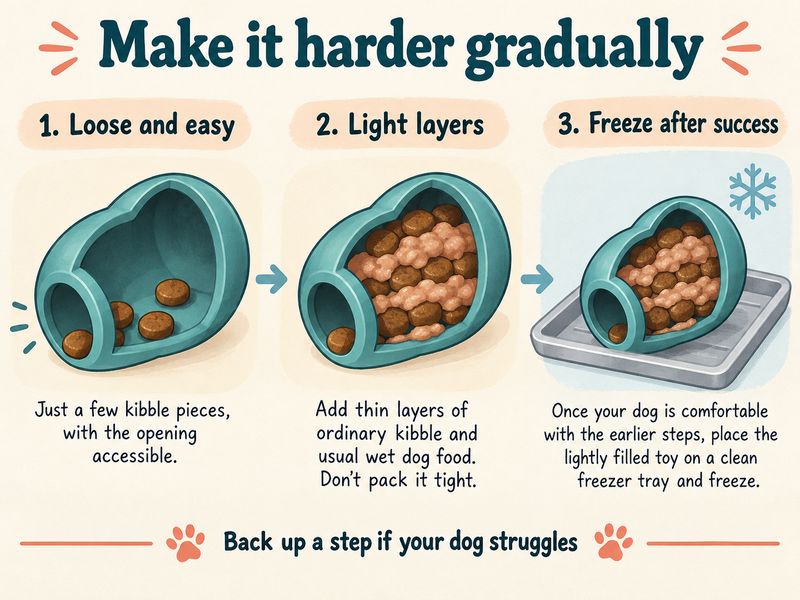
Frozen KONG stuffing ideas: add difficulty gradually
Freezing is an optional next step, not a requirement for a successful first filling. Try it after your dog can manage an easier, unfrozen version.
KONG describes freezing a stuffed toy for a few hours as a way to increase the challenge. Begin with an already familiar, diet-appropriate combination rather than introducing several new foods in the frozen version. Check whether the dog can still retrieve it comfortably.
There is no reliable playtime promise for a homemade filling. Its texture, amount and the dog’s technique all change the experience. If the dog repeatedly gives up, return to a looser or unfrozen filling instead of assuming that a tougher challenge is better.
Storage depends on the food and handling, not simply on the toy being frozen. The FDA’s pet-food storage advice calls for promptly refrigerating or discarding unused canned or pouched food and keeping the refrigerator at 40°F or below.
Follow the ingredient’s storage directions for food prepared ahead. Refrigerator and freezer storage times depend on the ingredients and their handling. Do not use freezing to rescue spoiled or mishandled food, and discard residue from a used toy rather than mixing it into a new batch.
Check size, damage and cleanup before reuse
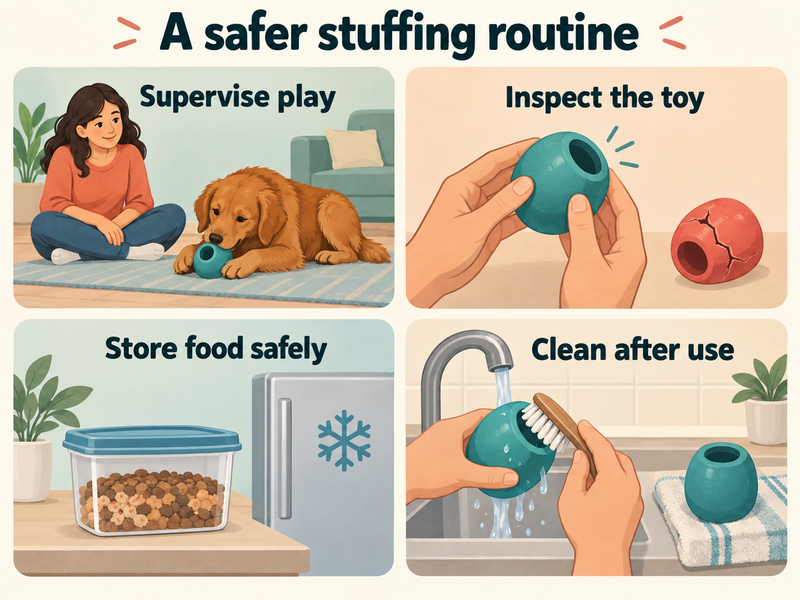
A successful filling also needs a suitable toy and a clean cavity. Inspect the rubber before and after use, and remove the toy if it develops cracks, missing pieces or significant wear.
According to KONG’s care and sizing FAQ, the rubber formula and size should match the dog’s chewing style and the manufacturer’s sizing guidance. “Large” is a selected product size, not a guarantee of suitability for every dog.
After the session, remove leftover food and clean the inside. KONG recommends warm water, soap and a bottle brush or toothbrush for its rubber toys. Check the specific product’s instructions before dishwasher cleaning; the company advises the top rack and skipping the heated-dry cycle. It does not recommend bleach.
Rinse away food and cleaning residue, and let the toy dry before storing it. A filling that gets trapped deep inside may create more cleanup work than an easier version. Keep care and upkeep in an everyday routine manageable: choose a preparation you can clean consistently.
When Classic or Extreme is worth considering
Keep an appropriate toy you already own. If you need a replacement, match the material and size to your dog rather than choosing solely by color.
KONG describes its red Classic rubber as intended for average chewers and its black Extreme formula as more durable for power chewers. Both still need supervision and inspection. Neither is a guarantee that the toy cannot be damaged.
The two options are specifically Large. If that size is not appropriate, do not order it just to follow a stuffing recipe. Confirm the selected variant and packaging before buying.
View the KONG Classic Dog Toy — Large on Amazon if its chewing and sizing guidance fits your dog.
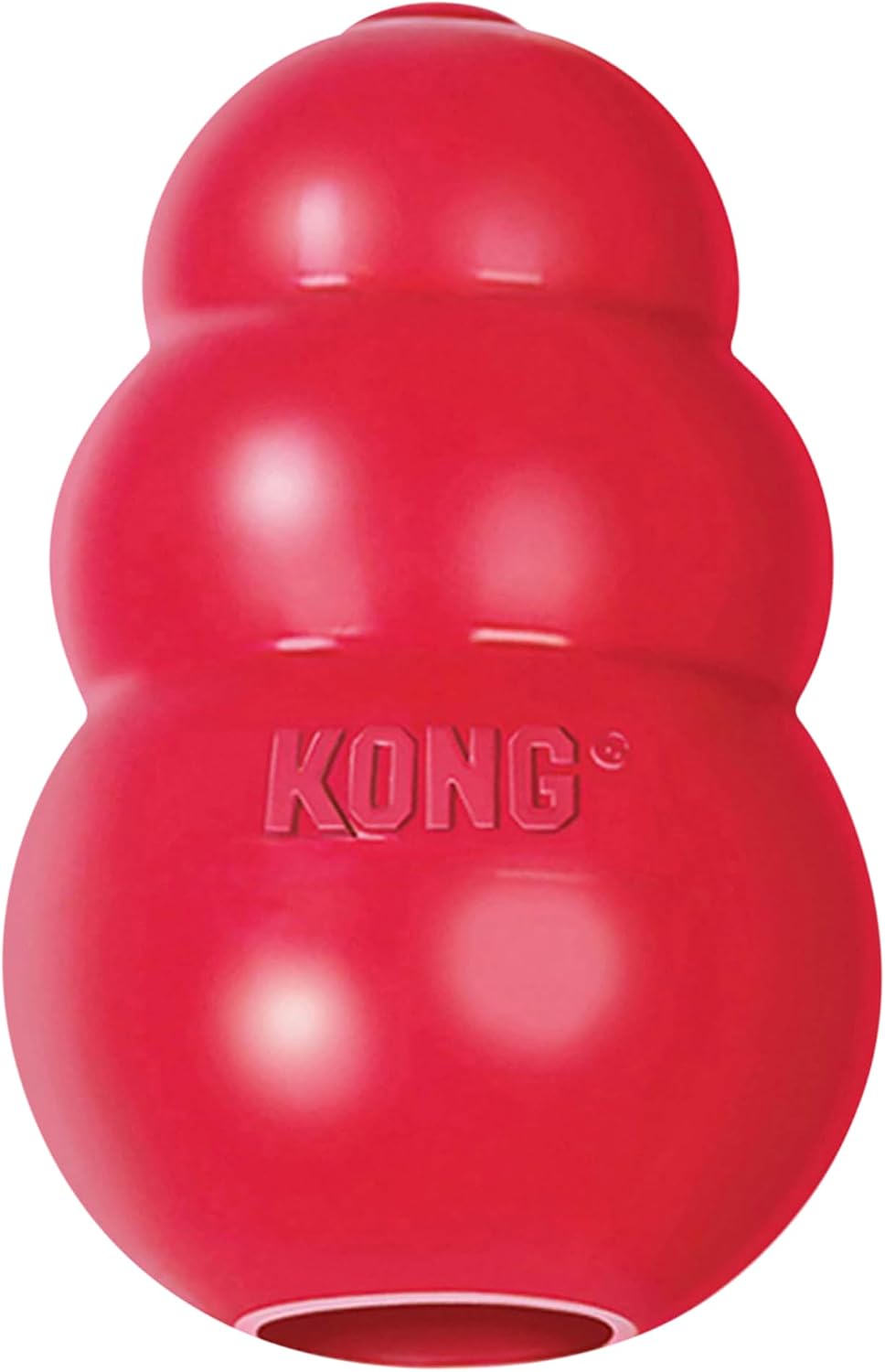
PRODUCT MENTIONED
KONG Classic Dog Toy — Large
Amazon · Details on the retailer’s website
View the KONG Extreme Dog Toy — Large on Amazon if its chewing and sizing guidance fits your dog.
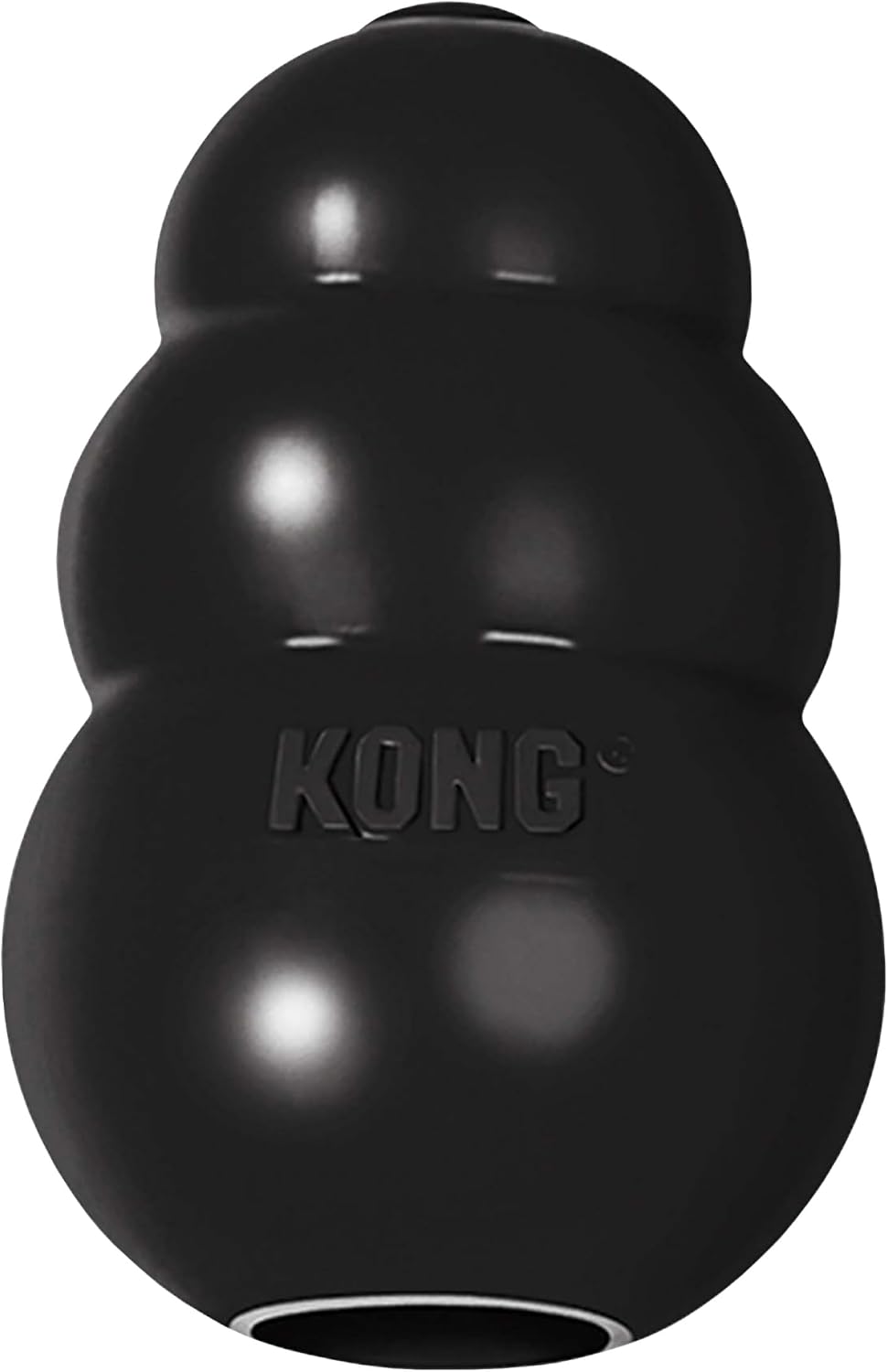
PRODUCT MENTIONED
KONG Extreme Dog Toy — Large
Amazon · Details on the retailer’s website
A simple next step
Choose one of these KONG stuffing ideas that uses familiar food, measure the portion and keep the first attempt easy. Stay nearby while your dog works out how to retrieve it, then clean and inspect the toy.
If that goes well, change one feature next time: add a soft layer, place some food deeper inside, or try freezing the familiar mixture. Return to the easier version when needed. A useful routine respects your dog’s diet, ability and chewing habits; it does not depend on a full toy, an elaborate recipe or the longest possible session.
Frequently asked questions
What should a beginner put in a KONG?
Start with a small amount of the dog’s regular kibble, loosely placed so pieces can fall out, or accessible familiar wet food. Keep it within the day’s measured food allowance. Add more difficult layers only when the dog can manage the easier filling.
Can you freeze a stuffed KONG?
Yes, KONG recommends freezing as an added challenge. Begin with an easier unfrozen filling, and use ingredients appropriate to your dog. Follow their storage directions; freezing is not a reason to keep refilling with used residue or to promise one storage lifespan for every recipe.
Is peanut butter automatically a safe filling?
No. Check the label for xylitol, including the names birch sugar and wood sugar, and consider the dog’s diet and calorie allowance. A product without xylitol may still be unsuitable for an individual dog. Peanut butter is optional; familiar meal food can be used instead.
Does an Extreme KONG remove the need for supervision?
No. KONG describes Extreme as a more durable rubber for power chewers, but still recommends supervision and regular inspection. Stop use when the toy is damaged. Choosing a stronger formula does not make every size appropriate or every filling suitable for your dog.
Comments are reviewed before they appear publicly. Please keep questions and feedback relevant to this article.