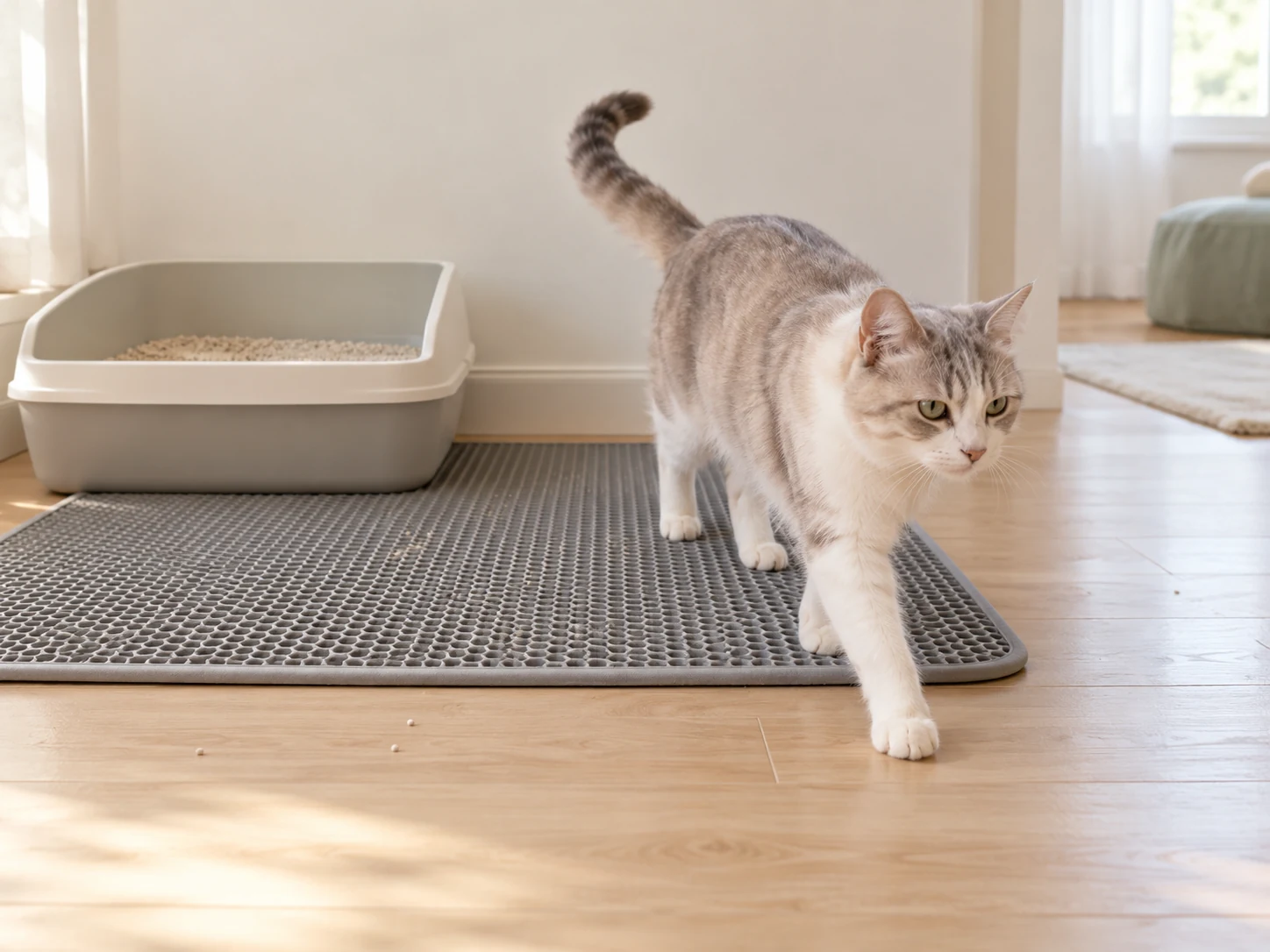
AI-created editorial scene. Useful coverage follows the cat's normal route; no capture rate, slip resistance or zero-tracking result is demonstrated.
The best cat litter mat is one your cat will cross comfortably and you can empty and clean without difficulty. Start with where the litter lands, how the cat leaves the box and the space around the exit. A large mat does little if the cat jumps over it or avoids its texture.
A mat collects litter outside the tray; it does not stop every grain from leaving or replace cleaning the box. The ondware 30-by-24-inch double-layer EVA mat is one specific option to consider. Its honeycomb design and listed size are useful features to evaluate, while waterproof, non-slip and all-litter claims remain manufacturer descriptions rather than measured guarantees.
Choose the best cat litter mat around the exit route
Observe several normal exits before choosing a size. Note whether the cat walks forward, turns to one side or jumps beyond the first part of the floor. Look at where grains collect rather than assuming the mess forms a neat rectangle directly in front of the opening.
Then measure the area available for a mat without narrowing a doorway or making the approach awkward. The goal is to collect litter along an ordinary route, not force the cat through a surface it dislikes. Keep the box itself accessible.
| Check | What to observe | Purchase implication |
|---|---|---|
| Exit direction | Walking, turning or jumping from the box | Choose coverage where paws actually land. |
| Scatter pattern | Loose grains close to the rim or farther away | Separate kicked litter from litter carried on paws. |
| Available floor | Doors, furniture and nearby walkways | A larger mat is not useful if it blocks access. |
| Surface acceptance | Comfortable crossing versus repeated avoidance | Texture can matter as much as the advertised size. |
| Maintenance | How captured litter and spills will be removed | Check the whole cleaning process before buying. |
Record the problem you are trying to improve. Litter kicked over a side wall and grains carried across the room may need different adjustments. A mat can be part of the response without being the entire solution.
Compare collection designs by their cleaning task
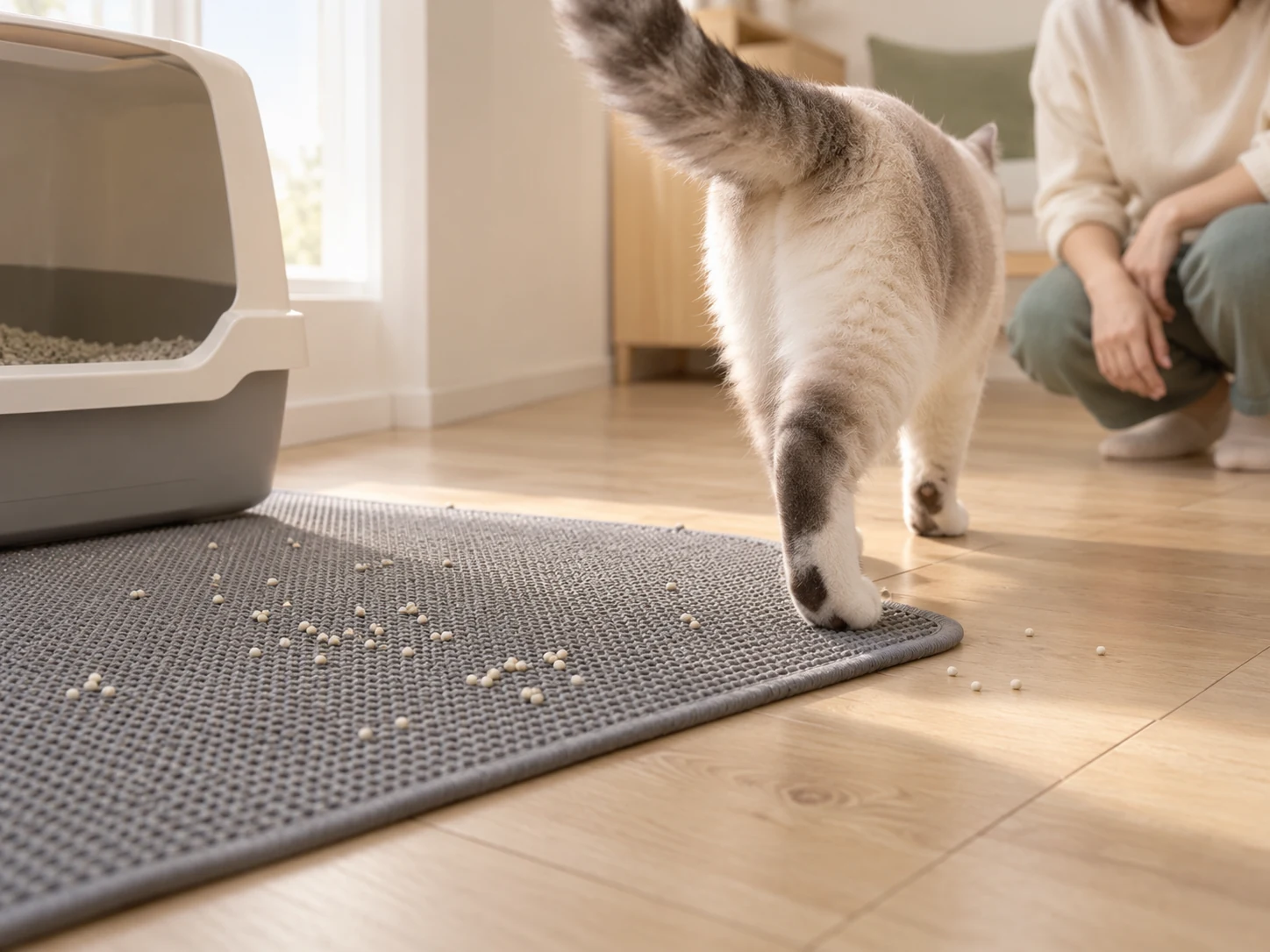
A flat surface leaves collected material visible and accessible. A textured or looped surface introduces spaces that hold grains. A double-layer design lets material pass through an upper opening into a lower area. These are different arrangements to inspect, not a ranking of cleaning performance.
Ask how you will release what the mat collects. Can you lift it without spilling? Can you reach the inner corners? If litter becomes wet, can you clean the affected area according to the product instructions? An attractive collection pattern is less useful if maintenance is impractical.
Grain size still matters
A claim that a mat works with all litter does not establish how every grain behaves in its openings. Large pellets, fine grains and broken clumps present different sizes and shapes. Check with your actual litter rather than assuming that material will pass through or release cleanly.
Choose a mat around the litter the cat accepts, rather than changing that litter to suit a mat. If you are considering a different formulation separately, the Pidan tofu litter versus blend guide addresses that decision.
ondware double-layer mat: the exact variant
The selected product is the ondware Cat Litter Mat, 30 × 24 inches, Gray, model A1223K11V0, ASIN B0DLGW4MD7. The checked listing identifies EVA material, a double-layer honeycomb design and one mat in the package.
| Verified listing detail | What remains to assess |
|---|---|
| 30 × 24-inch selected size | Whether it covers the cat’s actual landing and walking area |
| Double-layer honeycomb design | How the actual litter passes through and is emptied |
| EVA material | The cat’s acceptance and the supplied cleaning instructions |
| Gray, one mat | The exact size and quantity selected at checkout |
| Manufacturer describes a waterproof lower layer | No independent spill-retention or edge-leak test is established |
| Manufacturer describes anti-slip backing | Stability still needs checking on your floor |
When this format is worth considering
Consider it if the footprint fits, your cat accepts the texture and you want to try a two-layer collection arrangement. It is less suitable when the route is too narrow, the cat avoids the surface or your main need is a verified liquid-containment system.
Litter capture, drying time and slip resistance have not been independently verified for this mat. The listing’s all-granule and quick-drying language should not be read as tested performance across different litters and homes. Confirm model and size because the seller lists other mat options as well.
Distinguish the mat’s selected size from the shipping package dimensions. The listing also gives a much smaller package measurement, which is not the deployed coverage area. Use the 30-by-24-inch selected option for planning, then check the actual mat when unpacked instead of assuming its packaging describes the floor space it covers.
Check the ondware A1223K11V0 litter mat, 30 × 24 inches, Gray on Amazon
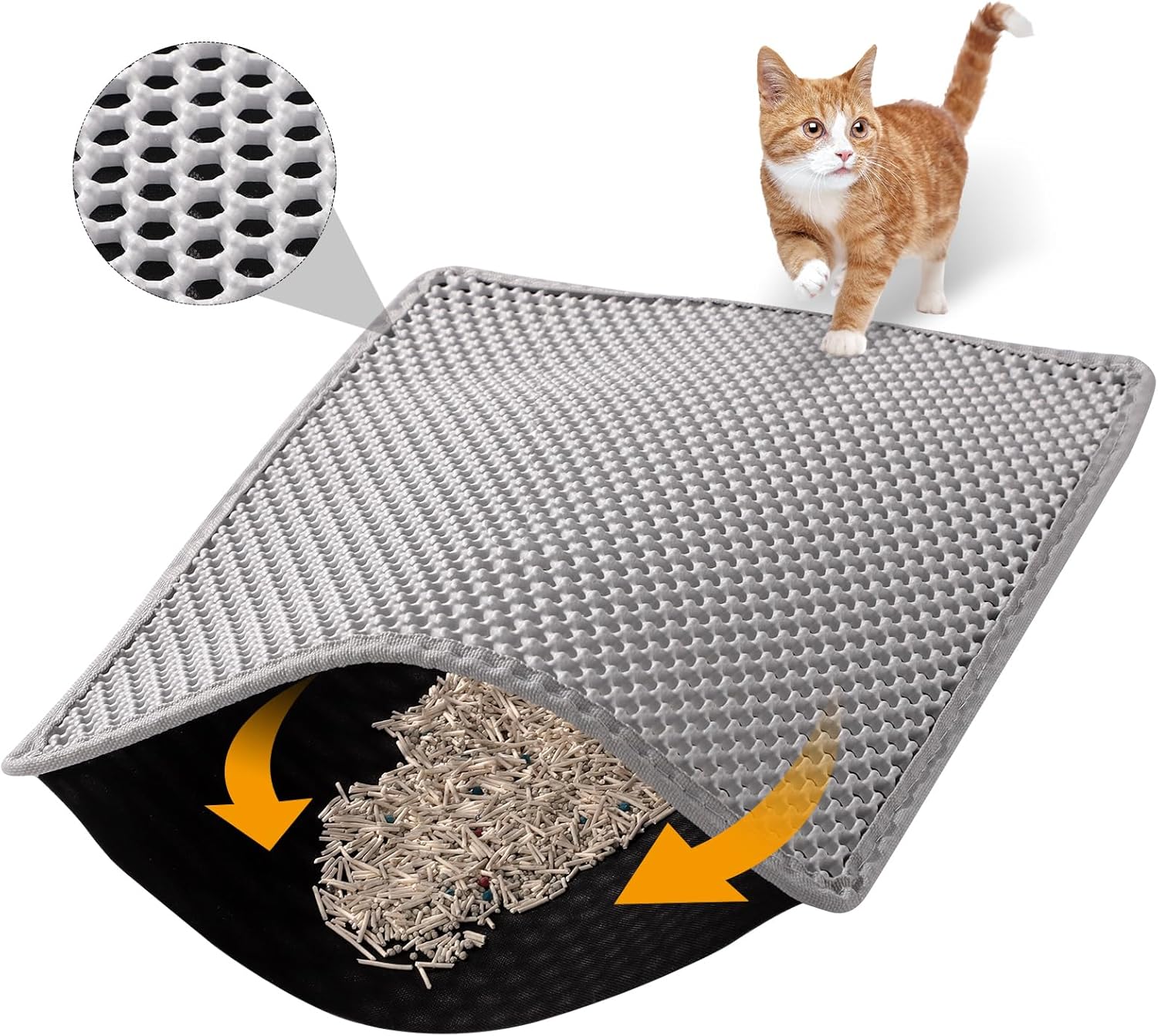
PRODUCT MENTIONED
ondware A1223K11V0 Double-Layer EVA Litter Mat, Gray, 30 × 24 in
Amazon · Details on the retailer’s website
Keep the litter mat comfortable to cross
Introduce the mat without turning it into the only difficult route to the toilet. Watch whether the cat walks over it normally, hesitates at the edge or changes its exit path. A mat that looks soft to a person is not proof of comfort for every cat.
Cat Friendly Homes notes in its litter box guidance that older cats and those with sensitive paws can need particular attention to surface consistency and accessible entries. That advice concerns the litter setup; it does not certify this EVA mat for a sensitive-pawed cat.
Reassess avoidance rather than enforcing contact
Do not place obstacles around the mat simply to make the cat step on it. Keep access to a suitable toilet clear. If repeated avoidance begins after the mat is added, remove or reposition it and observe whether the route becomes comfortable again.
If toileting behavior changes, consider more than the accessory. Cat Friendly Homes explains in its house-soiling guidance that medical, physical and social needs can contribute. Persistent changes warrant veterinary assessment rather than punishment or repeated product changes.
Waterproof backing is not a complete floor guarantee
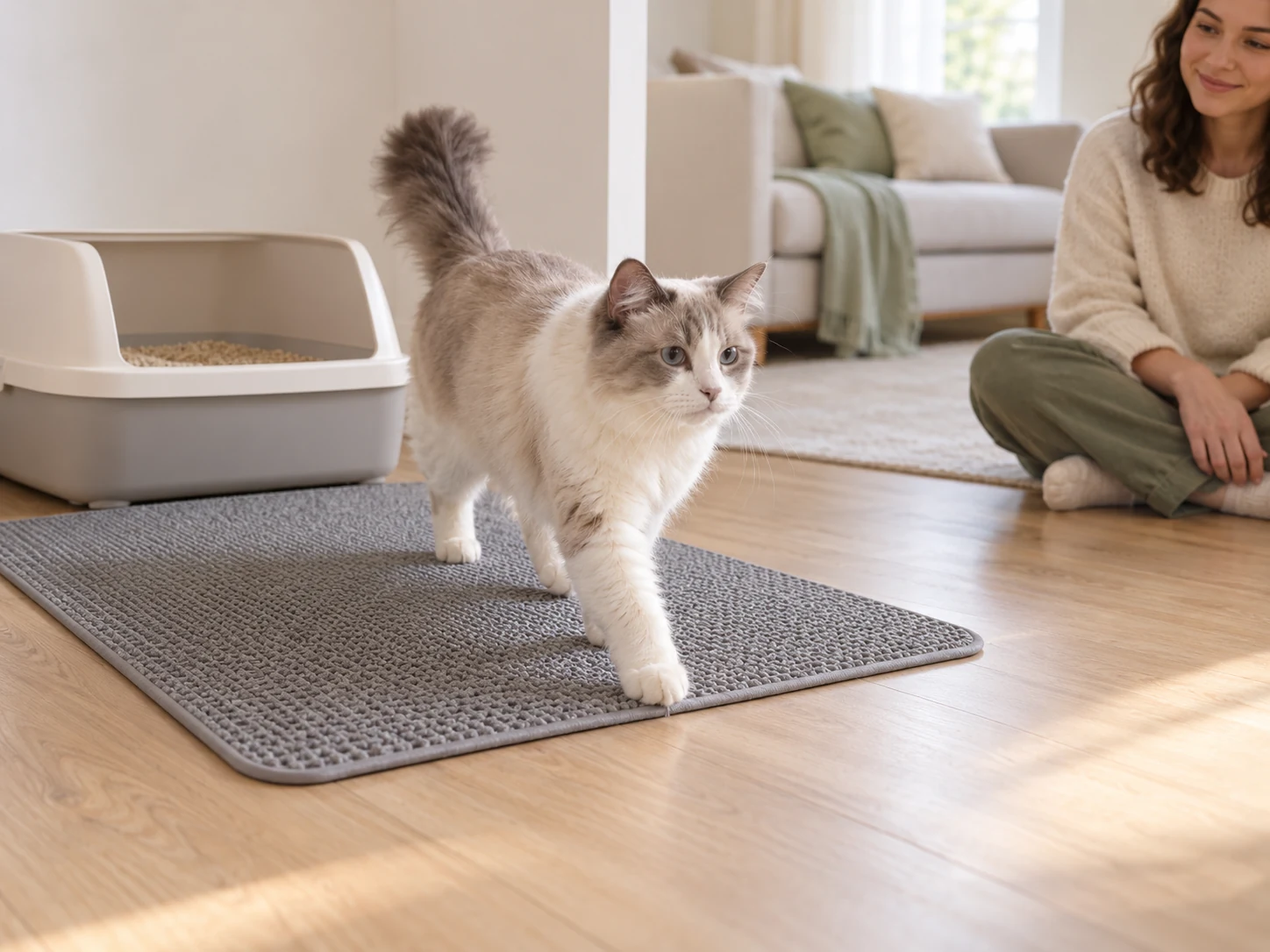
The listing describes the lower layer as waterproof and urine-proof. Keep that claim limited to the manufacturer’s description. It does not establish how liquid behaves at an edge, around a fold, beneath the mat or after damage.
Inspect the floor underneath as part of care, especially after a spill. A surface that conceals grains can also make it easier to overlook moisture. Do not leave wet material in place because the product title suggests the floor is protected.
Check stability on the actual surface
Confirm that the mat lies in a usable position and does not slide or create an awkward edge during normal entry and exit. The backing’s description does not guarantee identical behavior on every floor. Follow the supplied placement instructions and keep the surrounding route clear.
If accidents outside the box are recurring, the mat is not an explanation or treatment. Assess the litter setup and seek veterinary advice about a change in toileting. Buying a larger waterproof-labeled accessory should not delay that assessment.
Empty captured litter without returning contaminated material
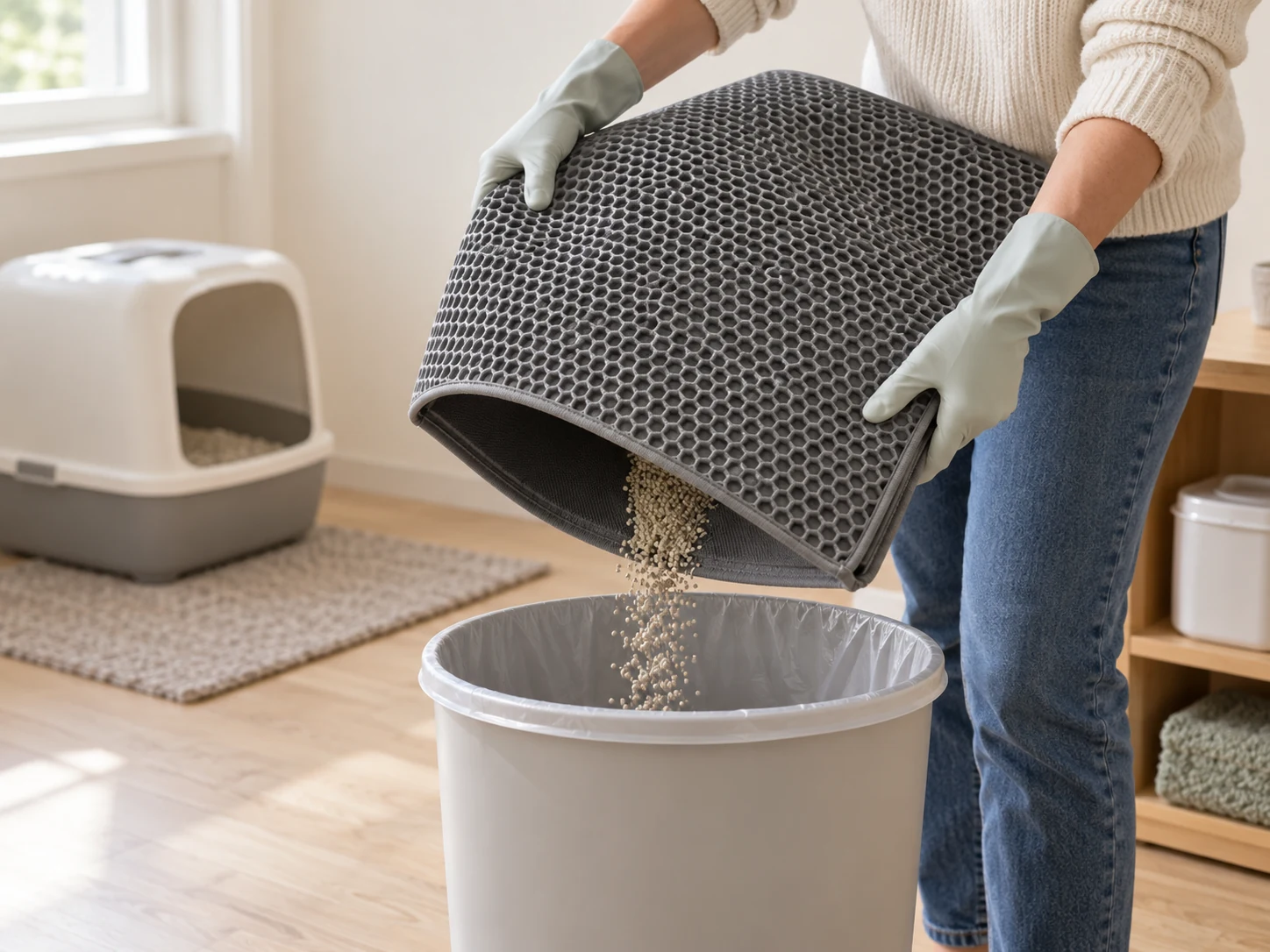
The ondware listing describes lifting and tipping the mat to release collected grains. Plan where that happens before the mat is full: over an appropriate container or another area where you can control the spill. The flexible construction does not establish that every grain stays contained during lifting.
Do not automatically pour everything back into the tray. Inspect what was collected and discard soiled or questionable material appropriately. A collection area can contain more than clean loose litter, particularly after a spill or an accident.
Separate routine emptying from washing
Removing dry grains does not clean urine or other residue. Follow the exact product instructions for washing. The checked listing permits rinsing under a faucet, but it does not establish dishwasher compatibility, machine washing or a particular disinfectant’s compatibility with EVA.
Do not promise that the mat will dry in minutes. Drying depends on conditions and how much water remains between layers. Follow the supplied directions, inspect the result and avoid putting a damp mat over a floor you cannot check.
Clean litter equipment away from food preparation
The CDC’s pet supply cleaning guidance recommends following item-specific care instructions. For litter equipment, use dedicated cleaning tools and an appropriate wash area rather than treating it like a food-contact dish.
Cleaning removes dirt; disinfecting is a separate process. If disinfecting is needed, use a method compatible with the mat and follow the disinfectant label. Keep animals away while cleaning and complete the required rinsing and drying steps. Confirm material compatibility on the cleaning label rather than mixing a homemade solution.
Keep the routine manageable
Check the mat during daily litter care, empty it before handling becomes messy and inspect it for damage. Include the underside and the floor in periodic cleaning. Keep the box itself on its normal scooping and replacement routine.
Recheck its position after washing or moving the box. The original footprint is useful only while it still covers the route the cat uses.
If the collection design takes more effort than it saves or the cat continually bypasses it, change the arrangement. A simpler cleanable surface may be more practical than keeping a complex mat solely because it was marketed as a better catcher.
Use a simple household record
Note the litter, mat position, where grains still collect and whether the cat crosses normally. Include the effort needed to empty and wash it. Those observations help you decide whether the setup is useful without pretending that one household trial establishes a universal capture rate.
Change one relevant feature at a time where practical. Moving the mat, replacing the litter and changing the box together can make an apparent improvement hard to explain. Keep the cat’s reliable toilet routine as the priority while you adjust the cleanup area around it.
Cat litter mat questions
Will this stop all tracking?
No such result is established. The cat’s route, litter, paw contact and placement affect what is collected. Treat the mat as one cleanup aid rather than a zero-tracking guarantee.
Is this a guaranteed urine-containment mat?
The manufacturer describes waterproof backing, but no complete liquid-retention test is provided. Inspect the mat and floor after spills and address recurring accidents separately.
Can I return every captured grain to the box?
Do not assume it is all clean. Inspect the collected material and dispose of soiled material appropriately. Emptying dry grains is different from cleaning residue.
Should I choose the largest mat available?
Choose useful coverage with a clear route and practical handling. A larger size is not better if it blocks a door, is difficult to lift or creates a surface the cat avoids.
Choose collection you can keep clean
The best cat litter mat fits the exit path, works with the actual litter and remains comfortable for the cat. The ondware 30-by-24-inch double-layer option gives you a defined size and collection format to evaluate. Observe normal use, check the floor beneath it and judge the purchase by manageable cleanup rather than a promise of no mess.
View ondware A1223K11V0 Double-Layer EVA Litter Mat, Gray, 30 × 24 in on Amazon.
Comments are reviewed before they appear publicly. Please keep questions and feedback relevant to this article.