AI-created concept illustration; the grains and tray are generic and do not show either pidan product or measured performance.
For a pidan tofu cat litter comparison, start with the box you use and the formula you want. Consider the Natural four-pack for a manually scooped box when its ingredients and your cat’s acceptance suit your household. Consider the two-pack Blend when you want its stated tofu-and-bentonite combination, with any automatic-box use subject to the exact machine’s requirements.
Neither is a useful shortcut if you need guaranteed dust-free performance, cannot confirm equipment compatibility, or are trying to solve new house-soiling without checking the cause. Keeping a familiar litter your cat reliably uses can be the better decision.
The selections are pidan Natural Tofu Cat Litter, four bags, and pidan Tofu and Bentonite Blend Cat Litter, two bags. The current Blend packaging identifies a 70/30 combination. Compare these packages rather than assuming that every pidan litter has the same recipe.
Use the box as the first filter: Natural’s selected packaging does not recommend automatic boxes. Blend’s test-first compatibility wording does not override your machine’s rules. For a manual box, compare ingredients, your cat’s acceptance and cost per usable routine before choosing the larger pack.
pidan Tofu Cat Litter: The Two Packs at a Glance
The clearest differences are the stated ingredients, package quantity and automatic-box instructions. They do not establish a universal winner for odor, dust or your cat’s preferences.
| Decision point | Natural tofu selection | Tofu-bentonite Blend selection |
|---|---|---|
| Exact selection | ASIN B0B9MWNV3F; four bags. | ASIN B0FB91ZCY9; two bags. |
| Formula description | Plant-fiber and starch-based tofu litter with additional listed materials; no bentonite blend advertised. | Current packaging: 70% tofu cat litter and 30% bentonite clay cat litter. |
| Printed net weight | 5.29lb / 2.4kg per bag. | 5.29lb / 2.4kg per bag. |
| Calculated package contents | Four bags: 9.6kg, or 21.16lb using the printed pound labels. | Two bags: 4.8kg, or 10.58lb using the printed pound labels. |
| Automatic litter boxes | The manufacturer explicitly does not recommend this product for automatic boxes. | The manufacturer calls it compatible but requires compatibility testing first; the machine’s requirements still apply. |
| Ingredient notice | The product-information label says it contains gluten from wheat-derived ingredients. | The product-information label also carries a gluten notice. |
Those totals are calculations from selected bag counts and manufacturer net labels, not scale measurements. Check the selected package and the label on delivery; a shipping-weight field is not an alternative measure of how much usable litter you receive.
Know What Each Formula Contains
Tofu is a product category, not a claim that the bag contains only tofu or pea fiber. Read the actual ingredient information before choosing by the name.
Natural does not mean a single ingredient
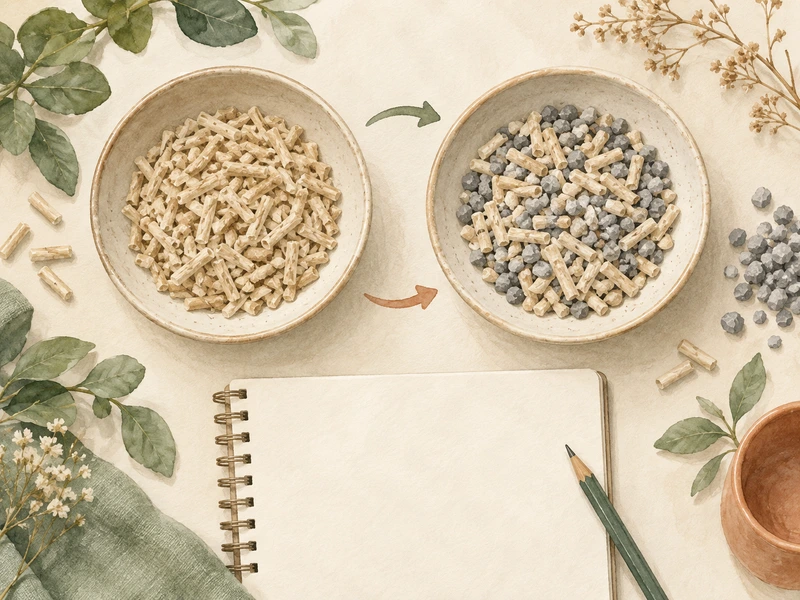
The pidan Natural product page and selected product-information graphic describe soy and pea fiber, starch and flour ingredients, and additional mineral materials. The target graphic names silica and calcium-carbonate materials among its components. This is not evidence of pure pea litter, a mineral-free recipe or an edible product.
The Natural page also describes a 70/30 mix of 2mm and 1.5mm pellet diameters. That ratio concerns pellet sizes, not tofu versus bentonite. Diameter does not tell you pellet length, prove the grains were independently measured, or establish that they pass a particular machine’s screen.
Use the current Blend label for its composition
The selected Blend’s current product-information graphic states 70% tofu cat litter plus 30% bentonite clay cat litter. Its tofu component includes plant fiber, starch and other listed materials; bentonite is the clay component.
The Signature Tofu Blend page gives the same broad 70/30 split, with shorter ingredient wording and a reference to STA particles. Matching headline percentages do not prove that every ingredient, trace component or package version is identical. Use the selected package rather than importing another pidan recipe.
Both target graphics carry a wheat-derived gluten notice. Do not call either gluten-free or universally suitable for sensitive cats or people. If ingredient avoidance is essential, resolve it before buying rather than treating a Natural label as reassurance.
Check Clumping, Dust and Tracking in Your Routine
Neither formula is an evidence-based performance winner. pidan describes clumping, dust resistance and reduced tracking, but those are manufacturer claims rather than results from a household comparison.
The retailer bullets include dimensional scores for these qualities. They do not provide a complete independently verified protocol for comparing the two selected packages. Avoid turning the numbers into independent ratings, a guaranteed clumping time, or proof that the Blend produces less dust.
A useful household check is narrower: does your cat use the box, do clumps remain manageable during normal scooping, and how much litter needs clearing from the surrounding floor? Keep notes about fill level, box, scoop and cleaning routine so that a change in setup is not mistaken for a formula effect.
Low-dust wording does not mean dust-free, and an odor-control claim does not remove the need to clear waste. Both target labels recommend at least daily care and dry, well-ventilated placement. A larger bag purchase cannot compensate for a routine you cannot maintain.
Nor do plant-based ingredients prove respiratory benefits, safety for every allergy, or independent organic certification. Choose using the supported material information and practical fit; do not buy either as treatment for a health problem.
Choose for Your Exact Litter Box
The Natural selection has a direct limit: its packaging does not recommend it for automatic litter boxes. Use Natural only in a compatible manually scooped box; do not weaken that instruction into an experiment inside an automatic unit.
The Blend label takes a different position, describing automatic-box compatibility while asking for testing first. That is a conditional litter-manufacturer claim, not approval from every equipment manufacturer. Adding 30% bentonite does not by itself solve sifting, clump or sensing requirements.
Whisker’s current litter-compatibility guidance illustrates why the exact machine matters: some tofu brands may work, while certain pellet products do not sift properly. Whisker does not approve either pidan ASIN in that guidance. Confirm the exact formulation and machine rather than treating all tofu litters alike.
Confirm requirements before a machine trial
Check the machine’s model-specific instructions for litter type, particle shape and size, clumping, fill level and sensing. Ask its manufacturer about the exact Blend selection if the information is unclear. Carry out only a permitted compatibility test, following the equipment instructions rather than improvising a cycle or overriding a warning.
For a manual box, cat preference still matters. A formula change can affect a familiar toileting routine even when the product is sold for cats. Equipment fit and cat acceptance are separate checks; passing one does not establish the other.
Compare Cost per Pound, Not per Bag
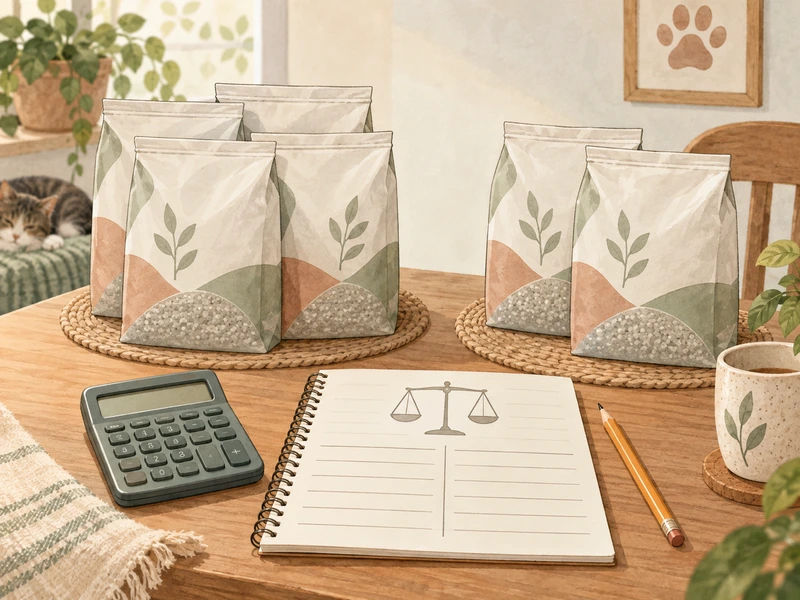
Four bags are not automatically better value than two. Compare the actual selected checkout cost against the total net contents, using the same units and cost basis.
| Worksheet input | Natural four-pack | Blend two-pack |
|---|---|---|
| Price check and selection | Date/seller: ___; B0B9MWNV3F, four bags. | Date/seller: ___; B0FB91ZCY9, two bags. |
| Your selected checkout cost | C4 = ___; use a consistent shipping/tax basis. | C2 = ___; use the same shipping/tax basis. |
| Total labelled net contents | 9.6kg, or 21.16lb from printed pound labels. | 4.8kg, or 10.58lb from printed pound labels. |
| Cost per kilogram | C4 ÷ 9.6 = ___ per kg | C2 ÷ 4.8 = ___ per kg |
| Cost per pound | C4 ÷ 21.16 = ___ per lb | C2 ÷ 10.58 = ___ per lb |
Include or exclude shipping and taxes consistently. Use either the kilogram or pound calculation for both selections, and keep the printed-label basis consistent rather than mixing rounded figures.
Because the selected four-pack contains twice the labelled net mass, its unit cost equals the two-pack’s when C4 is twice C2. Below that threshold it costs less per unit of purchased weight; above it, more. This is arithmetic, not a claim about current prices or which formula lasts longer.
Purchased weight is not useful-life savings
Price per pound does not measure how much litter you discard with each clump, how your cat accepts it, or the cleaning work it creates. Record actual consumption before estimating a recurring cost. Do not assume a fixed monthly bag count or annual saving from the larger package.
Storage space also matters when choosing the four-pack. Follow the package’s storage directions and keep unused material dry. The labelled 24-month expiry is not the life of opened litter or a used litter box. Budget for ongoing supplies and upkeep, rather than buying more stock than your household can sensibly use because of a lower unit price.
Handle Used Litter According to Local Rules
A flushable label does not establish permission for your home. Both pidan selections advertise flushing, but product marketing does not settle local wastewater rules or your plumbing-system requirements.
For a concrete US example, San Francisco’s wastewater guidance lists kitty litter for landfill disposal and limits toilet flushing to human waste and toilet paper. That is a specific municipal instruction, not a claim that every US locality has the same law.
Check your own wastewater authority and waste collector’s instructions before choosing a disposal route. Where litter belongs in household waste, contain it and use the locally instructed collection route. Do not repeat a small-batch flushing technique as a general US recommendation or assume dissolving proves harmlessness.
The same check applies to both formulas. Tofu in the name does not make used litter suitable for every compost stream or turn the litter into food. Disposal should be a confirmed part of your routine, rather than the deciding benefit of an unverified marketing promise.
Introduce the Change Without Rushing Your Cat
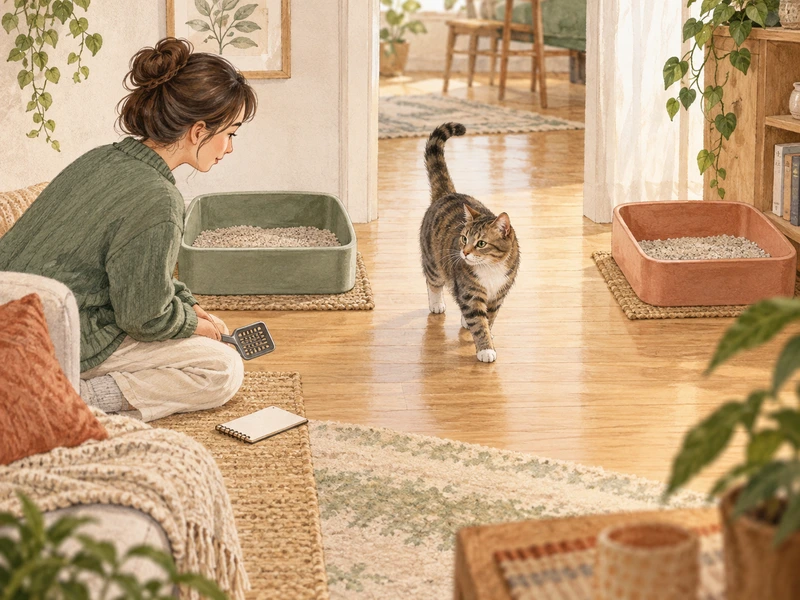
Let observed acceptance guide the switch. Cornell’s feline house-soiling guidance recommends changing litter brands gradually by adding small amounts of new litter to the old. It does not supply a universal seven-day schedule or required percentages.
- Keep familiar access: preserve a toileting option the cat already uses. Do not remove it simply because a different formula seems preferable on paper.
- Choose an appropriate trial box: use a manual box for Natural. For automatic equipment, mix or introduce only materials that meet the exact machine’s requirements.
- Introduce a small amount: increase the change gradually if the cat continues using the box comfortably. Do not force progress to fit a calendar.
- Observe each cat: note use, avoidance and cleaning needs. A multi-cat household should not assume that one cat’s acceptance proves everyone accepts the change.
- Reassess problems: new house-soiling or signs of illness call for veterinary advice, not an automatic conclusion that the litter is disliked.
If a cat seems unwell or struggles to urinate, contact a veterinarian promptly rather than waiting through a transition schedule. A litter comparison cannot determine the medical cause.
The selected packages suggest mixing with old litter before full replacement, but that is not a success guarantee. In particular, do not mix Natural into an automatic box to follow a general transition tip. Keep product and equipment restrictions in place throughout the switch.
Keep a simple transition observation record
Write one entry per observation period, not a promised day-by-day transition schedule. Keep the box, fill depth and care routine identifiable so a setup change is not mistaken for proof that one formula performs better.
| Record | Your entry | Decision it supports |
|---|---|---|
| Setup | Date, cat, exact formula, box and fill level: ___ | Natural stays in a compatible manual box; preserve all machine restrictions for Blend. |
| Acceptance | Voluntary use, avoidance and familiar box available: ___ | Increase the change only if the cat continues using an appropriate box comfortably. |
| Routine performance | Clumps at normal scooping, floor cleanup and litter discarded: ___ | Compare observations under a consistent routine, not retailer dimensional scores. |
| Cost and next step | Litter added, cost and time spent: ___; continue/pause: ___ | Use actual consumption for recurring cost; seek veterinary help for concerning changes. |
Which pidan Tofu Cat Litter Pack Should You Buy?
Consider Natural when you use a manual box, want its stated tofu-litter formulation rather than the explicit bentonite blend, and can store the four-pack. Confirm that the ingredients suit your household and let your cat’s acceptance determine whether the switch continues.
View pidan Natural Tofu Cat Litter — 4 Bags on Amazon
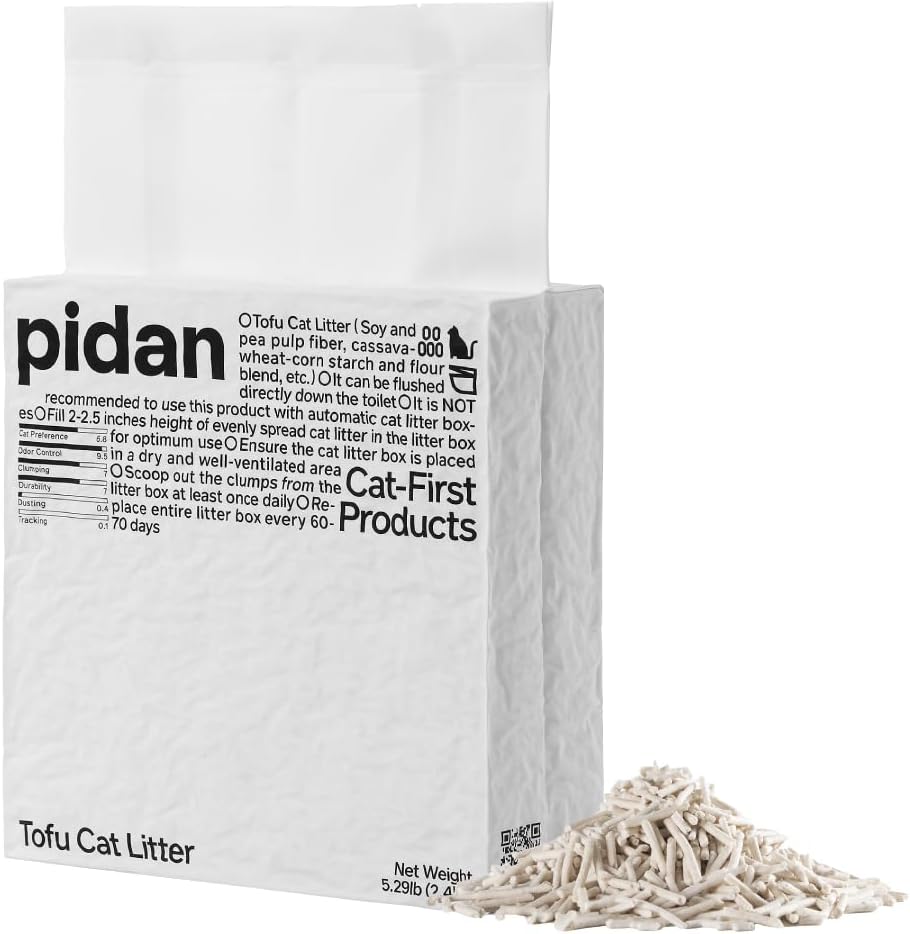
PRODUCT MENTIONED
pidan Natural Tofu Cat Litter — 4 Bags
Amazon · Details on the retailer’s website
Consider the current two-pack Blend when you specifically want the stated 70% tofu-litter and 30% bentonite combination and its calculated unit cost suits you. For automatic use, obtain model-specific confirmation and follow the permitted test conditions before treating it as a usable choice.
View pidan Tofu and Bentonite Blend Cat Litter — 2 Bags on Amazon
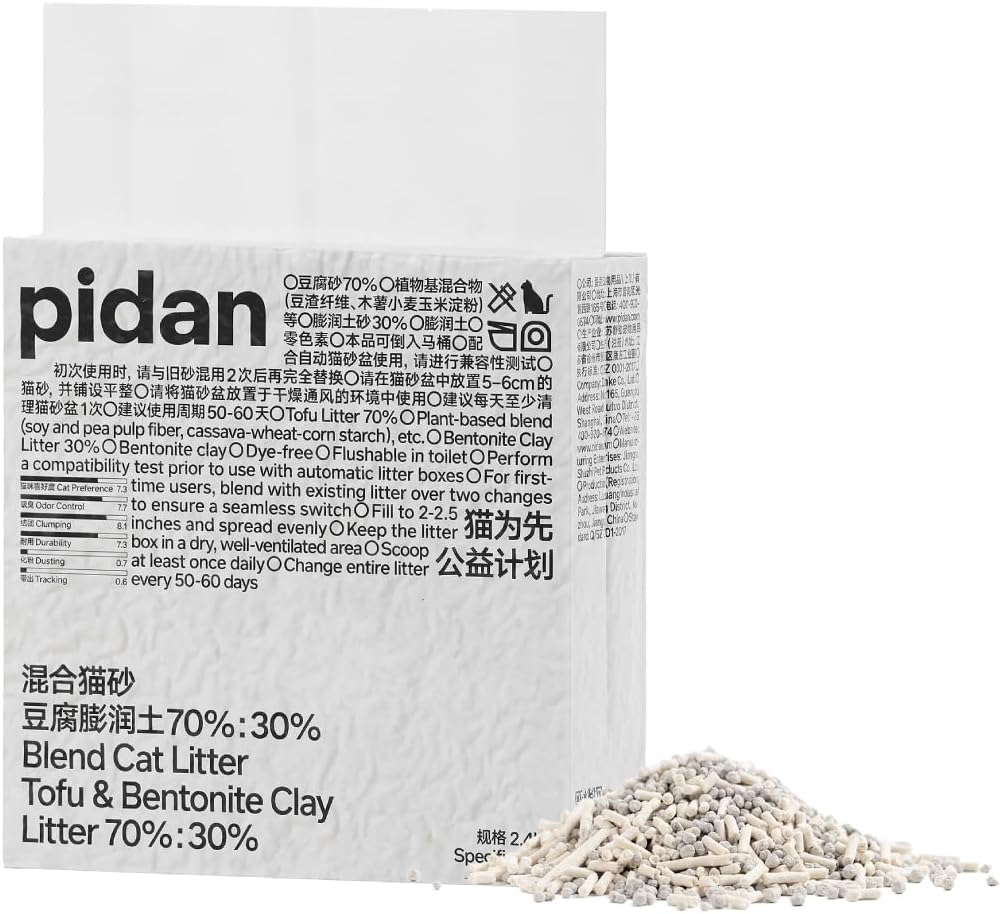
PRODUCT MENTIONED
pidan Tofu and Bentonite Blend Cat Litter — 2 Bags
Amazon · Details on the retailer’s website
For either selection, check the exact package, printed net weight, ingredients, box instructions and local disposal route. Leave performance claims as claims until you have observations that actually apply to your household.
The better pidan tofu cat litter purchase is the one your cat can use within a workable care routine. Keep the current litter if it works and there is no clear reason to change; choose neither if essential ingredient or equipment questions remain unresolved. Bag count and a material name cannot make that decision for you.
pidan Tofu Cat Litter FAQ
Is the Natural formula 70% tofu and 30% clay?
No. The Natural brand page’s 70/30 figure refers to two pellet diameters. The selected Blend’s current packaging uses 70/30 for tofu cat litter and bentonite clay cat litter. Natural has several listed ingredients and additional materials; it should not be described as pure tofu or mineral-free.
Does the four-pack contain twice as much litter?
On the selected counts and printed net labels, yes: four bags total 9.6kg versus 4.8kg for two. Using the printed pound labels gives 21.16lb versus 10.58lb. These are calculated labelled contents, not measured weights or shipping figures. Twice the purchased mass does not guarantee twice the usable life.
Can I use either product in an automatic litter box?
Natural’s selected packaging explicitly does not recommend automatic boxes. Blend’s packaging makes a compatibility claim with a test-first condition, which does not override your machine’s requirements. A generic statement that some tofu litters work is not approval for this exact Blend ASIN or every automatic model.
Does low dust mean no dust or a health benefit?
No. Manufacturer dust-resistance claims do not establish a dust-free product, respiratory treatment or suitability for every sensitivity. Both selected product-information labels carry wheat-derived gluten notices. Check ingredients when avoidance matters, and obtain professional advice for health concerns rather than treating a product claim as medical evidence.
Comments are reviewed before they appear publicly. Please keep questions and feedback relevant to this article.