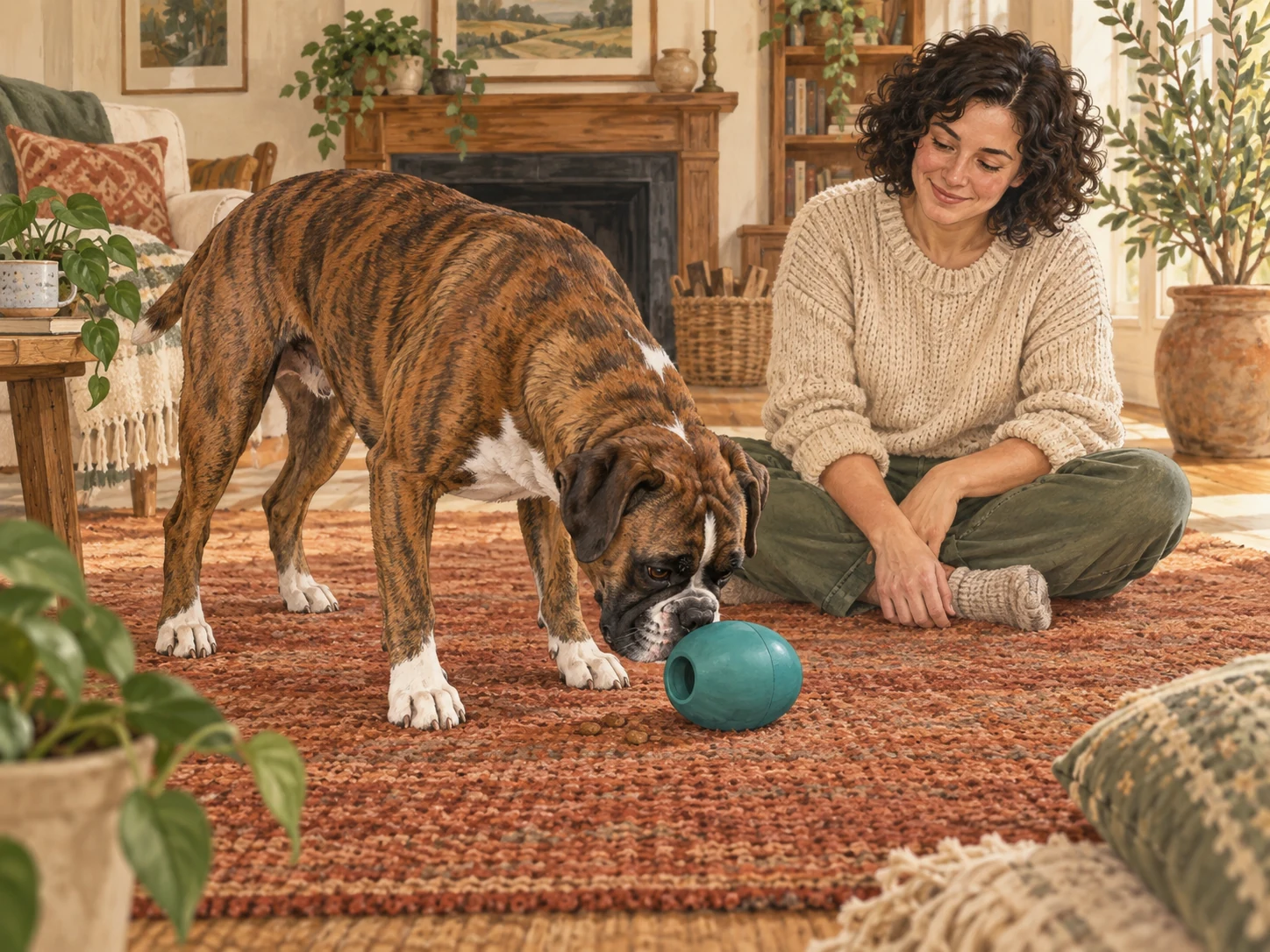
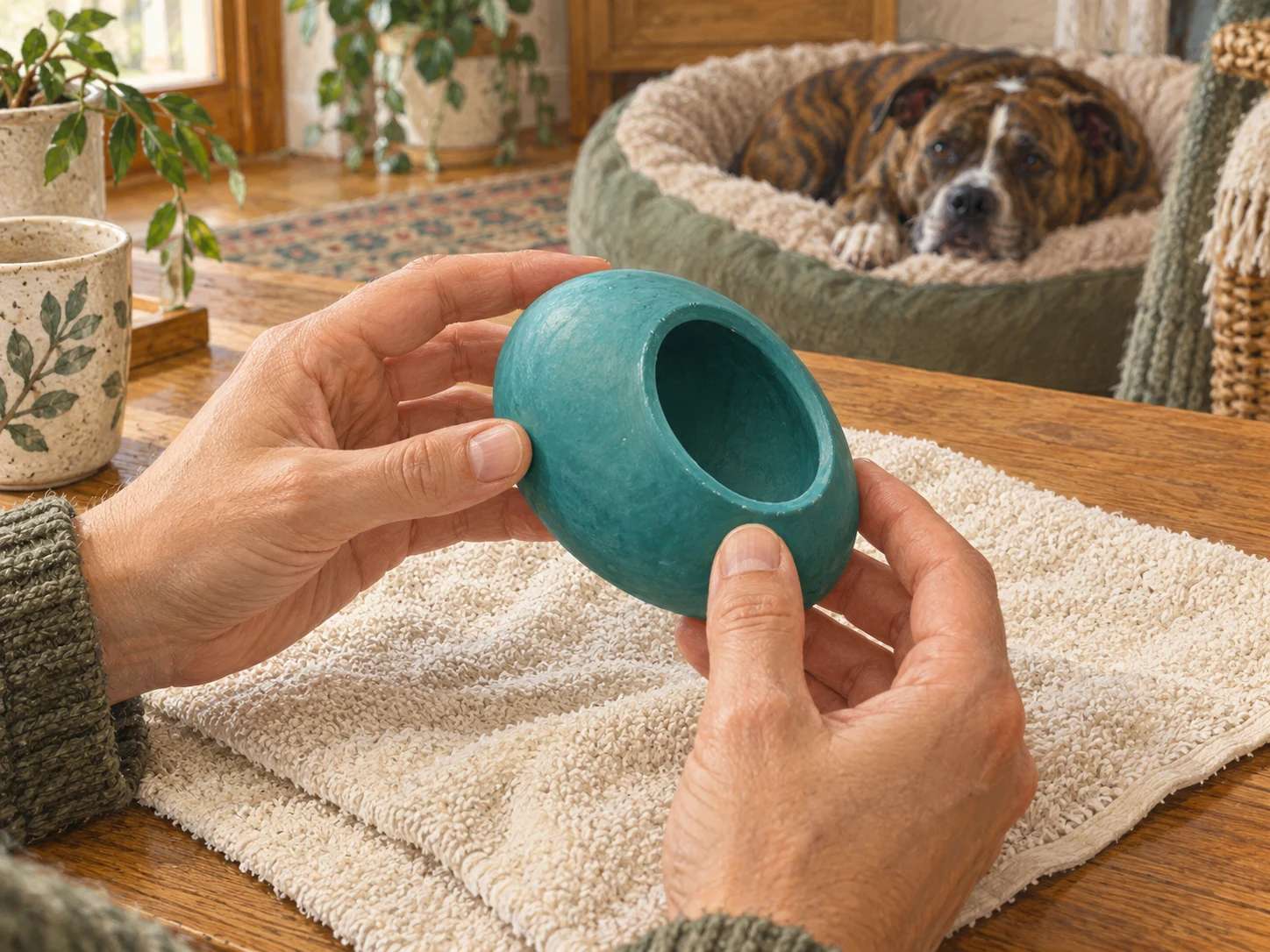
AI-created editorial scene: assess fit and supervised interaction before relying on a tough-chewer label; not a product photo or bite test.
The best dog toys for aggressive chewers depend on how the dog uses a toy, its mouth fit and whether you can supervise and inspect it. A tough-chewer label is a starting point for selection, not a promise that the toy cannot break.
“Aggressive chewer” describes powerful or persistent chewing. It does not diagnose aggression toward people or animals. The selected WEST PAW Tux Large is one treat-holding option to assess for that chewing style, with clear limits on size, condition and access.
Choose the best dog toys for aggressive chewers by fit
Think about what happened to previous toys. Did the dog work at a seam, tear off a projection, swallow loose material or lose interest when food became inaccessible? Those observations are more useful than a general claim that your dog destroys everything.
A dog that removes pieces needs a different decision from a dog that carries a toy and occasionally chews it. Do not keep offering a failing design to collect another example. If swallowing or repeated destruction makes toy choice difficult, ask your veterinarian for help with a suitable plan.
The Blue Cross play guide emphasizes appropriate size, supervision and regular checks for damage. Apply all three together. An intact toy can still be too small for the animal that reaches it, while a suitably sized toy can still become unsafe when damaged.
Plan where you will observe the activity and how you will prevent access afterward. A durable toy does not make an unsupervised interval safe. In a multi-dog home, review every dog that can reach it rather than buying for the intended dog alone.
| Selection question | Useful evidence | What it cannot prove |
|---|---|---|
| Is it intended for tough chewing? | The manufacturer’s stated use and material | That this dog cannot damage it |
| Does the size suit the dog? | Exact selected size, shape and actual mouth fit | That a Large label fits every large breed |
| Can the activity be supervised? | A person can watch and remove a damaged toy | That occasional room checks replace supervision |
| Can it be kept clean? | Accessible food cavity and matched care directions | That a rinse repairs surface damage |
| Does the dog enjoy it? | Comfortable engagement with a manageable task | That longer chewing automatically means better enrichment |
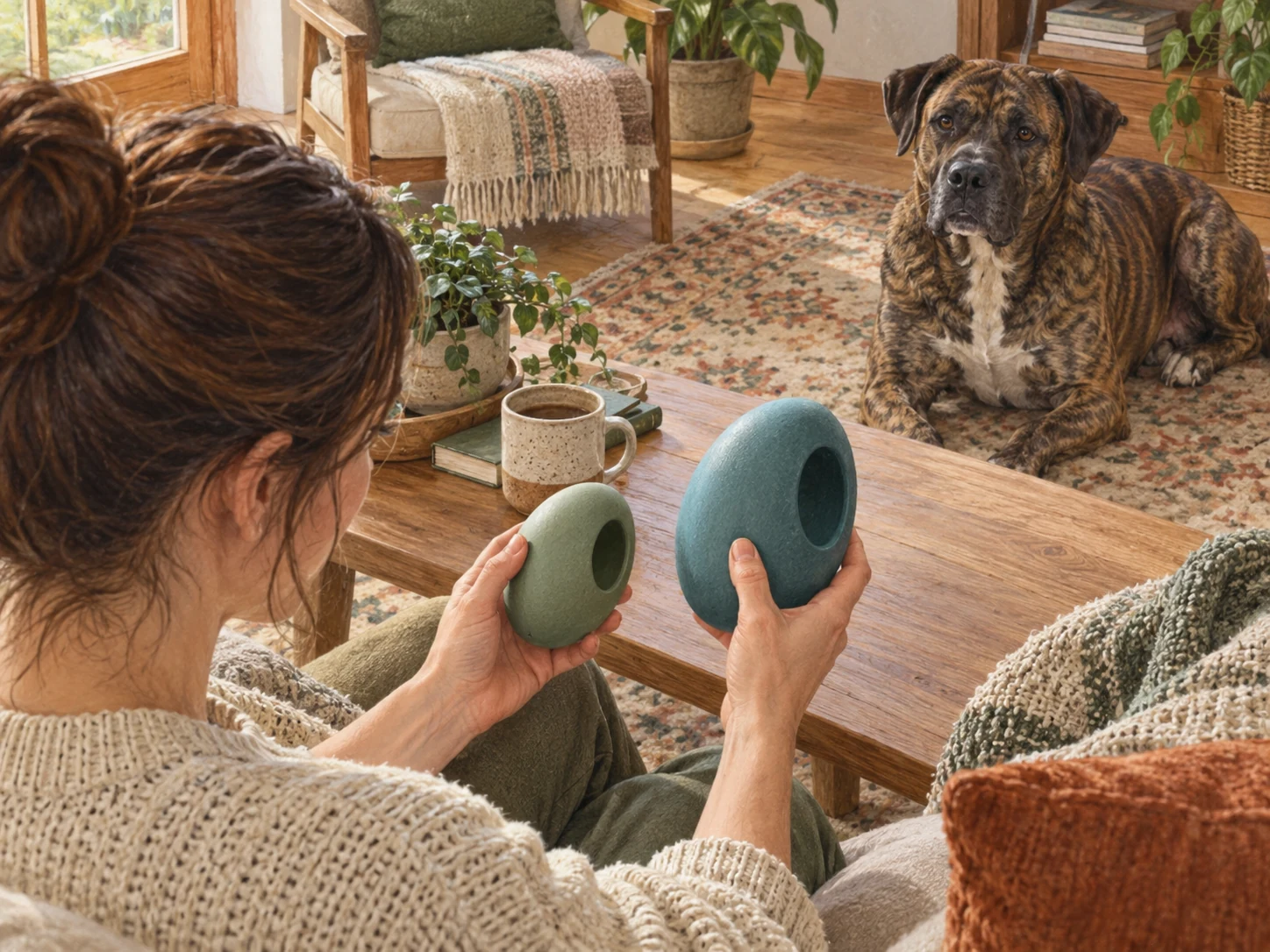
What the Tux Large offers a powerful chewer
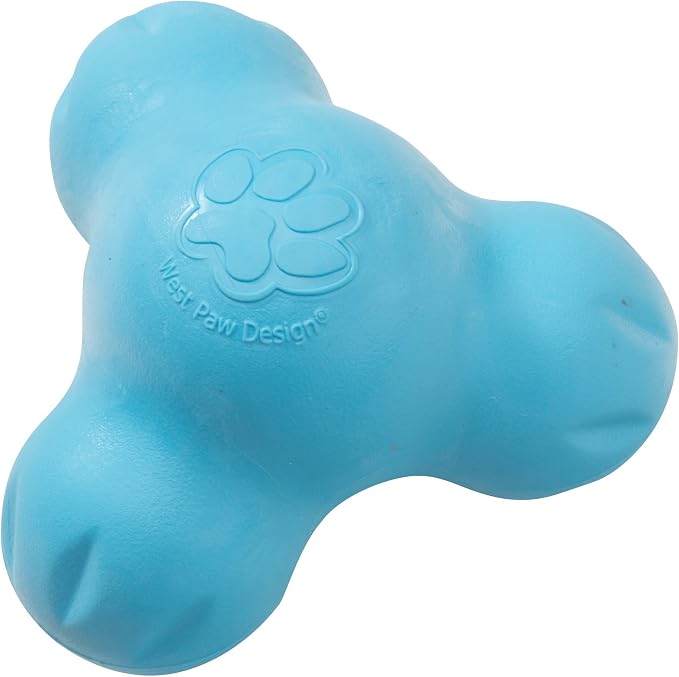
The selected product is WEST PAW Design Tux Dog Toy Large Aqua, model ZG041AQA, ASIN B004A7X27W. Keep the Large size and Aqua Blue variant together when checking the listing and delivered package.
WEST PAW’s Tux product page describes a shallow treat cavity, Zogoflex material and a toy built for tough chewers. It lists Large as 5 inches or 13 centimeters and Small as 4 inches or 10 centimeters. Those are the manufacturer’s size references; they are not a complete three-axis fit measurement.
The company’s tough-chewer collection includes Tux. That confirms the intended product family, while the product’s Safety section still says no dog toy is indestructible. Both statements belong in the buying decision.
For a dog whose fit and supervised chewing style suit this design, check the WEST PAW Tux Large Aqua, ZG041AQA, on Amazon. Match the actual Large variant before purchase; a family page showing other sizes does not confirm which one you selected.
PRODUCT MENTIONED
WEST PAW Design, Tux Dog Toy Large Aqua
Amazon · Details on the retailer’s website
Bite resistance and wear have not been independently verified or compared across all competing toys for the specified Tux. The useful advantages to consider are the treat cavity, a material the manufacturer assigns to tough chewing and an explicit top-rack dishwasher cleaning direction.
The limits are equally practical: it can suffer damage, food still needs dietary planning, and the shape must suit the actual dog. Choose it for those defined tasks rather than a claim that it is the universal winner among dog toys for aggressive chewers.
Dog toys for aggressive chewers: read material claims
The manufacturer calls the material Zogoflex. Do not describe this product as a natural-rubber toy merely because its surface looks flexible or because other chew toys use rubber. A retailer’s broad “plastic” field also does not replace the branded material description.
WEST PAW states that the material contains no BPA, latex, phthalates or silicone. Those are manufacturer composition declarations; independent results for those claims have not been verified. They do not establish that swallowing a piece is harmless or that every chewing pattern is appropriate.
Likewise, “ultra durable” describes the manufacturer’s intended positioning. It is not a measured lifespan, a guarantee against tooth problems or permission to ignore wear. That wording does not establish a lifespan in hours, months or chewing sessions.
The page mentions a customer guarantee, but a remedy after dissatisfaction does not prevent a broken toy or protect the dog while it happens. Read the current guarantee terms separately if they affect the purchase. Do not use a replacement offer as the reason to continue with a damaged toy.
When choosing dog toys for aggressive chewers, the material label should therefore lead to a supervised trial and inspection routine. It should not end the assessment. The dog’s actual response and the condition of the toy remain part of every use.
Make the treat activity manageable
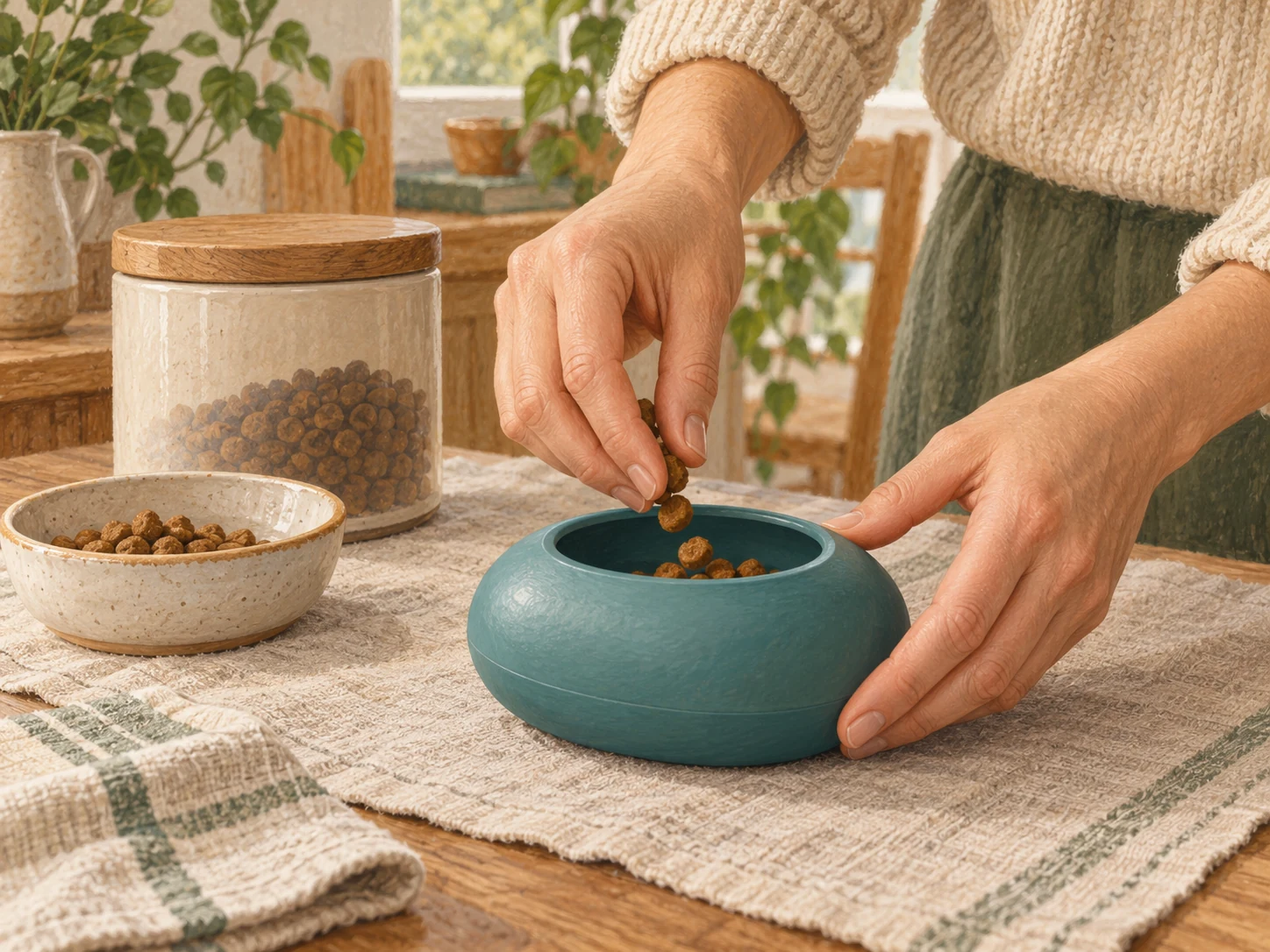
Treat accessibility is part of choosing dog toys for aggressive chewers. The Tux cavity can hold dry treats, and the manufacturer also describes filling it with wet treats and freezing it. That gives different activity options, but a harder or colder filling is not a necessary starting point.
Begin with a small amount of familiar food that the dog can access comfortably. Check the ingredients and the dog’s existing diet before introducing a filling. The KONG filling guide includes ingredient-checking considerations; its recipe quantities and packing methods do not establish the correct filling for the different Tux cavity. If a veterinary diet or health condition limits treats or chewing, ask the care team how this toy could fit the plan.
Dogs Trust’s enrichment guidance recommends activities appropriate to the individual dog’s ability, health and preferences, with food included in the daily allowance. It also advises watching the response and simplifying an activity when frustration appears.
Observe what the dog does with an easy filling before making anything more difficult. Comfortable licking and investigation are different from repeatedly biting at an inaccessible spot. A shallow cavity can make the food easier to reach, but it does not prove safe access for every mouth.
The brand specifically markets that cavity to short-snouted dogs. Treat this as a design description rather than a breed-wide safety guarantee. Check the individual dog’s approach, breathing comfort and ability to use the toy without force or distress.
Stop if the activity produces avoidance, frustration or a concerning chewing pattern. Review the food, difficulty, fit or activity choice rather than adding more food to keep the dog engaged. A useful session does not need to become progressively longer.
Inspect dog toys for aggressive chewers for damage
WEST PAW’s Safety section tells owners to choose an appropriate shape and size, supervise use and discontinue the toy immediately if damage occurs. Follow that direct instruction. Do not reinterpret it as permission to trim off a damaged area and keep using the remainder.
Check the body, edges and cavity before the activity, observe them during use and inspect again afterward. Look for missing material, tears, breaks or a changed surface. A food-covered cavity can hide an area that needs closer examination after cleaning.
Remove a damaged toy from the dog’s access. Do not patch it with glue, melt a split closed or cut it into a different shape. Those changes create a different object without the manufacturer’s fit and care guidance.
If you suspect the dog swallowed toy material, contact a veterinarian promptly rather than waiting for the next planned toy check. A home check cannot reliably rule out an obstruction; follow the veterinarian’s instructions rather than trying an improvised treatment.
Keep observations specific when asking for help: the product and size, where the damage appeared, what may be missing and what the dog was doing. That information is more useful than assuming every product in the same material family will behave identically.
Plan chew-toy cleaning and supervised storage
The Tux page permits top-rack dishwasher cleaning. Follow the delivered product’s care instructions and keep food residue out of the cavity. Do not invent a boiling, chemical-soaking or sterilization routine beyond the matched instructions.
The best dog toys for aggressive chewers still need both cleaning and inspection. Removing food does not restore strength to a torn surface, and an intact-looking exterior does not tell you that old filling has been removed. Check both condition and cleanliness before offering the toy again.
Store the cleaned toy where the dog cannot take it without the intended supervision. Include other pets and visiting dogs in that access decision. A suitable activity for one animal does not automatically transfer to another.
Frequently asked questions
Are any toys for aggressive chewers indestructible?
No such guarantee is established. WEST PAW explicitly says no dog toy is indestructible. A tough-chewer category helps identify intended use, but size, supervision, inspection and removal after damage still apply.
Does Large mean it fits every large dog?
No. It identifies the selected Tux variant, with the manufacturer’s 5-inch or 13-centimeter reference. Actual shape and mouth fit still matter, including the other dogs that can reach it. Do not substitute a breed label for that assessment.
Should the filling always be frozen?
No. The manufacturer allows that option, but the activity should suit the individual dog. Start with accessible, diet-appropriate food and observe comfort. Increasing difficulty is optional, and it should not compensate for poor fit or a frustrating task.
Choose a toy you can assess during use
The best dog toys for aggressive chewers support a manageable activity while keeping fit and condition visible. Select for the actual chewing pattern, confirm the exact variant and plan how to supervise and inspect it.
The WEST PAW Tux Large Aqua is a defined Zogoflex treat-toy option when those conditions fit. Its tough-chewer positioning and shallow cavity are reasons to consider it, while the manufacturer’s damage warning remains a reason to stop. Keep those two parts of the decision together throughout ownership.
Comments are reviewed before they appear publicly. Please keep questions and feedback relevant to this article.