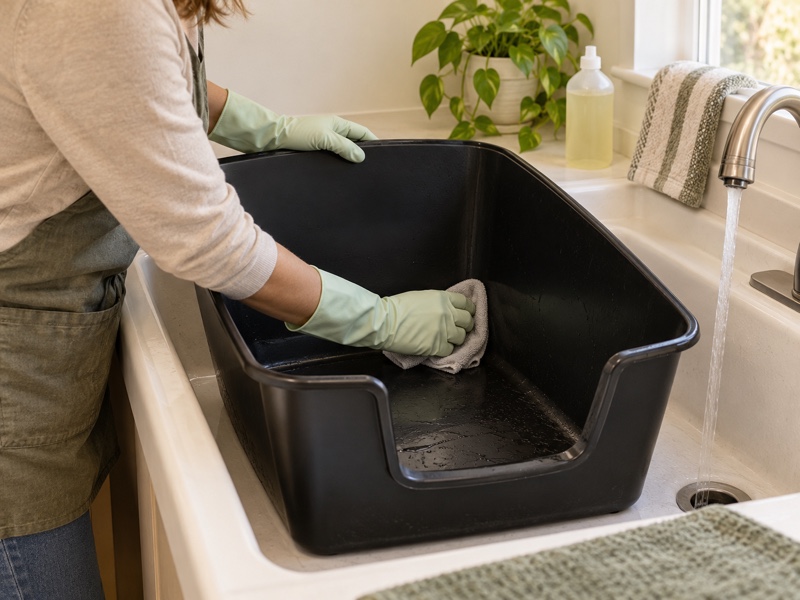
AI-created illustrative scene; this generic pan is not the IRIS USA model 588433 or a containment test.
The best litter box for cats that pee high is the one whose walls, entrance and joints contain your cat’s actual urine path while leaving enough room to move comfortably. Start by finding where liquid escapes. A taller rear wall may help when urine passes over the back, but it will not fix a low doorway facing the stream or an unsealed joint below it. A new or changing elimination pattern also needs veterinary attention.
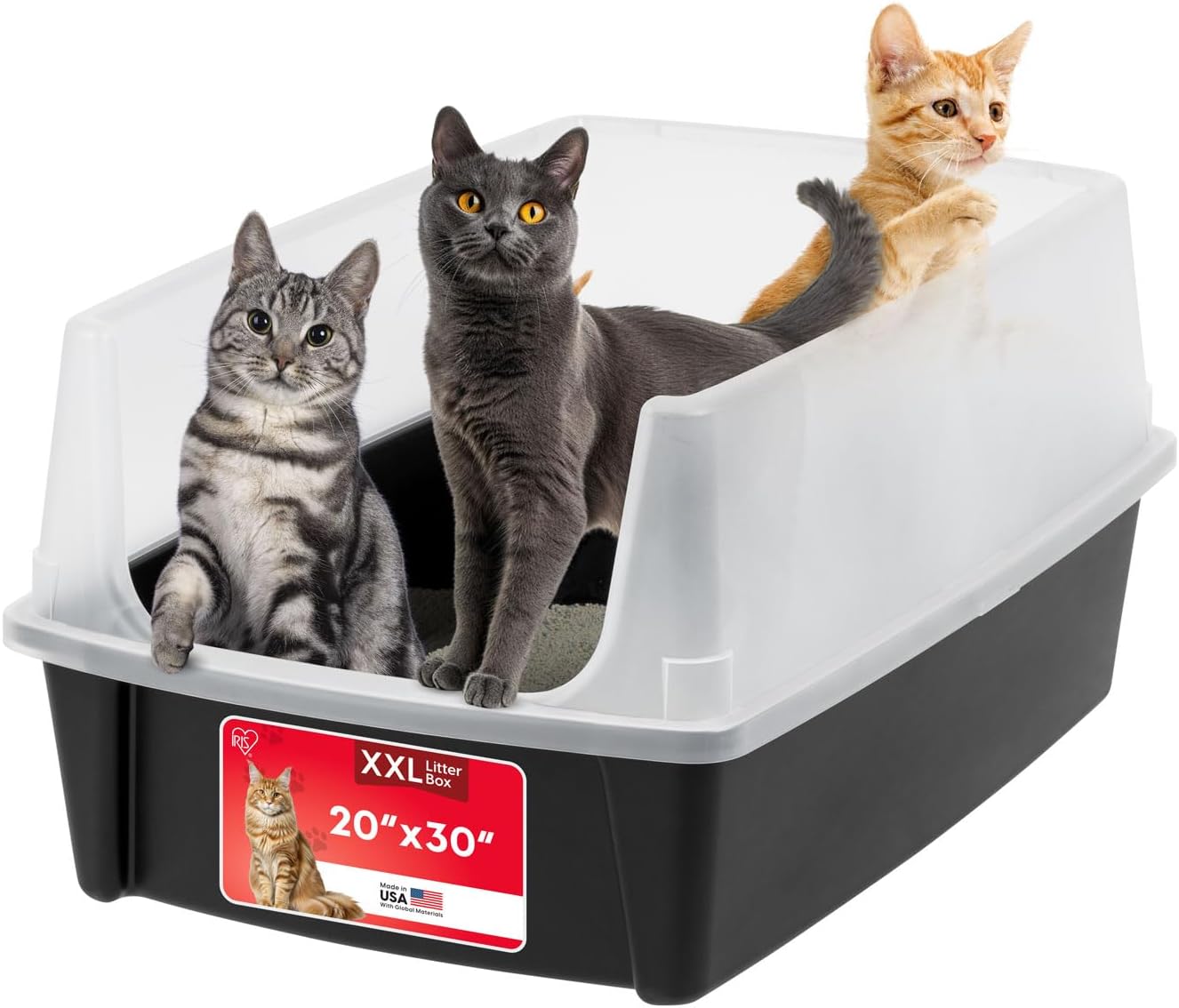
One option is the IRIS USA XX-Large High Sided Cat Litter Box, Black, model 588433, ASIN B0CVZRYCPW. Its published overall dimensions are 30 × 20 × 14 inches, with a 6.5-inch curved entrance. Those measurements provide a starting point for a fit check. They do not establish that every high-standing cat will keep urine inside, or that every older cat can negotiate the entrance.
Quick decision: consider this open-top XXL pan when the cat needs a broad box and taller sides, and can comfortably use its doorway. Choose a different configuration if the main escape point is below the proposed wall, the entrance remains too difficult or the cat cannot turn inside. Preserve a familiar box during the trial, and keep a record of the escape location rather than guessing from the puddle’s final position.
Find where urine leaves the current box
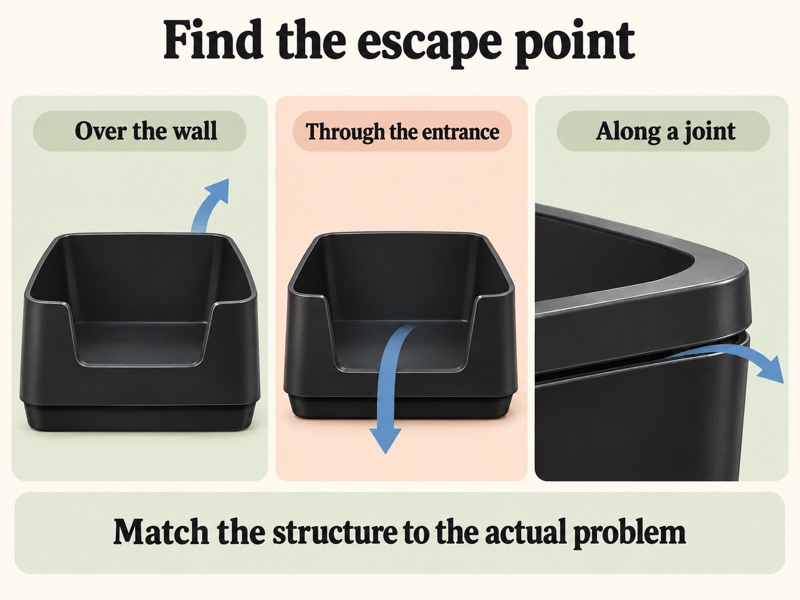
Inspect the box and floor after an ordinary visit without crowding the cat. Liquid on the floor can travel from a rim, doorway or joint before forming a puddle, so the final wet patch may not identify the exit point. Dry the outside and nearby floor during cleanup, then observe which surface becomes wet first on the next visit. Do not postpone veterinary care to complete this exercise.
Check the rear wall, side walls, entrance and any connection between a base and a shield. A detachable upper section can add height while leaving a joint that needs inspection. The selected IRIS retailer image shows a black base and a lighter upper shield; treat the connection as a point to examine on the delivered product. The published height alone is not a liquid-tightness test.
| Observed escape point | Useful structural check | What taller sides cannot establish |
|---|---|---|
| Over the rear or side wall | Compare the actual stream height with wall height above the litter surface | Whether the cat will change position or reach another opening |
| Through the front entrance | Check the doorway’s location, width and remaining lip | Containment when the cat faces or backs toward that opening |
| Along a shield connection | Inspect how upper and lower parts overlap and whether they seat fully | A seal merely because parts clip together |
| Under the base | Inspect for a crack, wet underside or liquid that ran down the outside | The cause without cleaning and examining the pan |
| Beside the box without visible contact | Observe access, posture, location and health changes | That the box dimensions are the only problem |
A standing posture, wall-directed marking and an accident outside the box can require different responses. Describe what you see rather than diagnosing behavior from a single visit. A veterinary history may include location, frequency, amount and changes in the cat’s routine. Higher walls may help physical containment; the cause of a changed elimination pattern still needs a separate assessment.
What makes the best litter box for cats that pee high?
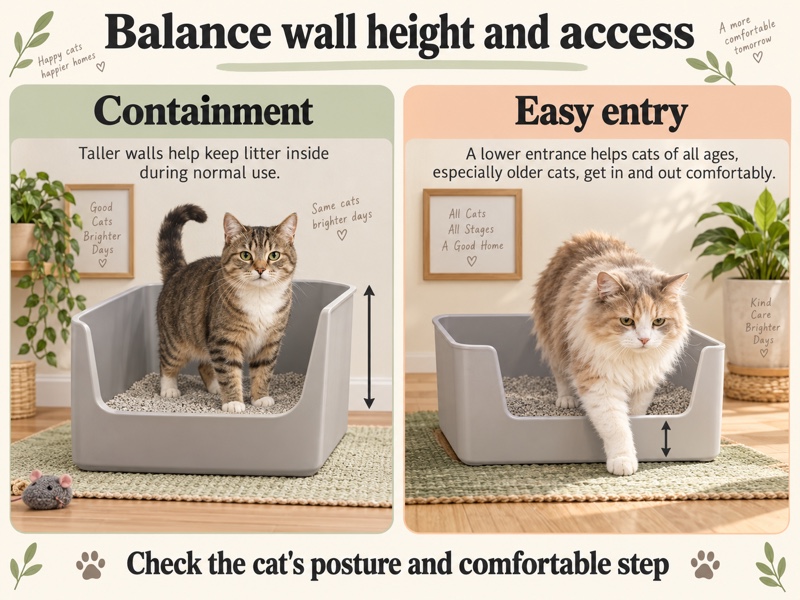
Look for sufficient height where the urine actually reaches the wall, an entrance the cat can use and a floor that allows normal positioning. None of these dimensions works alone. A tall narrow box can constrain the cat’s posture, while a broad low pan can offer room but limited containment. A cover can also change the available headroom and cleaning access.
Measure from the litter surface as well as the floor
Overall height is measured from the outside base. The effective wall above the litter becomes shorter as litter depth increases. If the cat digs a mound beside the wall, the standing level may rise further. Measure the actual setup and follow the litter’s use instructions rather than overfilling to compensate for a dirty box. Do not reduce litter arbitrarily if that makes the surface unacceptable to the cat.
Leave room for the cat to choose a posture
The AAFP and ISFM house-soiling guidelines use about 1.5 times the cat’s nose-to-tail-base length as a box-sizing reference. Compare that with the usable interior floor, rather than a rim-to-rim exterior measurement. A breed name or “XX-Large” label cannot confirm fit for your particular cat. Watch whether it turns, stands and leaves without perching awkwardly on an edge.
For a cat with mobility limits, evaluate the doorway as seriously as the tall wall. A 6.5-inch opening is lower than a 14-inch side, but it still requires a step. The best litter box for cats that pee high must remain usable by the cat it is intended to help. A box that contains a splash but discourages entry has not solved the household problem.
IRIS USA 588433: dimensions, design and limits
The current IRIS USA black XXL product page identifies model 588433 and gives the same 30 × 20 × 14-inch overall size and 6.5-inch curved entrance as the selected Amazon listing. The maker describes an open top, smooth interior and high sides intended to reduce litter and urine escaping. These are manufacturer descriptions, not independently verified containment or cleaning results.
The generous outside footprint requires room beyond a 30-by-20-inch rectangle. Leave space for the cat to approach and turn outside, and for a person to scoop and remove parts. Check the narrowest doorway and the route to the cleaning area before ordering. If the pan sits inside furniture, the furniture’s opening can become the real access limit even when the box itself fits.
Confirm the actual package and connection
The official page is titled “XXL Cat Litter Box with Litter Scoop,” while the selected Amazon title emphasizes the black high-sided pan and scatter shield. Confirm the current included components on the exact retailer variant; do not assume that another seller’s bundle supplies the same accessories. Keep the ASIN and model number together when comparing listings, and inspect all parts on arrival.
Seat the shield according to the supplied instructions. Check the full connection for uneven gaps, damaged tabs or a section resting above its intended position. A fitted shield can reduce scatter while still allowing liquid to travel through a joint under some conditions. An independent leak result has not been verified for this exact setup, so a blanket leakproof claim would exceed the evidence.
Who should consider another layout?
A cat that struggles with the entrance may need a lower-front design with containment concentrated at the rear. A cat whose stream consistently exits through the opening may need a different opening position or a larger standing area. A cat that avoids enclosed spaces may prefer an open design, but individual preference still matters. Do not add an improvised tall front barrier that defeats easy entry.
PRODUCT MENTIONED
IRIS USA XXL High-Sided Litter Box, Black, 588433
Amazon · Details on the retailer’s website
Test containment while preserving a familiar option
Offer the new pan with a familiar litter and keep an established box available. That makes it easier to evaluate the structure without simultaneously changing the substrate or all toileting locations. Let the cat enter voluntarily. Avoid holding it inside or rearranging its body to demonstrate that the walls are high enough.
During early use, place suitable washable floor protection beneath the pan where it stays flat and cannot obstruct the doorway. A stable, dry surface is the priority. Check beneath protection during cleaning because trapped moisture can conceal a continuing escape path. Protecting the floor gives you time to assess the setup; it does not turn an unsuitable pan into a successful one.
Keep a practical trial record
- Write down which wall or opening becomes wet first.
- Note the cat’s entry, turning and exit movements.
- Check that the upper section remains correctly seated after cleaning.
- Record whether the cat chooses another box instead.
- Tell the veterinary team about changed frequency, straining, posture or urine amount.
Compare a proposed best litter box for cats that pee high with these observations instead of online ratings. A review from a different cat cannot establish the height of your cat’s stream or its ability to step over an entrance. If leakage continues, use the recorded exit point to decide which dimension or joint needs attention before buying another similar pan.
Clean walls, joints and the floor beneath the pan
High sides add vertical surfaces to inspect and clean. Scoop frequently, remove residue from the inside walls and follow the manufacturer’s cleaning directions for the parts. When the shield is removable, examine the connection during a full clean and reassemble it completely. A visible stain near a joint can be a useful observation to record before cleaning it away.
The house-soiling guidelines recommend avoiding strong chemicals and ammonia-based cleaning products in litter boxes. Use cleaning materials appropriate to the pan and the product label, rinse where directed and let the parts dry. Keep the cat away from cleaning products and wet disassembled parts. Do not combine cleaners or assume a fragrance removes the source of an odor.
A large pan may be awkward to carry when filled. Support the base, remove litter before moving it when practical and choose a cleaning location you can use safely. The maker’s smooth-surface description does not establish scratch resistance or an unlimited service life. Replace a damaged part if a crack, rough edge or distorted connection prevents safe use and reliable cleaning.
Keep medical assessment separate from the wall-height decision
Consult your veterinarian about a new, persistent or changed elimination pattern, even when you can identify a structural escape point. Pain, urinary problems and other health or environmental issues may affect use of the box. The AAFP/ISFM guideline treats assessment of house-soiling as a broader task than choosing a container. A taller pan can be one environmental change within that plan.
Repeated straining with little or no urine requires urgent veterinary attention. Cornell’s Feline Health Center describes urethral obstruction as an emergency. Do not wait for a new box to arrive or continue a trial when the cat may be unable to urinate. A video or notes can assist a consultation, but obtaining them should not delay care.
If you are comparing an open pan with a motorized unit, the Neakasa and Litter-Robot comparison discusses differences in entrance and enclosed space. Automation introduces its own fit and maintenance checks. It does not establish containment for a cat whose urine path reaches an opening or a joint.
Questions about high-standing cats and litter boxes
Is a covered box always better?
A cover adds surfaces above the pan, but its doorway and connection can still allow leakage. It may also change the cat’s available space and preference. Inspect the complete structure, keep it clean and compare the cat’s behavior with a familiar option rather than assuming a lid solves every escape path.
Is the IRIS entrance suitable for senior cats?
The selected model’s entrance is listed at 6.5 inches. That may remain difficult for an individual cat with reduced mobility. Watch the actual step and discuss discomfort with your veterinarian. “Lower than the side wall” describes a relative dimension; it does not establish easy access for every cat.
Can a larger box reduce cleanup by replacing several boxes?
A larger pan offers more standing space, but it does not remove the need for accessible toileting choices and regular cleaning. Consider the household’s locations and relationships between cats. Choosing one XXL box solely to reduce the number of boxes can create an access or competition problem that size alone cannot solve.
Choose the structure after locating the escape point
The best litter box for cats that pee high depends on where urine leaves the current setup, how much space the cat needs and the entrance it can use comfortably. For IRIS USA model 588433, compare the published 14-inch overall wall and 6.5-inch doorway with the actual litter level, posture and connection between parts. Keep a familiar box available, monitor the trial and address health changes promptly. If the escape point remains below a proposed wall or at the opening, change the layout criteria before repeating the same purchase.
When those checks suit your cat, view the IRIS USA black XXL model 588433. Confirm ASIN B0CVZRYCPW, included components, seller and current delivery to your address.
Comments are reviewed before they appear publicly. Please keep questions and feedback relevant to this article.