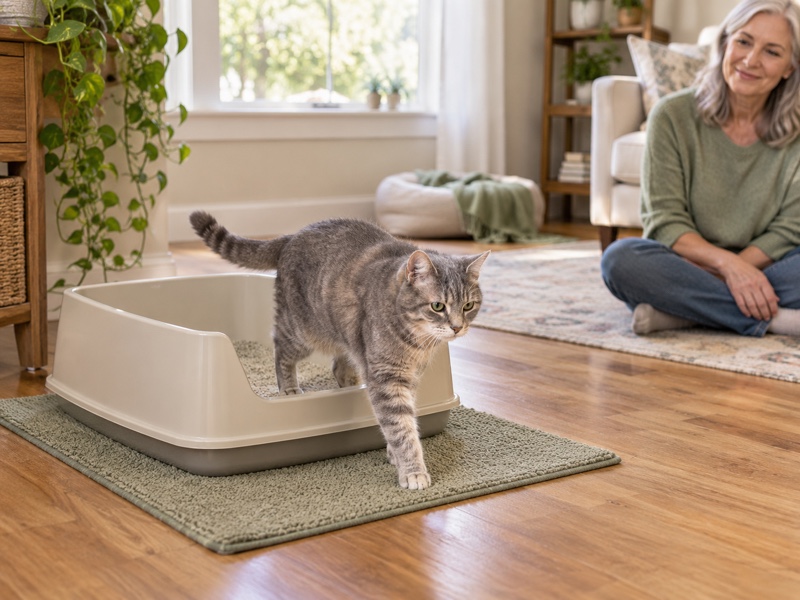
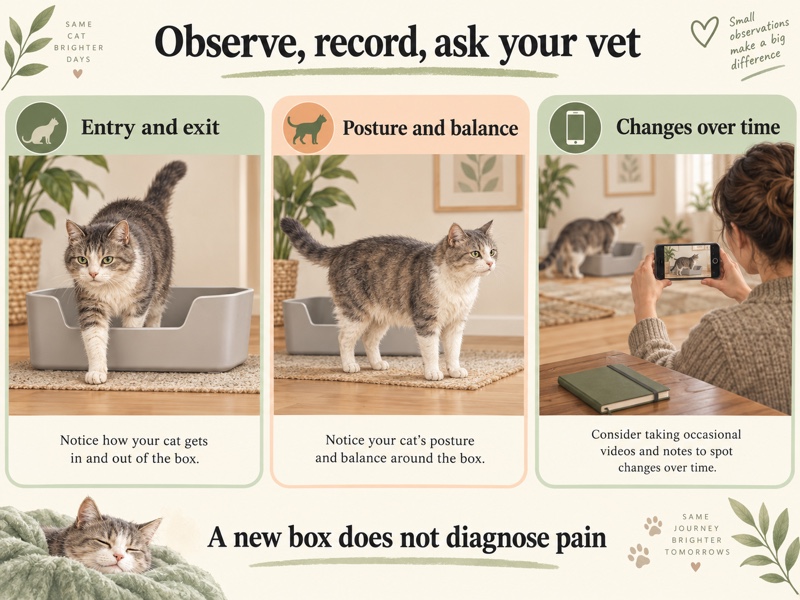
AI-created illustrative scene; the generic pan is not a KittyGoHere product photograph or a mobility test.
A low litter box for senior cats should make the whole toileting routine easier: stepping in, turning, balancing and stepping out. A low doorway helps only if the cat can also reach the box on a clear route and stand comfortably inside. Start by watching where your cat hesitates, then compare the entrance, usable floor and surrounding footing. New house-soiling or difficulty moving also deserves veterinary attention; a different pan cannot identify the cause.
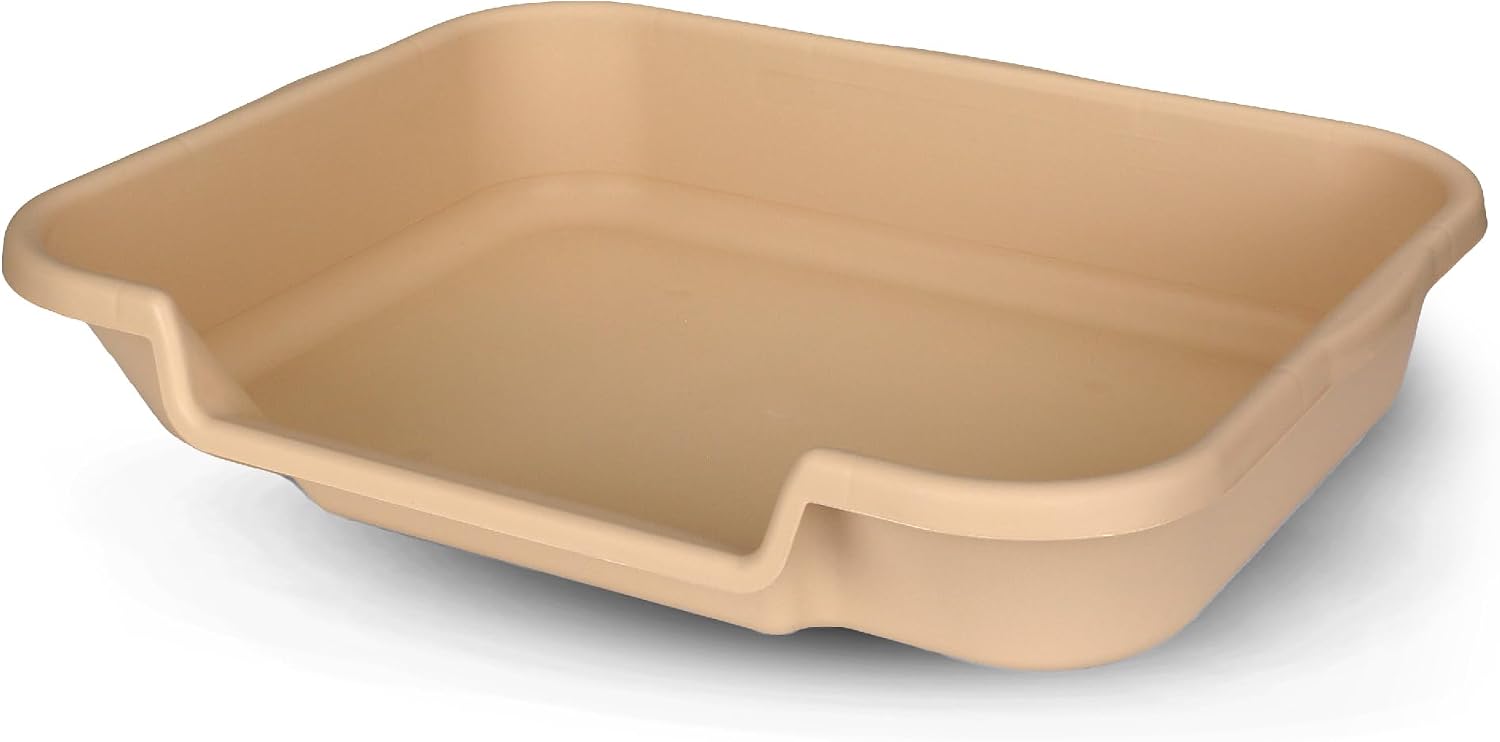
The KittyGoHere Senior Cat Litter Box, Large, Beach Sand is one option for a cat that needs an open pan with a lower front. The selected Amazon product is model 202682, ASIN B074MKWWQ2, sold as one Large pan. Its listing gives an outside size of 23 × 20 × 5 inches and a 3-inch entrance. Those numbers help screen the purchase, but the usable inside floor and your cat’s movement still need checking.
Quick choice: consider this low-front design when a taller threshold is an obstacle and modest wall height suits the cat’s posture. Look for a different configuration if the cat still cannot step over the entrance, needs more turning room or sends urine above the sides. Keep the familiar box available during the transition, and address pain or elimination changes with your veterinarian.
What to measure in a low litter box for senior cats
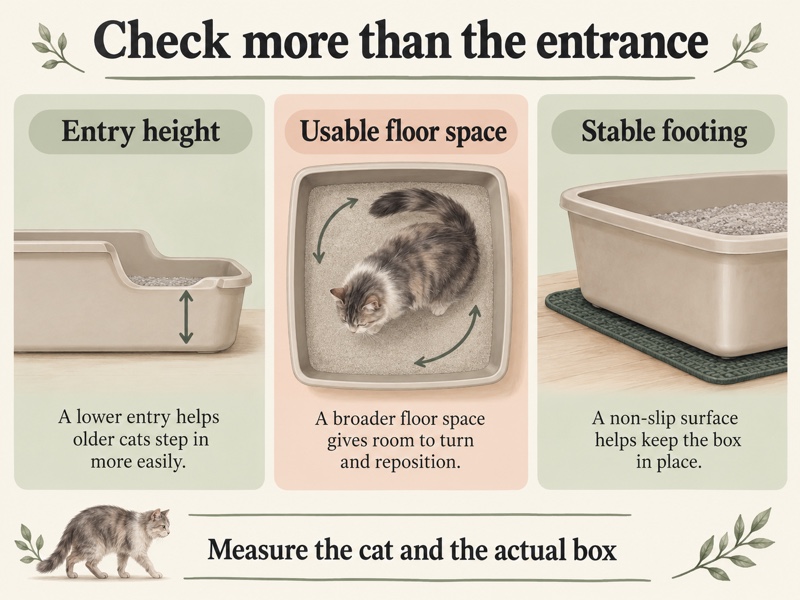
Measure the opening and the inside floor separately. A product’s outside length includes its walls and rim, so a 23-inch listing does not establish 23 inches of standing space. Rounded corners and sloping walls can reduce the flat area further. Before ordering, ask for the interior floor dimensions if the manufacturer does not publish them; after delivery, measure the actual pan before filling it.
The AAFP and ISFM house-soiling guidelines recommend a rectangular box about 1.5 times the cat’s length from nose to base of tail. Use that as a planning reference alongside the cat’s actual turning and posturing. Weight alone is a poor fit test: two cats with the same weight can have different body lengths and mobility. Avoid holding or stretching an uncomfortable cat just to obtain a measurement.
| Check | What to compare | Reason to reconsider |
|---|---|---|
| Entrance | Floor-to-opening height and any raised edge on the approach | The cat catches a paw, jumps or hesitates despite the lower front |
| Standing floor | Actual flat interior, excluding rim and sloping sides | The cat cannot turn or choose a comfortable posture |
| Wall height | The cat’s usual elimination position and where splashes occur | Urine regularly passes over the side or out through the entrance |
| Footing | Pan stability and the mat’s grip, thickness and edge | The pan slides, rocks or requires another difficult step |
| Route | Distance, stairs, doors and other animals along the approach | The cat must climb or pass an intimidating bottleneck |
A lower opening also reduces the height that contains litter at the front. Filling the pan close to that opening can encourage scatter or spillage. Choose the litter depth for the cat and the litter’s instructions, then check the remaining clearance at the doorway. Do not solve scatter by adding a tall barrier across the very entrance the cat needs.
KittyGoHere Large: confirmed features and unresolved fit
The current NE14pets Large Senior Cat Litter Box page describes a 3-inch entrance, an open top, a reinforced bottom and polypropylene construction. Amazon identifies the selected Beach Sand Large pan as model 202682 and lists the 23 × 20 × 5-inch outside dimensions. Small, Jumbo, two-pack and scoop bundles are different purchases from this single pan.
Compare body length with the actual interior
The manufacturer markets the Large for cats up to 20 pounds. Treat that as its broad sizing guidance rather than a promise of comfortable fit for every cat below that weight. Neither the published outside measurements nor the weight description confirms the flat interior area for a particular cat. The practical question is whether your cat can enter, stand, turn and leave without struggling.
Where this design makes sense
An open pan offers a direct approach and lets the caregiver see litter condition without removing a cover. The simple shell also avoids a doorway flap or an enclosed entrance tunnel. Those are useful features when a cat has trouble negotiating a more complicated box. They do not guarantee that a cat will prefer the pan, tolerate its texture or stop having accidents.
Tradeoffs to accept before buying
The shallow front provides less containment than a high-sided box. The open top leaves litter visible, and a vigorous digger may move litter onto the surrounding floor. A cat that stands high while urinating may need a higher back or a different arrangement with an equally accessible entrance. This pan has no motorized cleaning system; daily scooping and regular washing remain the owner’s job.
The listing and maker supply the specifications. The delivered pan’s inside-floor dimensions, traction and acceptance by an individual cat still need checking; those results have not been independently verified. Keep the packaging and review the seller’s return terms before committing a reluctant cat to a new setup.
PRODUCT MENTIONED
KittyGoHere Senior Cat Litter Box, Large Beach Sand
Amazon · Details on the retailer’s website
Put the box on a route the cat can use
Place the new pan on the level where the cat spends time, with a clear approach and enough room to leave freely. A low litter box for senior cats offers little benefit if reaching it still requires stairs or crossing a slippery room. Move loose objects, keep the door accessible and check that another pet cannot trap the cat in a narrow corner.
The 2021 AAFP Feline Senior Care Guidelines include easy-access litter boxes among environmental adjustments for mobility challenges. They also emphasize assessing changes in the cat’s individual routine. Think through the complete journey from resting place to pan, including nighttime access and the distance the cat must walk. A second accessible location may solve a route problem more effectively than replacing a box in a difficult location.
Check the mat as carefully as the pan
Use a flat, stable surface and check whether the pan rocks when its corners are pressed gently. A thin nonslip mat can help prevent movement, but a thick, curled or loose mat introduces its own obstacle. Place its edges flat and leave a broad approach. If the cat avoids the mat’s texture, provide a different stable surface rather than insisting on a litter-catching accessory.
Keep food and water in a separate area and preserve privacy without hiding the box behind a difficult door. A quiet accessible location works better than a laundry area where sudden noise interrupts the cat. There is no single distance that suits every home; watch whether the cat approaches willingly and can withdraw without meeting a dog, child or competing cat.
Introduce a low litter box for senior cats gradually
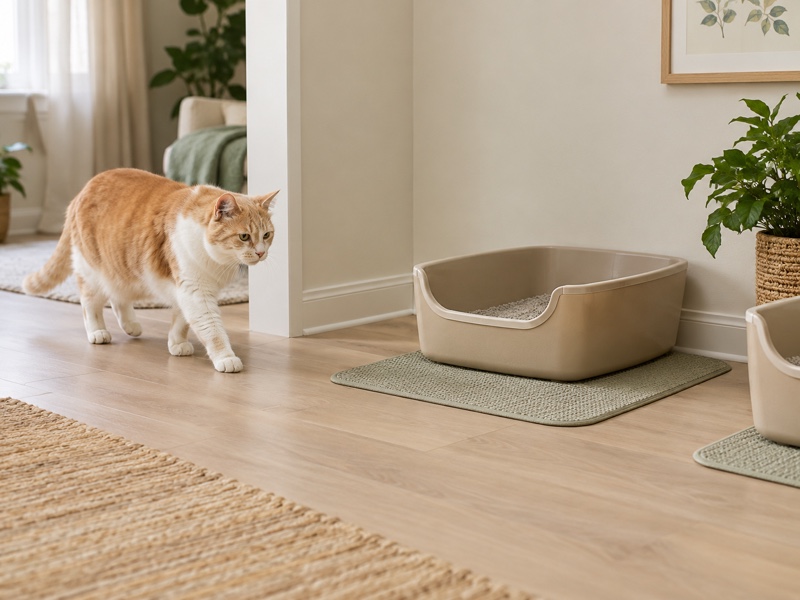
Offer the new pan as another choice while keeping the established litter type and a familiar box available. Changing the box, litter, room and cleaning fragrance at once makes it difficult to identify what the cat accepts. Begin with the accessibility problem you observed. Let the cat investigate voluntarily; placing or holding the cat inside can make the experience harder to interpret.
Observe from a distance. Note whether hesitation occurs at the mat, the doorway, the turn inside or the exit. Those are different problems. A cat that enters easily but perches on the rim may need more floor space or different footing. A cat that never approaches may be reacting to location, smell, another animal or discomfort. Record the pattern instead of repeatedly moving the box around the house.
Use a short observation log
- Record which box the cat chooses and whether the route is clear.
- Note entry and exit movements, including pauses, slips or a sudden jump.
- Describe whether the cat can turn and hold its usual posture.
- Record any change in urine, stool, appetite or general activity for the veterinarian.
- Keep notes factual; an accident beside a pan does not prove stubbornness or a particular disease.
Compare a low litter box for senior cats by these observations rather than the speed of a successful first visit. One use does not establish a lasting preference, and one missed visit does not identify the cause. Continue necessary veterinary care while evaluating the environment. If the cat is weak or cannot safely use any raised entrance, ask the veterinary team for an individualized arrangement.
Clean the pan and protect the accessible entrance
Scoop regularly and wash the pan using the maker’s instructions. NE14pets describes cleaning its polypropylene shell with soap and water. Rinse away residues and dry it before refilling. Avoid adding a strong fragrance to disguise a dirty box; the cat still needs a clean usable surface. Inspect the rim, entry edge and base for rough damage or deep scratches that make cleaning difficult.
When lifting a filled pan, support its base and avoid twisting it by a single corner. The manufacturer’s reinforced-bottom description does not remove the need to handle the weight carefully. If carrying the full box strains your hands or back, remove litter first and divide the task. Accessibility has to work for the person cleaning the pan as well as the cat using it.
Protecting the floor should not block access. Place washable protection beneath or behind the pan where it stays flat and cannot fall into the entrance. Check under the mat for moisture and let surfaces dry. Persistent leakage over a wall calls for a different containment plan; stacking towels or raising the front lip may recreate the barrier you were trying to remove.
When a new box is only part of the answer
New house-soiling, altered posture or reduced mobility warrants a veterinary discussion. The senior-care guidelines explain that pain and other health changes can affect ordinary routines. A caregiver’s video of the cat walking toward the box may help the consultation, provided filming does not disturb the cat or delay care. Describe what changed and when, rather than deciding that age alone explains it.
If a cat repeatedly strains and passes little or no urine, seek urgent veterinary care. Cornell’s Feline Health Center identifies urethral obstruction as an emergency. Do not wait to test a new box, change the litter or see whether a different doorway helps. For nonurgent ongoing difficulties, bring your measurements and observation notes to the appointment. They can support an environmental plan while the veterinary team evaluates the underlying problem.
An automated box with a ramp is a different purchase decision from an open low pan. The Litter-Robot 4 ramp fit and space guide explains the accessory and its layout checks. A ramp still needs secure footing and adequate approach space, and its presence does not establish that an individual cat can use the entrance comfortably.
Questions before choosing a senior-cat litter box
Is a 3-inch entrance low enough?
That depends on the cat’s movement and comfort. The selected KittyGoHere Large lists a 3-inch entrance, but this is a product measurement rather than a clinical threshold. Watch the actual step and ask your veterinarian about a lower or different arrangement if the cat catches a paw or struggles.
Will this pan stop urine from reaching the floor?
Its low opening and 5-inch overall height provide limited containment. A cat that urinates high may still send liquid over the wall or through the entrance. Observe the escape point, protect the floor without adding an obstacle and consider a different structure if the current walls cannot contain it.
Should I replace every box immediately?
Offer an accessible option first and preserve familiar choices while watching the cat’s response. A sudden overhaul can make preferences harder to understand. The useful goal is reliable access to clean boxes in suitable locations, rather than making every box in the home identical on the same day.
Choose by access, space and the cat’s response
The right low litter box for senior cats combines a manageable entrance, room to posture, stable footing and a route the cat can reach. Measure those features before relying on the word “senior” or a weight recommendation. For the KittyGoHere Large Beach Sand, confirm the single-pan variant, model 202682 and ASIN B074MKWWQ2, then check the delivered interior floor and opening. Keep a familiar option available and watch the complete entry-to-exit routine. If pain, weakness or elimination changes are present, pair the environmental adjustment with veterinary assessment.
If those checks suit your cat, view the KittyGoHere Large Beach Sand single pan. Confirm the selected size, seller and delivery for your own address before ordering.
Comments are reviewed before they appear publicly. Please keep questions and feedback relevant to this article.