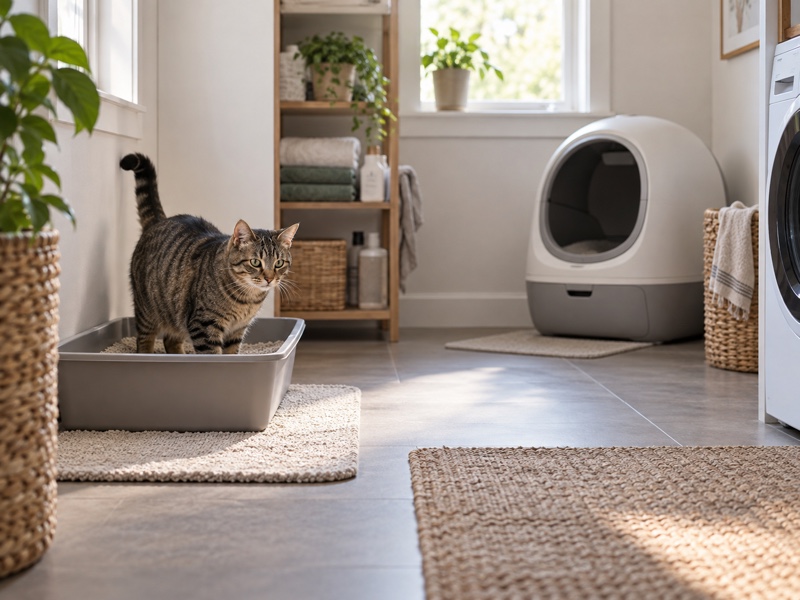
AI-created editorial scene. The generic automated unit is not a Litter-Robot model photo, and the image is not a behavior trial.
If your cat refuses to use Litter-Robot, keep a clean, familiar litter box available while you work out what changed. A new globe, a different litter, the sound of a cleaning cycle, a difficult entrance, another cat guarding the route or a medical problem can all look like “the cat just won’t use it.” Do not remove the working toilet to force a choice.
Start with the cat’s actual toileting, not the device’s app history. Check that urine and stool are being passed normally, then make the new unit quiet and optional while you compare its location, litter and access with the box the cat accepts. A cat that cannot pass urine needs immediate veterinary attention; no acclimation schedule should delay that care.
Check for a health problem before treating refusal as training
A cat that approaches a box repeatedly, strains, cries, passes only drops, shows blood in urine or cannot urinate may be ill. Cats Protection’s urinary-problem guidance says inability to pass urine is an emergency requiring immediate veterinary attention. Pain, arthritis, constipation and other conditions can also change toilet behavior. If the change is sudden, or the cat is urinating or defecating outside its usual box, arrange a veterinary assessment rather than assuming the new machine is the whole explanation.
Record what you can observe without delaying help: where the cat goes, whether anything comes out, the approximate time, and whether eating, drinking or behavior changed. An app visit record is not a diagnosis and may not tell you whether a cat actually passed urine. In a multi-cat home, identify which cat used which toilet before drawing conclusions from a shared box or camera-free activity log.
| What you notice | What it may mean | Low-risk next step | When to get help |
|---|---|---|---|
| Cat uses the old box but will not approach the new globe | Novel object, location or access may be the barrier | Keep the old box clean; leave the robot off and let the cat choose | Ask a veterinarian or qualified feline behavior professional if refusal persists or worsens |
| Cat entered once, then avoids the unit after a cycle | Motion or noise may have startled the cat | Stop automatic cycling during reintroduction; confirm model-specific controls | Seek behavior help if fear spreads to the room or toileting changes |
| Cat strains, vocalizes, produces little urine or has blood in urine | A urinary problem is possible | Contact a veterinarian promptly; do not wait for training to work | If no urine can be passed, seek emergency veterinary care immediately |
| One cat seems to block the entrance or old box | Social access may be part of the problem | Provide clean toilets in separate accessible locations | Discuss persistent intercat tension and house-soiling with a veterinarian |
The feline veterinary house-soiling guidance emphasizes both medical causes and the cat’s physical and social environment. Refusal is useful information about fit or comfort, not evidence of spite or stubbornness. Avoid punishment, trapping a cat in the globe or carrying it there repeatedly.
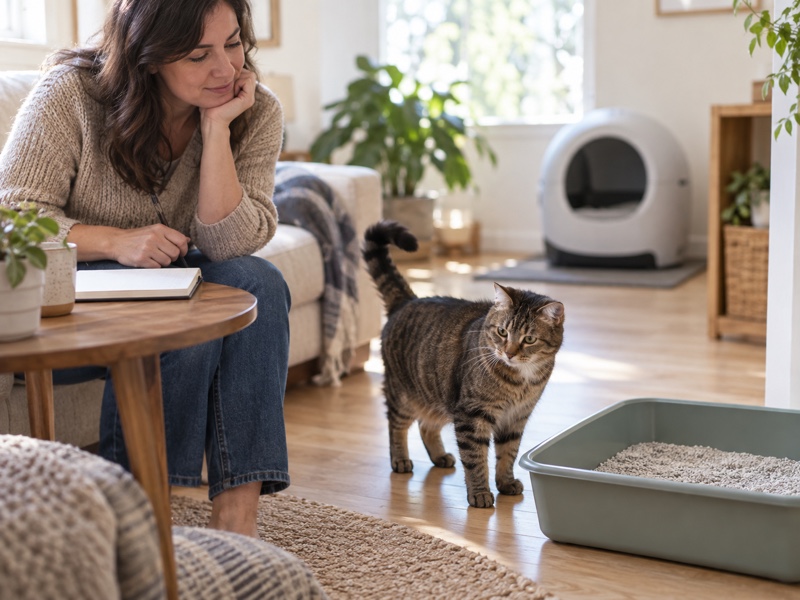
Restore a clean, reliable old litter box
Leave the familiar toilet where the cat can reach it and maintain normal cleaning. The manufacturer suggests keeping both boxes available while the cat adjusts; that is safer than abruptly removing the only accepted option. Do not deliberately make the old box dirty to “persuade” the cat to switch. Cats need a usable toilet now, even if the new one remains untouched for weeks.
Compare the old and new toilets one variable at a time. Is the new unit in a busy room, next to a noisy appliance, behind a door that gets shut, or on a route another pet can block? Is the opening or step awkward for an older cat? Does the litter feel or smell different? Cats Protection’s toileting advice recommends accessible, quiet locations, enough tray space, and attention to litter preference. The automatic unit’s convenience does not cancel those needs.
In a multi-cat household, put toilets in more than one location rather than making every cat pass through one bottleneck. A useful starting point is one tray per cat plus an extra, adjusted to the household and each cat’s actual access. Watch for subtle blocking: a cat sitting in the doorway, ambushing another on exit, or claiming the corridor can make a technically available toilet unusable.
Leave the Litter-Robot off while the cat explores
Whisker’s acclimation guide recommends leaving Litter-Robot turned off at first, placing it near the old box and keeping the usual litter when compatible with the model. Treat that as a gradual introduction, not a deadline. An inactive unit can be examined without an unexpected rotation. Follow the instructions for your exact Litter-Robot model when changing modes; controls and automatic-mode weight limits differ between versions.
Let the cat approach voluntarily. You can reward calm investigation nearby, but do not put food inside the litter globe or make the cat step into it for a treat if that creates pressure. If a fence, shield or step seems to obstruct the entrance, check the model’s instructions before removing or adjusting it. An accessory may help one cat and make another more wary; it is not a universal fix or a reason to buy something before checking the basic setup.
Keep litter changes small. If the cat already accepts a litter that the particular robot supports, start there rather than switching substrate and box at once. If the current litter is incompatible, check the manufacturer’s guidance for the model and make any change gradually while keeping a working alternative. The brand suggests adding a little used litter for a familiar scent; if you try that, avoid contaminating clean supplies, and remember that scent alone cannot fix pain, poor access or fear of cycling.
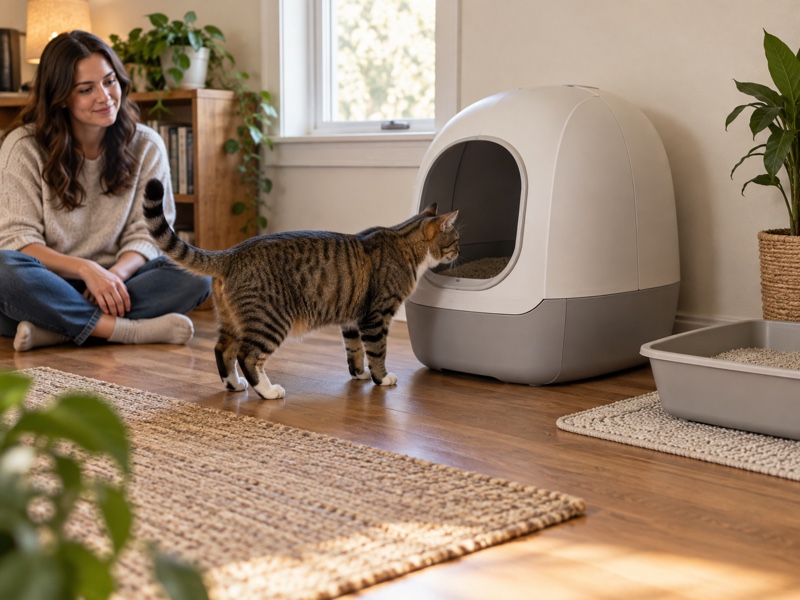
Reintroduce a cleaning cycle only after voluntary use
Wait until the cat has entered and toileted in the stationary unit by choice before testing automation. Then arrange for a supervised cycle when the cat is safely outside, with room to retreat and the old toilet still available. Whisker’s guide recommends letting the cat observe a cycle from a distance. Stop if the motion or sound provokes a strong fear response rather than repeating the event to “get it over with.”
The cycle delay, sensors, controls and automatic-mode eligibility depend on the exact version. Check its manual, the cat’s weight and any manufacturer safety limits before enabling automatic mode. Do not copy an online button sequence for Litter-Robot 4 onto an older or newer model. A longer delay may reduce surprise for some cats, but it is not proof that a frightened cat will accept the mechanism.
After each change, look for the behavior that matters: normal toileting in a comfortable location. A single curious visit, an app notification, or a successful manual cycle is not enough to retire the old box. Keep notes for a few days about where each cat actually urinates and defecates, while keeping all available toilets clean. If the cat chooses the old box, that is still a successful welfare outcome while you investigate the new setup.
Look beyond the machine if the cat still refuses
Some cats dislike an enclosed or elevated toilet even when it is silent. Others have a history of being startled in a particular room, struggle with a step, or need a wider, lower opening. Compare the cat’s ordinary posture and turning space in a familiar tray with what the globe permits. Do not assume the manufacturer’s general acclimation claim predicts this cat’s response. If mobility is in question, ask a veterinarian about pain before treating it as a training issue.
Also check whether the device itself is operating normally. A dirty globe, unusual odor, unexpected movement, unstable placement, alarm or fault signal can change the experience. Clean and troubleshoot according to the manual with the cat away from moving parts. If the machine is cycling unexpectedly or has an unresolved fault, leave it off until the issue is resolved; do not use the cat as a test of the repair.
When a cat refuses to use Litter-Robot despite a quiet setup and a clean familiar alternative, the next step may be to keep using a conventional box. A second expensive machine is not an evidence-based answer to a cat’s reluctance. Ask your veterinarian to rule out medical factors and, if needed, refer you to someone experienced with feline behavior and environmental problems. A stable toilet the cat accepts is more valuable than forcing a particular device into the routine.
Questions when a cat refuses to use Litter-Robot
Should I remove the old litter box?
No. Keep a clean accepted box available during the transition. Removing it can leave the cat without a comfortable place to eliminate and can make it harder to tell whether the new unit or a medical change is the issue.
How many days should the transition take?
There is no reliable deadline for an individual cat. The manufacturer’s guide says timing varies; assess the cat’s voluntary use and normal toileting rather than expecting a fixed number of days. Stop or seek help sooner when elimination changes or fear increases.
Will a ramp or attractant solve refusal?
Either might address a narrow problem for a particular cat, but neither resolves pain, a blocked route, a disliked litter or fear of rotation by itself. Identify the barrier first. If an accessory is considered, confirm its compatibility with the exact model. An accessory may be unnecessary if the barrier can be resolved with the existing setup.
When is refusal urgent?
Inability to pass urine is an emergency. Straining, pain, blood or passing very little urine also calls for prompt veterinary advice. Do not wait for a new litter-box routine to make those signs disappear.
Keep the cat’s working toilet at the center of the plan
If a cat refuses to use Litter-Robot, protect normal toileting first: keep the old box clean, check for medical warning signs, and introduce the powered unit slowly with the cat free to choose. Change one environmental factor at a time and observe what the cat actually does. If the robot never becomes an accepted toilet, a suitable conventional box remains a valid solution.
Comments are reviewed before they appear publicly. Please keep questions and feedback relevant to this article.