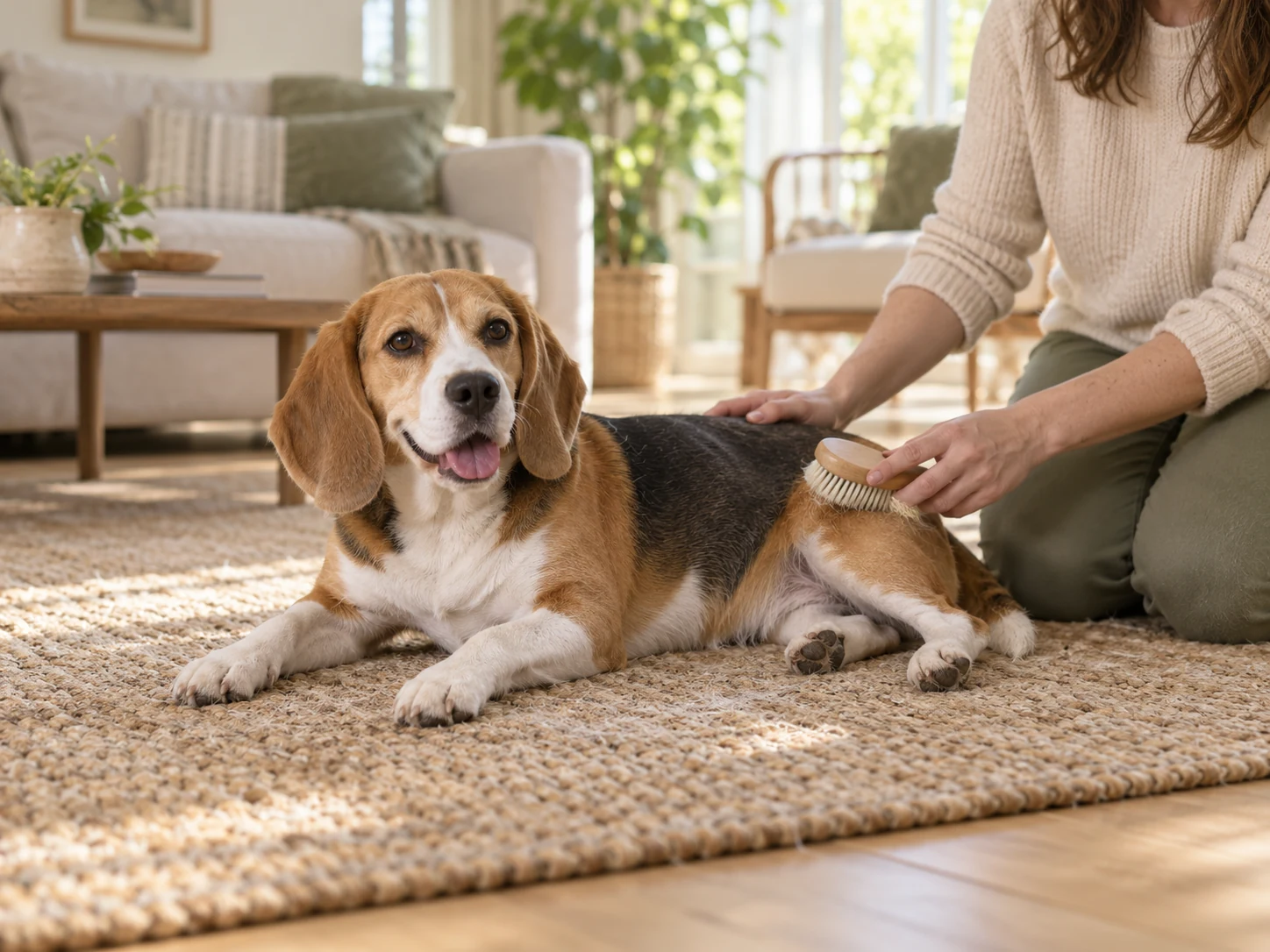
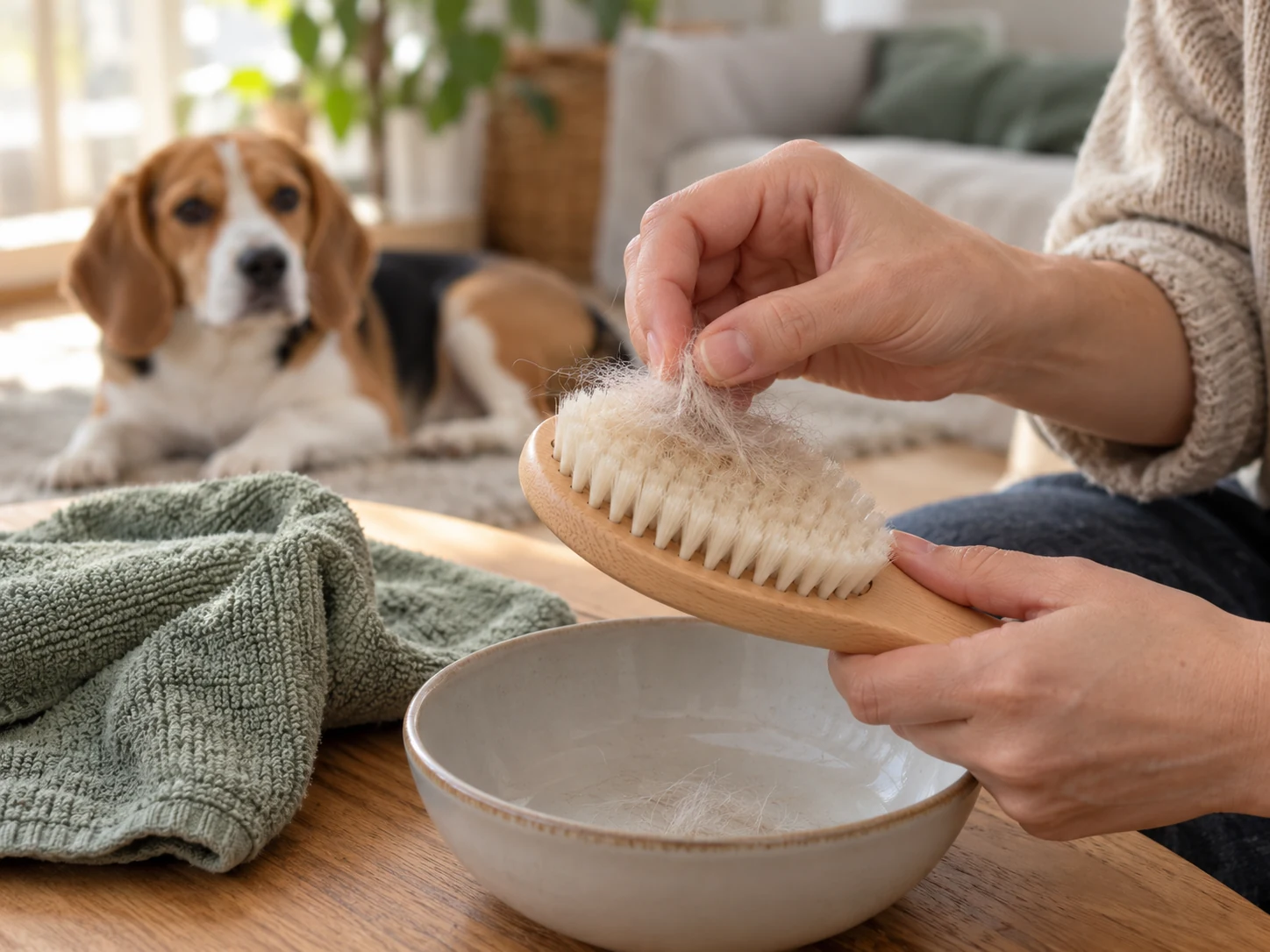
AI-created editorial scene for a dog brush for short hair guide; light contact and the individual coat still need assessment.
A good dog brush for short hair should make light contact with the coat without scraping the skin. For a smooth, close coat, start with a soft bristle surface or a gently used rubber grooming tool; choose by the dog’s coat texture and response, rather than the amount of hair a tool promises to remove.
Short hair is not a single coat type. A fine, close coat feels different from a short coat with a dense underlayer, and both can need a different approach from a wiry coat. Before buying a brush, separate three questions: what you need to remove, how much coat lies between the tool and the skin, and whether your dog stays comfortable during a brief session.
Match a dog brush for short hair to the coat
Run your hand gently with the direction of hair growth and look at the coat in good light. A smooth outer surface does not tell you everything underneath it. Check the chest, back, sides, and other accessible areas separately; the same dog may have thinner coverage in some places.
Wahl’s brushing guide suggests bristle brushes or a suitable two-in-one comb for smooth short coats and distinguishes those from tools for denser or longer coats. That is a useful category distinction, rather than a reason to use every side of a dual brush over every part of the dog.
If your goal is to lift loose surface hair and tidy the coat, begin with a less aggressive contact surface. If you are trying to work out compacted coat or cannot identify what is catching the tool, get a groomer’s advice before moving to sharper or longer teeth. Increasing pressure is not a substitute for choosing a suitable tool.
| What you find | A sensible starting point | Check before continuing |
|---|---|---|
| Fine, close, smooth coat | Soft bristles with light strokes | The brush should glide without scraping or repeated passes |
| Loose surface hair on a comfortable dog | A suitable soft brush or gentle rubber tool | Check skin contact and the dog’s response, not just collected hair |
| Short coat that feels dense underneath | Identify the coat layers and ask which tool fits them | Do not assume “short hair” makes every deshedding edge suitable |
| A snag, knot, or compact patch | Pause and inspect without pulling | Seek help if the coat cannot be worked through comfortably |
| Redness, sore areas, or unusual hair loss | Stop the grooming trial | Ask a veterinarian rather than treating it as a brush-selection issue |
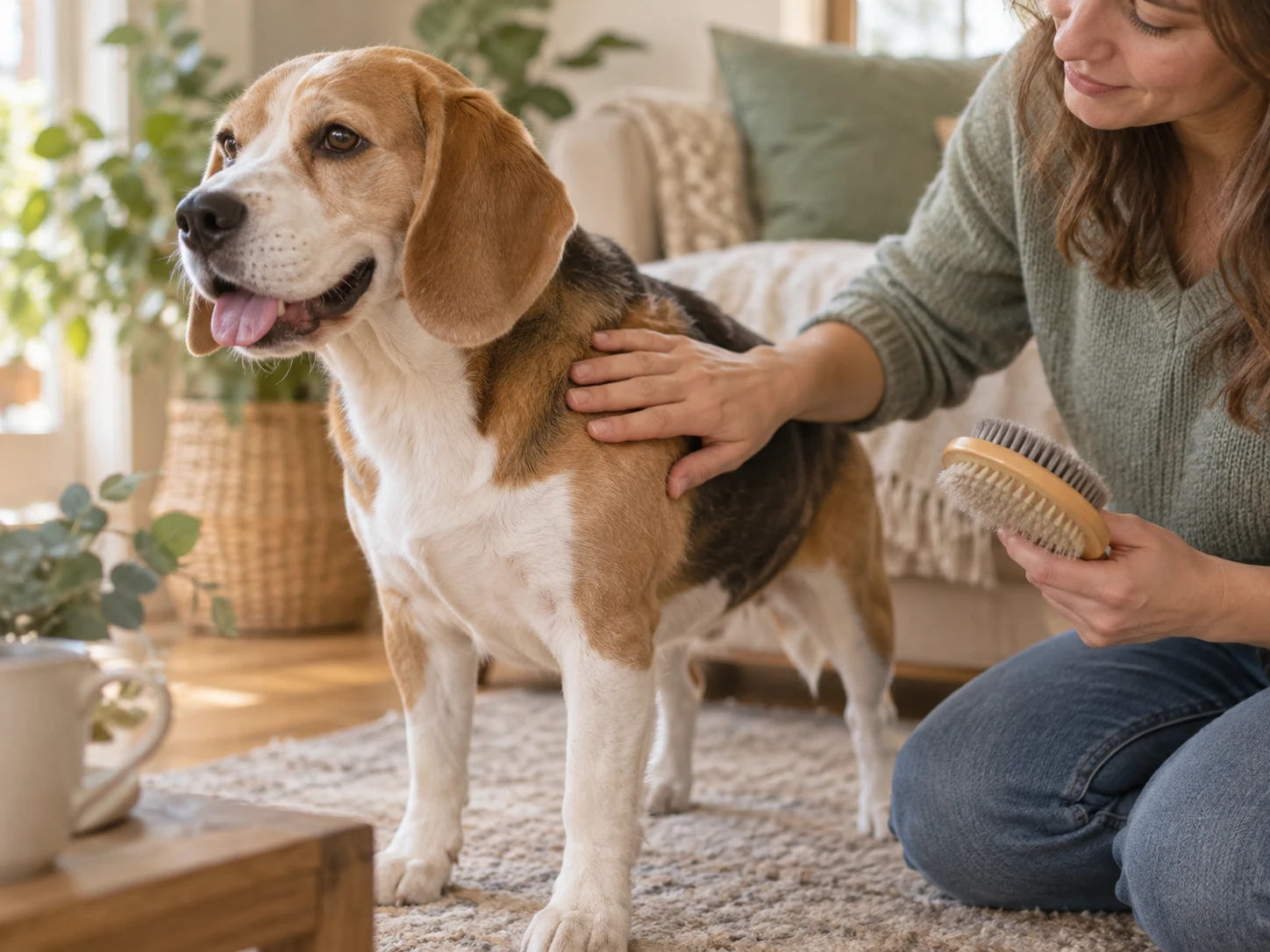
Dog brush for short hair: bristles, rubber, or pins?
Choose the contact surface for the coat task, not a universal “best brush” label. You may only need one suitable brush. A second surface is useful when it has a distinct job that your dog’s coat actually needs.
Soft bristles for a light finishing pass
Bristles are worth considering for a smooth topcoat when you want to collect surface debris and brush with the hair’s direction. Look for a comfortable handle and a head size that you can place accurately. A large head may cover the back quickly, but a smaller usable area can be easier to control on a narrow chest or around a change in body shape.
Soft does not mean unlimited brushing. Keep the stroke light, move to the next area, and check the skin. If you repeatedly work the same patch because it still releases some hair, you can turn a simple grooming session into an irritating one. The aim is a comfortable routine, not an empty coat.
Rubber grooming tools for gentle surface contact
A flexible rubber grooming tool is another category to assess for short coats. Compare the texture and spacing of its contact points, how easily you can control it, and the cleaning instructions. Do not assume every rubber tool is equally gentle: firmness, shape, pressure, and how you use it all matter.
If you already own one that your dog tolerates and that suits the coat, there may be no need to purchase another tool. Try the existing appropriate option lightly before adding equipment solely because a package promises more hair removal.
Pin surfaces require a separate suitability check
A dual brush may put metal pins on one side and bristles on the other. The pin side is not automatically the next step after the bristle side. On a very thin, close coat, there may be little hair between the pins and the skin. Use only an appropriate surface and the maker’s directions, and do not make a tool’s extra feature into a compulsory part of the session.
A slicker is a different category again, with its own wire arrangement and coat uses. Choose contact surfaces that suit the short coat; slicker technique and long-coat detangling are different tasks.
Assess the FURminator for short-coat brushing
The FURminator Dual Grooming Brush for Cats and Dogs, model T691663 and ASIN B07PRYWTD1, combines metal bristles with a separate soft boar’s-hair bristle surface. It is a topcoat-care brush, not the brand’s undercoat deshedding tool.
The manufacturer’s product page and directions describe the metal side for loose topcoat hair, tangles, and debris, and the soft boar’s-hair side for finishing the coat. When assessing this dog brush for short hair, start with the bristle surface for a fine, close coat. The fact that the other side exists does not establish that it is needed or appropriate on your dog.
FURminator describes a nonslip ergonomic handle and broad use across dogs and cats. Those are product descriptions, not proof that every animal will accept the brush. The more useful instruction on the same page is to work gently with hair growth and avoid excessive strokes in one area because irritation can result.
| Feature | Why it may help | Practical limitation |
|---|---|---|
| Soft boar’s-hair bristle side | A separate surface for topcoat finishing | Still needs light pressure and skin checks |
| Metal bristle side | A second surface for suitable coat tasks | Not a requirement for thin, close coats |
| Two surfaces on one handle | Convenient if both have a genuine use | Extra surfaces add little value when only one suits the dog |
| Identifiable model | T691663 / B07PRYWTD1 can be checked against the package | Do not confuse it with an undercoat blade or a different FURminator brush |
Who should consider or skip this dual brush?
Consider it if you want a conventional finishing brush and can use the bristle surface accurately. Skip it if your current appropriate brush already does that job, you want a rubber-only contact surface, or your dog has a skin concern that needs assessment before brushing. Comparative shedding, comfort and durability results have not been independently verified for this model.
View the FURminator T691663 Dual Grooming Brush on Amazon.
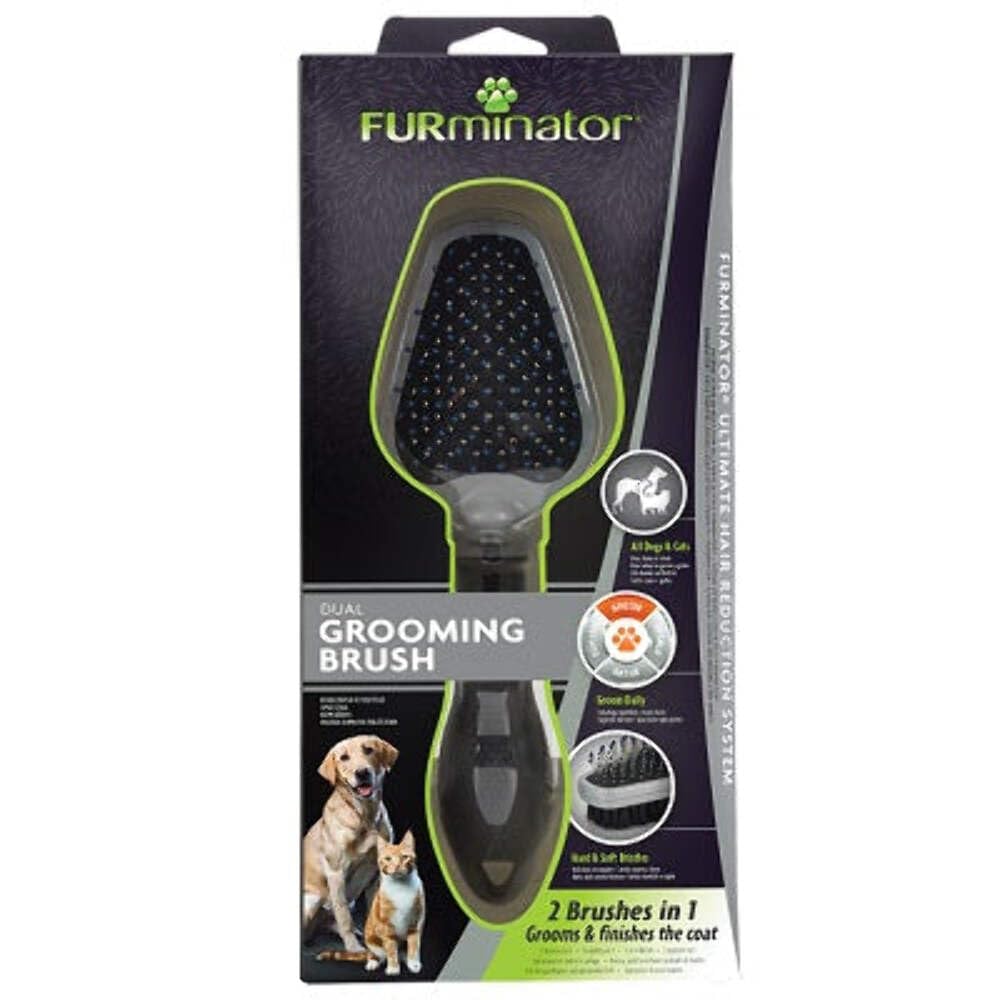
PRODUCT MENTIONED
FURminator Dual Grooming Brush for Cats and Dogs
Amazon · Details on the retailer’s website
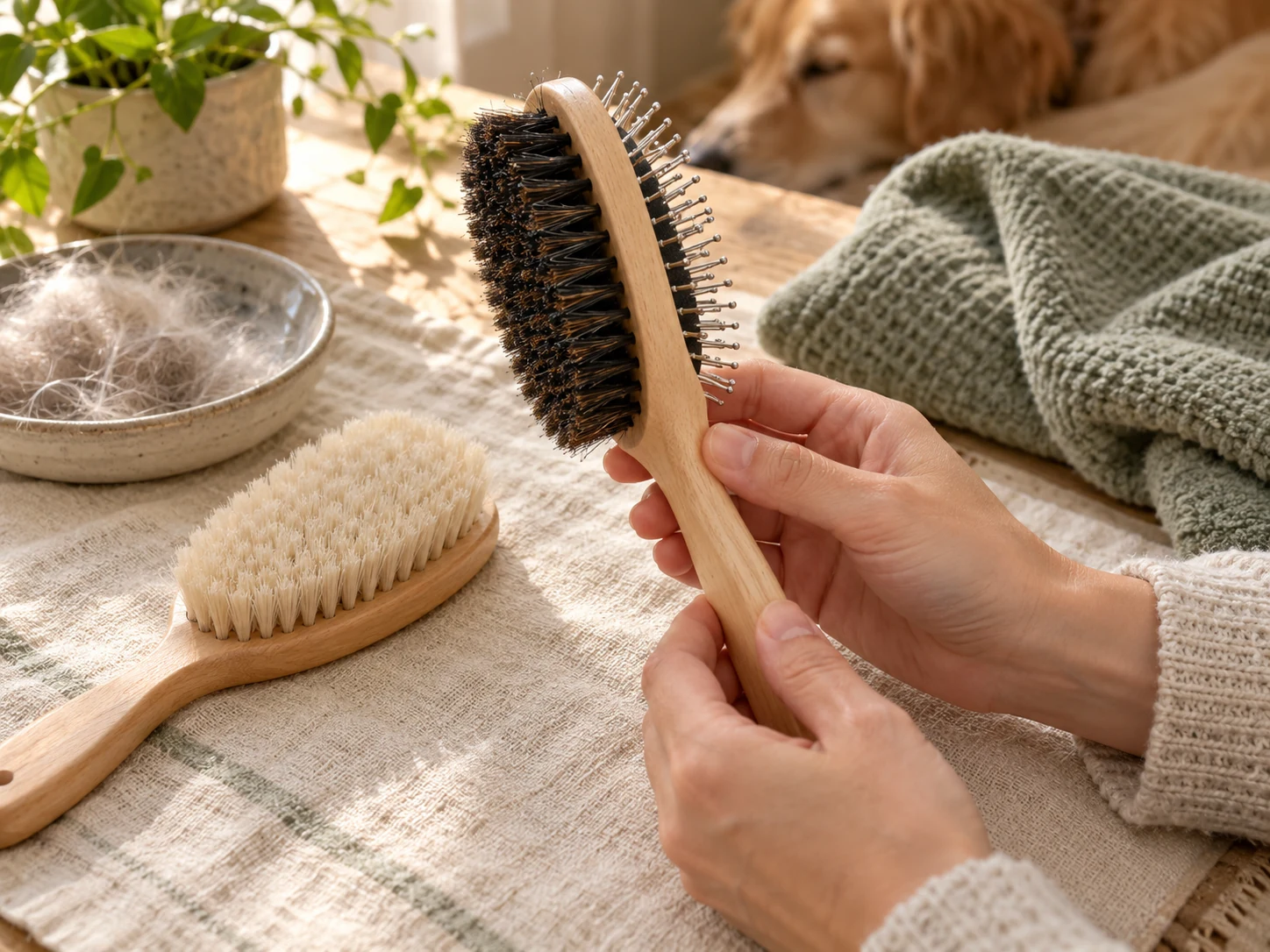
Use a brief comfort check before a full brushing session
Test a dog brush for short hair on a small, easy-to-reach area before brushing the whole dog. A successful trial tells you whether the tool and your handling make sense together; a large pile of hair does not answer that question.
- Inspect first. Check the skin and coat in the area you plan to brush. Avoid irritated, injured, or painful patches.
- Let the dog investigate. Introduce the brush without immediately placing it on the body. Choose a calm setting and allow the dog room to reposition.
- Start with the gentler suitable surface. Use light strokes in the direction of hair growth. Keep extra care around thinly covered or sensitive areas.
- Pause and look. Check for redness, pulling, flinching, repeated turning toward the brush, or attempts to move away. These are reasons to reduce or stop the interaction.
- Move on rather than repeat. If the area is comfortable and tidy, continue elsewhere briefly. Do not keep working one spot to chase every loose hair.
FURminator’s directions specifically warn against excessive strokes in a single area. Follow that caution rather than treating a listing’s suggested session length as a target to reach. A dog that is comfortable for a short pass has not consented to several more minutes of the same pressure.
Set the schedule by coat condition and tolerance
Choose a routine you can keep comfortable, then adjust it as the coat changes. Seasonal shedding, indoor conditions, and individual coat differences can change what you notice. The ASPCA’s grooming guidance explains that shedding varies with factors including health, breed type, and season; more loose hair does not by itself tell you to use a harsher brush.
Use the first few sessions to learn how quickly the tool gathers hair, how easily it cleans out, and whether the dog stays relaxed. If you are seeing a sudden change in shedding, bald areas, persistent scratching, or sore skin, get veterinary advice. A new brush cannot identify the cause.
Consider the household routine as well. Brushing in a location that is easy to clean can be useful, but do not select a tool solely for furniture cleanup. The part touching your dog still needs to suit the coat. Collect the loose hair after a short session rather than extending the session to make the room perfectly hair-free.
If you are comparing a dog brush for short hair with a vacuum-assisted grooming setup, assess hair collection separately from coat contact. The Neakasa P2 Pro grooming-vacuum guide explains that option. A vacuum feature does not establish that an attachment suits a thin coat or that the dog is comfortable with its sound.
Clean and inspect the brush between uses
Remove trapped hair and follow the specific brush’s cleaning instructions. Check for bent, loose, rough, or damaged contact points before the next session. A brush that was suitable when new may need replacing if its working surface changes.
Do not assume that a mixed-material brush can be soaked, heated, or cleaned with any household chemical. The handle, bristle attachment, and metal components may have different care requirements. If the instructions are unclear, ask the manufacturer before using a cleaning method that could damage the tool or leave residue.
When sharing equipment between pets, inspect each pet’s coat and skin rather than assuming the brush that works for one will suit another. If a pet has a suspected skin condition, ask your veterinarian about tool hygiene and shared use. The convenience of one handle should not override the needs of a particular animal.
Frequently asked questions
Does every short-haired dog need a deshedding tool?
No. Begin with the coat and the job, rather than the product category. A suitable soft brush may be enough for surface hair and routine tidying. A dense undercoat is a different situation from a very fine close coat. Ask a groomer if you cannot identify which layer needs attention.
Should I use both sides of a dual grooming brush?
Only if both surfaces are appropriate for the coat task. The FURminator Dual Grooming Brush has separate metal and soft boar’s-hair sides. For a fine short coat, assess the softer finishing surface first; the second side is an option with its own use conditions, not a mandatory step.
How hard should I press?
Use light contact that moves comfortably with the hair. There is no useful universal pressure number for different brushes and dogs. If the tool drags, the dog reacts, or the skin changes color, stop and reassess. Pressing harder to collect more hair is not a good measure of brushing quality.
Can brushing solve sudden heavy shedding?
It can collect loose hair, but it cannot establish why shedding has changed. Season and coat type matter, and health problems can also affect the skin and coat. Seek veterinary advice for unusual hair loss, persistent itching, redness, or pain instead of escalating the grooming tool.
Choose the gentlest useful tool for the job
The right dog brush for short hair is one that performs a clear coat-care task while staying comfortable in your hands and on your dog. Check whether the coat is fine and close, dense underneath, or changing in a way that needs professional advice. Then choose a contact surface, rather than buying the most aggressive hair-removal claim.
The FURminator T691663 is a defined dual-brush option when its soft bristle surface fits your topcoat-care routine. It is not a universal deshedding answer, and its metal side does not need to be used just because it is included. Keep the first session short, check the skin, and stop at discomfort. If your existing suitable brush already does the job, maintaining that routine may be the better next step.
View FURminator Dual Grooming Brush for Cats and Dogs on Amazon.
Comments are reviewed before they appear publicly. Please keep questions and feedback relevant to this article.