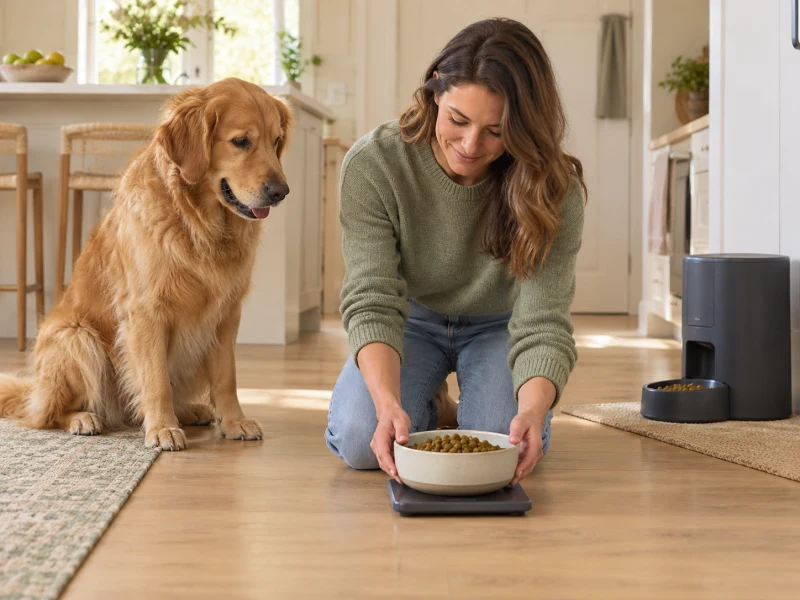
AI-created meal-planning scene with a generic feeder, not PetSafe PFD00-16828 photography or evidence of portion accuracy.
An automatic dog feeder for large dogs needs to fit the dog, the food and the daily routine. A big hopper answers only the storage question. It does not tell you whether a broad muzzle can reach the bowl, whether your kibble moves reliably, or whether a persistent dog can open the lid.
Start with a measured meal and the space your dog needs to eat comfortably. Then look for written confirmation of the intended dog size and food compatibility. If either is unclear, keep the model on a shortlist rather than treating its capacity as a recommendation.
The PetSafe Smart Feed PFD00-16828 illustrates why that distinction matters. Its 24-cup hopper and programmable portions are documented, but PetSafe’s current second-generation support page positions the feeder for cats and small to medium-sized dogs. Obtain further confirmation from PetSafe before choosing this model for a large dog.
What an automatic dog feeder for large dogs must do
A useful feeder should deliver your dog’s existing meal plan, let the dog eat without awkward contact with the housing, and remain manageable to clean. Remote controls are secondary if the bowl is difficult to reach or food stays caught in the dispensing path.
Write down your normal feeding routine before shopping: food type, measured amount per meal, number of meals, who checks the bowl, and who can visit if the mechanism stops. These are requirements to check against a manual. They are not settings to infer from a product’s photographs.
| Check | Evidence to request | Reason to pause |
|---|---|---|
| Dog and bowl fit | Manufacturer’s intended size range, bowl dimensions and clear approach space | Only “large capacity” is stated |
| Food compatibility | Allowed food types and any pellet size or shape limits | Your diet is outside the documented specification |
| Meal delivery | Supported portion range and a practical way to verify actual output | The required meal exceeds a supported setting or dispenses inconsistently |
| Security | Lid closure, stable placement and supervised behavior checks | The dog can open, tip or chew the unit |
| Power and network | Backup behavior for the exact model and current app requirements | Nobody can check a missed meal or error |
| Cleaning | Removable parts and clear wash/dry instructions | Food-contact areas cannot be maintained routinely |
Automatic dog feeder for large dogs: fit worksheet
| Requirement | Your measurement or question | Decision check |
|---|---|---|
| Existing meal plan | Food name: ___; amount per meal and unit: ___; meals / times: ___ | Compare the established plan with the exact model settings; do not invent a new ration. |
| Kibble shape and size | Diet and pellet shape: ___; representative length × width × thickness: ___ mm | Ask the manufacturer for the permitted dimensions and food types. A measurement alone does not establish compatibility. |
| Comfortable reference bowl | Inside width / length: ___; depth: ___; usual placement: ___ | Compare with the usable bowl, outlet position and surrounding housing, not just the machine width. |
| Actual feeder access | Bowl dimensions: ___; outlet-to-bowl clearance: ___; approach space: ___ | Request missing measurements, then observe comfortable supervised access. Similar dimensions are screening evidence, not a fit guarantee. |
| Delivered meal check | Setting and unit: ___; collected output using the normal food: ___; any variation or blockage: ___ | Do not rely on scheduled feeding until delivery is consistent with the existing meal plan. Ask the maker about a mismatch. |
| Caregiver and failure plan | Person and contact: ___; manual meal method: ___; power/network behavior confirmed: ___ | A person can inspect a missed meal, water, appetite and errors; remote status alone is insufficient. |
Leave an unanswered field marked unconfirmed. Ask the manufacturer about your actual food, bowl needs and exact model before ordering. No universal pellet size or outlet clearance can make every automatic dog feeder suitable for every large dog.
Hopper capacity is different from a meal portion
A 24-cup hopper describes the amount of food a container holds under the maker’s stated conditions. It is not a large-dog suitability rating, a calorie allowance or a promise that the machine can dispense any large meal in one setting.
Work from the food and feeding plan already agreed for your dog. If your veterinarian has prescribed a diet or meal schedule, that instruction takes priority over a feeder’s default program. A cup measures volume; the calories and weight in that volume depend on the particular food.
Check whether the controls express portions in cups, grams or proprietary increments. Do not assume one machine’s “portion” equals another’s. Where the display uses volume, compare actual dispensed food with your normal measured meal before relying on it.
Verify delivery with the food you actually use
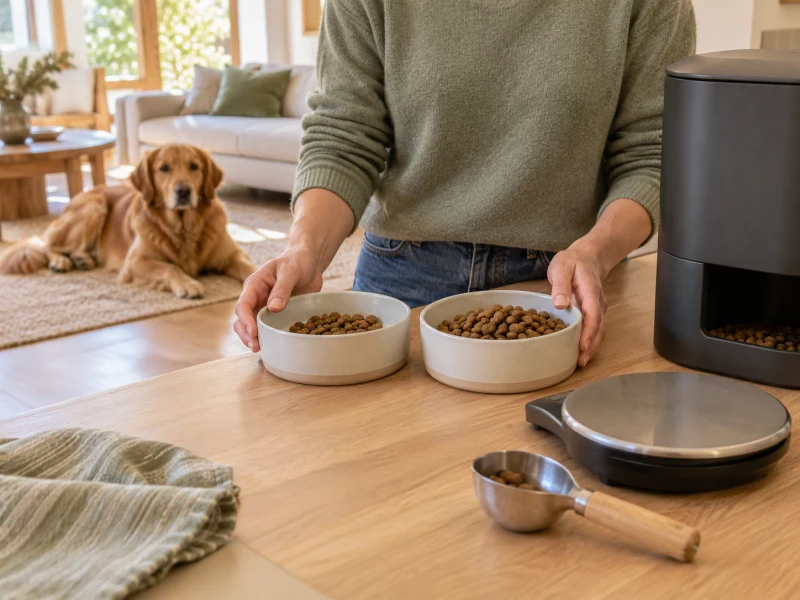
Run supervised checks after assembly and priming, using the same kibble as the daily diet. Collect and inspect the output rather than letting the dog eat it before you can see what arrived. Follow the manufacturer’s setup procedure and keep any extra test food within the day’s planned ration.
If output varies, food bridges above the outlet, or the conveyor needs repeated attention, resolve the cause before leaving a scheduled meal to the device. Changing pellet shape or formulation can justify repeating the checks. A previous result with another bag of food does not establish compatibility with a new diet.
Check bowl access and stability with your dog
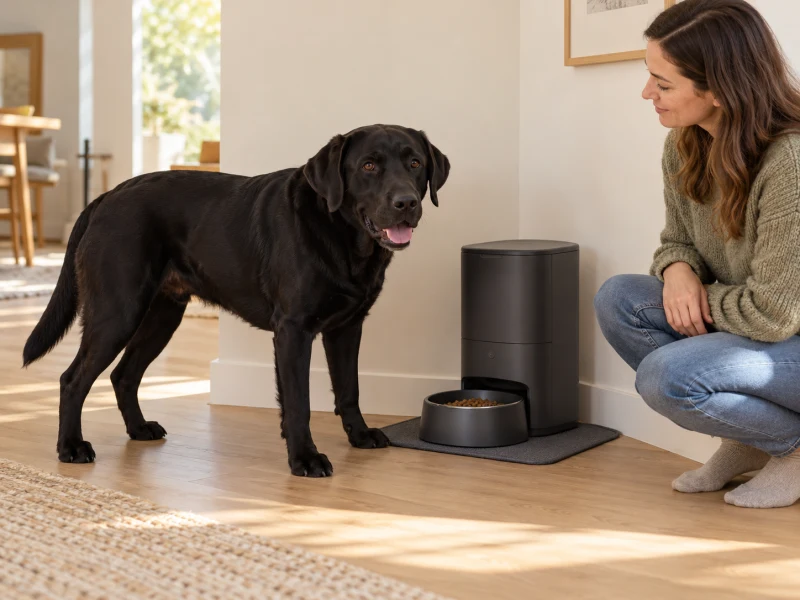
Look at the usable opening around the bowl, not just the overall width of the machine. Housing that projects above or behind a bowl can reduce the space available for a broad head. Product images rarely show enough detail to judge that fit for an individual dog.
Ask for the bowl’s inside dimensions and the clearance between its rim, outlet and feeder body. Compare them with a bowl your dog already uses comfortably. This is a screening step, not proof that identical measurements will produce the same eating posture.
Once the unit is available for a supervised introduction, observe the dog’s approach, stance and ability to withdraw. Stop if the dog must press its face against the housing, repeatedly knocks the bowl away, or becomes frustrated with the mechanism. A dog with mobility or access difficulties needs individual advice.
Use only the placement and accessories approved for that model. Raising a feeder on an improvised stand can change stability and access. Do not add a stand simply because “large dog” sounds like a reason for elevation; discuss any posture or medical concern with your veterinarian.
Watch the lid and body as well. A dog that paws at a manual-feed button, pushes the housing or works at a latch may access extra food or damage the unit. “Pet-proof” marketing cannot replace observing your own dog’s behavior.
Why the PetSafe Smart Feed is not a confirmed large-dog pick
The selected product is the second-generation PetSafe Smart Feed PFD00-16828, associated with Amazon ASIN B07NR47N2Q. The PetSafe support page documents a 24-cup hopper, up to 12 scheduled meals and settings from 1/8 cup to 4 cups. It also explicitly describes the intended fit as cats and small to medium-sized dogs.
That is a narrower statement than the large-dog wording on the retail listing. Neither the hopper size nor the upper portion setting resolves the difference. PetSafe’s wording does not prove that every large dog is prohibited, but it also does not support an unqualified large-dog recommendation.
Before buying it for a larger dog, ask PetSafe whether your dog’s size, existing bowl needs and food are appropriate for this exact model. Request usable bowl dimensions and any known access limitations. Keep the model number in the question so advice about a different feeder is not mistaken for confirmation.
Food compatibility for an automatic dog feeder for large dogs
The PFD00-16828 quick-start guide contains conflicting food wording: its safety section says dry food only and excludes wet, canned or moist food, while the setup section refers to dry or semi-moist food. The support page also mentions semi-moist food.
Do not use that conflict as permission to add an unsupported diet. Dry kibble is the clear common ground in those instructions. If you use semi-moist food, obtain clarification for the delivered model; do not put canned food, raw meals or soaked kibble into the hopper based on the setup sentence.
If your routine uses wet meals, compare the different storage and cleaning demands in the PETLIBRO wet-food feeder guide. That compartment-based design is a separate subject, not a confirmed large-dog alternative to the Smart Feed.
The guide also excludes pets unable to reach the tray and instructs owners to check operation frequently. Those cautions reinforce the need for an individual fit check. This is a scheduled dry-food device, not a substitute for a person monitoring whether the dog is eating.
Separate scheduled feeding from care and connectivity
Consider three different events: loss of household electricity, loss of Wi-Fi and loss of internet service. A feature that addresses one does not necessarily solve the others. Read the exact model’s instructions for saved schedules and recovery, and check the current app before depending on remote changes.
For PFD00-16828, the quick-start guide specifies a 2.4 GHz network and an AC adapter, with four D-cell alkaline batteries as optional backup. It says those batteries are backup power, not the main supply. It also calls for fresh batteries before an extended absence and frequent operation checks.
Do not infer a guaranteed backup duration from the battery count. Motor activity, battery condition and the device’s behavior matter. Similarly, an app notification or activity entry cannot establish that your dog actually ate the intended amount.
Plan who can inspect the feeder, refill water, check the dog and provide a meal manually if needed. A camera view may help you notice a problem, but it cannot free a blockage or assess an unwell animal. Keep ordinary bowls accessible to the caregiver.
Slow dispensing is not a medical claim
PetSafe describes a Slow Feed mode that distributes scheduled meals larger than 1/8 cup over 15 minutes. That is a dispensing feature. It does not establish a medical benefit for a particular large dog or mean the dog consumes the food evenly throughout that period.
If your dog bolts food, regurgitates, struggles to swallow or has a medical reason for a specific feeding method, discuss the plan with your veterinarian. Do not use an automatic feeder’s timing feature as evidence that it prevents bloat or treats digestive disease.
Keep food-contact parts clean and dry
A feeder adds a hopper and delivery path to the ordinary bowl-cleaning routine. Ask how those parts come out, which can be washed, and what must stay dry. Instructions for one model’s bowl do not extend automatically to its electrical base or conveyor.
PetSafe’s guide calls for washing and rinsing the listed removable parts before setup and drying them before reassembly. It warns against immersing the control panel or base. Disconnect power before cleaning and follow the delivered instructions for each component rather than washing the assembled machine.
The FDA’s pet-food storage guidance recommends keeping food identification details, using clean dry containers and washing storage containers between bags. It also advises washing and drying food bowls and measuring utensils after each use. A hopper does not remove those handling considerations.
Retain the bag or its product name, lot number and best-by details when transferring food into a feeder. Do not repeatedly mix new food with unidentified old crumbs. Follow a maintenance routine that lets you inspect the outlet and food-contact surfaces without exposing electrical parts to water.
Questions to answer before ordering
- Does the manufacturer confirm this exact model for your dog’s size and access needs?
- Are the existing diet and pellet characteristics supported without modification?
- Can the supported meal settings deliver the established feeding plan?
- Is there room for the dog to approach, eat and withdraw comfortably?
- Can a person check delivery, appetite, water and device errors every day?
- Can you remove, clean, dry and reassemble the food-contact parts routinely?
Frequently asked questions
Is a 24-cup automatic dog feeder for large dogs always suitable?
It may change refill frequency, but it does not establish bowl access, stability, food compatibility or the right meal size. Choose an automatic dog feeder for large dogs by confirmed fit and controllable delivery first.
Can an automatic feeder replace a sitter?
No. Someone still needs to check the dog, fresh water, appetite and actual food delivery. Have a person available to intervene if a meal is missed or the dog becomes unwell.
Which product details need clarification before buying?
PetSafe Smart Feed PFD00-16828 has documented feeding features, but its official small-to-medium-dog positioning does not confirm fit for a large dog. Obtain model-specific confirmation of intended size, usable bowl access and food compatibility before buying it for that purpose.
What is the most useful next step?
Measure the bowl your dog uses comfortably, record the established meal plan and send those details with the exact model number to the manufacturer. Choose only after the answers cover both the dog’s access and the food’s compatibility.
Comments are reviewed before they appear publicly. Please keep questions and feedback relevant to this article.