
AI-created tool-choice illustration with generic equipment, not a FURminator or Andis product test.
A dog brush should match the coat layer and job. Soft bristles, rubber contact points, pins, slicker wires and undercoat tools do different work; a comb adds another kind of check. There is no useful rule that every dog needs all of them in the same order.
Choose the needed role first, then the actual tool and its instructions. A fuller brush or a larger pile of collected hair does not establish better care. The coat should remain comfortable, and resistance should lead to reassessment rather than a stronger next tool.
Choose a dog brush by its working surface
Look at what touches the coat rather than relying on the brand name. A pin brush spreads metal pins across a head; a bristle brush uses a different contact surface; a straight comb places teeth along one spine. Those structures give different feedback in the same coat.
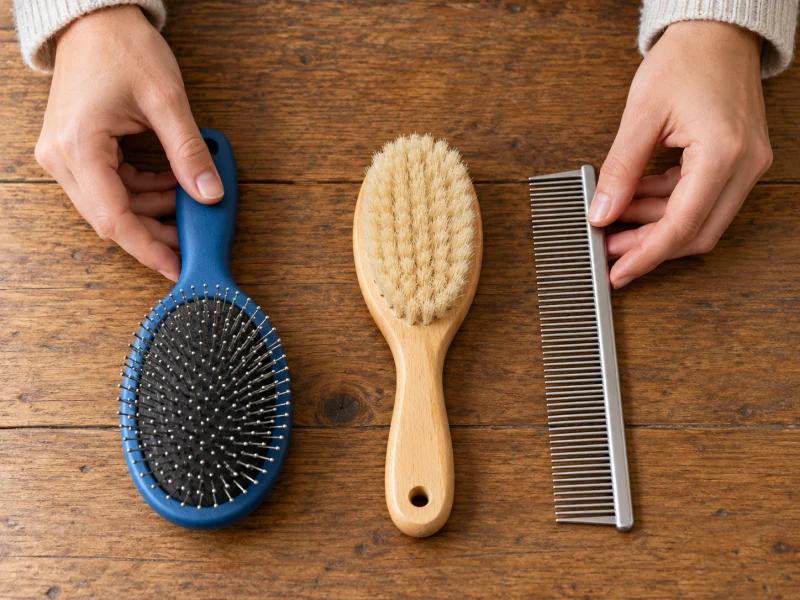
Blue Cross’s tool overview separates pin brushes, slickers, rubber brushes, mitts, undercoat rakes and finishing bristles. Its advice is to match the tool to the dog, with professional guidance when the choice is unclear.
| Structure | Main role to assess | Limit that changes the choice |
|---|---|---|
| Soft bristle brush | Surface hair, debris and a finishing pass | Does not establish that deeper coat is free of tangles |
| Rubber brush or grooming mitt | Suitable loose-hair contact, often for a short coat | Firmness and pressure still matter; not a tight-mat solution |
| Pin brush | Suitable coat separation and light tangle work | Pin reach and pad feel must suit the actual coat |
| Slicker | Fine-wire contact for appropriate coat preparation | A firm head can be unsuitable; repeated pressure is not a remedy |
| Undercoat rake or deShedding tool | A specifically identified loose-undercoat task | Different tooth or edge designs are not interchangeable |
| Coarse-and-fine comb | Accessible loose hair or a finishing check | A catch is information, not permission to pull |
Pin and slicker dog brush designs are different
In its brush-type explanation, Chris Christensen distinguishes its straight-pin brushes from bent-pin slickers. Shape, pad and head size also vary within those categories. A familiar-looking handle does not establish the working surface.
The distinction helps when a listing uses several grooming terms together. Check the actual head and intended role. A conventional pin surface is not automatically the same as a fine-wire slicker, and neither should inherit the use directions of a cutting-edge deShedding tool.
Pin length and pad firmness can affect contact, but a long-pin or firm-pad label is not a universal upgrade. Ask which structure suits the actual coat and area. Do not infer verified measurements from a retail photo or use extra pressure to make a short tool reach deeper.
For close or thin coverage, metal contact may be unnecessary even when the dog has visible shedding. For a longer coat, an appropriate brush may reach hair comfortably while a different head catches. The useful distinction is the task and response, rather than a category ranked from weakest to strongest.
Bristle material changes the finishing surface
Natural and synthetic bristles are another distinction. Chris Christensen describes natural animal-hair bristles, such as boar hair, separately from synthetic materials such as nylon. That material information concerns the brush surface; it does not establish a health benefit or suitability for every dog.
A finishing pass can help arrange the surface and collect accessible debris without proving that the coat underneath is clear. Do not use a smooth-looking outer layer as the only assessment of a dense or long coat.
Care requirements can also differ between a natural bristle surface, a pin cushion and a plain metal comb. Choose a tool whose instructions you can follow. A two-sided handle is convenient only when its usable sides and upkeep fit the work.
A two-sided dog brush for topcoat roles
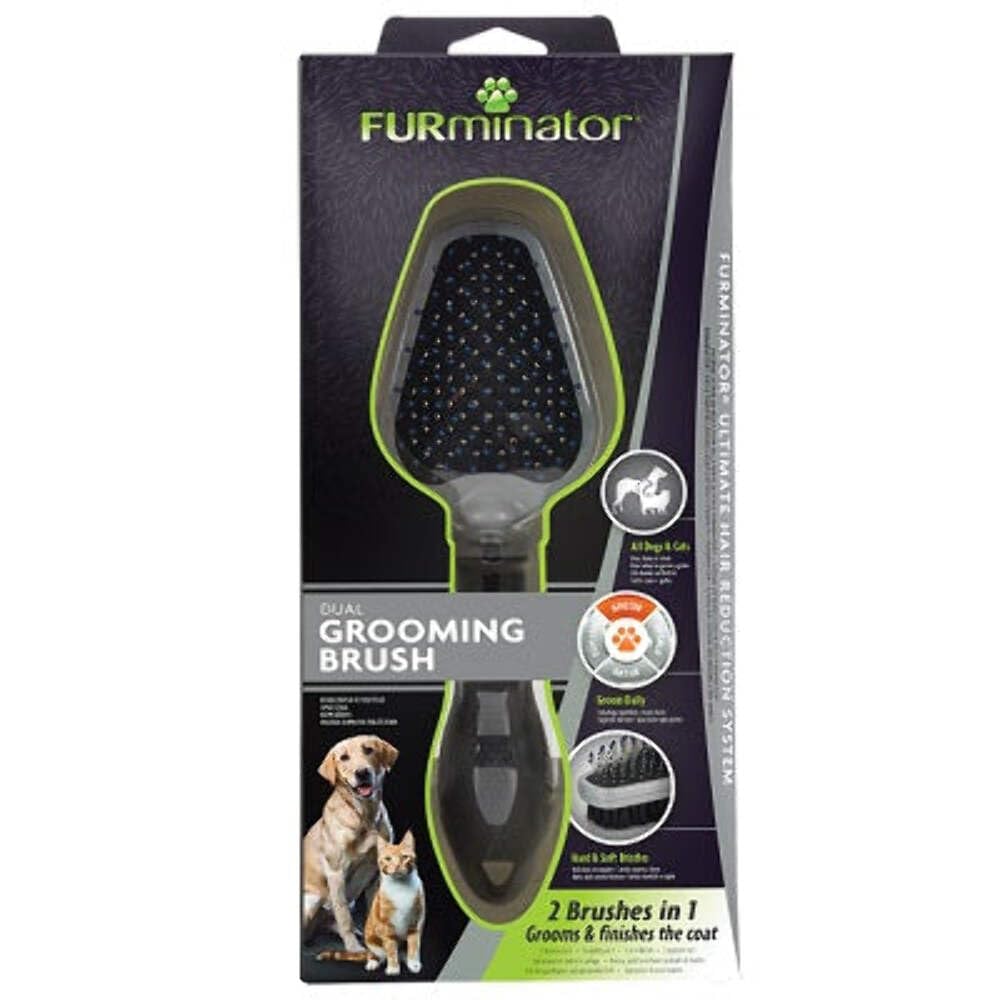
The selected FURminator Dual Grooming Brush is retail model T691663, ASIN B07PRYWTD1. It combines metal pins with soft boar’s-hair bristles. The manufacturer page describes topcoat grooming and finishing rather than the brand’s separate undercoat deShedding-edge function.
FURminator directs gentle strokes with hair growth and warns that excessive strokes in one area may irritate the coat and skin. The selected retail description refers to dogs and cats over one year. Confirm the delivered directions instead of assuming that every FURminator product has the same routine.
Use a side because the coat needs it. There is no compulsory rule to follow metal pins with bristles over every area, or to use the pins simply because the finishing side is appropriate. A single working face can be enough for the task.
Consider the Dual Grooming Brush when its soft-bristle finishing side, metal-pin side or both have a confirmed role on your adult dog’s coat. Choose a different type when you need a rubber-only surface, a specifically matched undercoat tool or professional help with matting.
PRODUCT MENTIONED
FURminator Dual Grooming Brush — T691663
Amazon · Details on the retailer’s website
Use a comb for feedback beyond the surface
A suitable comb can help check whether an appropriately prepared area allows a gentle pass. It can also reveal a remaining snag that a surface finish did not show. Stop and inspect a catch rather than using the finer section to force the same patch.
The selected Andis 65730 is a silver 7½-inch steel comb, ASIN B004UTDHP2, with coarse and fine areas. Its listed length does not identify the exact tooth gaps. Those gap measurements remain unverified, so assess the actual tool rather than assigning a numerical spacing.
The Andis Company product-video record identifies 65730 as a 7.5-inch steel comb. The current Andis store identifies its 7½-inch comb as 68550. Keep the selected retail identity and supplied directions separate from that different current number.
Consider the selected Andis 65730 when a separate gentle comb check is useful after appropriate brushing. Skip it when there is no distinct task, the size is difficult to control or the coat catches instead of allowing a comfortable pass.

PRODUCT MENTIONED
Andis Steel Comb — 65730, 7½ Inch
Amazon · Details on the retailer’s website
Choose the dog brush order from the coat task
The ASPCA’s coat-care examples use different combinations for smooth short coats, denser short fur and long silky coats. That variation is the reason a universal list of tools in order can mislead.
| Actual task | A sensible sequence to assess | What is not required |
|---|---|---|
| Light surface care on a suitable smooth coat | Inspect, use an appropriate gentle surface, reassess | Adding a rake or metal pins just to complete a routine |
| Suitable longer-coat maintenance | Inspect, use the demonstrated preparation tool, check gently where a comb is appropriate | Forcing every area through fine teeth |
| Identified loose-undercoat work | Confirm the layer and matched method with a groomer, then inspect the result | Raking until no more hair appears |
| A resistant patch or close mat | Stop and obtain appropriate assessment | Escalating through stronger tools |
A professional demonstration on the actual coat can settle which steps are needed and which should be omitted. The order may change with the area and condition. A product system’s suggested sequence does not make all its products necessary.
Check contact instead of chasing loose hair
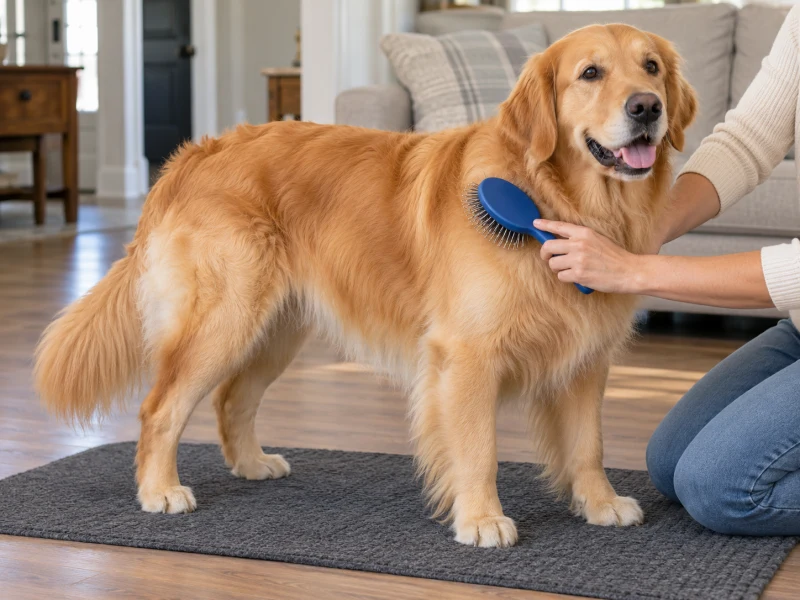
Introduce an unfamiliar dog brush gradually, using an accessible area and gentle contact. Dogs Trust advises stopping when handling becomes uncomfortable. A dog trying to leave or showing tension needs a pause, not a longer session to become accustomed to the tool.
Coat resistance, skin changes and the dog’s response are separate observations. A rounded tooth can still pull hair; a soft bristle can still be overused. Stop for repeated catching, pain, redness or damaged equipment and seek appropriate help.
Keep tight mats, hidden skin and unexplained hair loss outside an ordinary tool-selection trial. Do not use scissors beneath a comb or a more aggressive edge to make the selected brush seem effective.
Inspect and protect each working surface
Remove collected hair as directed and inspect pins, bristles and teeth before storage. Follow each product’s actual care directions rather than applying one soaking, heating or chemical routine across different materials.
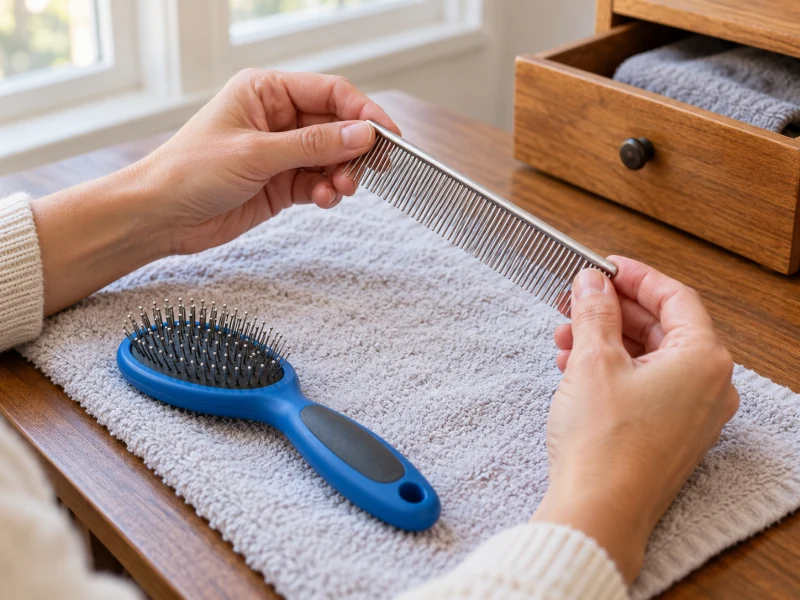
Protect a pin head from crushing and keep exposed teeth away from animals and children. Chris Christensen’s overview recommends protecting brushes from debris and crushing; that general storage principle does not verify a particular cleaning method for either selected product.
If a tooth bends, a pin loosens or the surface feels rough, keep it off the dog until the problem is resolved. Do not file or bend a tool into a new shape as an improvised repair. A useful brush category can become unsuitable when the actual tool is damaged.
Questions about dog brush types
Is the strongest tool the best starting point?
No. Choose the needed contact and layer, then use an appropriate gentle method. A cutting or raking action can add an unsuitable task rather than improve surface care.
Must a comb come after every brush?
No. Use it when a separate check is appropriate and comfortable. A close smooth coat may not need a metal comb, while a longer coat may benefit from a demonstrated comb check.
Does a two-sided brush replace all the other types?
No. It combines two particular surfaces. The selected Dual Grooming Brush offers pin and soft-bristle roles; it does not become a rubber mitt, a matched undercoat rake or a solution for tight mats.
Give every tool a clear reason to be used
The right dog brush order follows the actual coat task. Distinguish surface finishing, coat preparation, loose-undercoat work and a comb check, then omit steps that do not help. Keep the contact comfortable and stop when the coat or dog makes reassessment necessary.
If those roles fit, check the FURminator Dual Grooming Brush or the Andis 65730 comb on Amazon. They are two independent options for different jobs, not a compulsory pair or a universal grooming sequence.
Comments are reviewed before they appear publicly. Please keep questions and feedback relevant to this article.