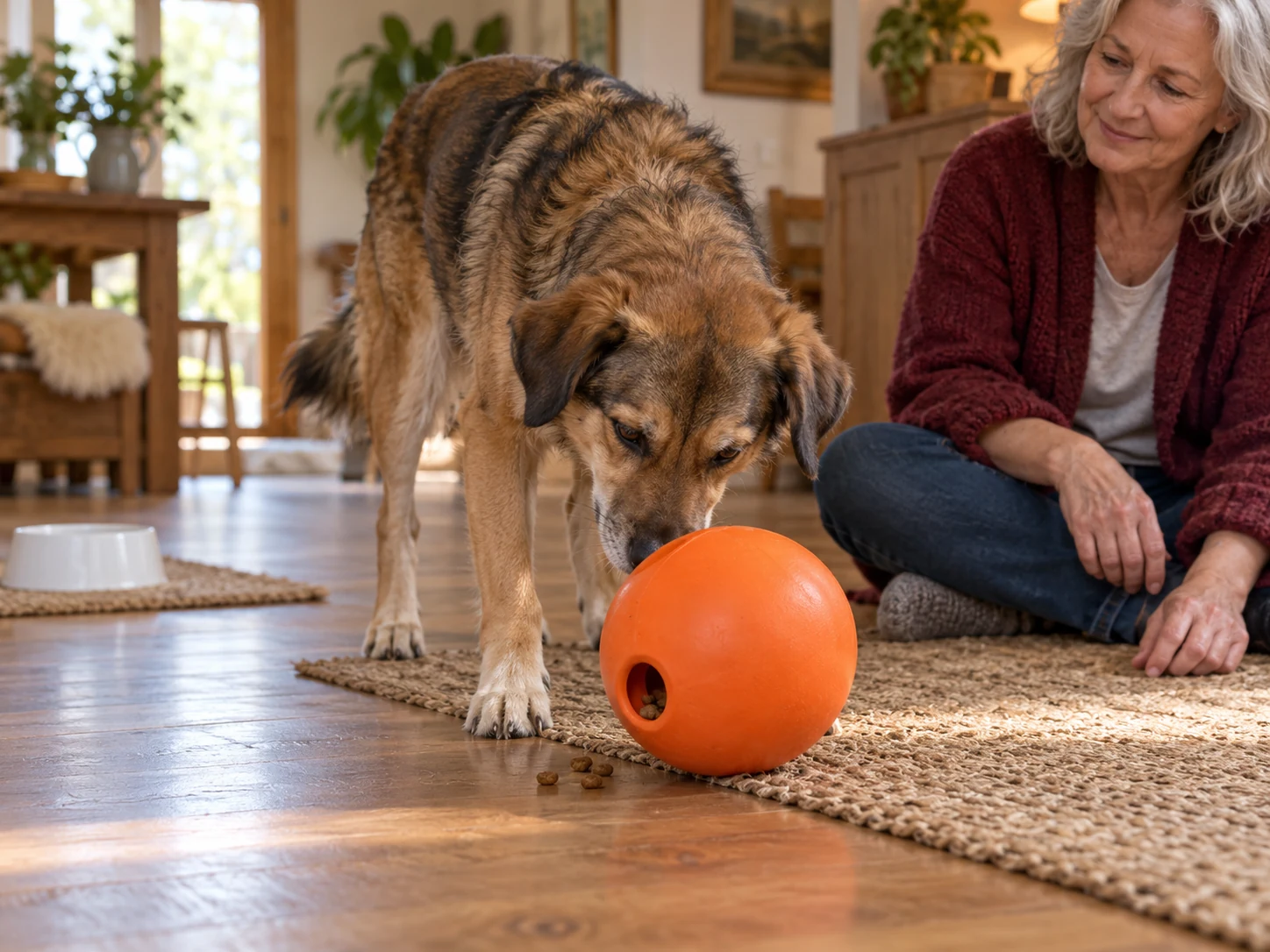
AI-created editorial scene: choose an achievable interaction and watch the dog's response; not a product photo, timed trial or treatment test.
A dog puzzle feeder should give your dog an achievable way to obtain food, not simply make a meal harder to reach. Choose the interaction—licking, nudging, searching, or moving a simple part—around the dog’s abilities and preferences, then start easier than you think necessary.
Before buying, try a suitable supervised food-search activity with a small amount from the existing allowance. If the dog enjoys finding accessible pieces, that tells you more than a package’s difficulty rating. If the dog is worried, frustrated, guarding food, or unable to obtain enough of the planned meal, change the setup instead of treating persistence as the goal.
Choose a dog puzzle feeder by the action it asks for
Different designs ask the dog to do different things. A dog that enjoys licking from an open container may not enjoy chasing a moving dispenser. A dog that nudges objects confidently may still find a tightly packed food toy frustrating.
Dogs Trust’s enrichment guidance recommends considering the individual dog’s health, abilities, dietary needs, and preferences, then observing enjoyment or frustration. Its examples include food-filled toys, lick mats, puzzle feeders, and food-search activities. The useful choice is the activity your dog can use comfortably.
| Format | Typical interaction | What to assess |
|---|---|---|
| Open fillable toy | Approaching and licking accessible food | Opening, food access, chewing behavior, and cleaning |
| Moving dispenser | Nudging, pawing, or following released dry pieces | Floor space, movement, noise tolerance, and food fit |
| Compartment puzzle | Moving a permitted lid or part to reveal food | Achievable actions, loose-part risks, and the exact instructions |
| Searching activity | Finding accessible food in a suitable area | Safe surroundings, supervision, and individual mobility |
Interaction types help match the activity to the dog; the categories are not a tested product ranking. A higher difficulty label, more compartments, or a larger toy does not establish a better experience. Choose the simplest format that provides an appropriate activity.
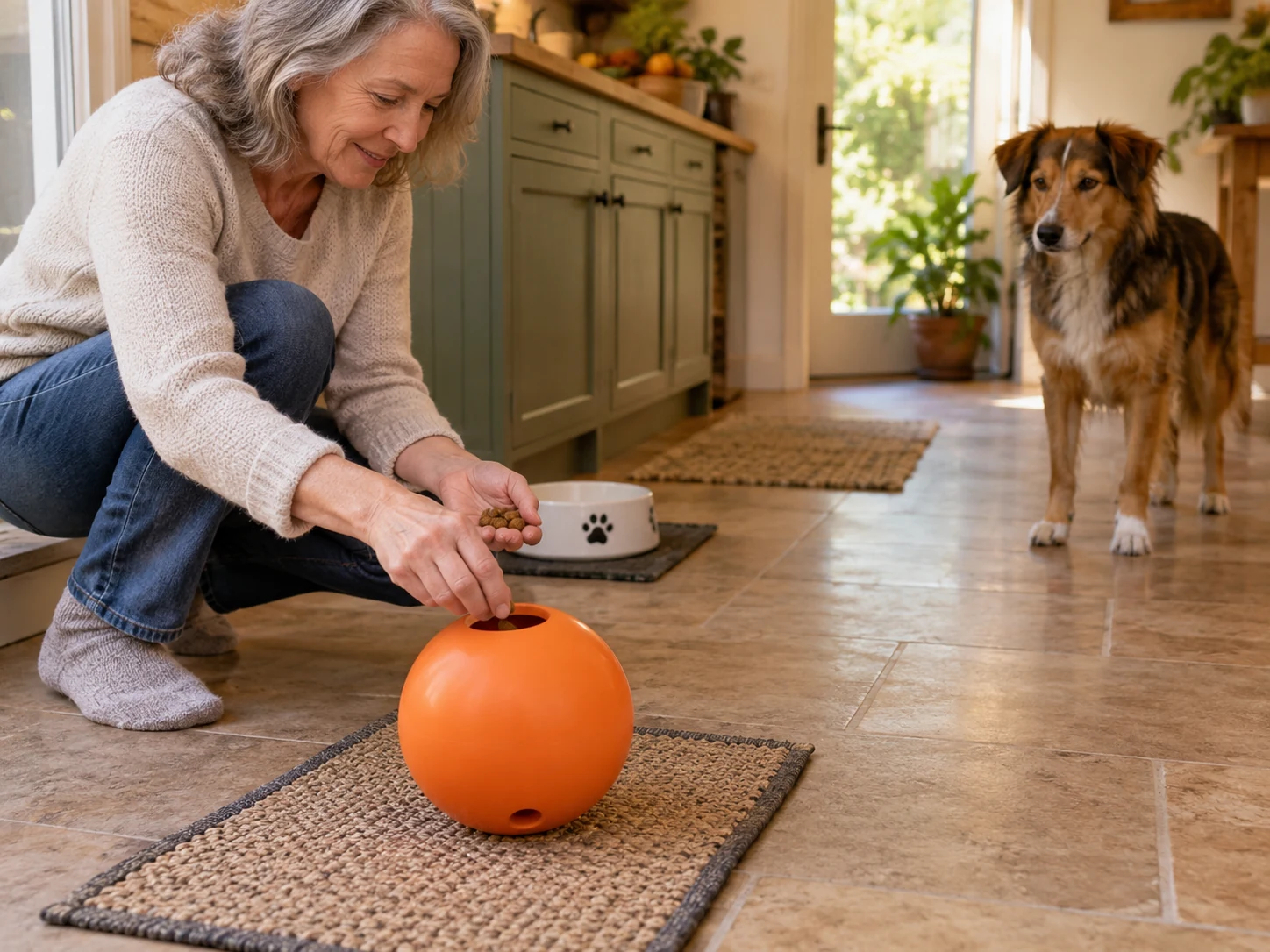
Set dog puzzle feeder difficulty around food access
The dog still needs dependable access to an appropriate amount of food. A puzzle can be one way to offer part of that allowance, but completing a new task should not become the only way the dog can eat. Keep a familiar suitable feeding option available during introduction.
Do not add an uncounted layer of treats just because a toy has space to fill. Dogs Trust advises including food used for activities within the normal allowance. For a prescribed diet, weight plan, or a health concern, ask your veterinarian how to use food-based activities without disrupting that plan.
Match the material to the particular toy as well. A moving dry-food dispenser and a fillable container do not necessarily accept the same food. Use the manufacturer’s approved format and do not force large pieces through an outlet, freeze a product without permission, or modify an opening to change difficulty.
Introduce a dog puzzle feeder with accessible food
A good first trial makes the food accessible and the activity easy to understand. Present a small amount and watch what the dog does. You are checking interest, access, and handling—not conducting a test the dog must pass.
With a fillable toy, begin with an appropriate loose, accessible filling rather than the hardest frozen arrangement. A moving dispenser needs to release suitable food with a manageable action. For a compartment product, follow its easiest permitted setup rather than presenting every challenge at once.
Change one variable at a time. If you increase filling density and introduce a new location and unfamiliar food together, it becomes difficult to tell what caused a change in response. Keep the task familiar before considering another level.
Signs that the activity needs adjustment include repeatedly leaving, inability to access food, escalating roughness, or focusing on tearing the material instead of obtaining the reward. Reduce difficulty or end the session. Do not hold the dog at the toy or keep offering it until the animal gives in.
A fillable option: West Paw Toppl Large Aqua Blue
The selected example is the West Paw Toppl Large in Aqua Blue, ASIN B00N54E9MI, with UPC 747473750307 in the current retailer record. It is a fillable Zogoflex toy, rather than a timed dispenser or a compartment board.
The manufacturer’s Toppl page describes filling, freezing, and optional interlocking play, and identifies it as built for moderate chewers. It lists the Large capacity as approximately three-quarters of a cup. That is a container reference, not the amount your dog should receive in a meal.
Start with one open, fillable toy and an accessible portion. The selected purchase is one Large unit. The brand’s two-size interlocking feature does not mean a second toy is included or that you need to buy another one to begin.
| Toppl decision point | Potential use | Limit |
|---|---|---|
| Open fillable format | A comparatively direct starting activity with accessible food | The actual filling still needs to be suitable and reachable |
| Manufacturer permits freezing | A later variation if appropriate for the dog and food | Harder is not automatically better; do not begin at maximum difficulty |
| Large Aqua Blue identity | A defined selected variant | Large does not guarantee every mouth or food amount fits |
| Top-rack dishwasher guidance | An established cleaning option from the maker | Check the toy for remaining food and damage after cleaning |
| Moderate-chewer description | A manufacturer’s use category | No toy is indestructible or suitable for every chewing style |
When an open fillable format fits
Consider the Toppl when an appropriately sized, supervised fillable toy matches your dog’s preferences and you can maintain it. It is less persuasive for a dog that persistently tears pieces from toys, cannot access the filling comfortably, or does not enjoy the interaction.
Engagement duration, meal speed and anxiety outcomes have not been independently verified for this toy. The retailer’s “calming” or healthy-habit language is not evidence that this toy treats a behavioral or medical condition. It should remain one activity within a suitable routine.
View the West Paw Toppl Large Aqua Blue on Amazon.
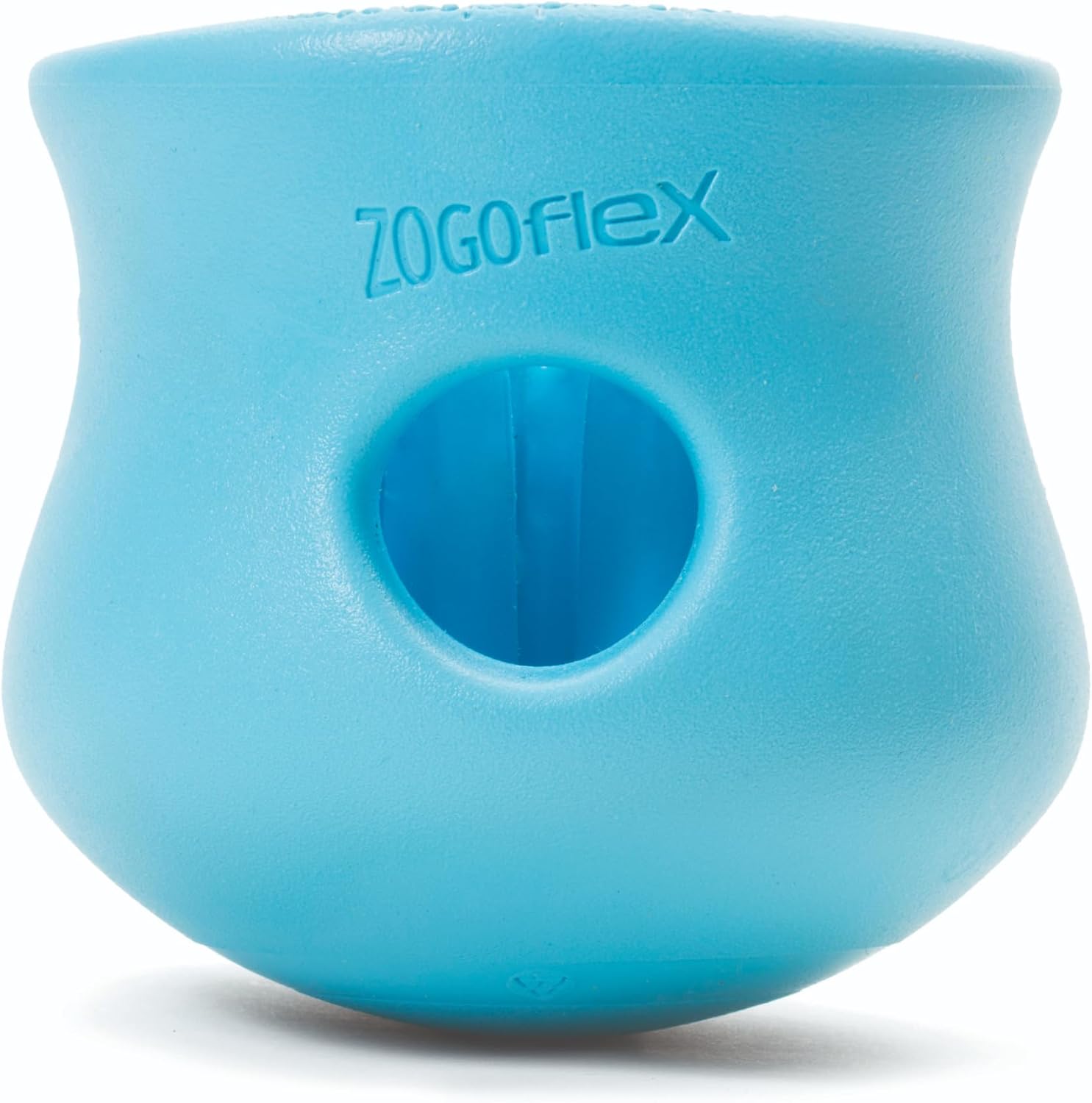
PRODUCT MENTIONED
West Paw Toppl Large Treat-Dispensing Puzzle Toy, Aqua Blue
Amazon · Details on the retailer’s website

Inspect the toy and observe the whole session
Check the material, openings, and any detachable components before use. Follow the exact product instructions and remove packaging. A toy that looks intact from above may have damage underneath or around a narrow edge.
West Paw explicitly requires supervision, appropriate shape and size, and discontinuing use when damage occurs. Its safety statement says no dog toy is indestructible. Do not turn a moderate-chewer label into a promise that a determined dog cannot remove material.
During a dog puzzle feeder session, watch how the dog gets the food and what happens when it becomes harder to reach. End the activity if the dog starts chewing off pieces, becomes frustrated, or shows discomfort. If you suspect material has been swallowed, get veterinary advice rather than waiting to see whether the next session goes better.
Afterward, account for remaining food and inspect the toy again. A successful session means appropriate access and an enjoyable interaction, not simply that the food eventually disappeared. In a multi-pet room, check whether another animal helped itself.
Keep each dog’s activity comfortable
Provide space without forcing dogs to share one food puzzle. An animal can be interested in food while being uncomfortable with another pet nearby. Separate supervised areas may be more useful than placing several toys close together and assuming that prevents competition.
If a dog guards the toy, avoid reaching in or forcing a release. Get qualified advice and use an appropriate management plan. The right product cannot replace help for an established food-related behavior problem.
Blue Cross’s play guidance emphasizes individual play styles, suitable size, and checking toys for swallowable parts. It also notes that independent play still needs supervision. A dog interacting alone with a puzzle is not the same as a toy left unattended.
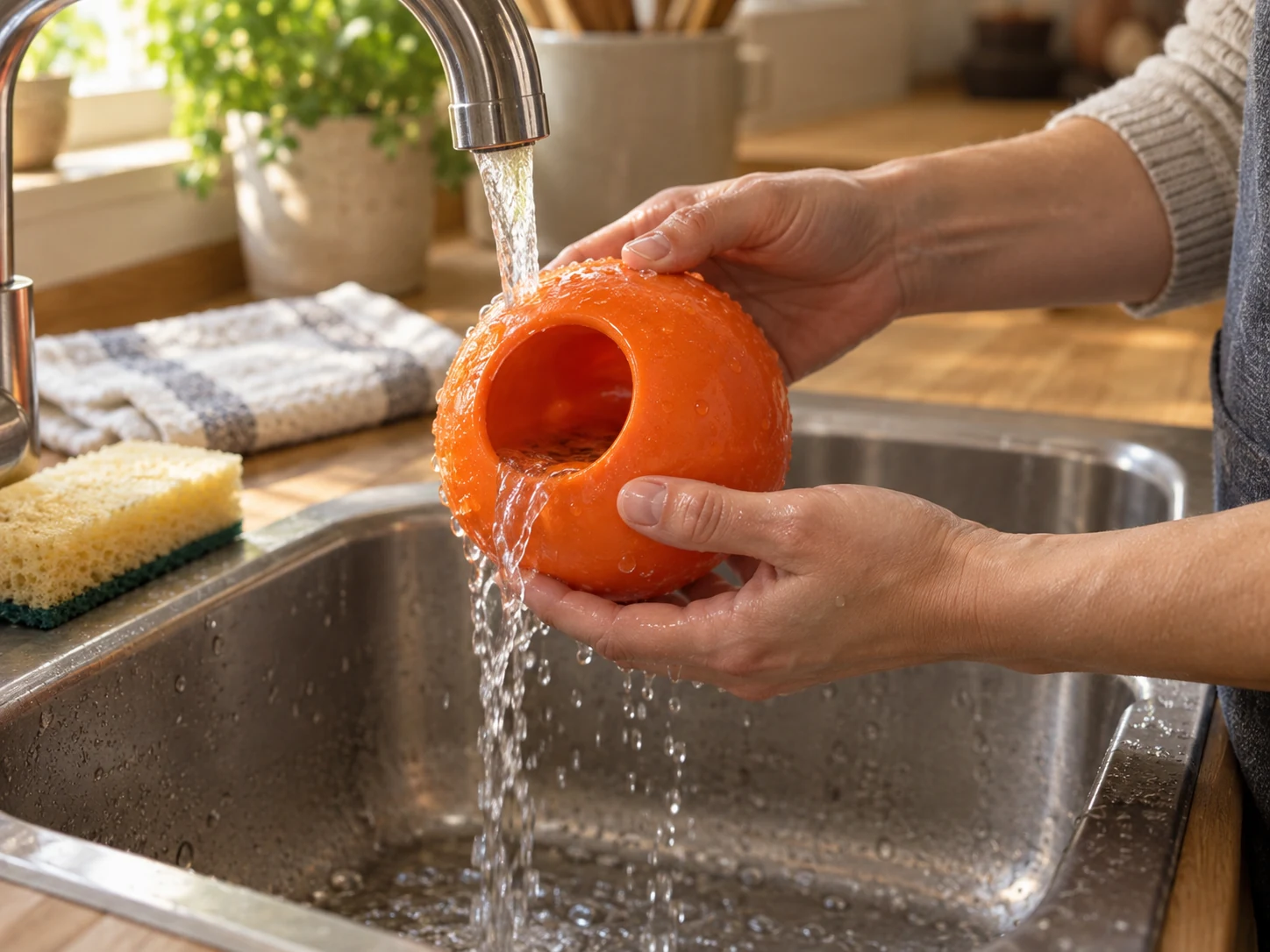
Clean the dog puzzle feeder before harder fillings
Check whether you can reach the food-contact surfaces and remove the filling completely. A complicated arrangement adds little value if residue stays trapped or the toy cannot be cleaned and dried between sessions.
For the selected Toppl, follow West Paw’s top-rack dishwasher guidance and current care instructions. Inspect the result instead of assuming the cycle makes every surface ready. Keep storage appropriate for the food and remove leftovers promptly according to the relevant food guidance.
Use more difficult or frozen fillings only when the manufacturer permits them and the food and dog are suitable. Check freezing instructions for the exact toy and food, and count any filling within the dog’s feeding plan. The KONG stuffing ideas guide discusses a separate product format; do not assume its preparation details apply to every puzzle feeder.
A simple record for the next session
Write down the toy format, permitted food, amount offered, starting difficulty, and what the dog did. Note whether food was easy to obtain, whether the dog stayed comfortable, and whether cleaning was practical. This is a useful household record, not a scientific performance test.
Use that record to change one thing at the next trial. You may decide to keep the same easy setup, reduce the amount, offer a different suitable interaction, or stop using the product. Buying a more complex puzzle is not the only way to add variety.
Frequently asked questions
Should a dog puzzle feeder replace every bowl meal?
Not automatically. It can be one way to offer part of an appropriate allowance, but the dog still needs dependable food access. Keep a familiar suitable option during introduction and ask your veterinarian about individual dietary needs. Do not make an unfamiliar puzzle a barrier to eating.
Is a harder puzzle better enrichment?
No. Difficulty should remain achievable for the individual dog. Watch interest and comfort rather than the package’s level number. If the dog cannot reach food, becomes frustrated, or starts damaging the toy, simplify or stop instead of interpreting struggle as a useful challenge.
Do I need two Toppls to start?
No. The brand describes interlocking two sizes as an optional variation, but the selected Amazon product is one Large Aqua Blue unit. Start with an appropriate accessible filling in one suitable toy. Extra equipment is unnecessary when a simple activity already works.
Will a food puzzle fix anxiety or rapid eating?
An enrichment label does not guarantee a behavioral or feeding outcome. It can provide a suitable activity for some dogs, but behavior and health concerns need the right assessment. Feeding-speed and treatment effects have not been independently verified for this toy. Use professional help when eating or distress is a persistent concern.
Choose an achievable activity and observe the result
A dog puzzle feeder should fit how your dog moves, obtains food, and responds to a challenge. Start with a simple interaction, use suitable food from the existing plan, and keep a familiar feeding option available. Then check enjoyment, access, condition, and cleanup before making the task harder.
The Toppl Large Aqua Blue is one defined fillable option, with clear supervision and damage limits. It is not a universal winner or a substitute for a nutrition or behavior plan. If another format or a supervised food-search game suits the dog better, use that approach. The useful result is a manageable, comfortable activity that fits the household—not the most complicated puzzle you can purchase.
View West Paw Toppl Large Treat-Dispensing Puzzle Toy, Aqua Blue on Amazon.
Comments are reviewed before they appear publicly. Please keep questions and feedback relevant to this article.