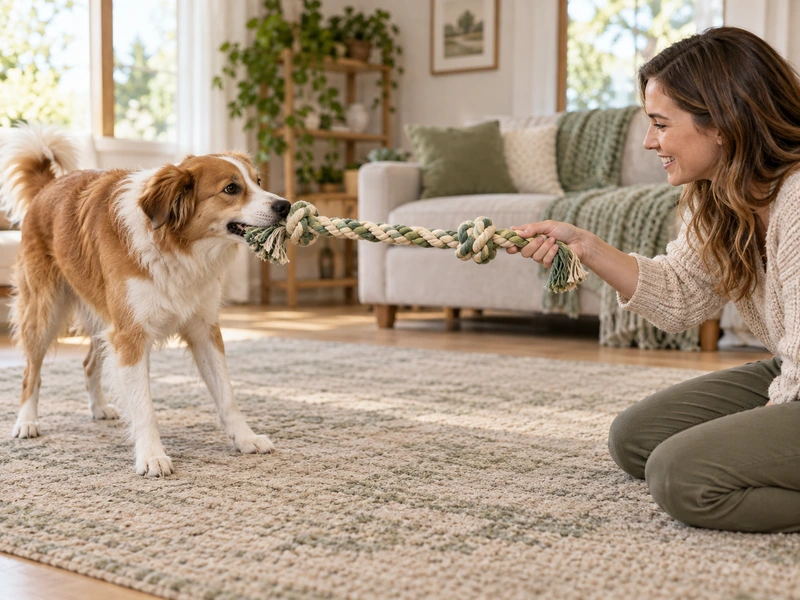
AI-created illustrative tug scene; this generic rope is not a photograph or durability test of the Mammoth 20012F toy.
A dog rope toy can suit a supervised game of tug if its size, condition and grip work for both you and your dog. It is a poor choice for a dog that settles down to unravel strands and swallow them.
Choose the interaction before choosing the rope. A longer toy can provide more gripping space, but length alone does not make a toy suitable for a particular mouth or chewing style. Inspect knots, strands and any attached parts before every game, and put the toy away when active supervision ends.
Decide whether a dog rope toy fits the way your dog plays
Watch whether your dog wants to carry, chase, tug or dismantle the toy. Those actions are not interchangeable. A dog can enjoy a brief tug game and then switch to picking at loose fibers once the person stops moving the rope.
The Blue Cross guide to playing with your dog distinguishes tug, chase-and-retrieve and searching games. It recommends choosing an appropriate size and checking for small parts that can be swallowed. It also makes clear that solo play still needs supervision.
For rope, the useful question is what happens when tension stops. Does the dog offer it for another game, carry it loosely or begin separating threads? That observation can change the decision more than a package’s description of strength. If the dog persistently tears material apart, choose a different activity rather than expecting a thicker rope to resolve the behavior.
| Observed play | Potential fit | Reason to change the plan |
|---|---|---|
| Invites a person to tug | A suitable intact rope may support an interactive game. | Hands are too close to the mouth or the dog cannot pause comfortably. |
| Carries and retrieves | A manageable toy can provide a shared activity. | The dog struggles with the weight or begins shredding after returning. |
| Picks at individual strands | Rope becomes a poor match. | Loose fibers or missing material require ending use. |
| Guards the toy | Use an appropriate behavior plan before more tug. | Do not force a hand into the dog’s mouth to retrieve it. |
You can learn about play preferences without buying another toy. Use an existing suitable, intact toy for an appropriate game or try a supervised searching activity without loose rope. The goal is comfortable interaction, not owning a particular material.
Check dog rope toy length, thickness and two usable grips
Choose enough room for the dog’s mouth and your hand to hold separate areas. The advertised overall length includes knots and fringed ends, so it does not necessarily describe the clear space between your grip and the dog.
Look at the rope’s thickness and knot bulk as well. A toy can be long but awkward for a smaller mouth to hold. Conversely, an object a dog can get fully into its mouth may be an unsuitable size even if its weight-category label sounds correct.
Check the actual selected variant. A range photograph can show several lengths, knots and colors together without making them part of one purchase. Do not estimate fit from a photograph of an unfamiliar dog whose size you cannot verify.
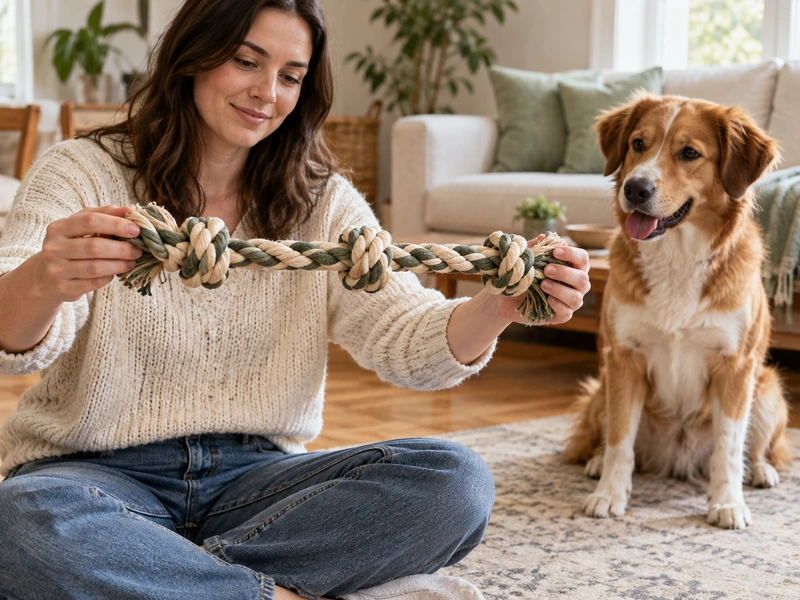
For the Mammoth Flossy Chews example, the selected listing specifies a Medium 20-inch tug for dogs in a 30–50-pound guide range. Treat that as the maker’s starting guidance, not a guarantee of fit or a substitute for observing grip and chewing. The exact product is model 20012F, ASIN B001GIEZLA.
If you cannot hold it with a comfortable distance from the dog’s mouth, choose another arrangement. Do not wrap the rope around your hand or the dog to manufacture more control. A useful tug should allow a straightforward pause and release, rather than becoming a restraint.
Keep tug comfortable and easy to pause
Begin a shared game gently and let the dog choose to engage. The point is a manageable exchange, not testing how hard either participant can pull. Keep the play area clear and choose stable footing.
Blue Cross describes inviting the dog to take the toy, beginning with gentle movement and using pauses to help teach that releasing can restart the game. It also advises keeping toys at a height the dog can reach rather than encouraging jumping. You do not need dramatic lifts or repeated airborne catches to make play worthwhile.
Notice changes in grip, movement and interest. If your dog loses balance, repeatedly misses the toy or becomes too excited to pause, lower the intensity or end the game. Do not lift the dog by the toy or keep pulling when the dog is uncomfortable.
For a dog with a mouth, neck or movement concern, ask the veterinarian which activities are appropriate before playing tug. A broad “for all breeds” claim cannot answer that individual question. The same applies when an older dog changes the way it grips or stops enjoying a familiar game.
Give dogs separate space when needed. Two animals pulling at one object can create a different interaction from a person playing with one dog. A longer rope does not automatically make shared play comfortable or prevent competition.
Loose strands are a stop signal
End play when the rope frays into accessible strands, a knot comes apart or material is missing. Do not treat visible wear as proof that the fibers are safely cleaning teeth or passing through the dog.
The American College of Veterinary Surgeons explains foreign-body risks from swallowed non-digestible objects, including toys and string. Such material can lodge in the gastrointestinal tract; string can cause particularly serious injury. A cotton content or “natural” description does not establish that swallowed rope is harmless.
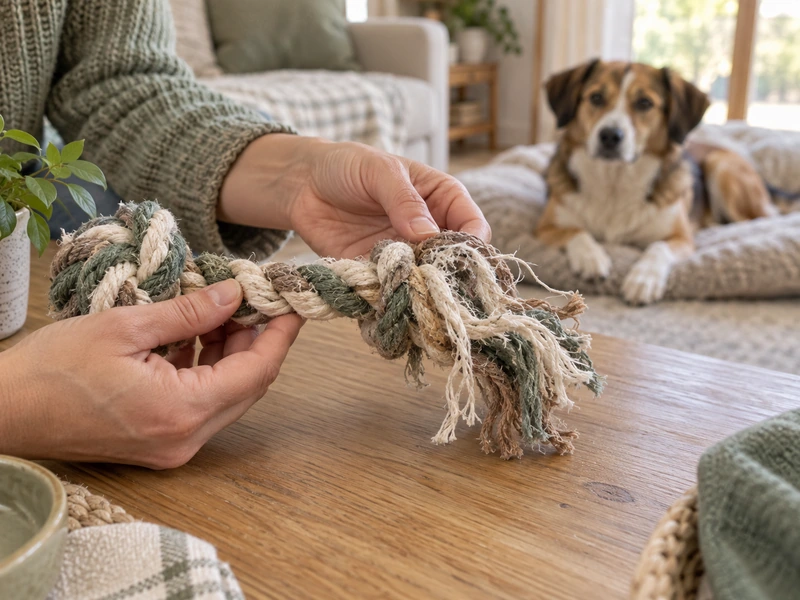
Check the full toy, not only the central knot. Examine the ends, the areas where teeth repeatedly grip and any joins to handles or attached objects. Compare its condition before and after the game. When a piece is missing and you do not know where it went, stop using the toy and seek veterinary advice about possible ingestion.
Vomiting, loss of appetite, abdominal pain or other illness after possible ingestion warrants prompt veterinary attention. Do not wait for a new toy to arrive or assume that a dog acting normally rules out every problem. Follow the veterinarian’s instructions rather than attempting home treatment.
Discarding a damaged rope is not evidence that every rope is unsuitable for every dog. It is a condition-based decision for this toy and this user. Equally, one intact session does not establish a future unattended-use guarantee.
One option: Mammoth Flossy Chews Medium 20-inch tug
The specified product is the Mammoth Flossy Chews Rope Tug, Medium 20-inch, model 20012F. The current listing describes a cotton-poly yarn construction with knots and assorted colors. Do not assume a particular color will arrive or call it pure cotton.
Its most defensible role is an interactive tug for a dog whose grip and play style suit it. The manufacturer-marketed “floss” and oral-health wording has not been independently verified as a dental outcome for this toy. Keep rope play separate from the dog’s dental-care routine.
| Selected detail | Useful question | Limit |
|---|---|---|
| Medium, 20 inches | Can both participants grip separate areas comfortably? | Total length includes knots and ends. |
| 30–50-pound guide range | Does the actual mouth and behavior fit? | Weight alone is not a suitability guarantee. |
| Cotton-poly yarn | Will the dog tug rather than unravel it? | Material composition does not make swallowing safe. |
| Assorted colors | Are you comfortable with a variable color? | The photo is not a color promise. |
| Knotted rope format | Can you inspect and store it between games? | Wear can make the toy unsuitable. |
Consider this option for controlled interactive play when the size works and you can inspect it throughout. Skip it for a dog that removes and swallows threads, or when you need something to leave behind without supervision. A general durable label cannot overcome those limits.
If that role fits, check the Mammoth Flossy Chews Medium 20-inch rope tug on Amazon and confirm model 20012F.
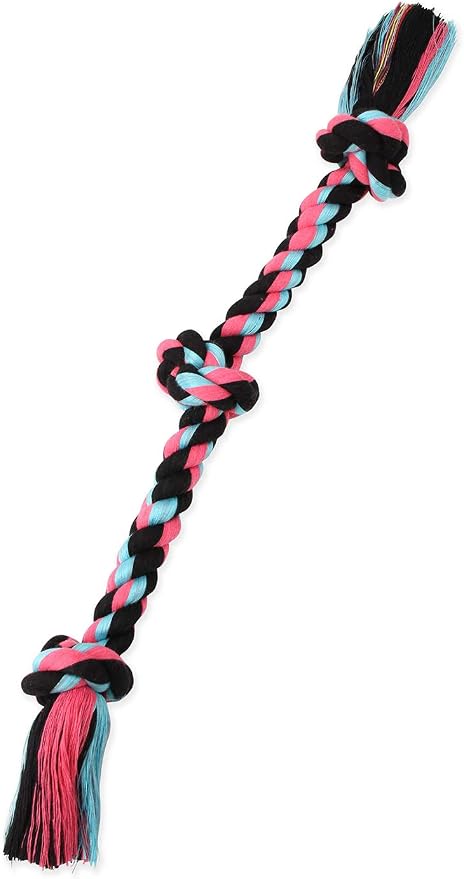
PRODUCT MENTIONED
Mammoth Flossy Chews Rope Tug, Medium 20-inch (20012F)
Amazon · Details on the retailer’s website
Cleaning does not restore a worn rope
Follow the care instructions supplied with the exact toy. The checked sources do not establish a product-specific washing temperature, dishwasher cycle or disinfectant recipe for this variant. Ask the manufacturer for the correct care method before using one.
Inspect the dog rope toy after permitted cleaning and before the next game. Cleaning can remove visible dirt without repairing separated strands, a loose knot or a weakened attachment. If the material is damaged, end its use rather than trimming it into a seemingly tidy shape and assuming the original strength has returned.
Store the dog rope toy away when the game ends. Keep it separate from ropes or cords used for household purposes so that your play routine does not become permission to grab any dangling item. Before reoffering it, verify condition again instead of assuming a previous inspection remains current.
Consider the practical cost as repeated inspection, cleaning and replacement when needed, not just the purchase price. If that upkeep does not fit your routine, a different supervised activity may be more useful than choosing a more elaborate rope design.
Build variety without making rope the whole routine
Vary play according to the dog, rather than continuing tug until the dog is tired or the toy fails. The Dogs Trust enrichment guide recommends considering health, abilities, preferences and signs of enjoyment or frustration.
A searching game, a calm training task or a suitable food activity can provide a different interaction. The KONG stuffing guide gives one food-activity example when that toy suits your dog. More intense pulling is not the only progression. If food is used, keep it within the dog’s appropriate daily plan rather than adding unlimited rewards.
Keep a simple record when evaluating a new rope: selected size, grip comfort, what happens during pauses and the condition afterward. You may decide that a short shared game works, that the format is a poor match or that another activity is more enjoyable. None of those outcomes requires a claim that the toy is universally good or bad.
Frequently asked questions
Can I leave a dog rope toy out for solo chewing?
Do not assume that is appropriate. Blue Cross advises supervision even for solo play, and rope needs particular attention to unraveling and missing strands. If the dog picks material apart, put the toy away and choose a different activity. Supervision must include being able to stop the session.
Does a bigger rope solve destructive chewing?
No guarantee is established. A larger size can change grip, but it does not change a dog’s determination to unravel material. Choose around the actual behavior, inspect the whole toy and stop when strands or parts loosen. Do not use size as permission for unattended access.
Does the Mammoth tug replace tooth brushing?
No. The product uses flossing and oral-health marketing, but a dental treatment or prevention outcome has not been independently verified for this rope toy. Choose it for a suitable supervised game. Discuss dental care and mouth discomfort with your veterinarian rather than relying on rope fibers.
What if I think my dog swallowed part of the rope?
Stop the game and contact a veterinarian for guidance. Describe the toy, missing material and any symptoms. Swallowed toys or string can cause serious foreign-body problems. Do not assume cotton-poly fibers are digestible or try a home remedy instead of following professional advice.
A dog rope toy works best as a defined interaction: choose the right grip and size, play comfortably, pause easily and inspect afterward. Its usefulness depends on the dog’s behavior as much as the construction. Loose strands, missing pieces or a change toward dismantling mean the routine needs to stop.
The Mammoth Medium 20-inch tug is one specified option for that role, with clear material and color limits. It is not a dental treatment, an indestructible chew or a universal fit for every dog in its weight range. Confirm the exact model, observe the first games and keep other suitable activities available. The useful result is enjoyable play with a manageable toy, not a rope that remains available at all times.
View Mammoth Flossy Chews Rope Tug, Medium 20-inch (20012F) on Amazon.
Comments are reviewed before they appear publicly. Please keep questions and feedback relevant to this article.