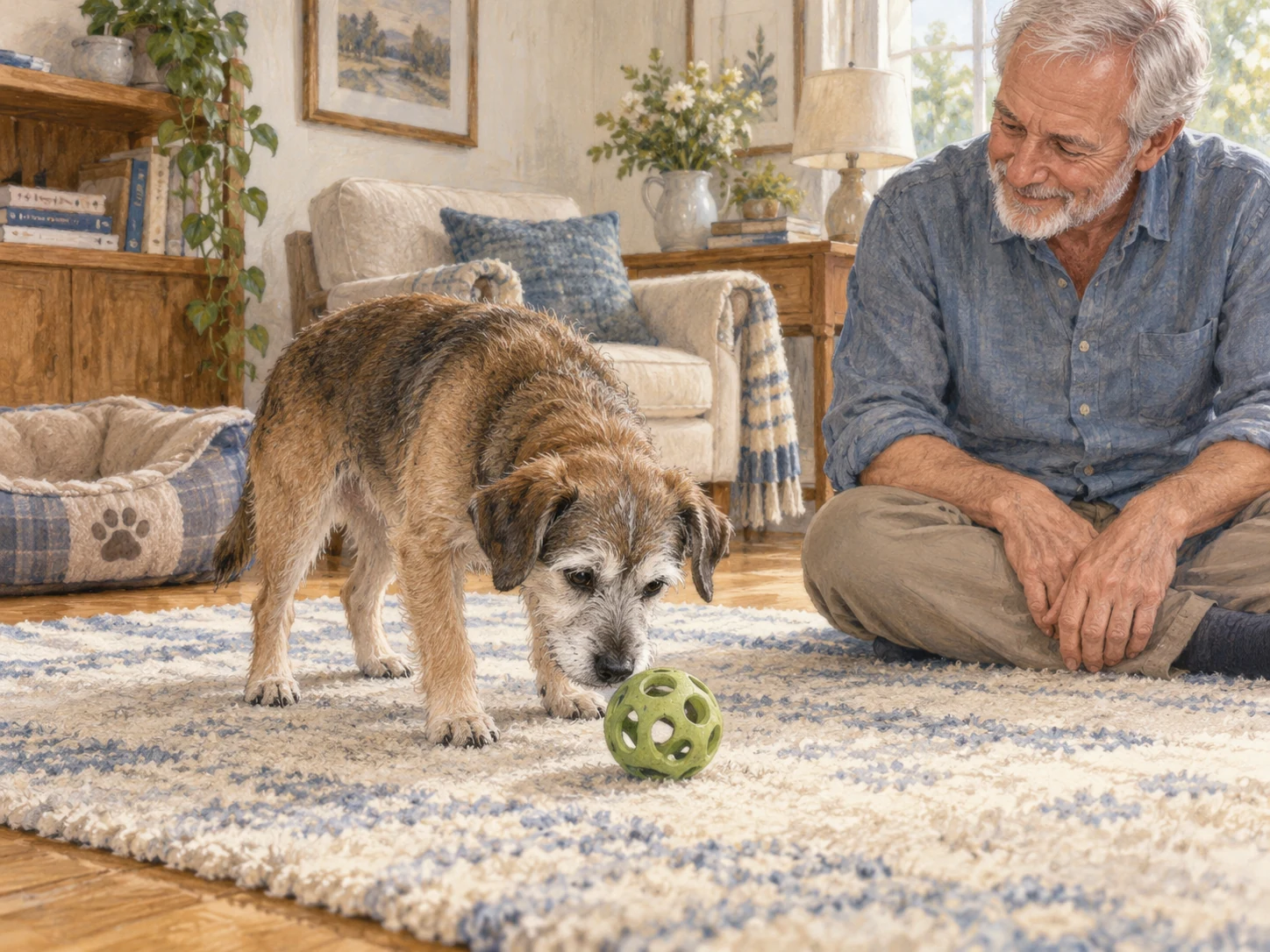
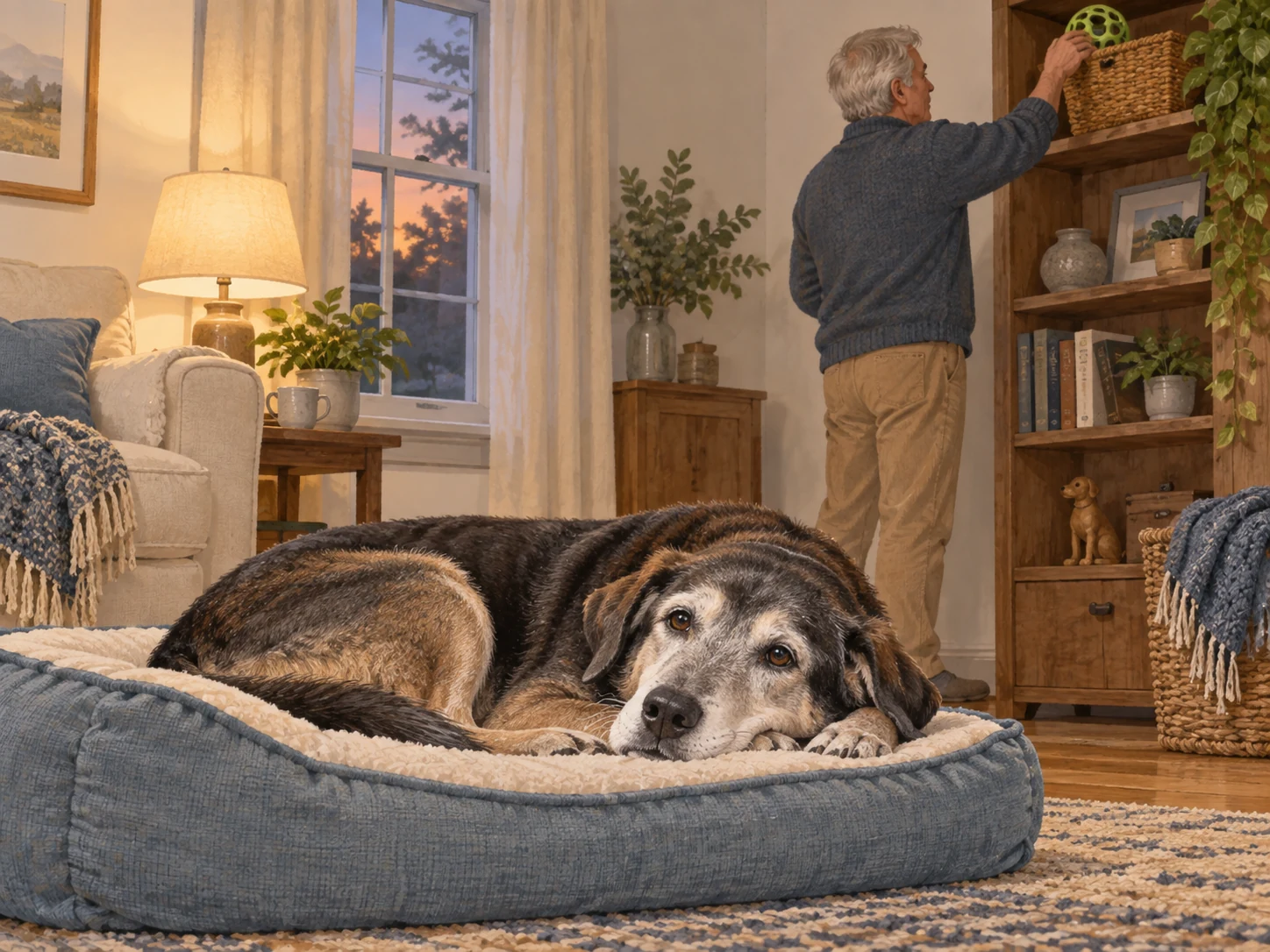
AI-created editorial scene: adapt play to the older dog's current comfort and preference. Generic toy, not a Senior Small product photo or treatment test.
Dog toys for senior dogs should suit the dog’s current comfort, chewing and ability to reach the activity. Age alone does not tell you to buy a smaller toy, a softer material or a harder puzzle.
The selected purple KONG Senior Small is a gentle-rubber option for an appropriate dog. It is not treatment for sore teeth, joint pain or a new loss of interest in play. Check those changes before treating a purchase as the solution.
Choose dog toys for senior dogs by current ability
Start with what the dog comfortably does today. Can the dog approach the toy, pick it up or work for accessible food without awkward movement? A game that suited the dog years ago may need a different setup now.
The American Veterinary Medical Association’s senior-pet guidance emphasizes that age is not a disease. It also notes that changes in play, activity or behavior can have medical causes and should prompt veterinary assessment. Do not assume a dog has simply become too old to enjoy enrichment.
Tell the veterinarian what changed: avoiding a familiar chew, dropping a toy, struggling to settle or declining a previously easy activity. Those observations do not diagnose the cause, but they are more useful than buying increasingly tempting toys without investigating discomfort.
Once the care plan is clear, choose activities within it. An older dog can still have preferences and enjoy a challenge, while needing shorter or more accessible sessions. Let the dog’s response guide the task instead of trying to reproduce a younger dog’s routine.
| What you observe | Useful next check | What not to assume |
|---|---|---|
| Enjoys gentle chewing | Rubber fit, mouth comfort and intact toy condition | Any soft toy is appropriate |
| Likes food games but gives up | Food access, difficulty and comfort | A more tightly packed puzzle provides more benefit |
| Struggles to reach or carry the toy | Placement, size and the individual activity plan | Every senior dog needs the Small size |
| Suddenly avoids play or chewing | Veterinary assessment of the change | A new toy will resolve pain or illness |
| Becomes tired or worried | A break and an easier activity when appropriate | Finishing a game matters more than comfort |
Separate soft rubber from a medical decision
KONG’s rubber-selection guidance describes purple Senior rubber for gentle chewers and aging dogs. That formulation is a product choice; it does not establish that chewing is suitable for a dog with a painful mouth or a specific dental condition.
Ask the treating veterinarian about toys and food activities when dental work, missing teeth, pain or another condition affects the care plan. Do not use a softer toy to test how much discomfort the dog will tolerate.
Chewing strength remains individual. An older dog may still damage a gentle formula. If the dog tears at rubber, stop access and reassess the activity instead of assuming the Senior name guarantees a safe match.
Keep clinical care and enrichment separate. A toy can offer an appropriate activity after assessment; it does not clean diseased teeth, restore mobility or prove that a behavioral change is harmless.
A defined option: KONG Senior Small
The selected product is KONG Senior Small, purple natural rubber, item model KN3E, ASIN B000S6PQX2. The current Amazon selection is Small, pack of one. Keep that size distinct from the broader Senior product family.
The KONG Senior product page describes a stuffable natural-rubber toy intended as a gentle chewing outlet for aging dogs. It also describes an erratic bounce. Those features give you possible activities to assess, not a requirement to make the dog chase or chew.
For a dog whose size, chewing and care plan fit, check the KONG Senior Small purple rubber toy, ASIN B000S6PQX2, on Amazon. Confirm the actual size and condition before use.
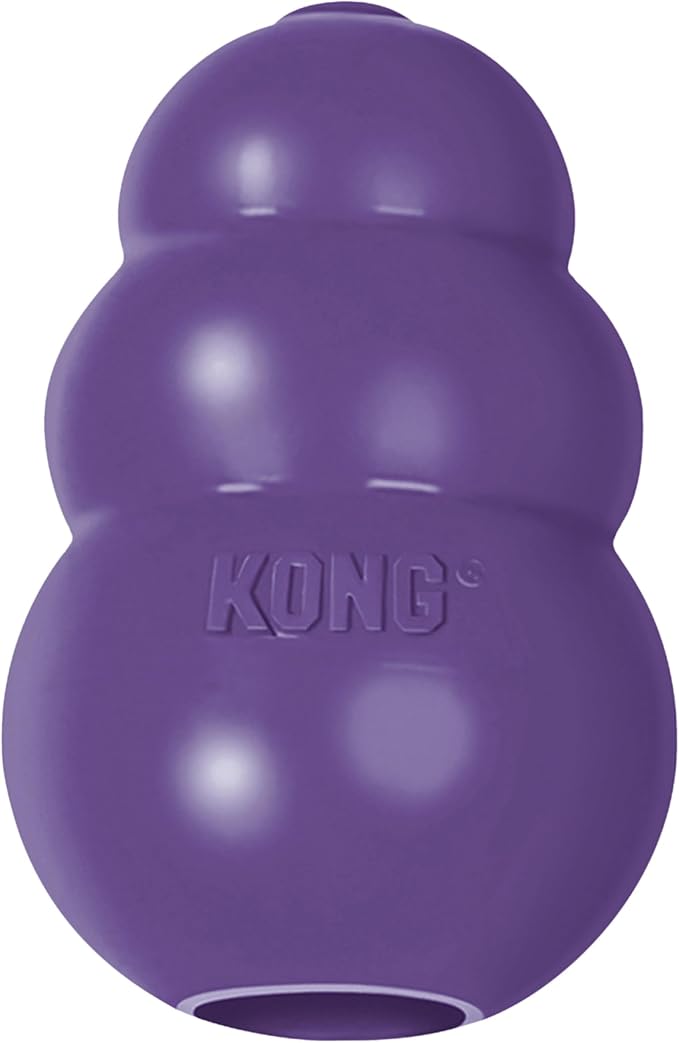
PRODUCT MENTIONED
KONG Senior, Gentle Natural Rubber Stuffable Dog Toy, for Small Dogs
Amazon · Details on the retailer’s website
The practical attraction is a simple rubber cavity for a manageable food task or gentle carrying and play. The trade-offs include cleaning, inspecting the softer material and judging whether the opening and body suit the dog. Durability, chewing comfort and engagement time have not been independently verified for this model.
Small is a size, not a senior-care instruction
The manufacturer lists Small as up to 20 pounds, but its sizing guidance also considers head and mouth size and advises sizing up when uncertain or between sizes. Being older does not make a large dog a candidate for the selected Small toy.
Consider access by other pets too. KONG advises sizing household toys for the largest dog. Do not leave this Small option where a larger dog can pick it up merely because the intended user is small and older.
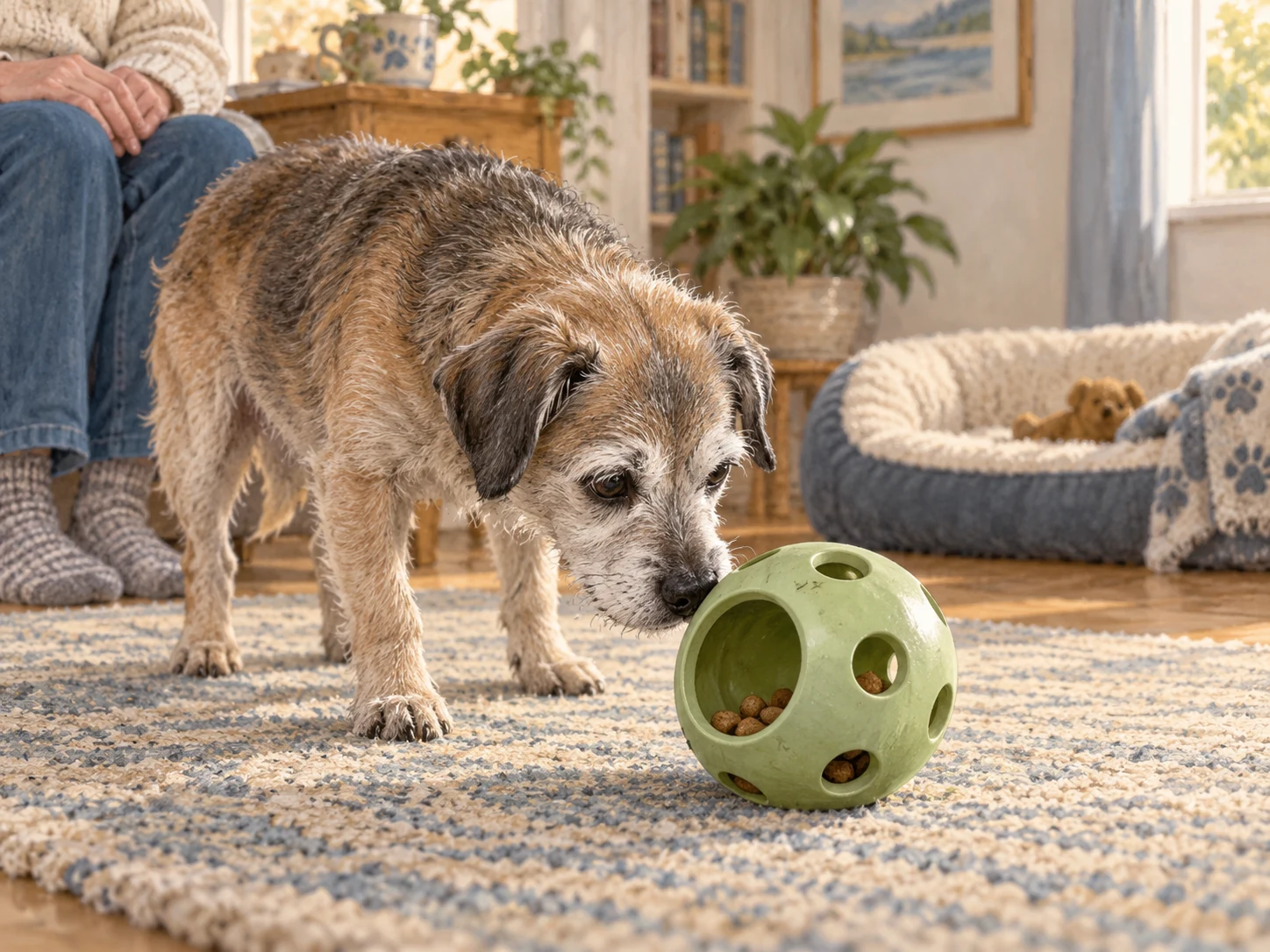
Make dog toys for senior dogs easy to access
Offer the activity in a calm, familiar place with secure footing. Keep the toy within an approach the dog can manage comfortably and allow an easy exit to rest. Avoid adding an obstacle course or slippery chase to introduce a new toy.
Dogs Trust’s enrichment advice recommends considering health, ability, diet and preference, then observing enjoyment and frustration. An easier food task or a short search can provide a different experience from a difficult chew challenge.
Keep one part of the setup familiar when possible. If you change the toy, food, location and difficulty together, it becomes harder to identify why the dog avoids or struggles with the activity. Start with a manageable task and review the response.
For food use, choose a small, accessible amount that fits the dog’s existing diet and care plan. Count it within the day’s allowance. Do not assume a popular topping is suitable for a dog with dietary restrictions or that a smaller cavity automatically supplies the correct amount.
The KONG stuffing guide separates ingredient checks, easy filling and gradual difficulty. Use those food decisions after confirming the toy’s fit, and keep a restricted diet under the veterinary team’s direction.
Adapt the game rather than increase effort
A toy that bounces does not need a high throw. Blue Cross’s play guidance advises against upward throws that encourage awkward landings and cautions about repetitive fetch with turns and sudden stops.
Choose a quiet investigation, accessible food task or short, controlled movement if those fit the dog. Let the toy come to rest before the dog approaches when that makes the activity more manageable. Follow any exercise limits set by the veterinarian.
Stop before fatigue or frustration turns the session into persistence. A dog continuing to follow a toy does not prove that more repetitions suit its body. Breaks and an undisturbed place to rest belong in the routine.
If the dog loses interest, check comfort and task difficulty before adding a richer filling or another toy. A simpler game can be a useful adjustment; a new loss of interest still deserves assessment when it represents a change.
Inspect senior-dog toys through every activity
Check the toy before use, during the activity and afterward. Look at the openings and body for tears, missing material or a changed shape. A soft formula still needs inspection, and damage is a reason to remove access.
The current selected listing explicitly warns that no dog toy is indestructible and calls for supervised play and removal when damaged. Treat that as an ongoing task, not a box checked by watching the first few minutes once.
Do not leave a damaged toy available because it has become familiar or the dog still wants it. Store unusable items away from pets and ask for veterinary advice promptly if you suspect swallowed material. A suspected obstruction needs veterinary assessment rather than an improvised home treatment.
Review fit when chewing behavior, household access or the dog’s condition changes. The right activity can change over time even when the product looks intact. Keep the animal’s response ahead of the wish to make a purchase last.
Keep cleanup and observation simple
Remove leftover food and clean the cavity by the selected package’s directions. Keep openings clear, inspect the surface and dry appropriately before storage. Do not invent a heat treatment, chemical soak or repair for worn rubber.
Record a few useful observations: what the dog attempted, whether the food was accessible, any difficulty carrying or chewing and how the dog behaved afterward. Use changes to guide a conversation with the veterinarian or qualified support.
You do not need to keep making the puzzle harder. A familiar, comfortable activity can remain useful without a longer playtime or more complicated recipe. Review comfort first and keep rest available.
Frequently asked questions
Do dog toys for senior dogs always need softer rubber?
No. The dog’s mouth, chewing style and care plan matter. The selected purple Senior formula targets a gentle chewing role, but it does not treat pain or fit every older dog. Ask for advice when dental or other health conditions affect the choice.
Should an older dog automatically use a smaller toy?
No. Size still depends on mouth fit and other dogs that can reach it. KONG’s Small reference is up to 20 pounds, with additional head-and-mouth and sizing-up guidance. Age alone does not justify choosing this exact size.
Should I freeze the filling to keep the dog busy longer?
Longer is not automatically better. First confirm that the dog can comfortably manage an easy, appropriate activity. Food, temperature and difficulty need to suit the individual care plan. Do not increase the challenge to overcome pain, avoidance or frustration.
Choose comfortable engagement over a harder challenge
Dog toys for senior dogs should support an activity the animal can access and enjoy now. Check new changes with the veterinarian, match size and rubber separately, and keep the introduction easy enough to observe.
The KONG Senior Small is one defined gentle-rubber option when those conditions fit. Keep the Small size, supervision, cleaning and damage checks visible. A useful senior play routine offers choice and rest while giving you a clear view of the dog’s comfort, rather than a promise that one toy suits every stage of aging.
View KONG Senior, Gentle Natural Rubber Stuffable Dog Toy, for Small Dogs on Amazon.
Comments are reviewed before they appear publicly. Please keep questions and feedback relevant to this article.