AI-created generic aquarium surface care scene; not a named-model product photograph or a hands-on test.
A Fluval surface skimmer is worth considering when unwanted film is collecting on the aquarium’s water surface. For the powered SK400, the useful buying checks are the exact model, the floating intake’s operating room and the maintenance you can provide. It supplements the aquarium’s main filtration; it does not turn a surface-film problem into a complete water-quality assessment.
Fluval SK400 is item A208, Amazon ASIN B0CZTZLDKX. It is different from Fluval’s older A240 canister-connected surface intake and from the Sea PS1 protein skimmer. Identify the device before following installation advice or comparing features.
Fluval surface skimmer models: identify SK400 A208
The official SK400 page describes powered surface collection, an adjustable flow slider, a separate intake regulator, an output diffuser and a floating intake assembly. Its sponge collects particles drawn into the unit.
| Check | Documented North American SK400 | Practical limit |
|---|---|---|
| Identity | SK400, A208. | Do not use A240 or PS1 instructions as substitutes. |
| Power | 120 V, 60 Hz; 3.3 W. | Confirm the delivered label and local supply. |
| Nominal flow | 105 US GPH / 400 LPH. | This is a flow rating, not an aquarium volume. |
| Manufacturer aquarium rating | Up to 105 US gal / 400 L. | It does not replace the main filter’s capacity. |
| Body dimensions | Approximately 1.7 L × 2.7 W × 5.8 H inches. | Allow additional room for the floating intake and access. |
| Care | Collection-sponge and impeller maintenance. | The compact body still needs routine attention. |
The North American manual separately lists a European version at 220–240 V, 50 Hz, 2.8 W and 380 LPH. Do not combine the regional ratings or assume a seller’s unit matches your supply because its product photo looks familiar.
Who should choose this Fluval surface skimmer?
The SK400 makes sense when collecting surface residue is a distinct task in an otherwise planned aquarium. It can be useful where the setup lacks a surface overflow, provided there is a suitable location and you can observe how the intake behaves around the inhabitants.
It is a less useful first purchase when you have not identified why the water is cloudy, the main filter is not functioning or the desired task is protein skimming in a marine system. Those are different issues. Surface collection should be selected for the problem it actually addresses.
Consider SK400 A208 when you have an identified surface-film problem, space for its floating intake and a suitable plan for monitoring the inhabitants and cleaning the unit. Skip it if you expect it to replace the main filter, need a protein skimmer or cannot provide the required water-level and intake conditions.
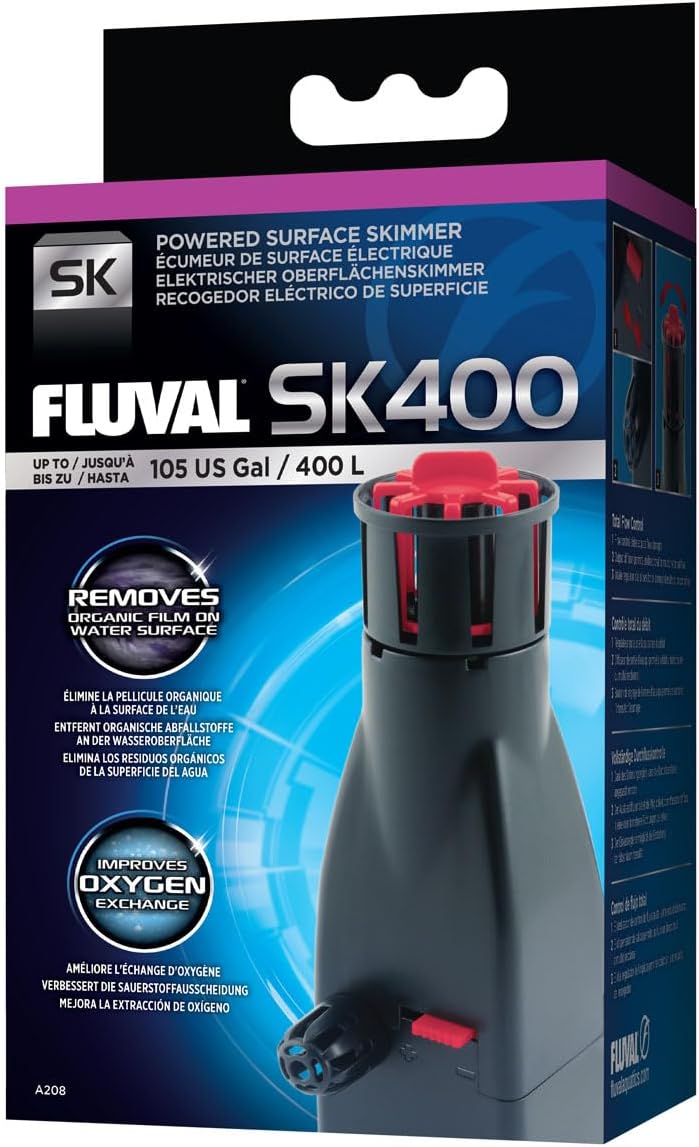
PRODUCT MENTIONED
Fluval SK400 Powered Surface Skimmer — A208
Amazon · Details on the retailer’s website
What surface collection can and cannot show
Fluval identifies several possible contributors to a surface film, including dust, oils, cooking smoke and the fat content of food. Removing a visible layer may improve the display and support gas exchange at the surface, but the visible change does not establish a measured oxygen increase in your aquarium.
Keep ordinary husbandry in view as well as the device. Review avoidable contamination and feeding practices rather than relying on a collector to make every input harmless. A clear-looking surface cannot establish ammonia, nitrite or other relevant water readings.
The manufacturer’s SK400 FAQ says the unit is an addition to traditional filtration and can be used in freshwater or saltwater. That does not make it equivalent to a protein skimmer, which has a different collection process and operating arrangement.
Fluval surface skimmer placement and water level
The North American A208 manual directs owners to an area with the least flow. Positioning the unit where the intake can collect a surface layer is different from placing it directly against the strongest return jet.
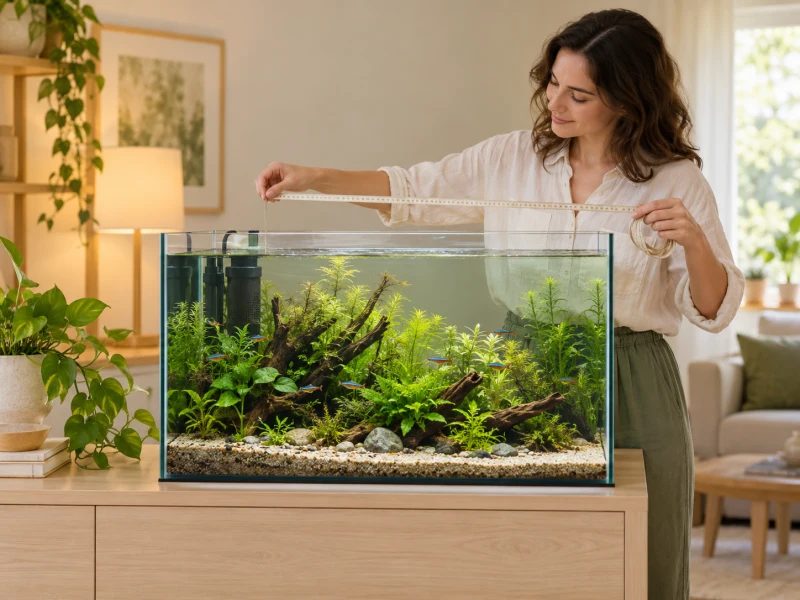
The manual places the body below the water level with the floating intake’s neck extending approximately one inch, 2.5 cm, above the body. The FAQ gives an approximate 2–3 cm range. This allows movement as evaporation changes the water level; it is not unlimited protection against a neglected water level.
Secure the unit with the supplied suction cups, use its spacer arrangement as directed and leave the intake free to move. The manual specifically warns against contact between the electrical cord and floating assembly. Check the actual operating arrangement rather than assuming the float is free because the body is attached firmly.
Before installation, inspect the suction cups and plastic assembly for damage. If parts are missing, resolve that before powering the unit.
Install and handle equipment only with the required power precautions. Never use a dry tabletop run to test a unit intended to operate in water. Keep plugs and connections dry and follow the actual manual’s cord and drip-loop instructions.
Fluval surface skimmer flow: use both controls
The intake regulator and flow slider perform related but different adjustments. The first changes skimming intensity; the second changes overall flow strength. Start from the manufacturer’s setup instructions and observe the actual result rather than treating maximum output as the default goal.
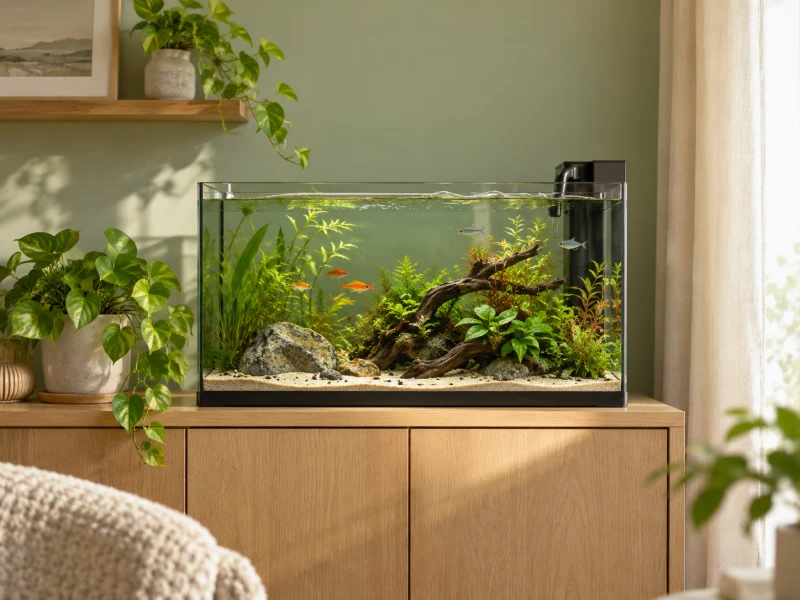
Watch the inhabitants as well as the surface. The aquarium’s species, size and layout matter when assessing flow. A nominal capacity number does not demonstrate that every small fish, fry or shrimp can safely approach the intake in every configuration.
If an animal becomes trapped or behaves unusually around the device, stop and assess the situation, including injury, intake access, condition and flow. Do not assume it proves a pre-existing illness. A general manufacturer’s explanation cannot diagnose an individual animal.
Seek model-specific advice about any needed intake protection. Do not improvise a modification that obstructs water flow or prevents the floating assembly from operating correctly. The current sources do not establish a universal shrimp-safe or fry-safe configuration.
Interpret bubbles and a moving float carefully
The manufacturer says the floating intake can bob with surface agitation. Movement alone is therefore not proof of a fault. Check whether it is free to travel and whether collection is continuing in the intended operating arrangement.
Bursts of fine air bubbles can indicate positioning too close to the surface or an obstructed intake, according to the FAQ. Inspect the stated causes with equipment disconnected before handling it. Do not immediately replace a working motor because a surface-level adjustment is needed.
If the intake fits too tightly, the FAQ directs attention to aligning its ribs with the body slots and checking for debris. Do not force parts or treat resistance as permission to trim the assembly. Obtain support if correct fitting is unclear.
Fluval surface skimmer care: sponge and impeller
Collection creates a maintenance task: debris must be removed from the device. The manual calls for sponge rinsing every few weeks, with more frequent care where film accumulation is heavier. The FAQ describes monthly rinsing, so condition and the current supplied instructions should guide a practical inspection routine.
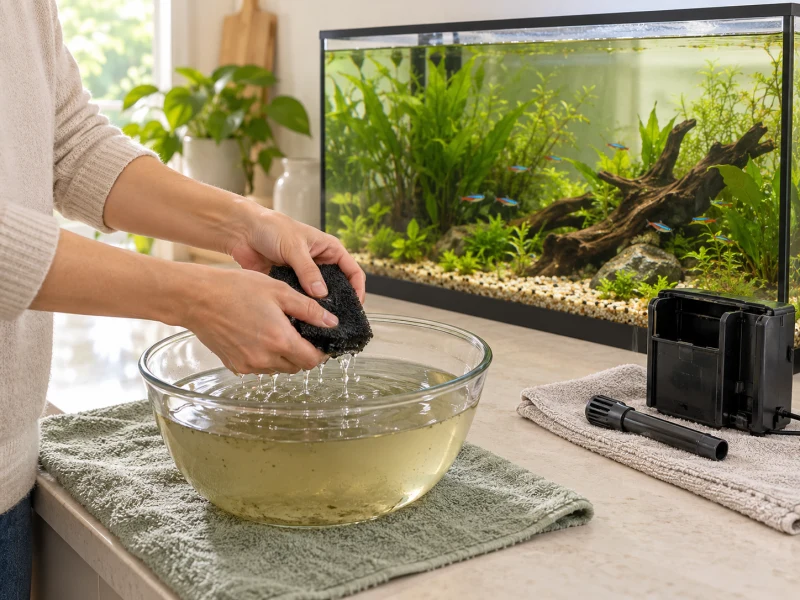
Disconnect all relevant aquarium appliances before maintenance, remove the unit and follow the documented disassembly. This collection sponge’s care should not be confused with replacing the aquarium’s complete established biological filter. Keep the main filtration’s own instructions in view.
The manual calls for monthly impeller cleaning and recommends yearly impeller replacement, identifying A16685. Confirm the actual unit and current replacement before ordering. Reduced output can also involve intake debris; check both the water path and permitted impeller care instead of assuming one cause.
Never submerge the electrical plug when cleaning components. Follow the manual for any permitted mineral-deposit cleaning and thorough rinsing. Avoid inventing a concentration or using instructions for a different motor or skimmer.
Keep testing alongside surface care
OATA’s freshwater water-testing guidance explains why appearance does not establish suitable conditions. A newly clear surface is one observation, separate from relevant chemical tests and the animals’ behavior.
Keep records if you are investigating a recurring film or flow issue. Note recent feeding, maintenance and equipment changes, then assess the pattern. A skimmer becoming dirty quickly can mean it needs more frequent attention; it does not by itself identify the original source of the material.
If the aquarium’s broader conditions are concerning, address those directly with appropriate aquatics advice. Adding another device should not postpone checking the main filter, stocking or water quality.
Before buying SK400 A208
Confirm the selected SK400 package and regional rating. Check available space, a suitable low-flow location, the floating intake’s movement and the maintenance access you can provide. Decide how the actual inhabitants will be monitored around the intake.
If those checks fit the task, view the Fluval SK400 surface skimmer on Amazon. Keep A208, the older A240 attachment and protein skimmers separate when comparing instructions.
Common questions
Can a Fluval surface skimmer replace the main filter?
The SK400 FAQ recommends using it in addition to a traditional filter. It does not establish a substitute biological-filtration capacity.
Is SK400 the same as A240?
No. The selected powered SK400 is A208. A240 is a different canister-connected surface-intake product.
Does the floating intake remove water-level maintenance?
No. It needs the documented starting position and room to move. Continue checking the aquarium’s operating water level.
Does the rating guarantee safety for every small animal?
No. Assess the actual inhabitants, flow and intake access. The checked sources establish no universal fry-safe or shrimp-safe configuration.
Comments are reviewed before they appear publicly. Please keep questions and feedback relevant to this article.