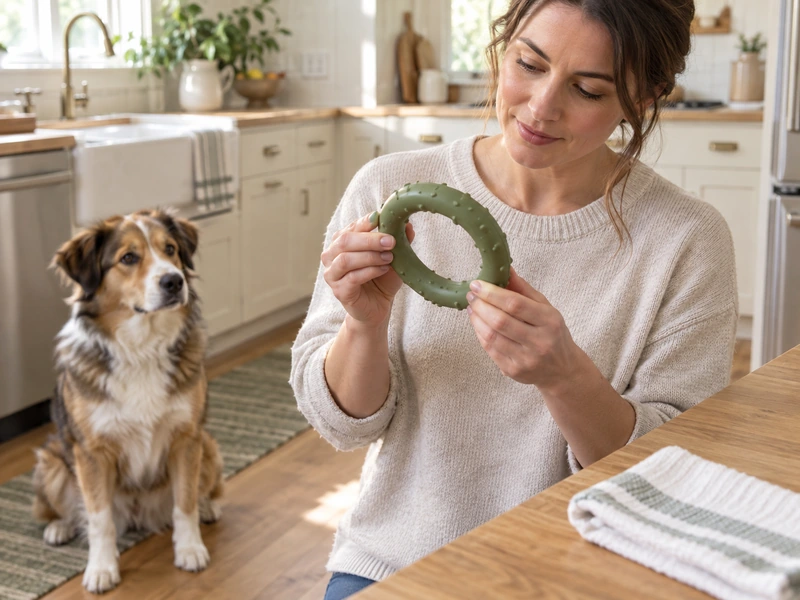
AI-created editorial scene of a generic dog toy; it is not a photograph of West Paw Toppl or evidence that a material is non-toxic.
If you are looking for non toxic dog toys, treat “non-toxic” as a claim to investigate, not a promise that a toy is harmless in every mouth. For a useful purchase decision, ask which material or substance the claim covers, whether the evidence identifies the exact toy, and what happens when your dog chews, cracks or swallows part of it. A well-documented material still needs an appropriate size, intact construction and supervised use.
The West Paw Toppl Large in Aqua Blue is a helpful example because its maker publishes specific material exclusions and describes how the toy is meant to be used. Those statements offer more to assess than an unqualified “safe” badge. They do not establish that every ingredient has been independently tested for every exposure, or that this Toppl can be left with every dog.
How to assess a “non toxic dog toys” claim
Packaging often puts several different ideas together: a named polymer, a list of substances the maker says are absent, a country-of-origin claim and a broad phrase such as “non-toxic.” Each answers a different question. The first describes the material category; the second narrows certain chemical concerns; the third addresses where manufacturing takes place. None alone predicts whether an individual dog can break the toy or swallow a piece.
Look for a statement that can be checked against the product you can actually buy. “BPA-free” names one substance. It does not say that every colorant, additive or attached component has been assessed for all possible uses. “Made in USA” concerns origin. It does not replace a material specification. “FDA compliant” needs a stated regulatory provision and intended use before it means much to a buyer.
| Claim on a dog toy | Evidence worth requesting | Conclusion it does not support by itself |
|---|---|---|
| “Non-toxic” | Named materials, substances assessed, test conditions, product or material identity and a current report or clear manufacturer statement. | That chewing, swallowing or every long-term exposure is risk-free. |
| “BPA-free” or other “free-from” wording | The exact substance, component covered, test method or supplier declaration, and whether color variants use the same formulation. | That all other substances have been tested or excluded. |
| “Food-contact compliant” | The cited rule, the material, and the food-contact conditions covered by that claim. | That a dog toy has FDA approval or is safe to ingest. |
| “Made in USA” | A product-specific origin statement and, for a broad claim, how the maker substantiates domestic content and processing. | That the material is chemically safer or the toy cannot break. |
| “Durable” | The intended chewing category, use guidance and damage-removal instructions. | That any dog can chew it unattended or that it has a guaranteed lifespan. |
A seller may be able to answer some questions with a supplier declaration rather than a public laboratory report. Record which type of evidence you have. A marketing page is useful as a statement of what the maker claims, but it is not the same thing as an independent, SKU-specific test certificate.
Read material labels on non toxic dog toys by component
Start with the part the dog mouths. Is it a single molded piece, a coated surface, a fabric shell, a glued-on feature or several materials combined? If a label says one material is free of a substance, check whether the same claim covers paint, ink, stuffing, squeakers, adhesives and removable accessories. A claim about the main body cannot automatically be extended to an unidentified attachment.
West Paw describes Toppl as a Zogoflex toy and states on its Toppl product page that it is free of BPA, latex, silicone and phthalates. This is a manufacturer statement about its product line, not an independent toxicology result for the Aqua Blue Large unit in your cart. The same page labels Toppl for moderate chewers; that limitation matters as much as the free-from list.
“Plastic” and “natural” are broad descriptions, not safety grades. Natural rubber can contain processing ingredients; a synthetic elastomer can have a well-specified formulation. The better comparison is between named materials, documented exclusions and the way the finished item is used. If a listing gives only a vague material word, ask the maker for the exact construction and applicable evidence instead of assuming one category is always safer.
Exposure also changes when a toy is damaged. A claim about contact with an intact surface does not evaluate a dog swallowing a separated fragment. If your dog tends to slice off edges or pull pieces from toys, select around that behavior first. Another material slogan will not turn a breakable object into an appropriate solo chew.
Check the tests behind non toxic dog toys
For non toxic dog toys, a report is most useful when it names the tested sample, material or finished SKU; the date; the laboratory; the standard or method; and the result or limit. A report for a different color, an earlier formulation or a raw material sample may be relevant, but it does not automatically prove the exact finished toy has the same result. Ask how a maker connects that report to the variant being sold.
West Paw’s Help Center says its Zogoflex and Seaflex materials use processes that comply with a U.S. food-packaging standard and that its toys are tested against the European Child Toy Safety Directive. The public page does not display a SKU-specific Toppl Large Aqua Blue laboratory report, its measured results or a certificate number. Treat the FAQ as the company’s account of its controls. The FAQ does not independently verify the results of those tests for this Toppl variant.
The cited U.S. rule needs a narrow reading. 21 CFR Part 177 is titled “Indirect Food Additives: Polymers” and addresses polymers for specified food-contact uses and conditions. A maker’s food-contact compliance claim is therefore about that stated material and use framework; it is not an FDA endorsement of the whole dog toy, an ingestion study or a guarantee against choking. If a listing says merely “FDA approved” without identifying what was approved, ask for clarification before repeating the phrase.
A child-toy test claim is also a matter of scope. It can indicate that a manufacturer checks certain requirements of that standard, but a dog’s chewing style and the consequences of swallowed pieces are separate questions. Look for the standard and the exact components tested. Do not convert a passing result in one category into a lifetime safety promise for a pet.
If you request additional evidence, a precise email is more useful than asking whether the toy is “safe.” Ask: “Does your current report cover Toppl Large Aqua Blue, including its colorant, and the product sold under this model or UPC? Which substances and exposure conditions were tested? May I see the date, laboratory and standard?” A refusal or missing document does not prove the product is unsafe. It does limit how strongly you can repeat the claim.
Made in USA answers a different question
Some shoppers searching for non toxic dog toys made in usa want both material transparency and a traceable manufacturing location. Keep those as separate checks. West Paw marks Toppl “Made in America” on its current product page and says in its Help Center that most, but not all, of its products are made in Bozeman, Montana. For a specific purchase, use the Toppl product statement and check the selected listing rather than applying a company-wide percentage to every item it sells.
The Federal Trade Commission’s Made in USA guidance explains that an unqualified U.S.-origin claim generally requires a product to be “all or virtually all” made domestically. This is a standard for an origin claim, not a chemical or dog-use safety test. Domestic manufacture may make a supply chain easier to question, but you still need the material and product evidence described above.
If a merchant listing, a manufacturer page and packaging disagree about origin, do not resolve the conflict by guessing. Save the exact product name, color, size and seller, then ask the brand which origin statement applies to that item. A marketplace title copied across multiple variations may not be enough to establish the provenance of the one in the cart.
Size, construction and wear remain part of the safety decision
Material claims cannot settle physical fit. The American Animal Hospital Association’s chew-toy guidance calls attention to a dog’s chew style and mouth size; it also warns that too-small toys and broken pieces can present choking or intestinal-blockage risks. A toy that is suitable for gentle food work may be a poor choice for a dog that dismantles toys quickly.
Assess the toy as it arrives, not just the stock photograph. Check for cracks, loose sections, sharp edges, detached parts and any label or accessory that must be removed before play. Supervise the first session so you can see whether the dog licks and works at the food or starts attacking a thin edge. Pause when the dog looks frustrated, has trouble reaching the filling or changes from working the food to tearing the toy.
Inspect again after use and cleaning. West Paw says Toppl is top-rack dishwasher safe and its Help Center advises taking away a toy with damage or missing pieces. That cleaning permission does not repair cuts or prove every household dishwasher setting is suitable. Follow the care label for the exact item, and retire it when you cannot account for missing material.
If a piece may have been swallowed, contact a veterinarian for advice and describe the toy and missing section. Do not assume a polymer marketed as non-toxic is digestible. Chemical exposure and a lodged object are different risks, and the absence of one claim does not answer the other.
Worked example: Toppl Large Aqua Blue
The mapped example is West Paw Toppl Large, Aqua Blue, ASIN B00N54E9MI. The current Amazon product page identifies that size and color, and the maker’s Toppl page lists Large as a 3/4-cup-capacity option made from Zogoflex. Capacity describes space for a planned portion; it is not a feeding recommendation. The manufacturer’s moderate-chewer label still applies. Independent testing by Warm Paw Pets has not been performed for this model, and the toy may not suit every dog.
This is a reasonable candidate to consider when you want an open, fillable food toy and your dog can use the Large unit comfortably without biting pieces away. It is a poor match when the dog persistently destroys similar toys, can fit it too far into the mouth, or needs an item to leave unattended. Confirm the current package and seller details before buying. For the separate decision about Small, Large and XL fit and pairings, use the Toppl size guide; material and safety claims still need product-specific support.
If the Large Aqua Blue variant fits that role, view the exact Toppl Large Aqua Blue listing on Amazon and recheck the product name, size and ASIN before ordering. Confirm Large, Aqua Blue and the specified ASIN at checkout rather than relying on a similar-looking variant.
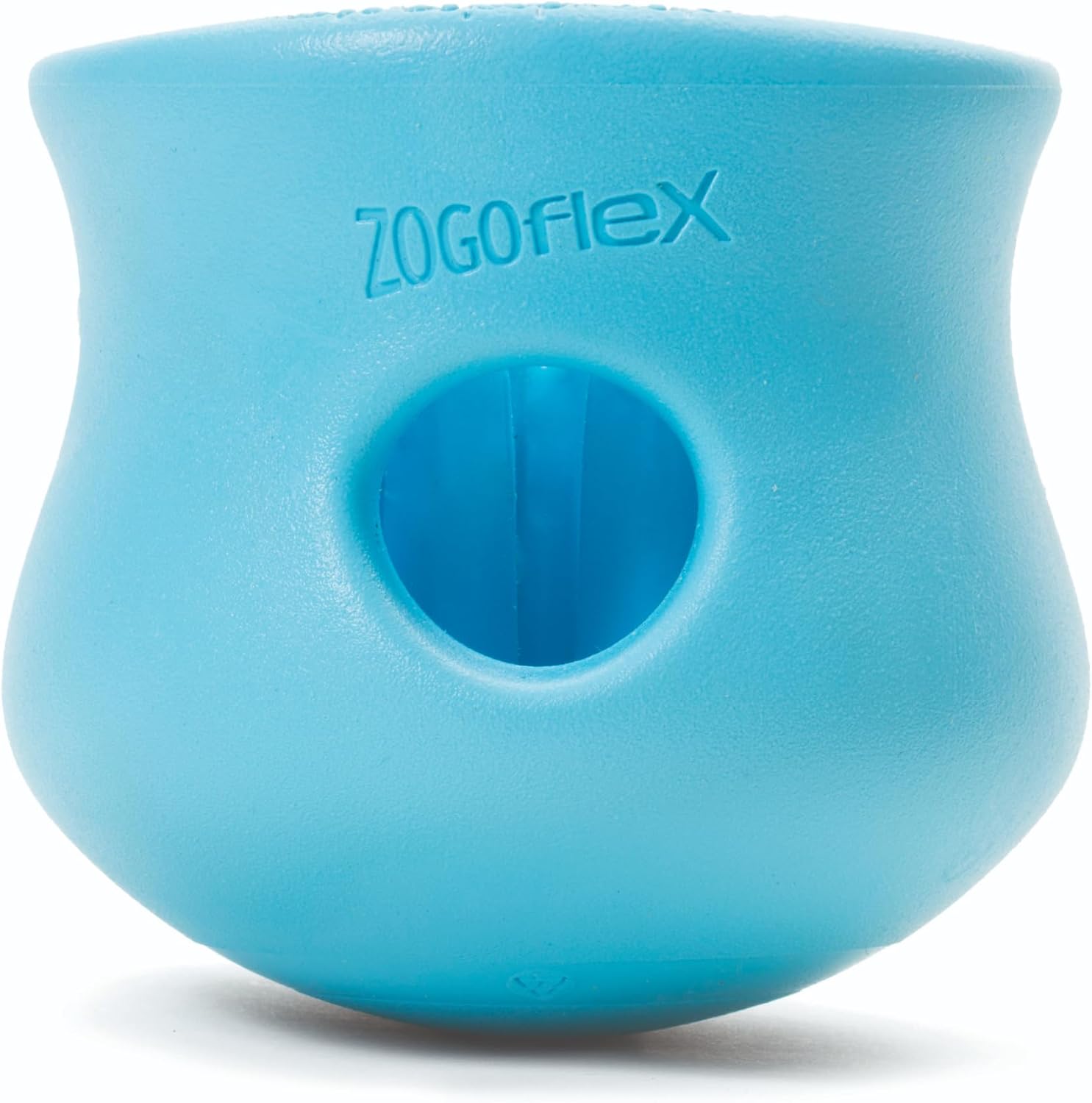
PRODUCT MENTIONED
West Paw Toppl — Large (Aqua Blue)
Amazon · Details on the retailer’s website
A five-question check before adding any toy to the cart
- What exactly is the item? Record the maker, model, size, color and seller. A range page can mix several formulations or components.
- Which materials and parts are covered? Ask whether exclusions cover the whole finished toy, not only the main polymer or fabric.
- What evidence is available? Separate a manufacturer statement, supplier declaration and independent test. Check the tested sample, standard, date and conditions before calling them equivalent.
- Will this dog use it as intended? Compare mouth size, chew behavior, food access and supervision needs with the maker’s guidance.
- What will make you stop using it? Decide in advance that cracks, separated fibers, missing pieces or a change toward dismantling end the session.
You need not buy a toy merely because it has a long list of claims. If the documentation is too vague, the size is wrong or the dog quickly destroys similar items, ask for clarification or choose a different supervised activity. If the materials are adequately described and the toy fits the dog’s behavior, keep using the same checks after purchase; a label is not a permanent substitute for inspection.
Questions about non-toxic dog toys
Does BPA-free mean a dog toy is safe?
It tells you that the maker claims the covered part does not contain BPA, or meets the stated limit if one is supplied. It does not identify every other component, prove resistance to chewing damage or address a swallowed piece. Ask what was assessed and for which variant.
Is “FDA compliant” the same as FDA-approved for dogs?
No such conclusion follows from the words alone. West Paw refers to a food-contact material standard; Part 177 addresses specified polymers and food-contact conditions. That is narrower than an approval of the finished pet toy or a finding that ingestion is harmless.
Does Made in USA prove non-toxic materials?
No. It is an origin claim. The FTC’s guidance concerns how marketers substantiate domestic manufacture. Review material composition and product-specific evidence separately, then assess the dog’s physical use of the toy.
Ask whether it can at least identify the tested material, components, standard and date. Do not invent a failure or a certification. Decide whether the remaining information is sufficient for your own purchase threshold, taking the dog’s chewing style and supervision needs into account.
Choose a documented toy you can inspect
For non toxic dog toys, the most useful claim is a narrow, traceable one. It names the product and material, says which substances or conditions it addresses, and leaves room for the physical risks of real dog play. Toppl Large Aqua Blue offers a relatively specific maker statement to examine, but that statement is not an independent all-hazards guarantee. Confirm the variant, match it to the dog, supervise its use and remove it when its condition changes.
Comments are reviewed before they appear publicly. Please keep questions and feedback relevant to this article.