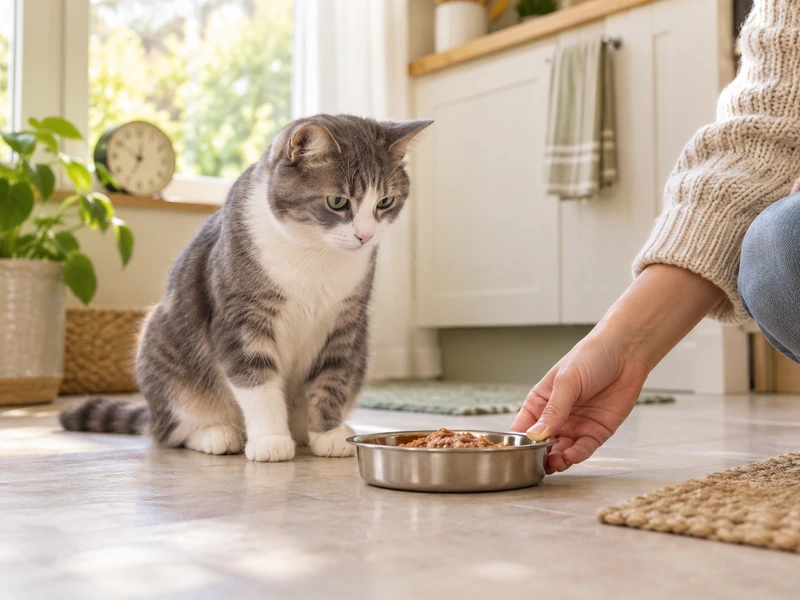
AI-created editorial scene about a feeding routine; the ordinary bowl is not a PETLIBRO product and this is not product testing.
A PETLIBRO wet food feeder can make scheduled meal access more convenient, but Polar’s three-day marketing is not a general refrigerated-storage allowance. Consider this stainless-tray Polar only when your food’s handling requirements, regular checks and cleaning fit the plan. If you need ordinary refrigerator conditions or a sole feeding solution for an unattended trip, do not assume this device provides them.
The selected product is the black PETLIBRO Polar Smart Wet Food Feeder, ASIN B0GRHQGDCB, sold as Feeder. Its retail title says 2026 New Version and its metadata identifies PLAF109. That year label does not prove a lower cooling temperature or a newly validated food-storage period.
| Your requirement | Buying implication |
|---|---|
| Scheduled wet-food access with regular caregiver checks | Consider Polar only after the exact food’s handling requirements and the device’s documented limits have been reconciled. |
| Storage equivalent to a household refrigerator | Not established by the manufacturer’s cooling claim; keep food requiring refrigeration under its required conditions. |
| A sole feeding solution for an unattended trip | Do not treat the meal slots or app status as a substitute for a person checking the cat, food and equipment. |
| A routine that survives an interruption | Arrange an appropriate alternative meal and a person who can respond to uncertain cooling or power loss. |
PETLIBRO Wet Food Feeder: What This Polar Version Offers
The practical features are scheduled access, app control and a removable stainless-steel tray. Their value depends on whether your cat can use the feeder and you can provide the necessary food handling and upkeep.
| Item to check | Current selected-product information |
|---|---|
| Selected package | Black / Feeder; the target listing says one three-compartment stainless-steel food tray is included. |
| Model and version | Retail metadata: PLAF109. 2026 New Version is a retail description, not independent proof of a thermal upgrade. |
| Tray capacity | The current manufacturer specification lists 200mL per serving across three meal compartments. |
| App connection | 2.4GHz Wi-Fi for PETLIBRO app control, schedules and feeding-status features. |
| Cooling | Manufacturer-described semiconductor cooling without ice packs; food-storage limits still require checking. |
| Maintenance | Removable steel bowl and powered base have different cleaning instructions. |
The current Polar stainless-steel page describes a steel bowl with numbered meal positions and a changed three-prong adapter compared with the plastic-bowl version. It does not establish a colder 2026 cooling system. Check the supplied unit and adapter rather than choosing accessories from an older diagram.
Polar Cooling and Wet-Food Storage Are Different Questions
The important comparison is between a manufacturer cooling claim and the storage conditions your food requires. A claim that meals stay fresh is not the same evidence as a food-specific safety assessment.
Read the temperature with its test conditions
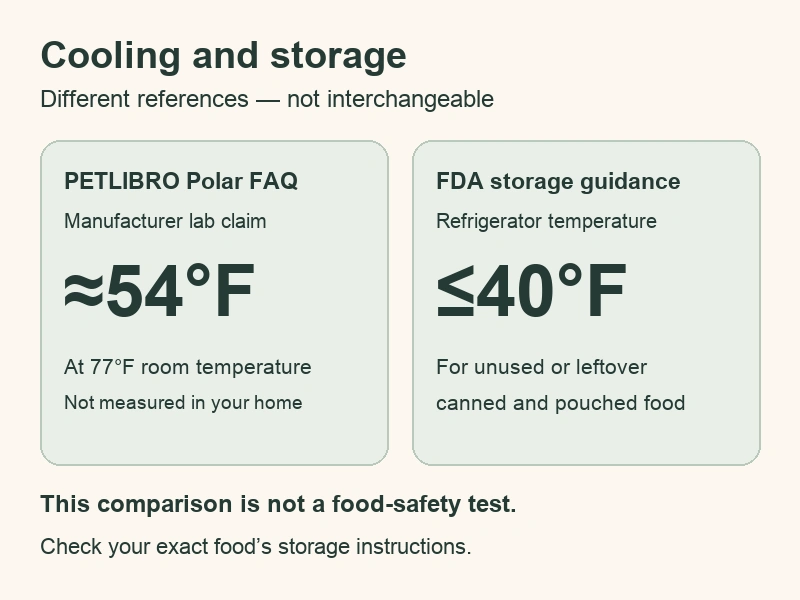
PETLIBRO’s current US FAQ says that, in its laboratory with a room temperature of 25°C / 77°F, Polar can cool food to around 12°C / 54°F. This is a brand claim with a stated ambient condition. The page does not provide a complete food-type, loading, sampling or microbial-testing protocol.
It is not a measurement of your filled tray at home. Different food loads, room conditions and serving events should not be silently treated as the same experiment. Nor should an older Polar page’s different temperature or capacity be imported to make this selected version appear colder.
Keep the FDA guidance separate
The FDA’s pet-food storage guidance says unused or leftover canned and pouched pet food should be promptly refrigerated or discarded, with the refrigerator set to 40°F or below. That is approximately 4.4°C, appreciably colder than the brand’s roughly 54°F claim.
These sources do not establish that Polar meets ordinary refrigerated-storage conditions. They also do not calculate a safe holding time for every food or constitute an FDA approval, product ban or test of this feeder. Follow the food label; obtain food-producer guidance when the proposed handling conditions are unclear.
If an opened food requires refrigeration, do not treat the feeder’s three-day advertisement as evidence that its requirements are met. Keep unused food properly refrigerated, and do not automatically prefill three days of meals because a schedule can be programmed that far ahead.
PETLIBRO also describes pausing cooling for about 30 minutes before serving so the offered portion can move toward room temperature. That is not a guaranteed measured serving temperature, a heater specification or proof of improved digestion. Include serving exposure in the handling plan rather than treating all food as continuously refrigerated.
Plan the Food and the Meal Slots Together
Choose the food-handling plan first, then program meal access to match it. Three compartments do not automatically mean three days of appropriate storage.
PETLIBRO lists commercial canned, pouched, semi-moist and prescription canned foods, while recommending that raw food be avoided in Polar. A listed food category does not override the individual product’s storage instructions. For a prescribed or special diet, check the food label and your veterinarian’s feeding directions before relying on an automated routine.
The current 200mL specification describes volume. It is not 200g of every food, a calorie allowance or the amount every cat should eat. Choose portions from the cat’s actual feeding plan, and check whether a filled compartment and the feeder’s access height suit the cat.
Match the tray to the saved plan
PETLIBRO’s meal-schedule and refill instructions include one-, two- and three-meal daily templates, including an option using one food section with daily refilling. These are software examples, not permission to hold every opened food for three days.
The support page requires refilled sections to match the selected meal positions and describes refreshing their position for a repeating plan. Use the current unit’s instructions and app interface for that process. Do not assume that simply adding food makes the saved plan point to the correct compartment.
The selected listing also describes Feed Now and reopening unfinished meals. Those controls change access, not the food’s preparation history. Reopening an old portion or cooling it again does not reset its handling time or make questionable leftovers newly prepared.
Keep a food and caregiver record for each refill
| When | Record for this meal or refill | Action to resolve before relying on the plan |
|---|---|---|
| Before loading | Exact food, label directions and any food-producer guidance for the proposed conditions. | If required storage conditions cannot be met, use proper refrigeration and another feeding arrangement. |
| At preparation or refill | Opening/preparation time, actual portion and compartment number. | Match the filled position to the saved plan; later cooling or reopening does not reset the food’s history. |
| Before scheduled access | Meal time and the named person responsible for checking food, cat and equipment. | Use a supervised trial; do not infer intake or food condition from an app event. |
| After use | Leftovers handled under the food’s directions and food-contact parts washed and dried. | Keep food-contact cleaning separate from wiping the powered cooling area. |
| If cooling or power becomes uncertain | Known interruption, responsible person and alternative feeding method. | Follow the food’s storage/discard requirements; an opening lid does not establish continued cooling. |
Observe a trial routine while someone is present and record what actually happened. Keep the food producer’s handling requirements with the plan. A feeding-status record does not prove how much was eaten, or which pet ate it in a multi-pet home.

Power Loss and Internet Loss Need Separate Plans
A meal opening during an outage does not mean cooling continues. Establish what the device can preserve before counting on any backup feature.
Do not count AA batteries as refrigerated storage
The PLAF109 manual currently linked by PETLIBRO says refrigeration stops during battery-backed operation, although feeding schedules can continue. This illustrated document dates from 2024 and predates the identified bowl and adapter changes; it is not a separately verified 2026 manual.
The current product page also has an eight-hour backup heading alongside twelve-hour feeding text. Do not promise an exact outage duration for your unit from that inconsistency. The decision that matters for food is simpler: backup feeding is not evidence of continued cooling.
Before depending on backup operation, obtain instructions matched to the delivered stainless-tray unit, its adapter and its backup-power arrangement. Ask separately which meal functions remain available and whether cooling continues. An older family document is not evidence that a changed component uses the same procedure.
Use the supplied, correct power equipment and suitable placement. If cooling is interrupted or its performance becomes uncertain, follow the food’s storage and discard requirements rather than continuing a plan because the lid still opens. A restart, running fan or cool-feeling surface does not validate the food’s temperature history.
Offline operation has a cycle limit
PETLIBRO’s offline-schedule guidance says locally saved plans can run without the network, but specifically qualifies Polar to the current feeding cycle. Remote controls and synchronization require reconnection. Do not broaden that into unlimited repeating meals while offline.
Internet loss and electrical loss are different events. A disconnected app does not necessarily describe the cooling state, and a working app does not certify the food. Keep a person available to check operation and provide an appropriate alternative if the routine fails.
Clean the Tray Without Washing the Powered Base
The stainless bowl’s washing permission applies to that component. It does not make the whole feeder dishwasher-safe.
The current stainless-steel FAQ permits hand-washing the bowl or dishwasher washing up to 100°C / 212°F. Follow the actual tray and appliance instructions, and dry it before reinstalling. That temperature limit is not a prescribed sanitation cycle or proof that every setting is suitable.
The FDA guidance calls for food bowls and scooping or measuring utensils to be washed and dried after each use. PETLIBRO’s additional advice to clean connection areas and nooks weekly describes another maintenance task; it does not replace food-contact cleaning after use.
Keep electronics and cooling areas within their instructions
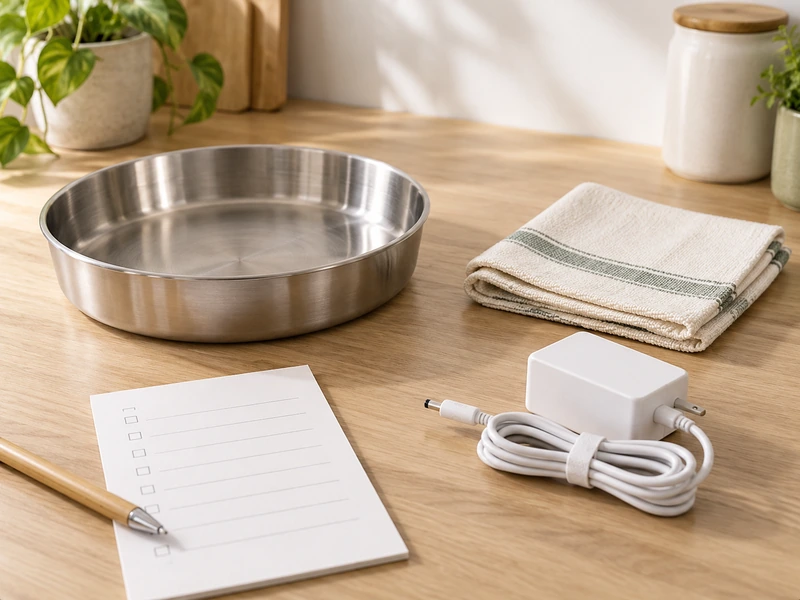
The linked family manual separates removable food parts from the powered body. It specifies dry-towel cleaning of feeding and refrigeration zones and says the base must not be immersed. Fully disconnect the unit, including backup power when fitted, before maintenance as instructed. Do not rinse the assembled feeder or improvise a new-version latch-removal procedure from an old drawing.
PETLIBRO explains that moisture can condense when room air meets the cooled interior, and its current FAQ advises wiping the cooling area dry after a feeding plan. Ordinary condensation does not prove that every leak, spill or malfunction is harmless. Water at a plug or electrical component requires stopping and resolving the problem.
Keep the vents unobstructed and the feeder on a suitable dry, level indoor surface. The linked manual’s room-temperature operating limits are 12–30°C, also described on the current page as 54–86°F. These are environmental limits, not a claim that food is held at refrigerator temperature.
Check Cat Access and the Work You Still Need to Do
Polar is a possible convenience tool when your cat can reach the bowl and your household can manage the food, cleaning and checks. The automation should fit that routine rather than replace it.
Observe actual reach and comfortable use, especially for a small or mobility-limited cat. The manufacturer describes lid-detection features, but those are not a guarantee of suitability for every animal. Do not infer joint benefits, acne prevention or individual-cat access control from a product photograph or a convenient schedule.
Before purchasing, answer these practical questions:
- Does the exact food’s handling plan fit the device’s documented cooling and serving limits?
- Can someone check the cat, portions and equipment rather than relying only on app status?
- Can you wash and dry the food-contact parts and maintain the powered areas correctly?
- Is there suitable placement, power and an alternative feeding plan when something fails?
- Have you checked the selected package and actual seller’s return and coverage terms?
Include food discarded, cleaning work and any actually needed replacement parts when assessing cost. No current price or guaranteed saving is assumed. Check the daily upkeep and setup before choosing a schedule; it must fit the care you can provide.
When to Consider This PETLIBRO Wet Food Feeder
Consider the selected black stainless-tray Polar for scheduled wet-food access when the food-specific handling requirements and your caregiver routine have been resolved. Verify the tray, adapter and current instructions for the actual package; keep the 2026 description separate from unproved cooling improvements.
View the PETLIBRO Polar Smart Wet Food Feeder on Amazon
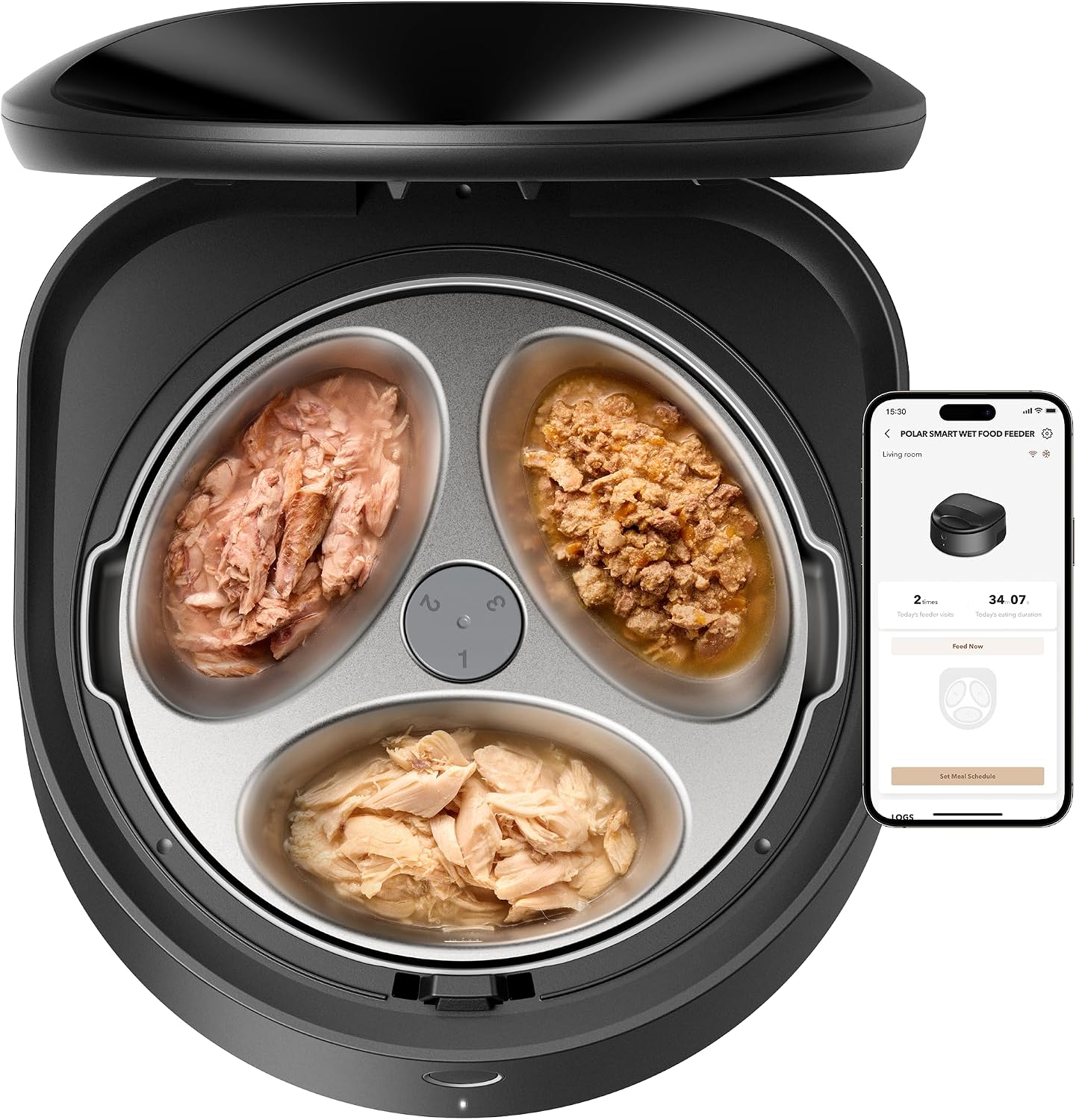
PRODUCT MENTIONED
PETLIBRO Polar Smart Wet Food Feeder — Black with Stainless Steel Tray
Amazon · Details on the retailer’s website
Choose a supervised feeding and proper refrigeration routine instead if food-storage requirements cannot be met, your cat cannot comfortably use the feeder, or nobody can manage an interruption. A device with three meal slots is not a substitute for ongoing care.
The useful PETLIBRO wet food feeder decision is about those confirmed conditions. Do not turn a software schedule, a steel bowl or a three-day slogan into a food-safety guarantee. Resolve an unknown with the food producer or PETLIBRO before relying on it, and retain an appropriate ordinary feeding option in the meantime.
PETLIBRO Wet Food Feeder FAQ
Does the 2026 version cool like a refrigerator?
That was not established. The current US brand claim is around 54°F at a 77°F laboratory room temperature, while FDA general refrigerator guidance for unused or leftover canned and pouched pet food is 40°F or below. The year label does not demonstrate a colder system or food-specific safe holding time.
Are three compartments permission to prepare three days of food?
No. They provide meal-access slots, and the app offers different schedules. Neither the number of compartments nor the advertised three-day period overrides the food label or general storage guidance. Determine appropriate food handling first; do not infer a universal safe interval from the available programming options.
Will backup batteries keep the meals cold?
The currently linked PLAF109 family manual says refrigeration stops on battery backup while feeding can continue. Current web backup-duration wording is inconsistent, so no exact duration is promised. Confirm your unit’s instructions, and treat food handling during lost cooling separately from whether a meal opens.
Can I put raw or prescription food in it?
PETLIBRO recommends avoiding raw food. It lists prescription canned food among its categories, but that is not permission for every medical diet or storage routine. Follow the exact food’s directions and your veterinarian’s plan; the feeder does not determine the right portion or validate the food’s safety.
View PETLIBRO Polar Smart Wet Food Feeder — Black with Stainless Steel Tray on Amazon.
Comments are reviewed before they appear publicly. Please keep questions and feedback relevant to this article.