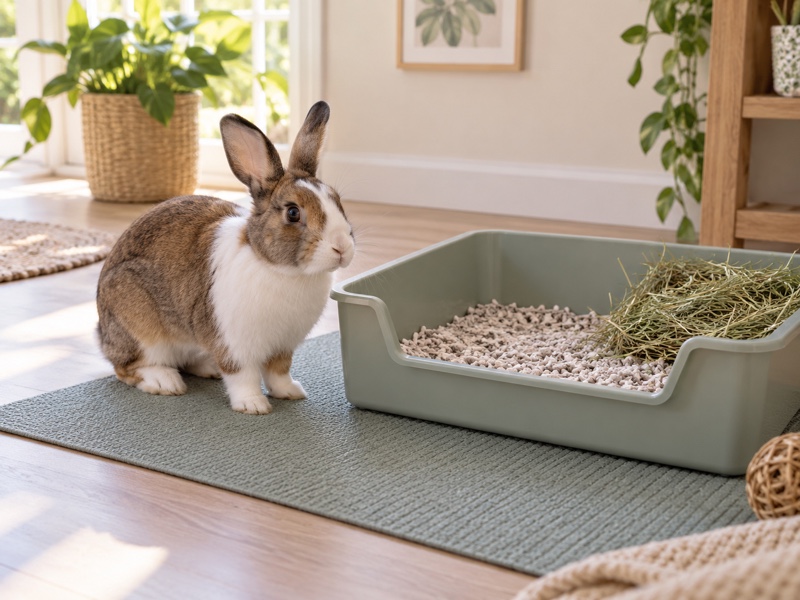
AI-created generic setup scene; not a HOP-01 product photograph, fit test or complete rabbit housing plan.
A rabbit litter box should let your rabbit enter comfortably, turn around and use a clean, supported floor without being forced into position. Check those practical needs before choosing a cover, hay feeder or compact shape. A box that looks tidy in a room can still be too restrictive for the rabbit or awkward to clean.
The selected product is the HOP Rabbit Litter Box, model HOP-01, ASIN B0C5Z83RGD. Its current listing describes a removable hay feeder, pan, lid and detachable access cover, with listed dimensions of 21 × 15 × 14 inches. Those are seller-provided specifications. Independent measurements, fit, cleaning and rabbit-preference results have not been verified for this box.
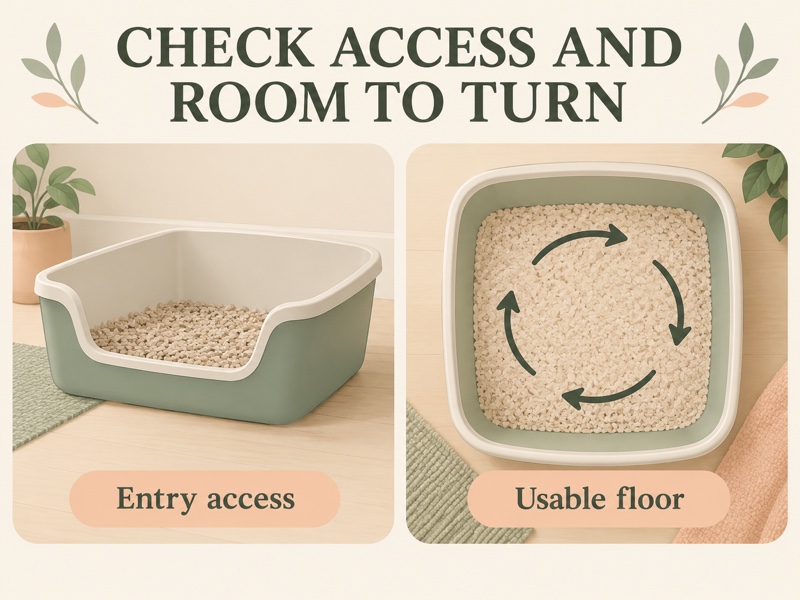
Rabbit litter box fit begins with entry and turning space
The Rabbit.org Foundation’s litter-training FAQ advises choosing a box with room for the rabbit to turn and stretch out, and identifies low-entry options for animals that need easier access. Use the rabbit’s actual size and movement, rather than a photograph of a smaller animal, to assess that requirement.
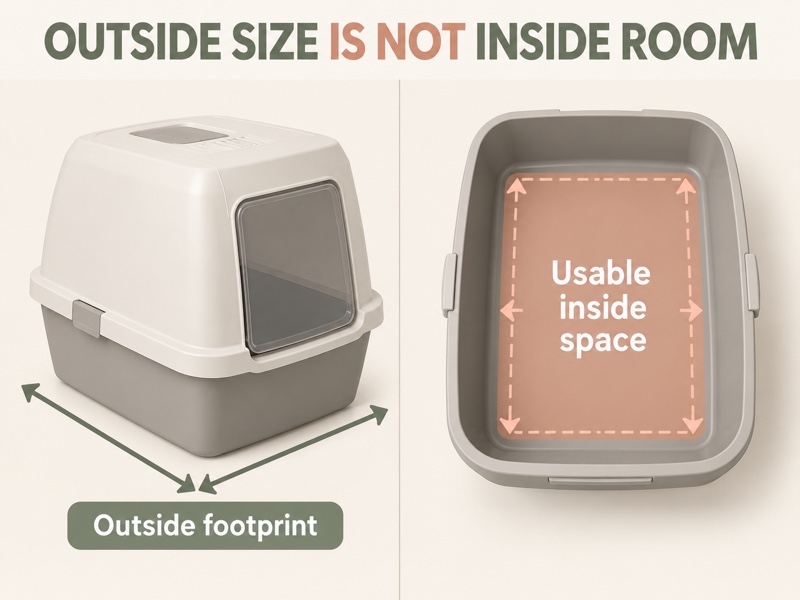
The HOP listing does not establish a verified internal floor drawing or entrance-height measurement in the cited specifications. Its stated 21 × 15 × 14-inch dimensions cannot be treated as usable internal space. Walls, the cover, the doorway and the feeder arrangement can affect what remains accessible.
| Fit check | What to verify | Reason to pause |
|---|---|---|
| Entrance | Actual step-over height, opening shape and the rabbit’s movement | Difficulty entering, hesitation linked to access or an unverified opening |
| Inside floor | Clear area with the selected parts fitted | Rabbit cannot turn or adopt its normal toileting posture |
| Cover | Headroom, ventilation and comfortable exit | Cover restricts movement or the rabbit avoids using it |
| Floor contact | A clean supported surface and suitable litter | Uncomfortable footing, trapped waste or an unsuitable grate |
| Maintenance | Access to remove parts and clean every used area | You must skip cleaning because disassembly is impractical |
The seller’s statement that the box accommodates up to two rabbits does not prove that it fits your bonded pair. Check each rabbit and their access needs. It also does not establish the space required for their living area; a toilet is not a home, rest enclosure or substitute for exercise space.
Understand the HOP-01 parts before comparing sizes
The current seller description calls this a four-part design with a hay feeder, pan or tray, lid and detachable access cover. Confirm the delivered parts and how the manufacturer intends them to connect. The main photo shows the covered configuration and feeder, but it is not a complete assembly manual.
Record the outside footprint separately from the useful inside area. You need enough room around the box to remove the cover, service the feeder and lift out the pan. A location that just accommodates the advertised outer dimensions can still make daily cleaning difficult.
The listing also uses “automatic” language for the hay feeder. The reviewed information does not establish powered feeding, portion control or a schedule. Treat it as an integrated hay-holder feature unless the actual instructions establish otherwise. It still requires checking, replenishment and removal of soiled hay.
Retailer imagery includes rabbits and a guinea pig, and the title names other species. That marketing does not justify housing different species together or sharing a toilet. Each species’ housing, litter and health requirements need separate consideration.
Decide whether a covered rabbit litter box suits the animal
A cover can help contain some scattered material, but it also changes access, headroom, visibility and the work of inspection. The seller presents enclosure as a source of security. That is not evidence that every rabbit prefers a covered toilet or that this design reduces mess in every home.
Ask how the selected parts can be used and removed according to the actual instructions. Do not assume that every component is optional or that a loose cover is safe to leave partly attached. If you plan an open configuration, confirm that it is supported by the product design and that no exposed edge or unstable part remains.
Observe voluntary use rather than placing the rabbit inside to demonstrate fit. A rabbit should have a clear approach and exit without being cornered by another animal or blocked by furniture. If access is uncertain for an older, disabled or unusually large rabbit, resolve the dimensions and seek appropriate advice before ordering.
More containment is not automatically more comfort. If the rabbit avoids a newly covered setup, check access, litter, location and cleaning rather than assuming it needs to be trained harder. A larger, simple open pan may be worth assessing when the cover or entrance creates a barrier.
Keep the foot-contact surface and accessory grid separate
Rabbit.org’s current FAQ recommends a solid, comfortable floor and advises against grates or wire mesh in litter boxes. A perforated accessory is a separate decision from the outer box. Do not assume that a grid is necessary because related-product images or customer reviews mention one.
The selected HOP-01 listing also displays a separate grid product in its comparison area. Confirm the current box contents instead of interpreting a comparison table or an illustration as a complete inventory. The presence of related accessories does not establish their suitability for your rabbit.
Check that litter, hay and any allowed removable components leave a stable surface and do not trap waste in an inaccessible area. A solid pan still needs inspection and cleaning. If your rabbit has foot soreness or difficulty standing, ask a rabbit-experienced vet about its surface and access needs rather than treating a product’s comfort claim as treatment advice.
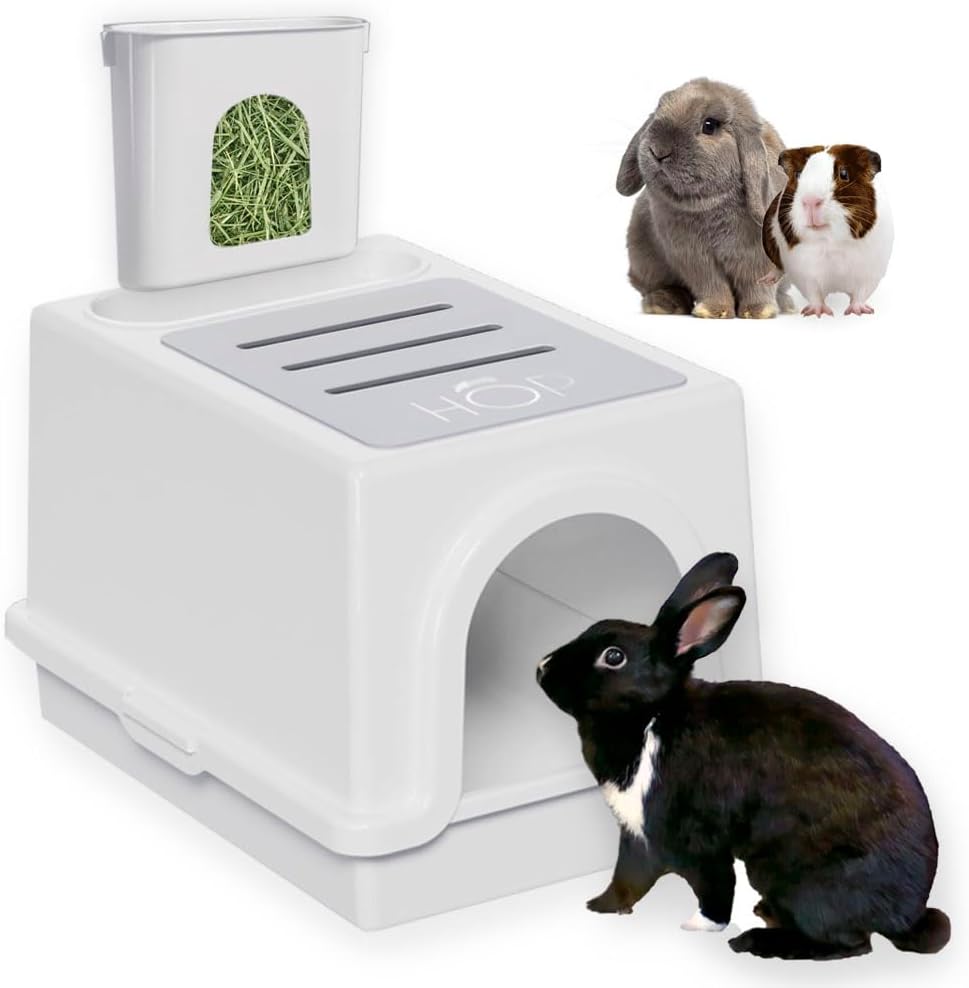
PRODUCT MENTIONED
HOP Rabbit Litter Box, Model HOP-01
Amazon · Details on the retailer’s website
Use rabbit-appropriate litter and keep feeding hay clean
The Rabbit Welfare Association & Fund bedding guide advises against sawdust and clumping cat litter. It distinguishes absorbent litter materials from bedding used for warmth and comfort, and discusses paper-based options. A cat-compatible box title does not make clumping cat litter appropriate for a rabbit.
Choose the actual litter deliberately, checking its ingredients and intended use. A paper label alone does not establish suitable ingredients or an appropriate mixture. The box and the substrate are separate purchases with separate suitability checks.
Rabbit.org notes that rabbits often eat hay while using a toilet and suggests fresh hay at one end or just outside the box. The HOP feeder may offer a way to arrange that access, but the seller’s design claim does not prove a comfortable feeding position for every rabbit. Check that the rabbit can reach the hay without an awkward posture or getting trapped.
Inspect hay at the access point and remove material that becomes soiled. Feeding hay remains a food supply, even when positioned near a toilet. An integrated holder does not prevent every spill or guarantee that hay stays clean. Replenish it and check access as part of the routine.
Place the rabbit litter box where it can be used easily
Rabbit.org recommends beginning with the location the rabbit already prefers for toileting. Place the box on a stable, nonslip surface with an easy approach. Check that its position does not interfere with a door, narrow an essential route or make you move the rabbit before every cleaning job.
Leave room to observe and service it. A decorative enclosure or furniture opening can change ventilation and restrict removal of the lid and tray. The RWAF guidance emphasizes adequate airflow and the rabbit’s ability to leave a sheltered area. Do not choose placement only from the outside appearance.
During a change, keep familiar toileting access available and introduce the new setup gradually. Reward voluntary use and avoid forcing or punishing the rabbit. Some stray droppings do not prove a product failure, and a tidy photo does not establish complete training. The goal is an accessible, clean setup the rabbit will actually use.
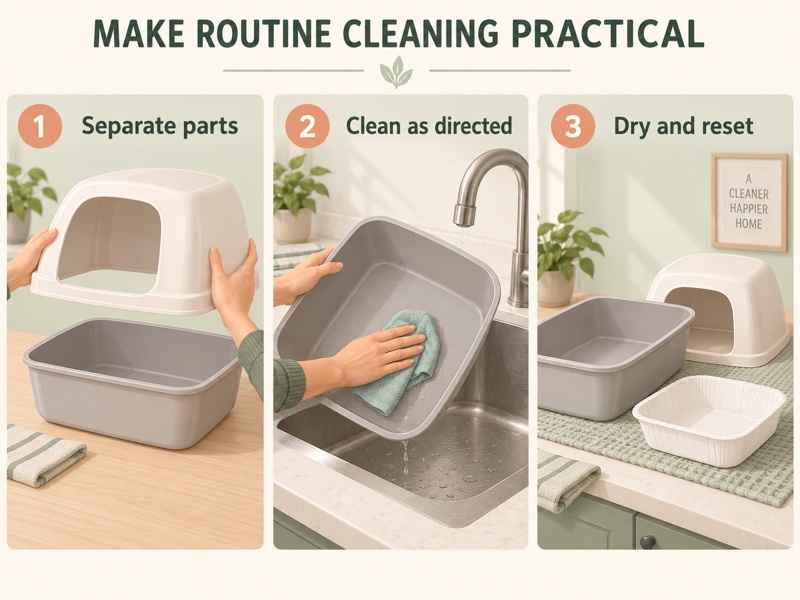
Make cleaning practical before buying
The HOP listing calls the materials BPA-free and the components dishwasher-safe. Those are seller claims; no independently verified material certificate, detailed wash program or part-by-part temperature limit was found in the reviewed information. Obtain and follow the current instructions for the actual delivered parts.
Before planning dishwasher use, confirm which parts are approved, their placement and any heat or detergent restrictions. Do not invent a sanitizing cycle or assume that a plastic part marked as washable tolerates every machine setting. Hand cleaning also needs compatible products and thorough rinsing and drying as directed.
- Inspect the pan, feeder and entry routinely for waste, moisture, damaged edges and soiled hay.
- Provide secure alternative access for the rabbit while the box is being serviced.
- Remove used litter and permitted detachable components according to the instructions.
- Clean all affected surfaces, including corners and attachment areas, with an appropriate method.
- Let parts dry fully and reassemble them securely before adding suitable fresh litter and hay.
- Check voluntary access again after replacing the box.
A claim of less mess does not remove maintenance. If you cannot lift the cover comfortably or reach the tray in its intended location, reassess placement before assuming the rabbit needs a different litter. The combined feeder-and-pan format also means both functions need attention when material gets wet or contaminated.
Know when a new box is not the answer
A sudden change in previously consistent toileting can involve access, stress or a health problem. Rabbit.org’s FAQ recommends veterinary assessment when a medical cause is possible. Do not repeatedly replace boxes or adjust training while ignoring a rabbit that appears unwell or has difficulty moving or toileting.
Record what changed: the box, cover configuration, litter, location, household routine or the rabbit’s behavior. Those observations can help you explain the problem. They are not a diagnosis; ask a rabbit-experienced veterinarian about an unexplained change rather than choosing a home treatment.
If the new box is physically unsuitable, stop using that configuration and restore appropriate access. A seller’s size claim or the money already spent is not a reason to force a rabbit into a cramped space. Resolve uncertain dimensions and return terms before purchase where possible.
Questions about a rabbit litter box
Do the listed dimensions tell me the inside floor area?
No. The selected HOP listing gives 21 × 15 × 14 inches, but a verified internal drawing and entry height were not established. Ask for those measurements and assess the exact assembled configuration against the rabbit’s needs.
Does the product need the separately displayed grid?
Rabbit.org advises avoiding grates and wire mesh in rabbit litter boxes. Confirm the actual supplied parts and a suitable solid-floor setup rather than buying an accessory because it appears beside the box.
Is this an automatically cleaning toilet?
No automatic cleaning function was established by the reviewed listing. Its “automatic” wording concerns the hay-feeder description, not a verified powered waste-cleaning system. You still need to remove litter, inspect surfaces and replenish clean hay.
Buy the rabbit litter box after the fit checks
For HOP-01, confirm usable internal space, the entrance, the exact removable parts and current cleaning instructions. Treat the cover, hay holder and mess-control language as features to assess, not proof of comfort or a care-free routine. If those checks cannot be resolved for your rabbit, wait rather than rely on the retailer photograph.
If the verified configuration meets your rabbit’s needs, view the HOP Rabbit Litter Box, model HOP-01. Confirm ASIN B0C5Z83RGD, the included parts and delivery for your address.
Comments are reviewed before they appear publicly. Please keep questions and feedback relevant to this article.