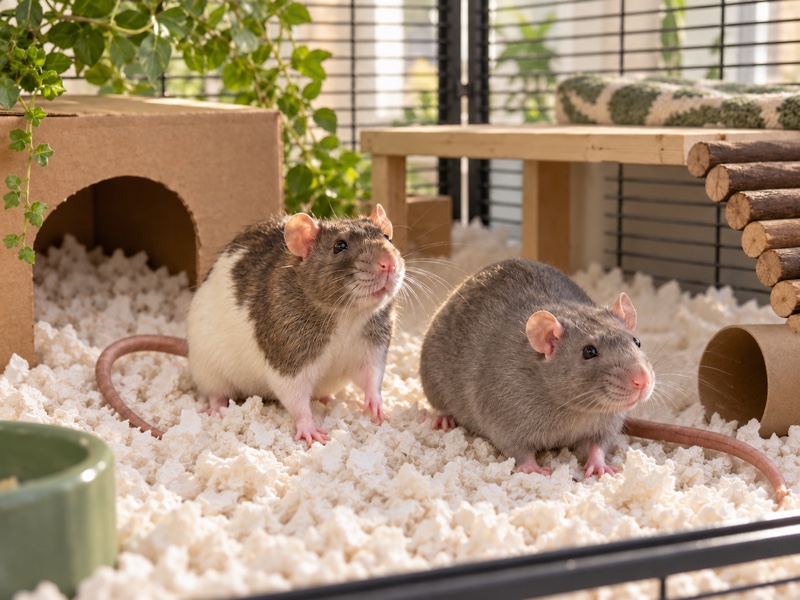
AI-created generic rat-care scene; not a product photograph, complete cage plan or health outcome test.
Avoid aspen bedding for rats under the current rat-specific welfare guidance. The current rat-specific RSPCA guidance explicitly advises avoiding aspen, and Blue Cross lists non-aspen wood chips among its alternatives. A multi-species product label and a low-dust claim do not resolve that conflict. Consider suitable dust-extracted paper or cellulose-based material and check the complete habitat plan, especially if a rat already has a health concern.
The planned product was Small Pet Select Premium Aspen Bedding, single 141 L pack, ASIN B0725L68KB. Its listing includes rats and describes heat-dried aspen shavings. Avoid that pack for rats under the rat-specific welfare guidance. That restriction does not establish unsuitability for every species or prove that a particular bag caused an illness.
Aspen bedding for rats: why this selection is excluded
The RSPCA’s rat-environment guidance distinguishes non-aspen wood chips, cellulose-based chips and shredded filter paper from materials it advises against. It specifically says to avoid bedding made of aspen because of breathing and other health concerns. That is a directly relevant species-specific caution, not a generic opinion about whether a bag looks clean.
Blue Cross’s rat-care guide likewise lists dust-extracted paper bedding, non-aspen wood chips and cellulose-based chips, while advising against wood shavings or sawdust. These sources support a conservative choice of another suitable material for a rat habitat. Neither source evaluates the selected Small Pet Select batch or supplies a comparative laboratory result for it.
Small Pet Select’s aspen product page describes heat treatment, low dust and no additives or dyes, and makes broad safety assurances. Those claims do not establish that the rat-specific cautions have been answered. The product’s availability and pack size also do not provide evidence of suitability.
Rat-specific material guidance supports avoiding this pack; it does not establish that every exposure to aspen causes disease. If a rat-experienced veterinarian has given you an individual substrate plan, discuss the exact material and animal with that professional. Do not treat a buying guide as a substitute for that assessment.
Separate material identity from marketing language
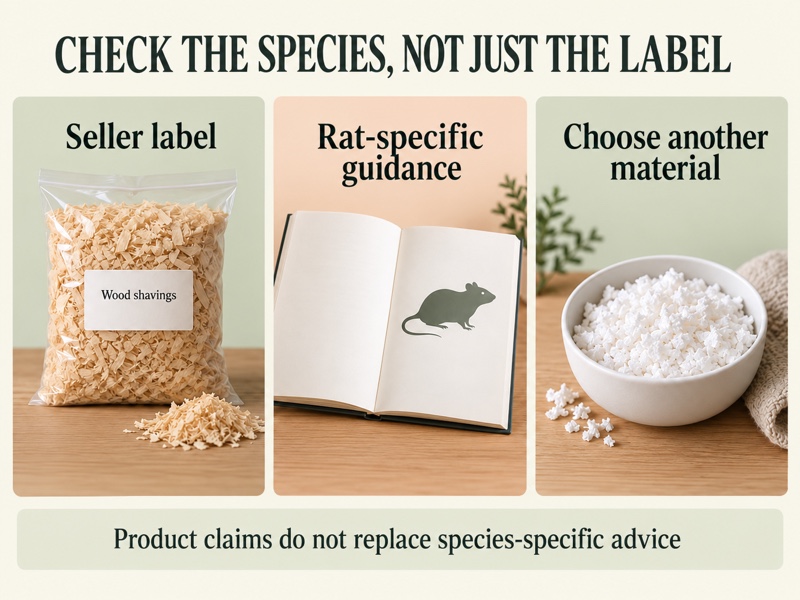
When assessing aspen bedding for rats, write down the actual raw material first. “Natural,” “premium,” “heat-dried” and “low dust” describe different attributes. None of them changes aspen into paper or establishes that a supplier has tested the product against every animal’s needs.
The selected listing’s short title emphasizes rabbits and guinea pigs, while its features name additional animals, including rats. Such a list is a supplier’s intended-use statement. It should prompt a species-specific check rather than replace one. Advice permitting suitable aspen for a hamster does not automatically authorize the same choice for rats.
| Information | What it tells you | What still needs assessment |
|---|---|---|
| Named raw material | Whether the product is aspen, paper, cellulose chips or something else | Rat-specific suitability and actual ingredients |
| Dust-extracted or low-dust wording | A supplier’s processing or performance claim | Condition of the delivered batch and supporting evidence |
| Heat treatment | A stated manufacturing step | No automatic proof of sterility, future dryness or health protection |
| No added fragrance | A useful ingredient check | Does not correct unsuitable material or wet housing |
| Pack volume | A starting quantity for budgeting | Not a safety finding, cleaning interval or guaranteed lifespan |
Look for a clear ingredient declaration and avoid products whose material cannot be identified. Keep the package and batch details after purchase. If a label changes or the contents differ from the description, resolve that discrepancy before putting the material into the habitat.
Consider suitable material categories without guessing a substitute
The reviewed rat-care sources support considering appropriate dust-extracted paper or cellulose-based products. Those are categories, not a blanket endorsement of every paper litter. Check additives, fragrance, texture and the manufacturer’s intended use. A paper-like appearance cannot verify the formula or dust content.
RSPCA also cautions against over-absorbent material and fragranced or colored bedding. That means choosing solely by the largest absorbency claim is not a complete assessment. The contact surface, nesting role and overall environment need to work together. Ask a rat-experienced vet for advice when a particular animal or existing condition complicates the choice.
An alternative pack still needs its own ingredient and suitability checks. You can use the material checklist to assess a candidate without assuming that its retailer category or a favorable review settles the decision.
Plain suitable paper material for nesting is also distinct from absorbent substrate in a toilet area. Rats may shred and move nesting material, so avoid long fluffy fibers and anything that could entangle them. RSPCA warns against cotton wool and similar products that separate into thin strands.
Plan toilet, resting and feeding areas separately
A decision about aspen bedding for rats belongs within a complete habitat review. Rats use more than one level and benefit from places to climb, hide and investigate. A substrate change on the bottom tray does not clean an upper shelf, replace a wet hammock or repair a leaking drinker.
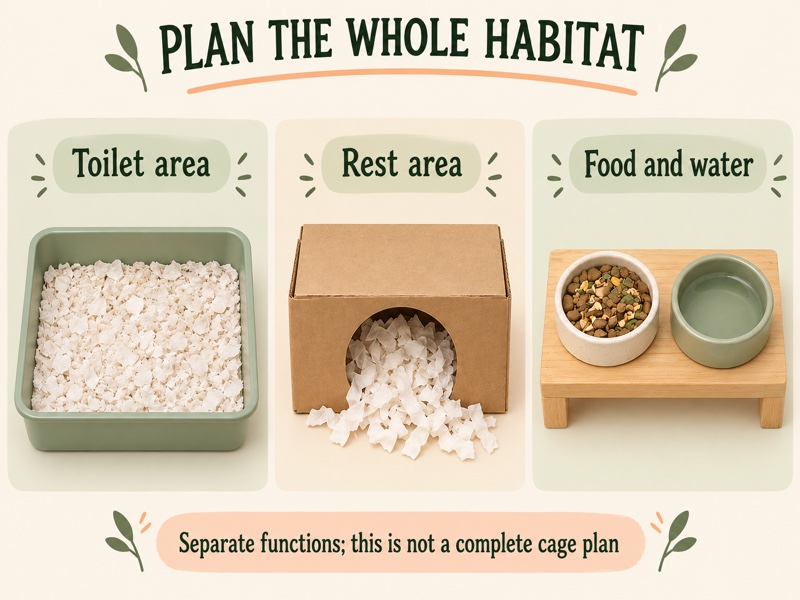
RSPCA describes rats’ preference for keeping toilet areas separate from sleeping, resting and feeding areas. Blue Cross suggests a suitable, distinct litter material in a favored toilet location when litter training. Do not assume a tray guarantees complete training or that the same cleaning action suits every zone.
Check each resting place and its material for moisture, damaged edges or trapped waste. Choose a secure solid floor rather than exposed wire mesh under the rats’ feet, as both rat-care sources recommend. Keep access to water stable and usable even when the animals rearrange nesting material.
The three-zone illustration is a conceptual checklist, not a complete cage plan or a minimum-space recommendation. It does not specify a safe cage size, bar spacing or number of shelters for your group. Assess those separately with rat-specific guidance and the actual enclosure instructions.
Inspect a new batch away from the animals
For any replacement material, open a small amount in a clean tray away from the rats. Look for damp clumps, foreign objects, unusual discoloration, a musty smell or excessive fine particles. Handle it gently rather than generating a cloud to see whether the rats react.
These checks can reveal an obvious issue, but they do not measure airborne dust or certify a material as harmless. A lack of visible dust is not a guarantee of tolerance. Equally, an unsuitable raw material does not become suitable simply because you shake or sift it at home.
Do not add perfume, essential oils or deodorizing powder to mask a smell. RSPCA and Blue Cross advise against strong artificial smells around rats. If a fresh product seems contaminated or different from its label, stop and ask the supplier to resolve it instead of trying to treat the bedding yourself.
Store unused material dry, protected from pests and away from cleaning products. Processing at a factory cannot prevent contamination after a bag is left beside a leak. Keep records of when a new material was introduced so that observations can be discussed accurately if a concern arises.
Keep moisture removal and ventilation in the routine
Replacing aspen bedding for rats does not remove other environmental variables. Wet bedding, soiled cloth, food debris and a poorly ventilated enclosure can remain problems after the pack has changed. Inspect the actual surfaces and equipment instead of judging the habitat by smell alone.
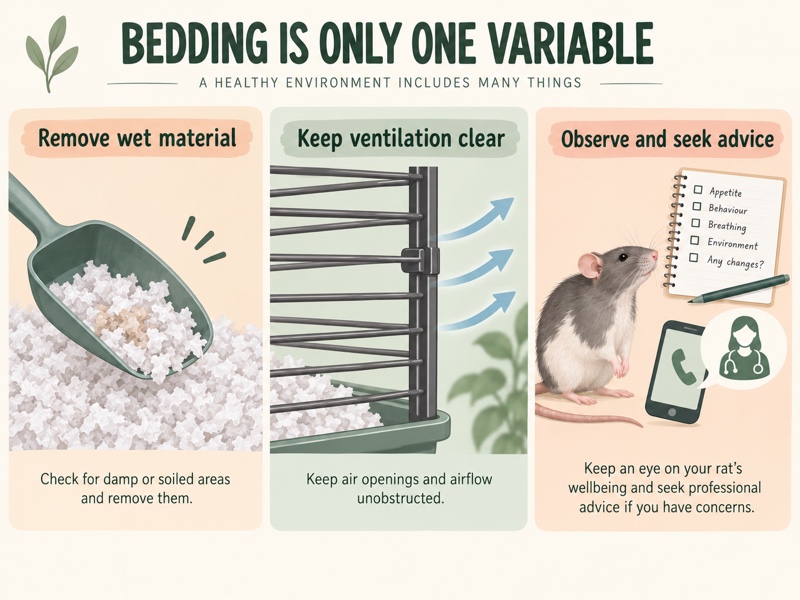
RSPCA recommends regular weekly cage cleaning with local removal of droppings, soiled material and spoiled food during the week. Blue Cross also describes a weekly larger clean with checks and removal of dirty bedding between those jobs. Increase attention where wet areas develop; a nominal schedule is not permission to leave contamination untouched.
- Check the toilet area, resting places, shelves and drinking station regularly.
- Remove wet or spoiled material and investigate recurring leaks.
- For a larger clean, move the rats to secure temporary accommodation while they are awake.
- Clean the appropriate parts using suitable habitat and cleaner instructions.
- Let the enclosure and cleaned items dry fully before replacing bedding and returning the animals.
- Retain only a suitable small amount of clean, unsoiled familiar nesting material where the care guidance supports it.
Both rat-care sources describe preserving some familiar clean nesting material during cleaning. That does not mean retaining damp or contaminated bedding for its scent. Use the distinction between familiar and soiled material deliberately, rather than either removing everything indiscriminately or keeping an unsafe patch.
Keep ventilation openings clear without creating a draft directly onto the rats. Blue Cross advises against aquarium-style glass housing because of ventilation concerns. Wrapping the sides of a cage to contain bedding can also change airflow, so assess a scatter-control idea before installing it. Better containment is not automatically better housing.
Observe changes without diagnosing the cause
Note concerning changes in breathing, behavior, appetite, eyes or skin and contact a rat-experienced vet. Blue Cross identifies rapid or noisy breathing as a concern that can involve respiratory infection. Do not assume that every change is caused by dust or that changing bedding alone treats an illness.
A useful record includes the material name, batch, introduction date, cleaning routine, any water leak and what you observed. Short videos may help you describe a change, but collecting evidence should not delay professional advice for an unwell animal. Ask a rat-experienced veterinarian about diagnosis and treatment rather than choosing medication, a dose or an inhalation remedy yourself.
Do not test the excluded aspen product by repeatedly exposing a rat to it and watching for a reaction. Follow the rat-specific material guidance and choose a suitable alternative instead of setting up an informal exposure experiment.
Questions about aspen bedding for rats
Why does the seller list rats despite rat-specific cautions?
A seller’s multi-species intended-use statement and species-specific welfare guidance can disagree. RSPCA explicitly advises against aspen for rats, and Blue Cross lists non-aspen alternatives. Choose around those rat-specific cautions rather than treating the product listing as the only authority.
Does heat drying settle the concern?
The manufacturer’s processing claim does not establish that the rat-specific advice no longer applies. No independent study of this exact product or batch was verified. It also does not guarantee that an opened bag remains clean or dry during storage.
Is all paper bedding automatically suitable?
No. Check the actual material, additives, fragrance, dust claim and condition, and use rat-specific advice. Paper and cellulose categories offer options to assess; they are not a guarantee for every product or individual animal.
Availability is a separate question from suitability. A product being offered for sale does not make it an appropriate recommendation for a particular species. The reason to avoid this pack for rats is the rat-specific material guidance, regardless of whether it is available to buy.
Make the aspen bedding for rats decision before shopping
Avoid the Small Pet Select aspen pack for rats in light of the rat-specific welfare cautions. Use suitable material categories as a starting point, verify the actual candidate and maintain clean, dry surfaces with appropriate ventilation. If a rat has a health concern, involve a rat-experienced vet rather than relying on a substrate label or a product rating.
Comments are reviewed before they appear publicly. Please keep questions and feedback relevant to this article.