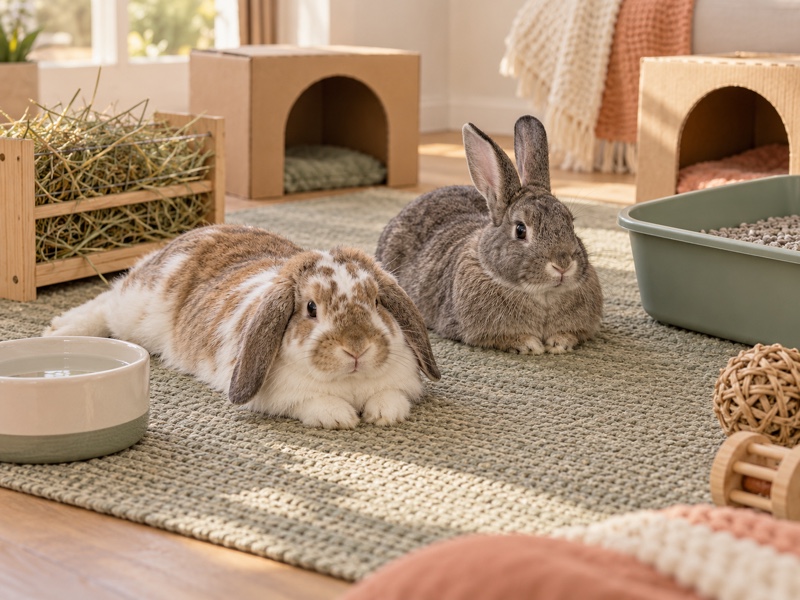
AI-created generic rabbit care scene; not a HOP product photo or a complete housing plan.
Rabbit supplies should support a complete daily care routine: safe space, comfortable footing, hay, water, suitable toileting, places to hide and gentle care. Start with those functions before choosing optional accessories. A small starter cage and a collection of toys do not automatically provide an appropriate home, and buying more equipment cannot replace time for observation and cleaning.
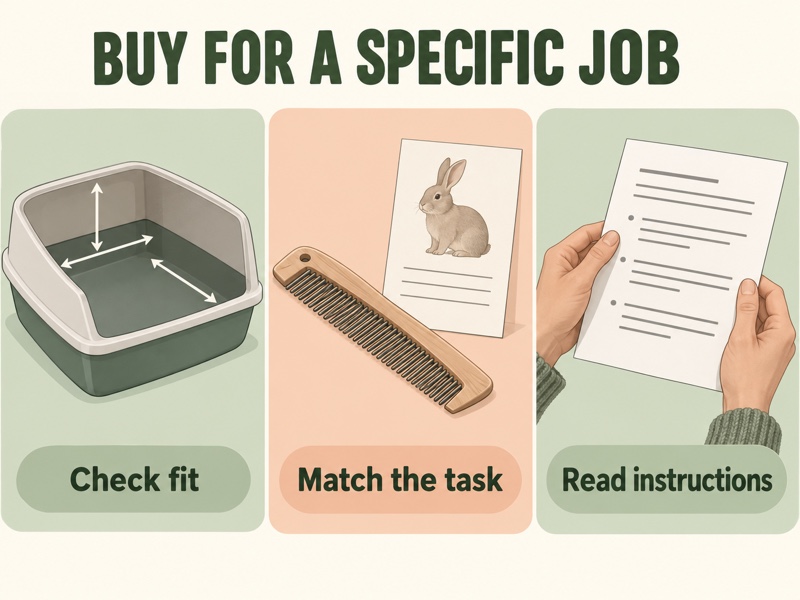
Two optional items are the HOP Rabbit Litter Box, HOP-01, ASIN B0C5Z83RGD, and the Small Pet Select Hair Buster Comb, model 611138712248, ASIN B06ZZXF81G. Each has a limited role and needs its own fit or handling checks. Neither is presented as a complete starter kit, and independent handling results have not been verified for either product.
Rabbit supplies checklist: put essential functions first
Plan the rabbits’ home and routine together. A tray needs a suitable place, hay needs regular replenishment, and a grooming tool needs a safe technique. Write down who will check each resource and what you will do when it becomes wet, damaged or unsuitable.
| Function | What to prepare | Buying or care check |
|---|---|---|
| Living and exercise space | A secure area with room for normal movement and rest | Check usable floor space, access, gaps and household hazards |
| Footing and rest | Suitable nonslip surfaces and comfortable resting areas | Watch for slipping, chewing or damaged material |
| Food and water | Clean feeding hay, appropriate diet supplies and reliable drinking access | Keep hay and water available; use individualized feeding advice where needed |
| Toileting | An accessible roomy pan and rabbit-appropriate litter | Confirm entry, inside space and cleaning access |
| Security and enrichment | Suitable hides, routes and items for exploring and chewing | Do not let accessories crowd out essential resources |
| Coat and nail care | Suitable tools and a demonstrated handling approach | Do not buy a cutting tool as a substitute for training or professional help |
| Transport and support | An appropriate carrier and rabbit-experienced veterinary contact | Plan access and ongoing care before a problem occurs |
This is a functional checklist, not a claim that the two selected products supply everything in it. Generic categories still need assessment against your rabbits, home and care plan. Avoid adding a product just to complete a shopping list when its role is unclear.
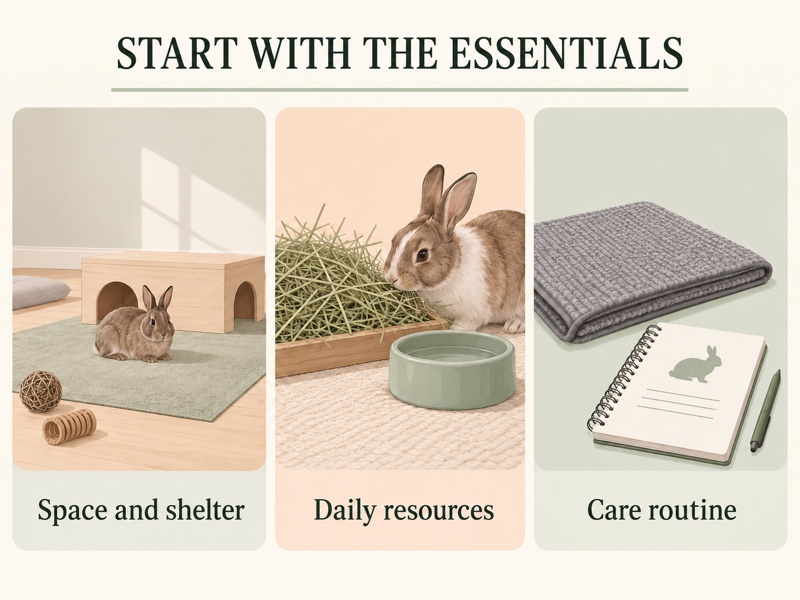
Choose space before accessories
The Rabbit Welfare Association & Fund indoor-housing guidance recommends a single enclosed area at least 3 × 2 m and 1 m high, including sleeping space. It also emphasizes nonslip flooring, hiding places and rabbit-proofing. These are the organization’s welfare recommendations, rather than dimensions established by a product’s marketing.
Measure the usable area, not just the outside dimensions of a pen or the footprint of a hutch. Check routes around litter trays, feeding stations and shelters after placing them. A large accessory can reduce the remaining movement space even when it fits neatly beside a wall.
Protect electrical cables and prevent access to hazardous plants, unsafe gaps and dangerous exits. RWAF explains that supervision alone does not prevent every chewing incident. Make the space suitable before relying on a person to notice a problem in time.
Consider compatible rabbit companionship as part of the overall care plan. RWAF emphasizes company of the same species. Another animal species, a person who is present occasionally or an interactive toy does not automatically meet that need. Obtain appropriate advice about bonding and veterinary care rather than introducing an unfamiliar rabbit impulsively.
Keep hay and drinking access among the daily rabbit supplies
PDSA’s rabbit-feeding guidance emphasizes a high-fiber diet centered on hay or grass and constant access to clean drinking water. A feeder or bowl is only the delivery method. It does not verify the freshness of hay or establish the right amount of other food for every rabbit.
Choose a drinking arrangement that remains clean, stable and accessible. Check it during the routine rather than assuming a full bottle or heavy bowl means the rabbits can drink normally. PDSA notes that many rabbits prefer bowls and that they require less effort to use; assess the actual animals and placement.
Keep food storage dry and protected, and remove contaminated hay or spoiled fresh food. Do not use decorative treats or a colorful mix as the centerpiece of the shopping list. A growing, elderly or unwell rabbit may need an individualized feeding plan; obtain rabbit-specific advice before choosing its diet.
Make changes to diet with suitable advice and avoid abrupt switches. PDSA specifically advises contacting a vet immediately if a rabbit stops eating. Ordering another feeder or trying a new treat should not delay that response.
Assess the HOP-01 as one toileting option
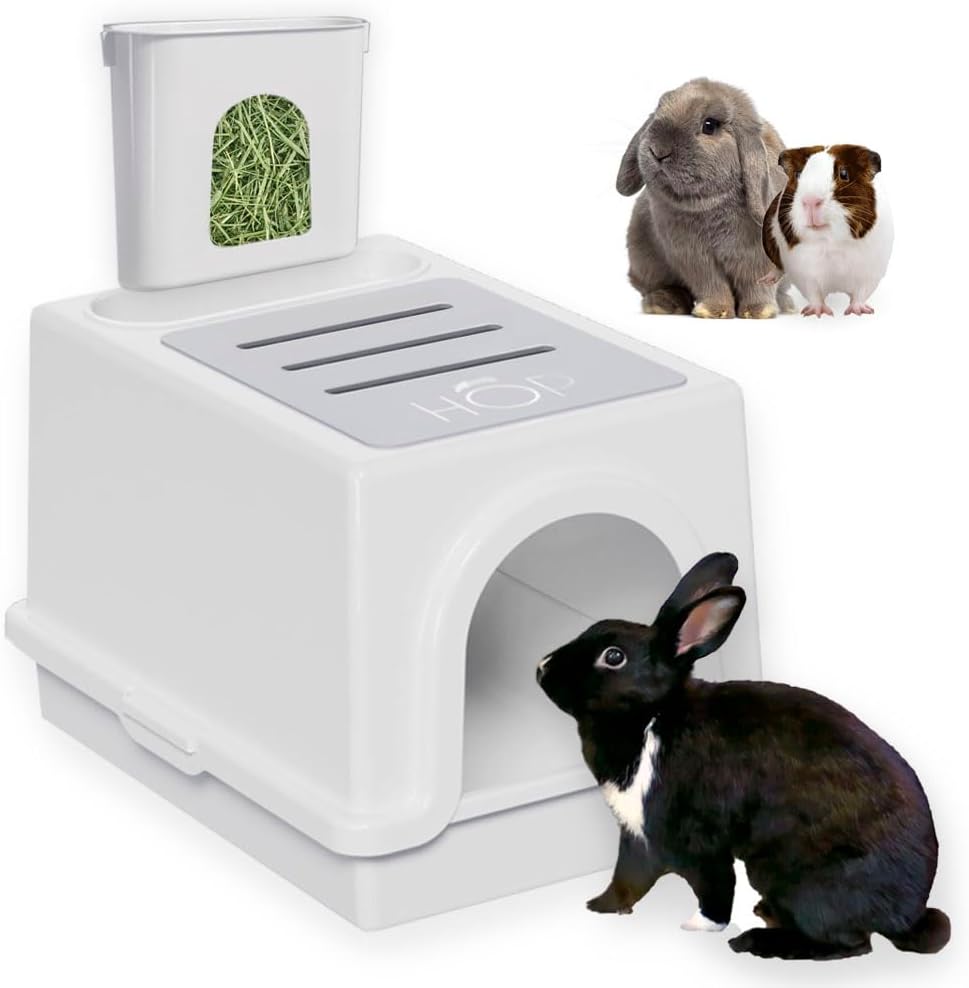
The selected HOP listing describes a pan, lid, detachable access cover and removable hay feeder, with listed dimensions of 21 × 15 × 14 inches. Those are seller-provided details. The reviewed material does not establish an internal-floor drawing or a verified entrance-height measurement.
Before choosing it, confirm the actual assembled configuration and whether your rabbit can enter, turn and toilet comfortably. The seller’s statement about accommodating two rabbits is not proof of fit for your pair. It also does not make the box a suitable living enclosure or sleeping arrangement.
The cover and feeder add functions that need inspection and cleaning. Confirm which components can be removed, how they fit securely and how the current instructions specify cleaning. The listing’s BPA-free and dishwasher-safe wording was not independently certified, and no detailed wash program was verified.
The hay-holder description does not establish powered feeding, portion control or automatic waste cleaning. Keep clean feeding hay accessible and remove soiled material. A related grid is a separate accessory ; do not assume every cross-sold part is required for a rabbit setup.
If the entrance, inside space or maintenance method remains unclear, resolve those questions before purchase. A simple, suitable pan may be an alternative when the HOP-01’s access or dimensions do not fit the rabbit.
PRODUCT MENTIONED
HOP Rabbit Litter Box, Model HOP-01
Amazon · Details on the retailer’s website
Use rabbit-appropriate litter and accessible surfaces
Rabbit supplies marketed across cats and small pets still need a species-specific material check. RWAF’s housing guidance advises using non-clumping litter rather than clay-based cat litter. Choose the actual substrate deliberately instead of assuming the box’s multi-species title approves everything placed inside it.
Check the floor around the tray as well as the tray itself. A rabbit may hesitate to approach an accessible entry if the surrounding surface is slippery. Keep the route clear and maintain a suitable nonslip resting and movement surface, as RWAF recommends.
Inspect wet areas and make cleaning practical. A lid that is awkward to remove or a tray placed behind heavy furniture can make daily care harder. More containment does not remove the need to check the pan, hay holder and nearby floor.
Choose a grooming tool for a specific coat task
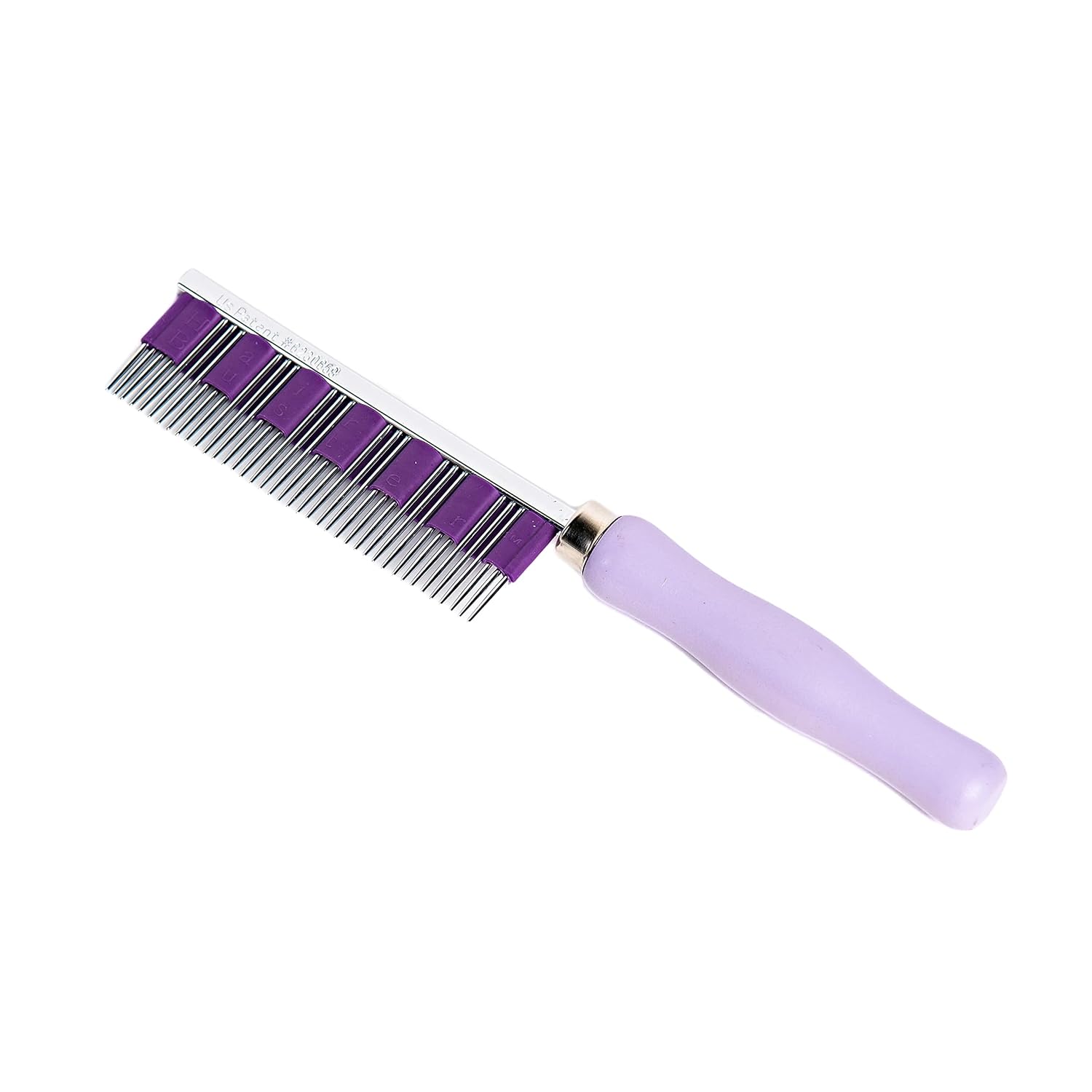
The selected Small Pet Select Hair Buster is one comb, not a complete grooming kit. Its manufacturer page describes rounded tines and a removable rubber sleeve intended to collect loose fur. The current retailer photo shows metal tines, a purple sleeve and a pale-purple handle.
Consider it only after assessing the rabbit’s coat and a suitable gentle technique. A feature called rounded does not eliminate the possibility of pulling, excessive pressure or a damaged tine. Inspect the tool and stop if it catches or the rabbit becomes distressed.
The RWAF grooming guide emphasizes delicate skin and careful tool use. It warns against assuming dog or cat deshedding tools suit rabbits and against turning a rabbit onto its back to make it motionless. Ask a rabbit-experienced professional to demonstrate handling when you are uncertain.
A tight mat near skin is not a reason to pull harder with the comb. Nail trimming and clipping are separate procedures that require appropriate instruction or professional help. Do not buy a large assortment of cutting tools simply because they appear in a starter bundle.
PRODUCT MENTIONED
Small Pet Select Hair Buster Comb, Model 611138712248
Amazon · Details on the retailer’s website
Plan enrichment and shelter without overcrowding
Provide suitable places to hide and investigate, with routes that remain accessible to the rabbits. RWAF’s indoor example uses shelters with two entrances and exits. Assess whether one animal can block another from a retreat or a necessary resource.
Suitable plain boxes, tunnels and chewing opportunities can have useful roles without every item being a complex purchase. Check the materials, openings, stability and wear. A decoration that photographs well is not automatically a suitable enrichment item.
Introduce items without forcing the rabbit to use them. Observe voluntary behavior and reassess the layout if it becomes restrictive or an item is damaged. No toy replaces the space, diet, compatible company or observation built into the rest of the care plan.
Budget rabbit supplies beyond the initial basket
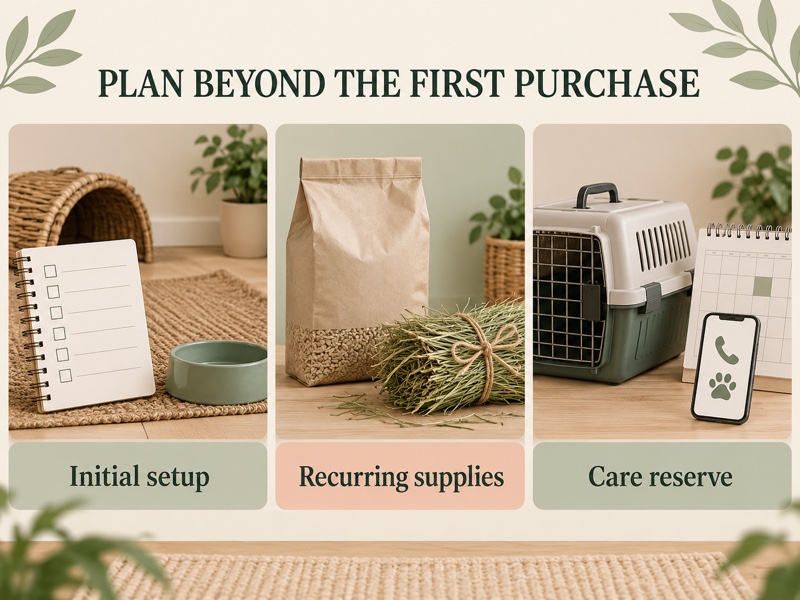
Separate initial setup, recurring consumables and ongoing care. A pan and comb may be one-time purchases for a period, while hay, litter, cleaning and replacement of worn items continue. An inexpensive starter offer can be poor value if its main enclosure or tools do not suit the rabbits.
Allow practical storage for dry hay and spare litter, and reserve time for cleaning and grooming. Consider suitable transport and access to a rabbit-experienced vet as part of planning, rather than optional additions after the shopping budget is exhausted.
Budget for the complete setup, ongoing supplies and veterinary care rather than treating a product bundle as the total cost. Local services, existing equipment and the rabbits’ needs vary. Compare the exact current product, seller and terms at the time of purchase, and keep fit and function ahead of a discount percentage.
Check the setup before the rabbits rely on it
- Confirm secure usable space and remove access to household hazards.
- Check comfortable footing and clear routes between resources.
- Provide clean hay and reliable drinking access.
- Verify the actual litter pan’s entry, inside space and cleaning method.
- Inspect hides and enrichment for fit, stability and wear.
- Use grooming tools only for tasks and handling you can perform safely.
- Keep a suitable carrier, care contacts and a plan for replenishment available.
Revisit the checklist as the rabbits grow, age or develop different needs. A product that once fitted can become awkward, and a care routine can change when an animal is unwell. Product ownership is not evidence that every requirement remains met.
Questions about rabbit supplies
Do these two products form a complete starter kit?
No. HOP-01 is a toileting accessory and the Hair Buster is a single coat comb. Housing, food, water, suitable litter, shelters, enrichment, transport and ongoing care require separate planning. Their presence does not make a small cage or incomplete routine adequate.
Can the listed HOP dimensions prove it fits my rabbits?
No. The listing dimensions are not verified usable floor or entry measurements. Check the actual configuration and your rabbits’ movement, and resolve uncertain details before buying. The seller’s two-rabbit wording is not an individual fit assessment.
Should every rabbit use the selected comb?
No universal suitability was established. Coat type, tool condition, handling and the rabbit’s response matter. Get a practical demonstration and seek professional help for tight mats, uncertain nail care or skin concerns rather than adding force or unfamiliar tools.
Buy rabbit supplies for the jobs they actually serve
Finish the essential space and daily-resource plan before adding optional equipment. Consider the HOP-01 only after its fit, parts and cleaning checks, and the Hair Buster only for an appropriate loose-coat task with safe handling. Keep the two products’ roles separate and continue inspecting the complete setup.
View the HOP Rabbit Litter Box, model HOP-01, ASIN B0C5Z83RGD, and confirm the current included parts and usable dimensions.
View the Small Pet Select Hair Buster Comb, model 611138712248, ASIN B06ZZXF81G, and confirm the exact single-comb selection.
Comments are reviewed before they appear publicly. Please keep questions and feedback relevant to this article.