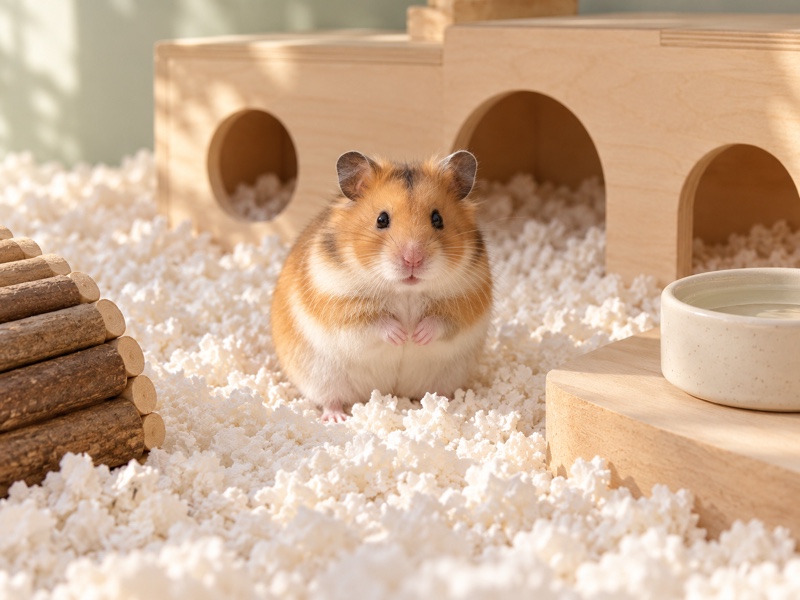
AI-created generic resource vignette; not a complete habitat plan or the selected bedding product.
Choose hamster pet supplies around the habitat your hamster can actually use: enough continuous floor space, deep stable bedding, quiet hiding places, reliable water and a suitable wheel. A colorful starter kit can still leave those jobs unfinished. Measure the enclosure and identify the hamster’s species before buying accessories that compete for the same space.
The Small Pet Select Premium Aspen Bedding 141 L pack, ASIN B0725L68KB, is one substrate option. It is not a complete habitat kit or proof that a bedding layer will hold tunnels. Start with the functional checklist below, then decide whether this particular material belongs in your setup.
Hamster pet supplies checklist: match each item to a function
A useful hamster pet supplies list records why an item is needed, how it fits and what you still need to verify. The largest package or most elaborate accessory does not necessarily solve the missing function. Keep the following checks together when comparing a bundled setup with separate purchases.
| Supply | Job to provide | Fit or material check | Limit to remember |
|---|---|---|---|
| Secure enclosure | Continuous usable living space | Internal floor area, ventilation, escape security and room for bedding | Extra shelves do not replace the main floor |
| Deep substrate | Digging, nesting and food storage | Material, usable depth and burrow structure | A large bag alone does not establish a suitable habitat |
| Enclosed hide | A quiet place to rest out of sight | Openings, internal space and secure placement | Decoration does not replace shelter |
| Water equipment | Constant access to fresh water | Reach, stability, cleanliness and actual operation | A full bottle can still have a blocked spout |
| Upright wheel | Running on a suitable surface | Species, straight posture and easy rotation | An included wheel may be too small |
| Foraging and enrichment | Exploring, digging and searching | Openings, material condition and accessible routes | More objects can also remove useful floor space |
| Carrier and cleaning supplies | Transport and practical care | Security, instructions and spare consumables | Transport equipment is not permanent housing |
Plan the space before adding hamster accessories
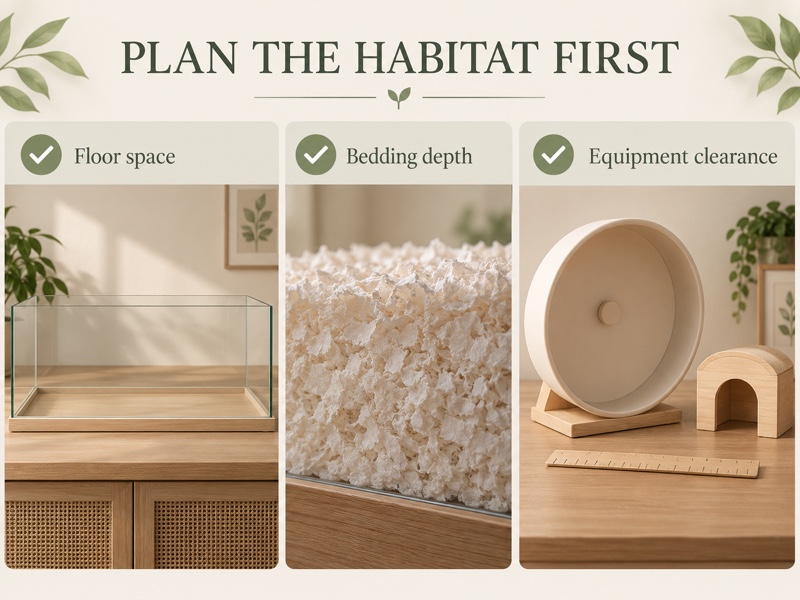
Blue Cross’s hamster care guidance recommends housing no smaller than 100 × 50 cm of floor space and 50 cm tall, with larger accommodation encouraged. PDSA also discusses a 100 × 50 cm minimum floor area while acknowledging limited evidence for one exact cage-size threshold. These are welfare planning recommendations, not a claim about a US legal minimum.
Measure the usable interior rather than copying an external product dimension. A tapering base, internal compartments and permanently occupied areas can change what remains available. Check that the enclosure accommodates the intended bedding depth and wheel without creating an escape route or removing necessary ventilation.
Favor a layout that you can inspect and maintain. Blue Cross cautions against elaborate tube systems because access, ventilation and fit can be poor; narrow or steep tubes are not an automatic enrichment upgrade. An attractive modular cage still needs adequate continuous space and accessible resources.
Plan for a single hamster’s resources rather than assuming a pair will enjoy sharing them. PDSA advises separate housing for pet hamsters because conflict and injury can occur. Blue Cross also says company is unnecessary, while discussing limited Roborovski pair situations with a risk of serious fighting. Buying duplicate bowls does not resolve that housing decision.
Choose bedding for digging and stable burrows
Substrate is part of the habitat’s working structure. PDSA’s hamster guide recommends at least 25 cm, approximately 10 inches, of bedding. Blue Cross specifies at least 20 cm of suitable digging material. State which recommendation you are planning around instead of averaging them into an unsupported new threshold.
For a setup planned around PDSA’s guidance, allow for 25 cm before allocating the remaining enclosure height to equipment and ventilation. A nominally tall cage may have a shallow base that cannot retain that material. Check the construction before ordering multiple bedding packs.
Paper bedding can be used alone or mixed with suitable other materials. PDSA says aspen needs paper-based bedding mixed in for additional burrow stability. Neither source gives a verified universal mixing ratio for the selected 141 L pack. Do not turn a supplier’s low-dust wording into evidence that pure aspen will support every tunnel.
Avoid scented bedding, fine sawdust and fluffy nesting products such as cotton wool or hamster wool. The welfare sources describe respiratory, entanglement and ingestion concerns with unsuitable materials. A hamster picture on a packet does not replace checking the actual contents and how the material behaves.
Where the Small Pet Select 141 L pack fits
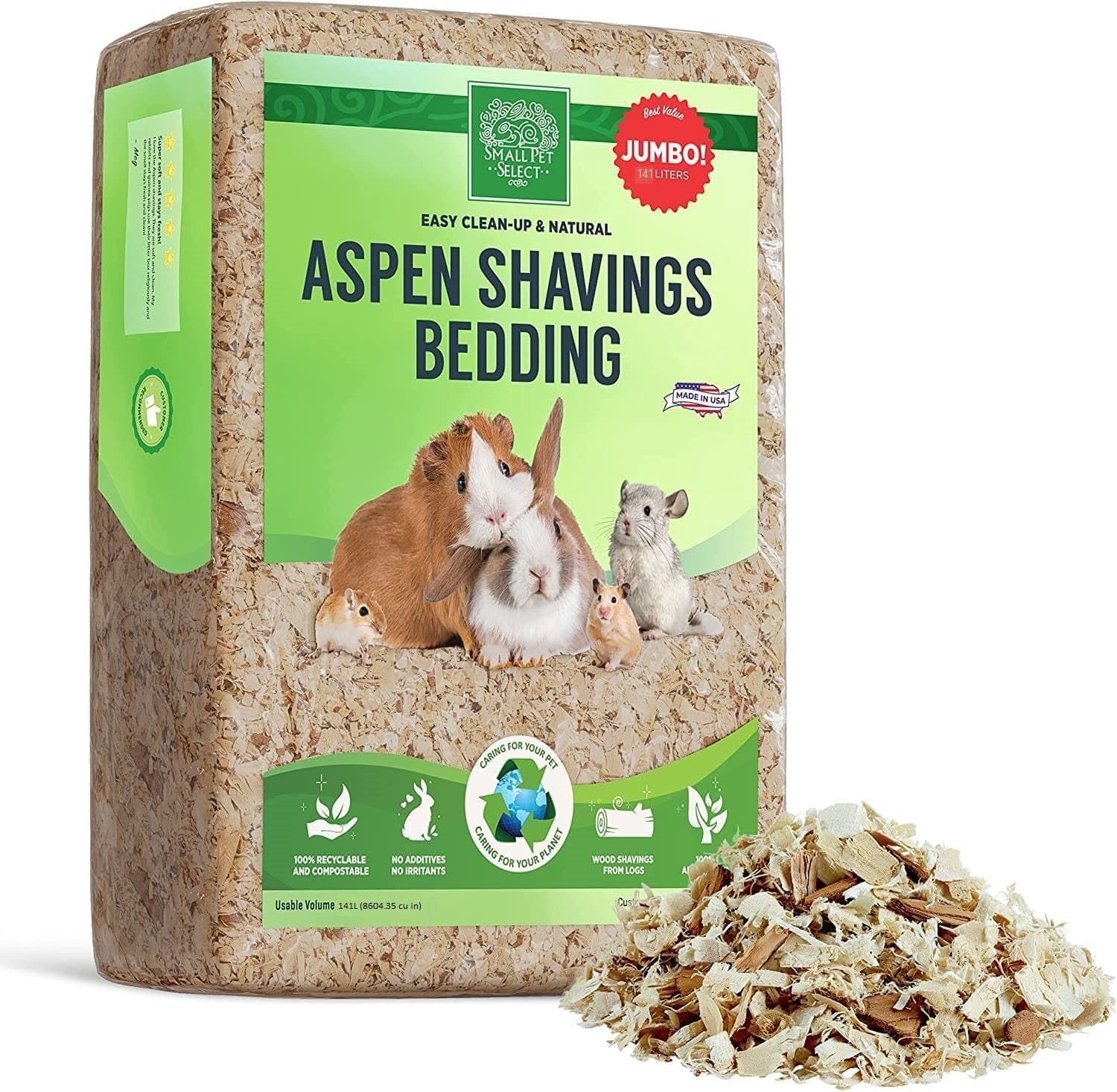
The selected product is Small Pet Select Premium Aspen Bedding, ASIN B0725L68KB. The current retailer image identifies a Jumbo 141 Liters usable-volume pack. This is the single selected pack, rather than a smaller size or a two-pack, and it supplies bedding rather than hides, water equipment or a wheel.
Small Pet Select describes its aspen bedding as heat-dried shavings from logs, without added dyes or artificial scents. Those are manufacturer statements. An independent dust measurement, absorption comparison and burrow-support test for the pack were not established, so avoid treating reassuring brand language as a guarantee against irritation.
Inspect the delivered material before use. Check its identity, condition and any unexpected odor or visible contamination. If the product or batch seems wrong, stop using it and contact the supplier. Persistent breathing, eye, appetite or behavior changes need veterinary advice rather than repeated bedding experiments.
Volume planning is also separate from material suitability. A rectangular 100 × 50 cm floor filled to 25 cm has a calculated geometric volume of 125 L: 100 × 50 × 25 divided by 1,000. This simplified example does not predict how a particular bedding mix settles, how much space fixtures occupy or how many future top-ups a package provides.
PRODUCT MENTIONED
Small Pet Select Premium Aspen Bedding, 141 L
Amazon · Details on the retailer’s website
Hamster pet supplies for shelter and water
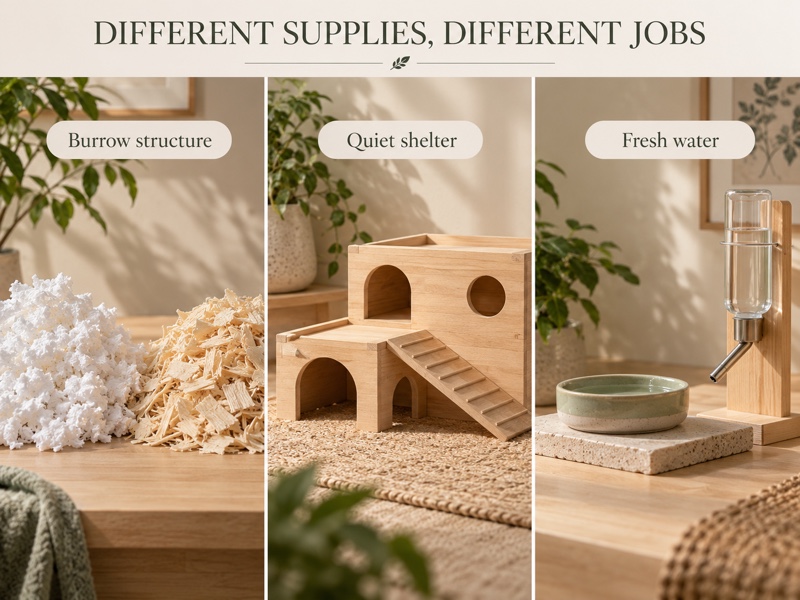
Among hamster pet supplies, an enclosed hide provides a resting place out of sight. Blue Cross favors a multi-chamber hide and also describes suitable cardboard-box arrangements. Measure the openings and useful internal space for your hamster, then check the edges and construction rather than buying by an exterior decorative shape.
Keep the shelter accessible for inspection while respecting the hamster’s rest. Both welfare guides discuss daytime sleep and evening or night activity. Do not wake a hamster just to demonstrate a new accessory or rearrange its home. Prepare the layout before the animal arrives when possible.
Fresh water must remain accessible. Blue Cross allows a water bottle or small bowl; PDSA specifies a bottle with a metal spout. Choose an arrangement you can check reliably for the individual hamster, rather than claiming one design always works better. Verify reach after bedding is added and whenever the layout changes.
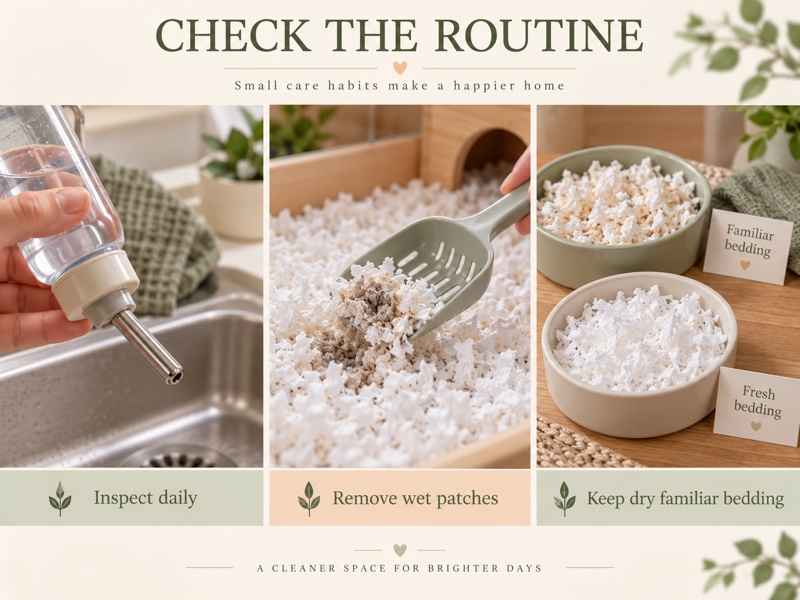
Check actual water delivery and cleanliness every day. Inspect a bottle’s tip for operation and leakage, or a bowl for contamination and stability. Follow the equipment instructions for secure positioning. Keep a suitable spare available so a damaged container does not become an interruption to drinking access.
Fit exercise equipment among your hamster pet supplies
An exercise wheel needs an upright, solid running surface. Blue Cross advises replacing mesh or spoke designs because feet can become caught. The hamster should run without curving its back or lifting its head, and should be able to turn the wheel comfortably. Watch the actual posture instead of assuming the supplied wheel is suitable.
Published size guidance differs in detail. Blue Cross lists 27–32 cm for Syrians, 22–25 cm for Campbell’s and winter whites, 20–22 cm for Roborovskis and 25–27 cm for Chinese hamsters. PDSA gives at least 30 cm for Syrians and 20 cm for dwarf hamsters. Use species and individual fit together; these numbers do not certify an unmeasured product.
Check the wheel’s complete assembled height, base and running width before buying. Its nominal diameter does not tell you whether it fits safely above the planned substrate. Keep its installation stable and follow its own assembly instructions; a wheel that rubs, tips or becomes inaccessible needs attention.
Do not replace the wheel with an exercise ball. Blue Cross advises against hamster balls, citing poor ventilation, inability to escape the ball and loss of access to food, water and hiding places. A supervised secure play area is a separate activity option, not a substitute for the hamster’s permanent habitat.
Add enrichment without crowding out useful space
Start with opportunities to dig, hide and forage. Suitable wide tunnels, low items and cardboard boxes can provide useful variety, but inspect their openings and condition. Avoid making a tall obstacle course out of an animal’s living space; the welfare guidance favors usable floor area and warns about falls.
Scatter feeding part of the normal dry-food allowance can support foraging, as Blue Cross describes. It does not mean adding an unlimited second meal or scattering easily spoiled fresh food into inaccessible bedding. Keep track of the normal food plan and remove spoiled leftovers while allowing appropriate food-storage behavior.
Blue Cross also includes a sand bath in its supply guidance, with particular importance for Roborovski hamsters. Select a material intended for hamster use and verify its instructions rather than assuming fragranced powder or an unidentified decorative sand is equivalent. Confirm the actual sand’s ingredients and intended hamster use before buying.
Choose enrichment from your hamster pet supplies with a reason for each addition. Keep water, shelter and movement routes accessible, and inspect chewed or damaged components. If a new accessory makes normal care harder or blocks access, change the layout instead of filling every remaining gap.
Budget for hamster pet supplies and ongoing care
Separate the initial equipment cost from recurring consumables and veterinary care. Enclosure fit, a suitable wheel and a reliable carrier are not the same spending category as bedding top-ups or food. A low purchase price can hide the cost of replacing components that do not fit.
Plan daily checks for drinking access, food condition and wet or soiled areas. PDSA recommends daily spot cleaning; Blue Cross describes regular localized removal and a broader clean adjusted to the enclosure. Their full-clean schedules differ, so use the actual habitat’s condition and your care professional’s advice rather than inventing a fixed interval from pack size.
During an appropriate broader clean, retain some dry, unsoiled familiar bedding, as both sources advise. That means selecting clean material, not keeping wet substrate to preserve scent. Follow cleaning-product instructions, rinse and dry equipment thoroughly, and return the familiar arrangement where practical.
Keep a carrier, spare water equipment and suitable cleaning tools ready before you need them. You can also use the pet care article library to organize further reading; each animal needs its own species-specific guidance. A carrier should be secure and appropriate for transport; it does not replace the permanent enclosure. Ask your veterinary practice about transport arrangements and keep its contact details with your care notes.
Questions before ordering hamster pet supplies
Does a starter kit include everything a hamster needs?
Not necessarily. Check the enclosure’s usable space and bedding capacity, wheel fit, enclosed shelter, drinking access and care equipment separately. Bundling does not establish that each included component fits the hamster or that the complete layout meets its needs.
Can I use the selected aspen bedding alone?
Pure aspen should not be assumed to hold stable burrows. PDSA recommends adding paper-based bedding for structural support. Inspect the actual material and plan sufficient depth; no universal mixing ratio or independent tunnel test was verified for the selected pack.
No. Shared equipment is not a reason to house hamsters together. PDSA recommends separate housing, and Blue Cross explains that company is unnecessary and fighting can be serious. Identify the species and obtain appropriate care advice before making any housing decision.
Finish the essential functions before adding extras
Buy hamster pet supplies in the order that completes the habitat: space, deep suitable substrate, shelter, water and appropriate movement opportunities. Then add manageable enrichment and care backups. Consider the Small Pet Select 141 L aspen pack only as one material choice within that wider plan, with paper support and batch inspection where appropriate.
View Small Pet Select Premium Aspen Bedding, 141 L, ASIN B0725L68KB, and confirm the selected pack size and material before ordering.
Comments are reviewed before they appear publicly. Please keep questions and feedback relevant to this article.