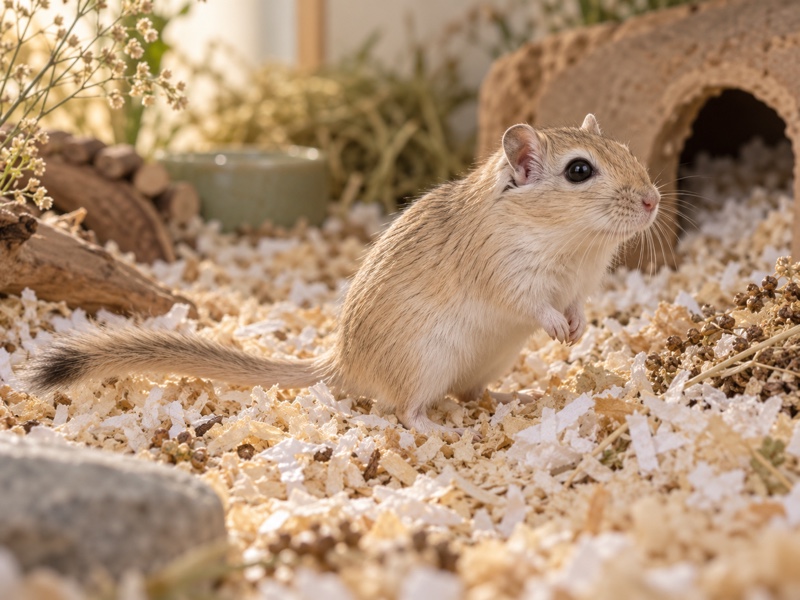
AI-created generic scene; no exact Small Pet Select product sample, tunnel test or complete habitat is shown.
Gerbil bedding has to do more than absorb a little urine. It must support digging, provide useful material for nests and fit a habitat with enough depth and secure space above ground. Start with that complete setup, then choose suitable materials. A bag advertised for many small animals does not establish that it forms stable gerbil tunnels by itself.
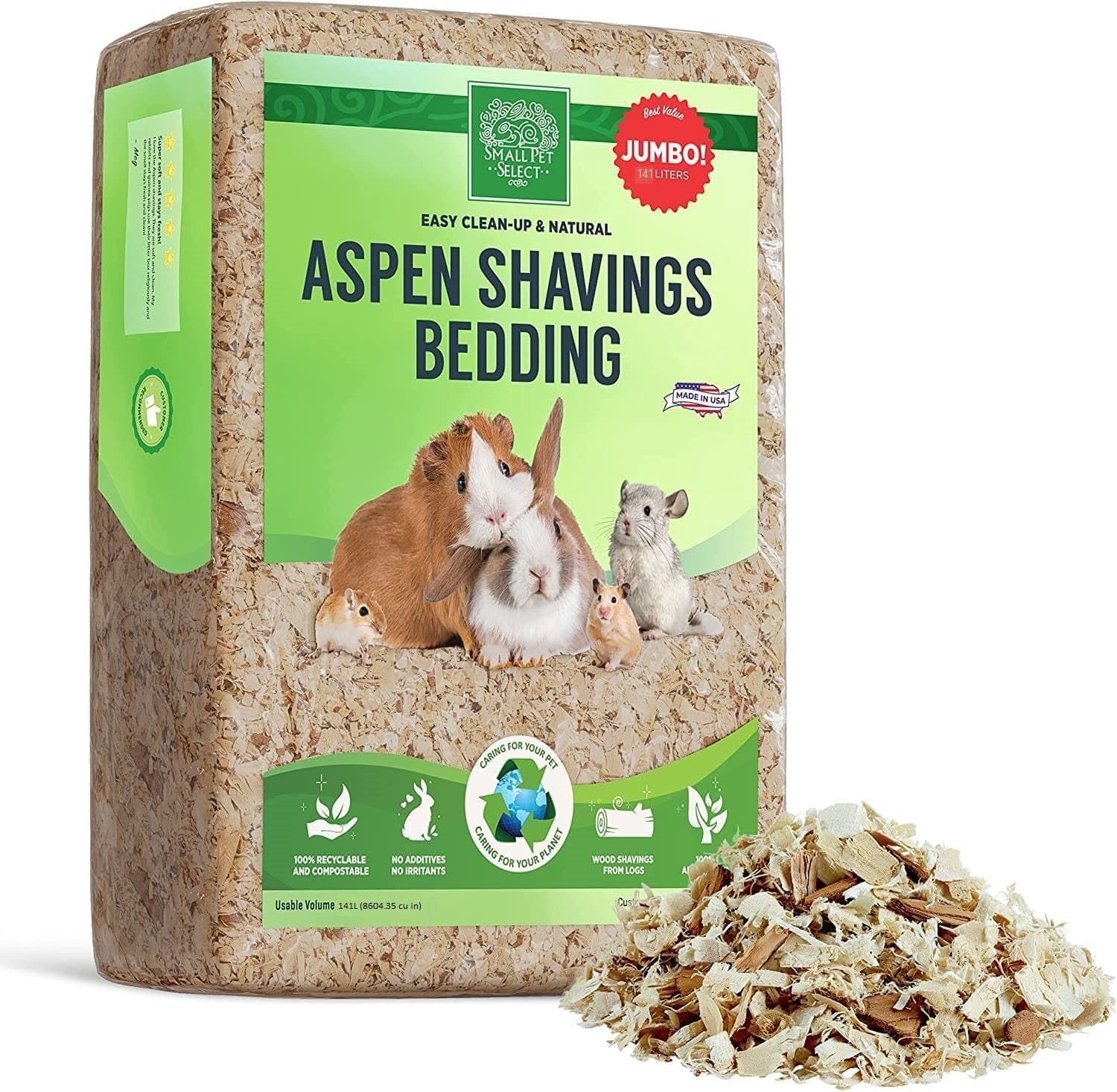
The selected product is Small Pet Select Premium Aspen Bedding, single 141 L pack, ASIN B0725L68KB. Its current listing includes gerbils among the intended animals and describes heat-dried aspen shavings. It is a candidate component of a substrate plan, not a tested complete burrowing mix. Independent tunnel-stability, dust and absorbency results have not been verified for this pack.
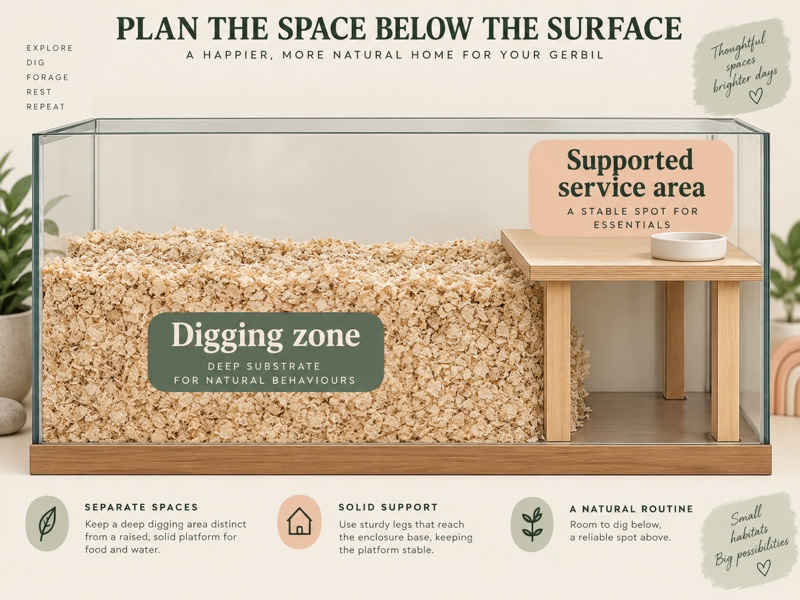
Plan gerbil bedding below and above the surface
The RSPCA’s gerbil-environment guidance recommends bedding deep enough to construct burrows and gives a depth of 20–30 cm, approximately 8–12 inches. It also explains that the enclosure needs space above the bedding for the animals to emerge and stand upright. This is gerbil welfare guidance, not a product-specific test or a US legal standard.
Measure the habitat’s usable depth and ventilation arrangement before ordering substrate. A deep layer that blocks air openings, creates an escape route to the lid or leaves no useful above-ground space is not an adequate solution. Shallow trays and tall decorative tubes do not provide the same opportunity as a broad, deep digging zone.
Think separately about items that need a stable base. A water station, heavy shelter or other equipment must not become unstable when gerbils excavate beneath it. Follow the enclosure and accessory instructions for support. The platform illustration explains the planning distinction; it is not a dimensioned construction drawing or a tested habitat design.
The PDSA gerbil-home guide also emphasizes digging space and a quiet nest box. A nesting box supplements the burrowing area rather than replacing it. Arrange access so that cleaning and water checks do not require dismantling the entire nest every time.
Choose materials for different gerbil bedding jobs
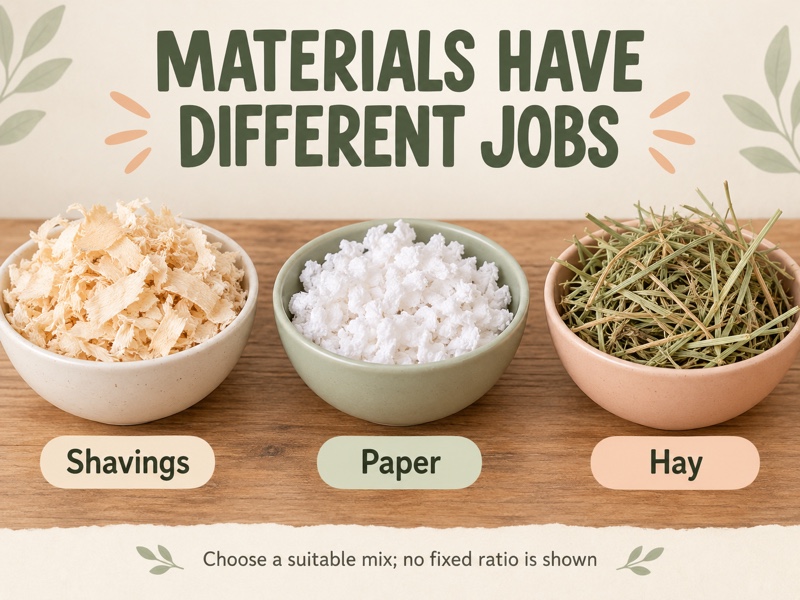
RSPCA describes a mix of rough-grained woodchips and hay for burrow structure, and suitable paper, cardboard and hay for shredding and nesting. The selected Small Pet Select product is described as aspen shavings. That wording does not prove it is identical in particle shape to the rough-grained chips in the guidance or that a full bag alone creates durable tunnels.
| Material role | What to evaluate | Limit |
|---|---|---|
| Identified aspen shavings | Actual particle size, fines, dryness and behavior in the prepared mix | Supplier’s multi-species claim is not a tunnel-strength result |
| Suitable plain paper material | Ingredients, absence of fragrance and useful shreddable structure | Do not substitute long fluffy fibers or printed household scraps without appropriate guidance |
| Suitable hay | Clean, dry condition and its structural role in the substrate | No exact ratio or lifetime was established for the selected pack |
| Nesting material | Safe material gerbils can carry and shred | A small nest supply does not replace the deep digging layer |
| Service area | Stable water access and local cleaning | Do not let equipment rely on loose excavated substrate for support |
Use an appropriate combination rather than copying a recipe from another species. The reviewed sources do not give a tested mixing ratio for this exact 141 L aspen pack. Do not invent percentages or promise a tunnel will remain open for a particular period. Observe whether the prepared material supports the intended digging behavior and seek specialist advice if the setup repeatedly fails.
A few cardboard tubes can add enrichment, but they are not proof that loose surrounding substrate is suitable. Nor is repeatedly rebuilding a collapsed artificial tunnel equivalent to giving gerbils the materials and depth to organize their own space. Assess the whole digging area rather than one photogenic entrance.
Read the exact aspen pack without accepting every claim
Small Pet Select’s Aspen Shavings Bedding page describes material shaved from logs, heat treatment, no added dyes or additives, and low dust. The selected retailer photo labels a single 141 L usable-volume pack. Other sizes and multi-packs exist, so confirm both the size and quantity on delivery.
Processing and ingredient statements are useful sourcing information, but they are not independent proof of sterility, zero irritation or disease prevention. The brand’s broad health assurances are not supported by independently verified outcomes for this pack. A dry, clean-looking bag still needs inspection, appropriate storage and a species-specific use plan.
The listing’s short title emphasizes rabbits and guinea pigs, while its feature list includes gerbils. Keep that distinction clear and check the actual material label. The same product’s use in a hamster or rat guide would not justify transferring that animal’s housing depth, cleaning rhythm or group behavior to gerbils.
Check dust and condition before filling the habitat
Inspect gerbil bedding away from the animals before adding a new batch. Open a small amount into a clean tray and look for excessive fines, damp clumps, foreign material, unusual discoloration or a musty smell. This can reveal an obvious problem, but it is not a laboratory measurement of dust or contamination.
RSPCA advises against sawdust for gerbils because of respiratory concerns. That is another reason to identify the material and examine the batch rather than treating every pale wood particle as equivalent. “Low dust” on a bag is a supplier claim, not permission to ignore a visibly dusty product.
Handle bedding gently and avoid a high pour into an occupied habitat. Do not deliberately create a cloud near the gerbils to test their response. If the material appears unsuitable, stop and contact the supplier. Adding fragrance or spraying a household product onto it does not resolve contamination or establish suitability.
Keep unused substrate dry and protected from pests and household chemicals. Heat treatment during manufacture cannot protect it from a later leak or damp storage. Preserve the label and batch details so that you can identify what was used if a concern arises. Concerning changes in the animals warrant veterinary advice, rather than a diagnosis based on the word “aspen.”
PRODUCT MENTIONED
Small Pet Select Premium Aspen Bedding, 141 L
Amazon · Details on the retailer’s website
Estimate gerbil bedding volume realistically
Measure the internal floor area of the digging zone and the intended working depth. For a simple rectangular space, length × width × depth gives geometric volume; divide cubic centimeters by 1,000 for liters. This calculation helps plan supplies but does not measure how the actual mixture settles or holds a burrow.
For example, an 80 × 40 cm zone filled to 25 cm corresponds to 80 L geometrically. That is an arithmetic example, not a minimum enclosure size or a complete layout recommendation. Shelves, partitions, mixed materials, settling and later replacement of soiled patches change actual consumption.
The selected 141 L label is a usable-volume claim, not the compressed block’s physical size. Do not promise that one pack fills every gerbilarium or lasts a fixed number of months. Reserve material for local replacement and confirm that you can store the remaining pack dry before choosing a large quantity.
Compare cost per labeled usable liter only when the quantities and volume definitions match. A low unit price does not compensate for unsuitable texture, a dusty batch or a habitat too shallow for digging. Compare the current price and actual usable quantity rather than assuming a permanent saving.
Clean gerbil bedding while protecting familiar nest material
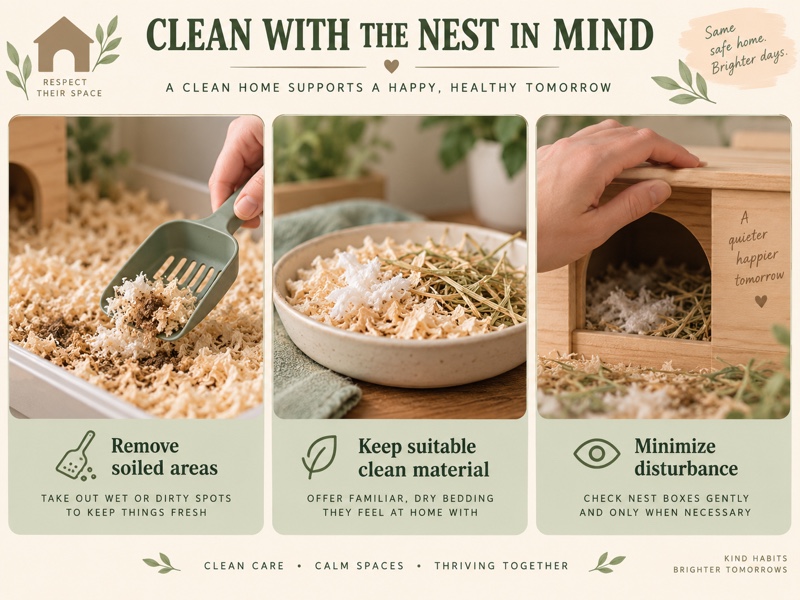
Cleaning has two aims: remove contamination and avoid unnecessary disruption of a familiar environment. RSPCA explains that removing every odor can be stressful and may trigger fighting. It advises keeping a small amount of suitable used but unsoiled bedding and nesting material during cleaning. Used does not mean wet, moldy or contaminated.
- Inspect water access, food stores and bedding condition regularly without dismantling every tunnel.
- Remove damp or soiled patches and spoiled food rather than burying them under a fresh layer.
- For a larger clean, move the gerbils to secure temporary accommodation.
- Set aside only an appropriate small amount of dry, unsoiled familiar material.
- Clean the habitat using suitable instructions and let it dry completely before refilling.
- Restore an appropriate substrate arrangement and familiar clean material, then observe the gerbils after their return.
The sources use cleaning terms differently. RSPCA describes deep cleaning every two to three weeks; PDSA describes regular cleaning on that interval and a more complete reset every three months. Do not present those as one identical fixed procedure. Inspect the actual habitat and obtain advice if you are unsure which cleaning job its condition requires.
The brand’s generic recommendation for very frequent bedding replacement is not a gerbil-specific instruction to destroy a deep nest system every day or two. Equally, retaining familiar material is not a reason to leave wet areas untouched. Match each action to the problem rather than choosing a calendar that ignores the bedding’s condition.
Keep unsuitable nesting materials out
RSPCA and PDSA both warn against cotton wool and similar fluffy nesting products. Material that separates into fine long strands can create hazards, even when it feels soft. Choose appropriate shreddable nesting material instead of adding fibrous fluff to make the habitat look more comfortable.
RSPCA identifies plain ink-free cardboard and paper as useful gnawable material and advises against garden soil because of possible harmful organisms. Do not replace a clearly identified commercial substrate with an unspecified garden or potting product on the assumption that all natural material is interchangeable.
Keep the bathing area separate from the substrate decision and follow gerbil-specific bathing guidance. A product sold for a dust bath is not automatically a suitable full-habitat bedding. Obtain species-specific advice before preparing soil or using a disinfectant; medical treatment requires veterinary guidance.
Questions about gerbil bedding
Is this aspen pack a complete ready-made burrowing mix?
The listing describes aspen shavings, not a tested blend of shavings, paper and hay. RSPCA’s structural guidance does not establish a fixed recipe for this ASIN. Consider it only as one possible material after checking the complete substrate plan and actual batch.
Should all old bedding be thrown away at every clean?
RSPCA advises retaining a small amount of suitable unsoiled familiar material. Wet, spoiled or contaminated material should not be preserved for scent. Larger cleaning jobs require secure temporary accommodation and a dry habitat before the animals return.
Does more absorbency guarantee better tunnels?
No. Absorbency, particle structure, depth and how materials work together are separate considerations. A supplier’s odor or moisture claim does not measure tunnel stability. Evaluate the digging role directly rather than ranking substrate by one marketing feature.
Choose gerbil bedding as part of a complete habitat
Plan a deep suitable digging area, safe above-ground access and stable equipment before choosing a pack. For the selected aspen, confirm the 141 L single-pack label, inspect the batch and assess its role alongside appropriate structural and nesting materials. Keep local cleaning practical and preserve only suitable clean familiar material during larger jobs.
If this conditional material choice fits your plan, view Small Pet Select Premium Aspen Bedding, 141 L. Confirm ASIN B0725L68KB, the single-pack quantity and delivery for your address.
Comments are reviewed before they appear publicly. Please keep questions and feedback relevant to this article.