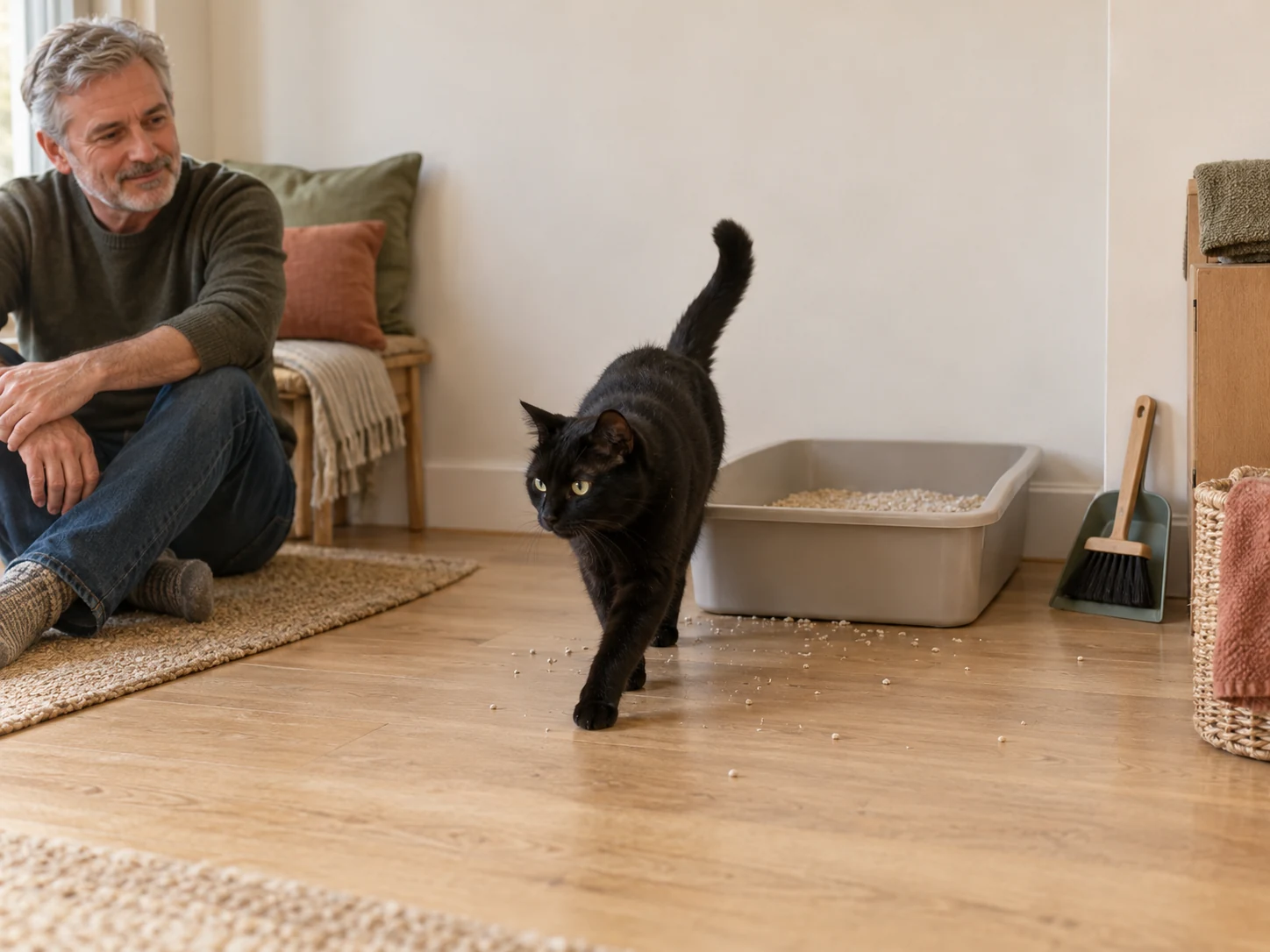
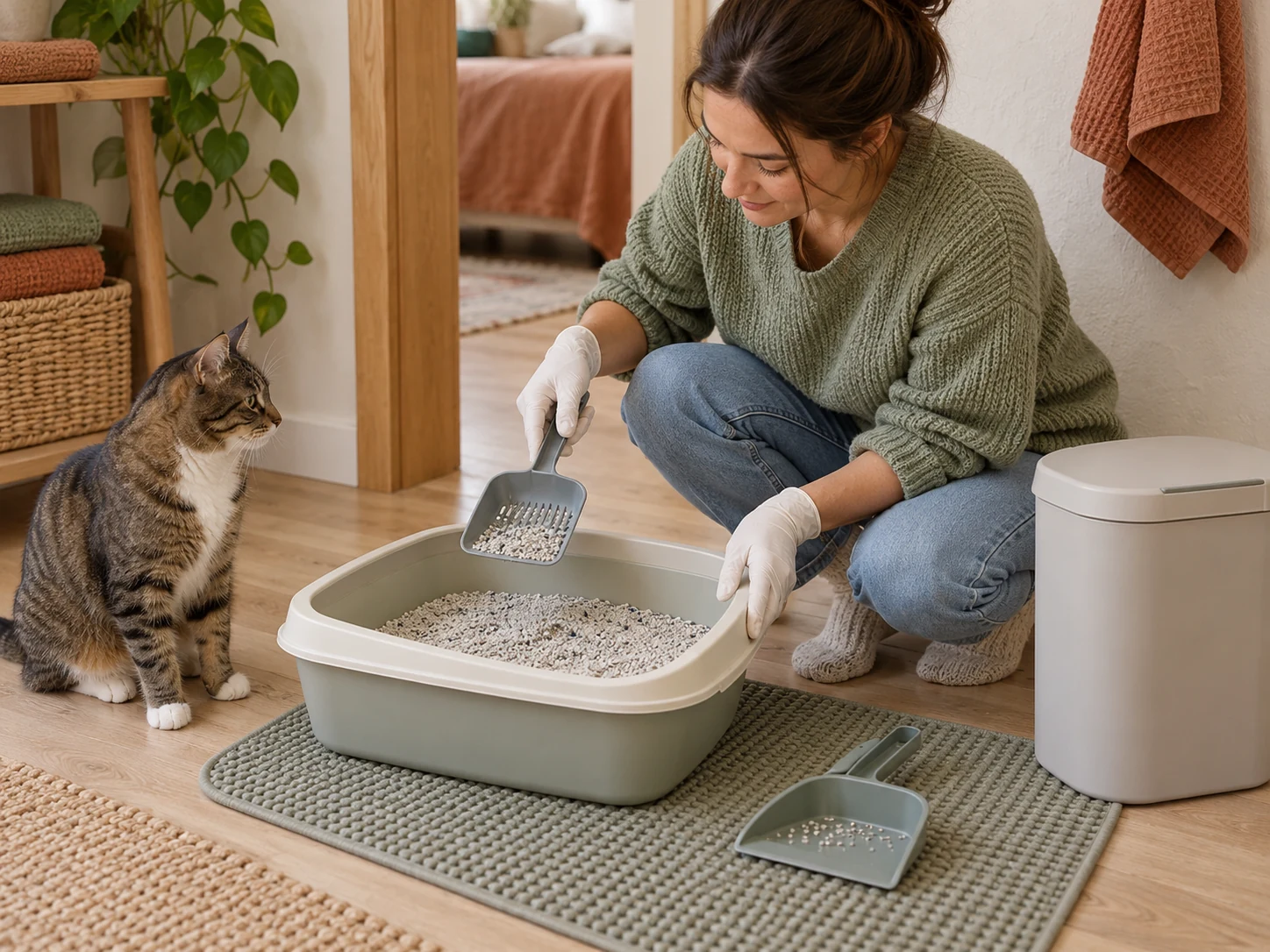
AI-created editorial scene. Tracking, kicked litter and dust are separate observations; no comparative low-tracking result is established.
The best low-tracking cat litter reduces a cleanup problem without making the litter box less acceptable to your cat. Start by identifying what leaves the tray: grains carried on paws, material kicked over a wall or small particles released during handling. Those are related messes, but they are not the same problem.
Granule size and weight are useful things to compare, alongside clumping, surface preference and maintenance. Dr. Elsey’s Ultra Unscented clumping clay is one defined candidate with manufacturer low-tracking claims. Its tracking performance has not been independently measured against the other litters considered, and a low-tracking claim does not promise zero tracking.
Find the source before choosing low-tracking litter
Look at the box and the floor after ordinary use. Is the largest pile next to the side where the cat digs? Do grains follow the walking route? Is the issue mainly a cloud or residue when you pour fresh litter? The answer helps you decide whether changing the litter is the most relevant first step.
| Observed mess | What to investigate | What a litter change cannot guarantee |
|---|---|---|
| Grains along the exit route | Granule characteristics, paw contact and the exit surface | No grains will ever leave the box. |
| A pile beyond one side | Digging direction, fill and usable box size | A low-tracking label prevents all kicking. |
| Fine residue during pouring | Handling method and the product’s dust information | Low tracking and low dust mean identical performance. |
| Small broken waste pieces | Clump formation, scooping technique and maintenance | A heavier grain repairs a fragile clump. |
| Wet or soiled areas outside | Box condition, access and the cat’s toileting behavior | A different granule treats a medical concern. |
Keep the cat’s reliable use of the box as the main constraint. A cleaner-looking floor is not a successful trade if the animal starts avoiding the new substrate.
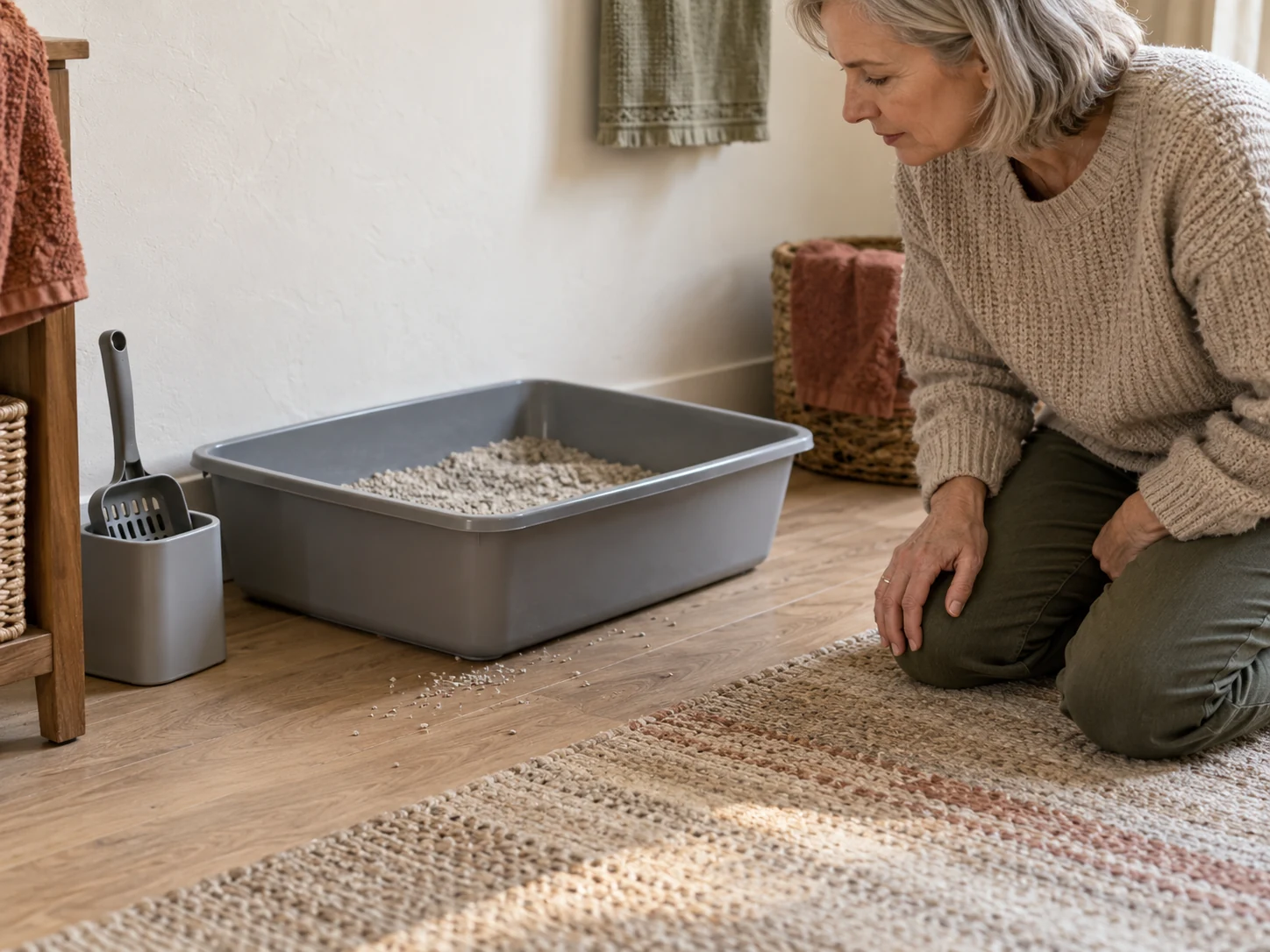
Best low-tracking cat litter: granule trade-offs
Different litters can vary in particle size, shape and weight, including within the same broad material category. Compare the actual formulation rather than treating every clay, crystal or plant-based product as identical. A material name alone does not establish what will cling to your cat’s paws or release onto the floor.
Larger particles may change handling and separation, but they also change the surface underfoot. Cat Friendly Homes notes that many cats prefer soft, unscented clumping litter and that sharp or very hard consistency can be unsuitable for older cats or sensitive paws in its litter box guidance. That is a reason to watch acceptance rather than automatically choosing the coarsest option.
Separate format from performance claims
A pellet format, fine granules and medium-grain clay require different questions about scooping and surface preference. None is automatically the best low-tracking cat litter for every cat. Check the product’s cleaning method and the equipment you use before changing formats.
For a separate comparison within tofu-based products, the Pidan tofu litter versus blend guide addresses two different formulations. Do not transfer those products’ handling details to the clumping clay selected.
Do not interpret a comparative adjective such as low as a measured capture rate. Unless a relevant test and conditions are supplied, treat it as the manufacturer’s description. Your own observations can guide a household decision without establishing a general ranking.
Dr. Elsey’s Ultra: the selected clay option
The selected product is Dr. Elsey’s Ultra Unscented Clumping Clay Cat Litter, 40-pound bag, model 460U, ASIN B0009X29WK. The retailer listing describes bentonite clay; the manufacturer’s Ultra page identifies natural clay and a combination of heavier granules with medium-grain clay.
| Established feature | Purchase implication |
|---|---|
| Unscented clumping clay | Consider the cat’s acceptance and an appropriate clump-removal routine. |
| 40-pound selected package | Check storage and manageable handling; this is not a lightweight bag. |
| Medium-grain formulation with manufacturer low-tracking description | Assess actual floor cleanup rather than expecting no tracking. |
| Manufacturer low-dust marketing | No independent dust measurement or allergy outcome is established here. |
| Manufacturer says dispose in trash, not the toilet | Plan appropriate waste disposal and local requirements. |
When Ultra is worth considering
It is a plausible candidate when you want an unscented clumping clay formulation and can manage the package and routine. It is less suitable if you require a non-clumping system, a lightweight supply or a guaranteed outcome for allergies or respiratory symptoms.
Confirm Ultra rather than Ultra+, Clean Tracks or another Dr. Elsey’s formula. Similar product names do not establish the same granules or instructions. The selected purchase is one 40-pound Ultra bag, not a tested set of competing litters.
Check Dr. Elsey’s Ultra Unscented clumping clay litter, 40 lb on Amazon
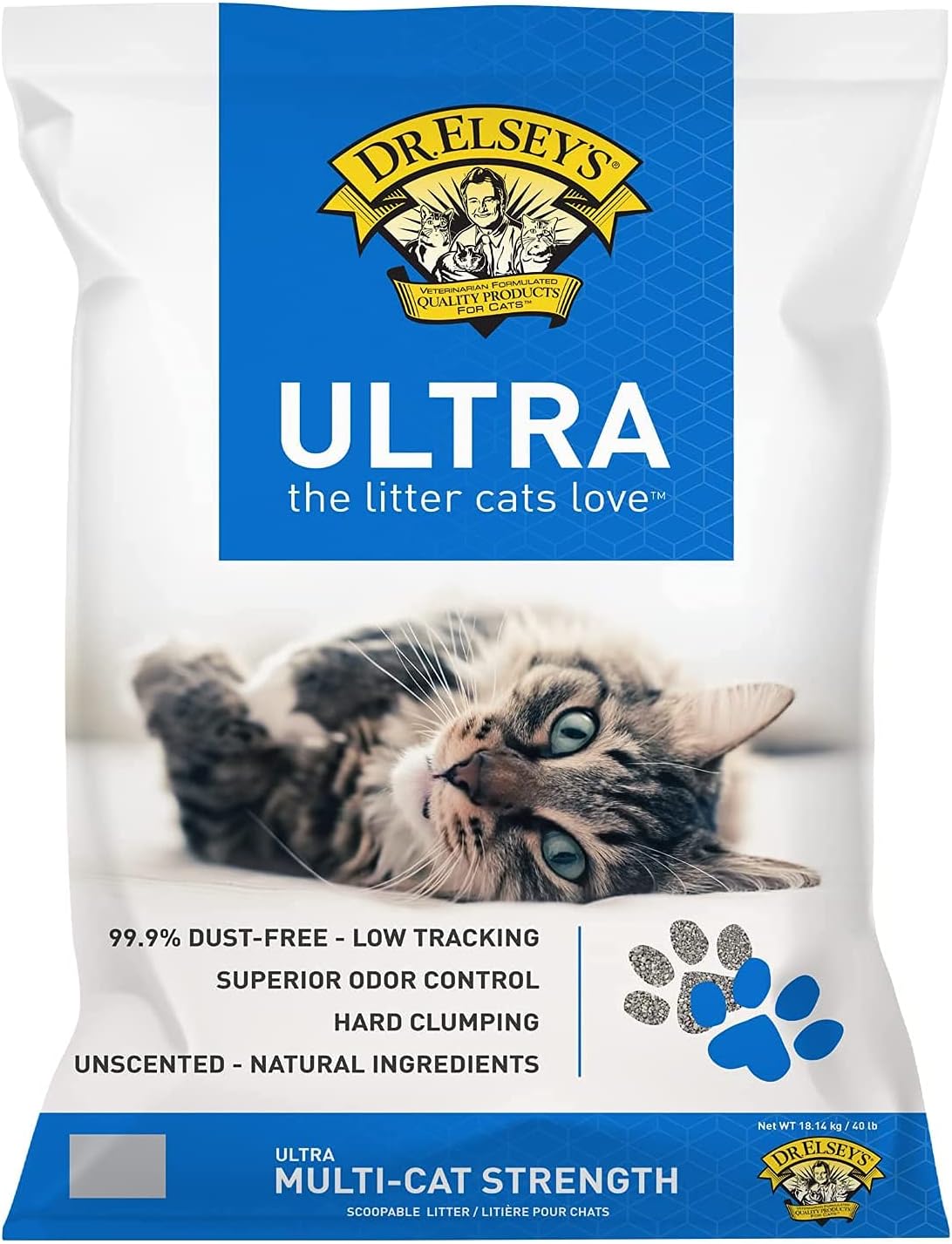
PRODUCT MENTIONED
Dr. Elsey’s Ultra Unscented Clumping Clay Litter, 40 lb (460U)
Amazon · Details on the retailer’s website
Is the best low-tracking cat litter also low dust?
Tracking concerns material leaving the box on the cat or along its route. Dust concerns fine particles associated with the product and handling. A litter can be marketed for both, but one description does not establish the other.
The checked Amazon listing and current manufacturer page use different numerical dust-free marketing descriptions. Neither percentage has been independently verified. Avoid turning those percentages into a medical assurance or a promise that no fine material will appear during use.
Respond to health concerns directly
Unscented and hypoallergenic labels are not a diagnosis or a guarantee that a particular person or cat will tolerate a product. If coughing, breathing difficulty or another health concern is the reason for changing litter, seek the appropriate veterinary or medical advice.
For ordinary handling, follow the package directions and avoid unnecessary disturbance of the material. Keep the comparison focused on the actual product and household experience, rather than assuming every bag of clay has the same dust behavior.
Trial a change while preserving reliable toilet access
To find the best low-tracking cat litter for your household, offer a candidate in a suitable box while retaining a familiar option where practical. Watch normal entry, digging and toileting, not just whether the cat investigates. If the animal avoids the new texture, the product’s tracking claim is not a reason to force acceptance.
Cat Friendly Homes describes offering different litter options when evaluating preference in its house-soiling guidance. It also emphasizes that toileting changes can have physical, social or medical causes. Do not assume every change is explained by granule preference.
Change one relevant variable at a time
Where practical, keep the box, location and cleaning routine consistent while you compare the new litter. Changing all of them at once makes a reduction in mess or a refusal to use the box harder to interpret. Record the product and the date of the change.
Do not transfer a cat-food transition schedule to litter or invent a universal mixing percentage. Use the litter maker’s applicable directions and the cat’s response. Restore suitable access and involve your vet if the cat’s toileting becomes concerning.
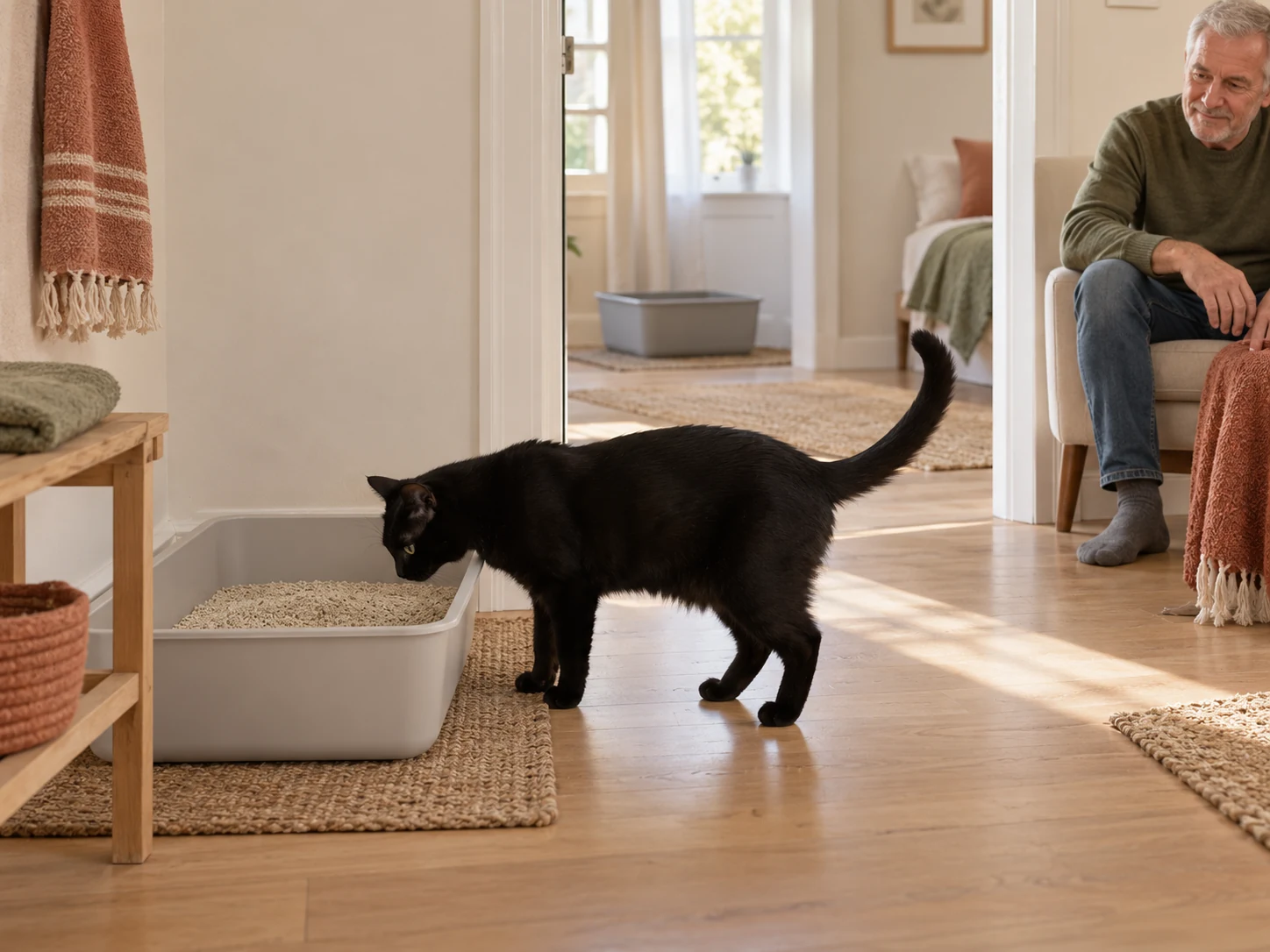
Compare low-tracking litter during normal care
For an ordinary manual tray, Dr. Elsey’s Ultra directions specify filling a clean, dry box to three to four inches, scooping waste twice daily and adding litter as necessary. Replacement depends on household needs. Use those directions for the intended manual setup, not as permission to override an automatic machine’s fill line.
Consistent care helps you judge what changed. If you scoop less often after a product switch or leave the tray much fuller, a difference in surrounding mess may reflect the routine as well as the granules. Note those changes instead of attributing every result to the bag.
Inspect the exit area too
A collection mat or an adjustment around the exit may help with floor cleanup, but that is a separate intervention. Choose coverage where paws actually land and preserve comfortable access. Do not trap the cat into crossing an avoided texture just to improve collection.
A mat, higher side wall or covered entrance cannot be assumed to solve every tracking pattern. Judge each change by the problem you observed and the cat’s continued comfortable use.
Record useful results without claiming a laboratory test
Record the low-tracking litter formulation, cleaning frequency, where grains collect and whether the cat uses the box normally. Include scooping effort and how much usable litter is discarded with waste. A floor that looks cleaner may come with another maintenance trade-off.
Compare similar periods of ordinary use rather than a freshly cleaned room with a neglected one. Your observations can answer whether the setup is easier for you to maintain. They cannot establish a precise tracking percentage or prove the result will be the same for another cat.
Include handling and disposal
A 40-pound package needs a practical route to its storage location and a manageable way to refill the tray. Consider whether the person doing the work can use that package comfortably. A low-tracking claim does not resolve lifting or storage needs.
The manufacturer’s FAQ says its clumping clay litter should not be flushed or put in a yard or garden. Follow local disposal requirements for used litter and waste rather than treating natural clay as automatically compostable.
Compare low-tracking litter use, not package weight alone
A heavier bag does not tell you how much usable litter will remain after scooping or how often your household will replace it. Different materials can occupy different volumes for the same weight. Comparing bag prices without their contents and observed use can therefore be misleading.
Keep a record of when you open a bag, how many boxes it supplies and how much clean material is lost during ordinary cleanup. Record unusual spills separately from normal use. Include a complete litter replacement when it occurs. Do not extend a comparison by delaying necessary care merely to make one product appear to last longer.
Use the result to assess your household’s ongoing cost and handling effort alongside floor cleanup. A product that leaves fewer visible grains may still be inconvenient to lift, difficult to scoop or unacceptable to the cat. There is no single label that resolves all of those trade-offs.
Low-tracking litter questions
Does low tracking mean no litter on the floor?
No. The description does not establish zero escape. Paw contact, digging, exit behavior and maintenance all affect the mess you see.
Is the largest grain always best?
No. Surface acceptance and the correct cleaning method matter too. Do not trade a usable toilet for a texture the cat avoids.
Is Ultra independently proven to track less than another brand?
No comparative tracking test was performed. Ultra is one defined candidate with manufacturer claims, not the winner of an independently tested ranking.
Should I use the manual-tray fill depth in a robot?
No. Follow the exact machine’s permitted litter and fill limit. A litter manufacturer’s general tray directions do not override equipment requirements.
Choose a manageable compromise
The best low-tracking cat litter suits the cat first and makes a specific cleanup problem easier to manage. Dr. Elsey’s Ultra offers an unscented clumping clay option to assess, with clearly identified package and care requirements. Preserve reliable toilet access, observe the floor and the cat, and keep tracking, dust and medical claims separate.
View Dr. Elsey’s Ultra Unscented Clumping Clay Litter, 40 lb (460U) on Amazon.
Comments are reviewed before they appear publicly. Please keep questions and feedback relevant to this article.