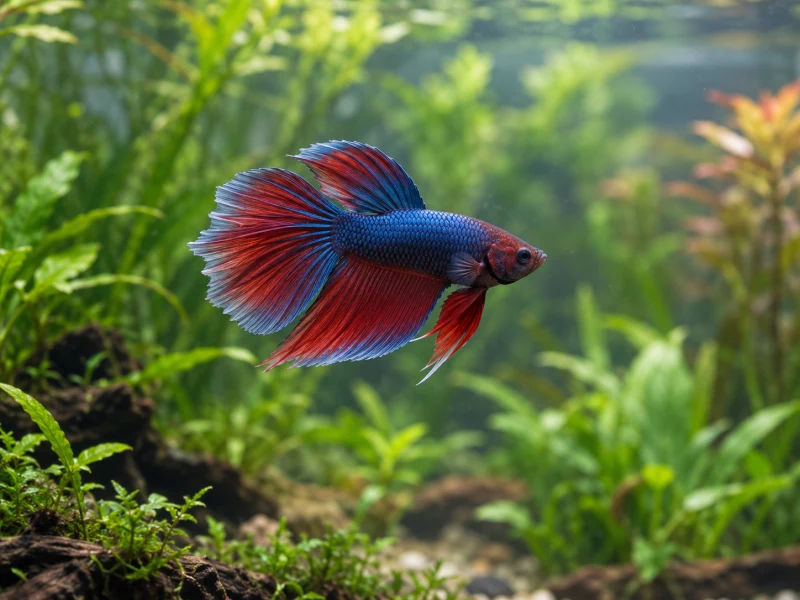
AI-created modern ornamental-betta illustration; not an archival photograph, a wild voucher specimen or proof of a named genetic line.
Betta fish history connects wild Southeast Asian fishes, centuries of human selection and today’s varied ornamental lines. The familiar pet is associated mainly with Betta splendens, but its history cannot be reduced to one color form, one founding story or one exact date.
First keeping a fish, breeding it selectively, publishing a scientific name and developing a modern variety are different events. Separating them explains how a fish with wild relatives became a diverse aquarium animal without turning a historical anecdote into a care rule.
Start betta fish history with the species name
FishBase lists the species as Betta splendens Regan, 1910, commonly called the Siamese fighting fish. The authority and year belong to its scientific naming record. They are not a date for the first person to keep or breed the fish.
Betta is a genus, while splendens identifies a species within it. A show name describing fin shape or color belongs to another category. Do not treat a fin label as the name of a separate wild species.
FishBase traces the genus name to Malay/Javanese fish names. That linguistic history is separate from the geographic origin of each species. A common name, a scientific name and a breeder’s label can each provide information without answering the same question.
Keep that distinction when reading an older account. Ask which fish the writer meant rather than assuming every historical use of “betta” refers to the modern ornamental form in a shop photograph.
Keep wild habitat separate from a domestic appearance
FishBase describes B. splendens in Southeast Asian freshwater settings including standing floodplain waters, canals and rice paddies. Its species summary also references rivers. A brief habitat phrase does not describe every location or every season.

Modern ornamental appearance reflects selection under human care. It cannot by itself identify the precise place where a fish’s ancestors lived. A dramatic fin outline or bright body color should not be mistaken for a geographical certificate.
Likewise, a fish described as wild-type needs clearer context. The phrase may concern appearance, while a claim about actual wild origin requires reliable provenance. A picture does not establish a collecting locality or the complete ancestry of an individual.
Natural habitat descriptions are useful for understanding the species, but they should be read alongside suitable captive-care guidance. A shallow-water reference does not prescribe a small container or remove the need for environmental care.
Human selection shaped fighting and ornamental lines
The introduction to Young Mi Kwon and colleagues’ 2022 Science Advances study reviews centuries of selection for fighting in Southeast Asia, followed by the development of ornamental breeding in the early twentieth century.
That broad sequence explains two different selection goals: behavior associated with historical contests and appearance associated with ornamental keeping. It does not establish one universal founding pair or a single moment when all modern varieties appeared.
The history of fighting is a description of past human activity, not an activity to reproduce. Present-day care should protect fish from injury and sustained confrontation. The common name does not justify arranging fights or placing males together to demonstrate their behavior.
Ornamental names describe the traits breeders emphasize. Different colors, patterns and fin forms can be combined, so a variety’s appearance is not the same thing as a separate species identity or a complete family history.
What genetics adds to betta fish history
The 2022 researchers assembled a wild B. splendens reference genome and sequenced fish representing ornamental lines and closely related wild species. The analysis placed ornamental bettas primarily with B. splendens.
It also found variable contributions from B. imbellis and B. mahachaiensis in sampled ornamental fish. Those contributions were not identical across all individuals. Avoid converting a result from sampled fish into a fixed ancestry percentage for every pet betta.
The findings make the history more detailed than a simple claim that every ornamental fish has one unchanged wild ancestry. At the same time, they do not justify assigning ancestry from a photograph or renaming an individual based on its color.
Genomic evidence can reveal relationships and past population changes that a breeding story leaves out. It answers questions through statistical comparison, rather than recovering an eyewitness account of the first breeder.

Read estimated dates in betta fish history carefully
The study inferred a strong population bottleneck in the ornamental lineage around 680 generations ago. Under its assumed captive generation time, that translated to roughly 400 years. The calendar estimate had wide uncertainty.
A bottleneck means a reduction in the ancestral breeding population inferred from genetic patterns. It can be consistent with domestication without identifying the first capture, a named breeder or an exact historical year.
The authors noted that generation time in the wild was unknown and used information about captive breeding age. Calendar dates therefore depend on assumptions as well as the genetic model. “About 400 years” should not become a precise anniversary.
The same analysis also considered much older separation among lineages. That deeper genetic history is not a date for human domestication. Similar-looking numbers can refer to different events, even within one study.
| Historical question | Relevant evidence | Limit |
|---|---|---|
| Which species name is used? | Taxonomic authority, such as Regan, 1910 | Does not date first captive keeping |
| How did human preferences change? | Accounts of fighting and ornamental selection | Does not establish every modern lineage |
| When did a population contract? | Genetic bottleneck model | Depends on assumptions and uncertainty |
| What does a variety name describe? | Color, pattern or fin-form terminology | Does not prove species or complete ancestry |
| How should a pet be housed? | Current species-care and welfare evidence | Cannot be derived from an old story alone |
Selected traits explain diversity without creating a new species for every fin
The genomic work associated different regions with aspects of coloration and fin morphology. It supports a history in which selection could combine traits, rather than one simple change producing every modern form.
A useful distinction is between appearance and origin. A named fin form describes something visible. The ancestry behind it concerns the sequence of breeding and population relationships, which a label alone cannot reconstruct.
Do not expect every trait to follow a single easy rule. The study’s findings for particular sampled colors and fins do not establish a universal inheritance chart for all varieties. They also do not make a home breeding project necessary to appreciate the fish.
The diversity is interesting as a record of human selection. It remains compatible with a simple responsibility: assess the needs and condition of the individual animal instead of treating a dramatic appearance as evidence of resilience or easy care.
Keep betta fish history separate from modern housing standards
RSPCA Australia’s species-care advice calls for appropriate space, temperature control, filtration and water monitoring. It also explains the need for surface-air access. Air breathing does not make poor water quality or a small bowl acceptable.

Neither an old habitat description nor a laboratory methods section should become a household housing standard. A managed research system may have support and monitoring that a small standalone container does not provide.
Use a current, species-appropriate care plan before acquiring a fish. Plan the full habitat and ongoing work, and get experienced aquatics or fish-veterinary advice where needed. The historical name does not establish compatibility with another fish.
Avoid using a mirror or another male to stage confrontation. Historical interest is better served by observing ordinary behavior in an appropriate environment, without creating the conditions of a fight.
Domestic popularity does not erase wild-population concerns
The genetic study also found evidence of ornamental ancestry in some wild samples. The authors raised concern about gene flow involving domestic fish and wild populations. A familiar aquarium animal and its wild relatives are not interchangeable conservation categories.
Do not release captive fish into waterways. Seek responsible rehoming if you can no longer provide care. A species’ broad geographic history does not establish that a captive individual belongs in a nearby pond, river or apparently similar habitat.
Maintain clear provenance when discussing a fish’s origin. Domestic variety, reported locality and verified ancestry deserve different descriptions. Leaving an uncertain detail unresolved is preferable to turning a retailer’s appearance label into a wild-origin claim.
Betta fish history questions
Does Regan, 1910 mean bettas were first kept in 1910?
No. It is the scientific authority and year listed for the species name. Captive keeping, selective breeding and scientific naming are separate events.
Is the genetic estimate an exact domestication date?
No. It describes an inferred population event with model assumptions and uncertainty. It cannot identify the first breeder or a precise calendar year.
Are all fish called bettas the same wild species?
No. Betta is a genus. The familiar ornamental fish is associated mainly with B. splendens, and the research also identifies contributions from related species in sampled domestic lines.
A history of species, people and changing evidence
Betta fish history becomes clearer when wild species, human selection, ornamental labels and scientific inference remain distinct. Taxonomy supplies a name, records describe human practices, and genetics helps investigate ancestry and population changes.
Those forms of evidence complement one another without supplying a single effortless origin story. Appreciating the history requires no special product purchase; caring for a modern betta still requires a suitable environment and a responsible long-term plan.
Comments are reviewed before they appear publicly. Please keep questions and feedback relevant to this article.