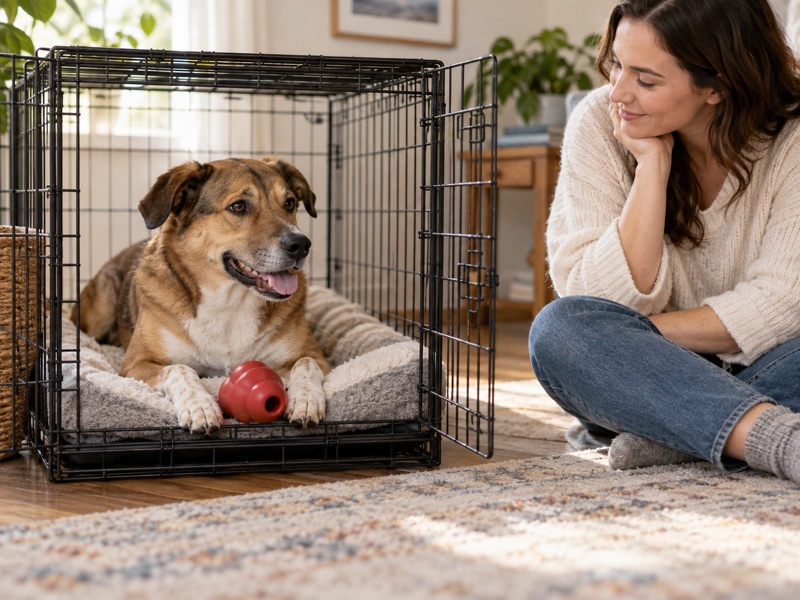
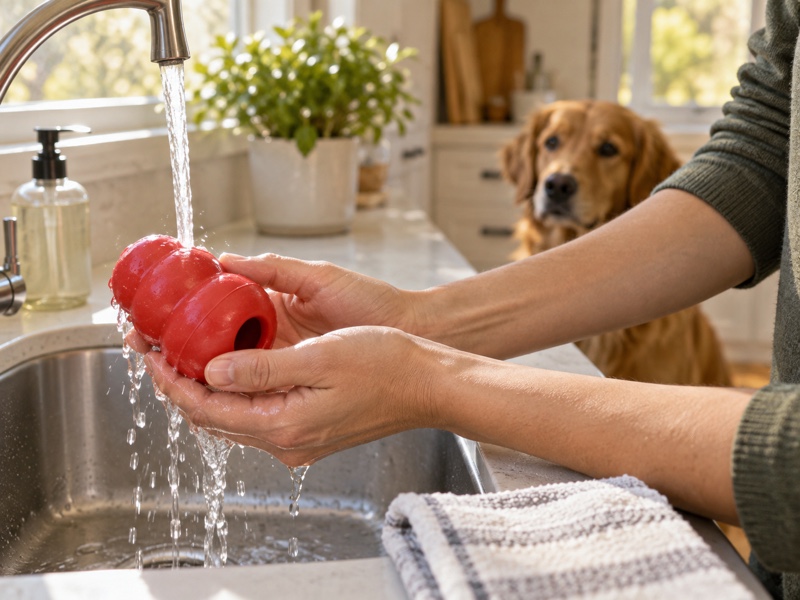
AI-created observed crate-play scene with a generic red toy; not a KONG product photo or a claim of unattended safety.
Choosing dog crate toys starts with a question that a shopping list cannot answer: who will watch the dog while the toy is in the crate? A toy can make a short training session more interesting, but the word “crate” does not turn it into an unattended-play guarantee. The dog’s size, chewing habits, ability to settle and history with that exact toy all matter.
One practical example is the red KONG Classic Large, Amazon ASIN B0002AR0I8, a one-piece hollow natural-rubber toy that can hold food. KONG identifies its red Classic formula for average chewers and its own product warning says supervised use only. Keep it to observed crate training rather than leaving the dog alone with it. If no one can supervise, the decision may be to leave a toy out of the crate and change the management plan instead.
Set the supervision rule before buying dog crate toys
The American Kennel Club’s crate-training guidance describes food-stuffed toys as a way to build a pleasant association with a crate. It also tells owners to supervise a new toy style first and to choose an item large enough not to be swallowed whole. That general advice should not override a particular maker’s warning. KONG’s Classic page explicitly says supervised use only, remove packaging attachments and stop use if damaged.
Define “supervised” in practical terms. An adult is present, can see and hear the dog, can open the crate promptly and can remove the toy if behavior changes. A camera feed watched later does not provide that control. Merely being somewhere in the house while the dog is behind a closed door may be too little if you cannot intervene. An open-door practice session beside the crate is a sensible place to learn how the dog handles a new object.
Watch for focused gnawing at one edge, tearing, attempts to swallow the whole toy, frantic pawing at the crate, or an inability to settle. Any of these changes the decision. Remove the toy calmly, end the session and reconsider fit or the training setup. A dog that panics in a crate needs a training or veterinary behavior assessment; a longer-lasting chew is not a treatment for separation anxiety.
| Object or situation | Why it may appeal | Supervision decision |
|---|---|---|
| One-piece food-stuffable rubber toy | Offers a familiar food task | Test size and chewing response in sight; follow product-specific supervised-use warning |
| Plush toy, rope or fabric comfort item | Soft to carry or rest against | Watch for seam, fiber or stuffing removal; do not assume it is safe for an unattended chewer |
| Puzzle with lids, cords or detachable parts | May extend activity | Use only where parts and behavior can be monitored; small pieces can become accessible |
| No toy during a rest period | Reduces loose objects when a dog settles well | Reasonable if the dog is comfortable and its exercise, potty and rest needs are met |
There is no universal “safe dog crate toys” list for every dog. Product warnings, the observed dog and the exact session determine the choice. A crate toy is optional; rest, gentle training and appropriate time outside the crate remain essential.
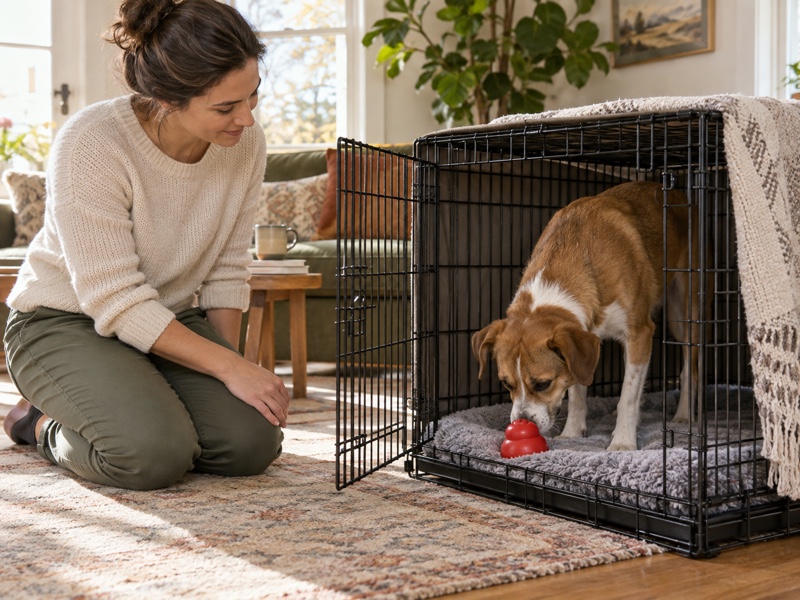
Check the exact KONG Classic Large offer
The selected Amazon B0002AR0I8 page currently names a KONG Classic Stuffable Dog Toy for Large dogs and shows Large, Pack of 1 selected. It lists item model T1E. The manufacturer’s Classic page describes the red natural-rubber formula as intended for average chewers, with a hollow center for stuffing and an irregular bounce for play. It lists Large as a starting size for roughly 30–65-pound dogs. That weight band is only a shopping guide; it does not establish mouth fit or chewing safety for an individual dog.
Some retailer dimension and weight fields for this ASIN are plainly implausible for a Large KONG, so they are not a reliable sizing basis. KONG’s own Large specification is about 2.75 × 2.75 × 4 inches on the checked product page. The retailer model suffix and manufacturer SKU display can differ, so compare the product name, size, color and package label when the order arrives. Do not silently switch to an X-Large, a black Extreme or a two-pack because they appear in the same size selector.
Place the real toy near the dog before using it in a crate. Can the dog pick it up without fitting the entire object into its mouth? Does the hollow opening remain clear rather than becoming a target for tearing? Does the dog work food out calmly or attack a rubber edge? If it looks too small or cannot withstand the observed style, the planned Large red Classic is not a good match for this session. The label “durable” is not a promise of indestructibility.
KONG specifically advises sizing up or trying its Extreme line for power chewers, with continued supervision and inspection. Choose the red Large Classic only when its average-chewer use case fits. A power chewer needs a separate product decision; another size or rubber formula needs its own fit and use check.
If the exact red Large one-piece toy suits the dog’s size and observed behavior, check the KONG Classic Large offer on Amazon. Confirm ASIN B0002AR0I8. Check the live seller, size and delivery terms at checkout; prices and availability can change.
Run a short observed crate-toy trial
Begin when the dog is already calm, has had a chance to toilet and is not being put in the crate as punishment. AKC’s crate-training guidance emphasizes gradual training and removing a dog’s collar in the crate so it cannot catch on the bars. Check the crate for exposed ties, frayed bedding, clips or other loose items before adding a toy. An intact toy cannot compensate for a hazardous crate setup.
Offer a lightly filled KONG Classic at the open crate entrance or just inside. Let the dog enter voluntarily, investigate and leave. Keep the first session short enough that the dog can succeed without becoming frustrated. Observe its bite location and whether it can retrieve the food without swallowing large chunks of filling or chewing material. Do not close the door merely because the dog touches the toy once.
On later practice sessions, close the door briefly only if the dog remains relaxed. Stay close enough to respond. The toy should support a calm routine; it should not distract from persistent barking, drooling, scratching or an attempt to escape. If those appear, back up in crate training and seek qualified help where appropriate. A food toy cannot make a dog tolerate an enclosure that causes distress.
After each trial, remove the toy, inspect its rim and body, wash out the food and dry it. Only then decide whether to repeat the same setup. Several uneventful sessions are useful observations, but they do not cancel KONG’s supervised-use instruction or guarantee future safety. Dogs can change how they chew when the filling runs out or when left in a different context.
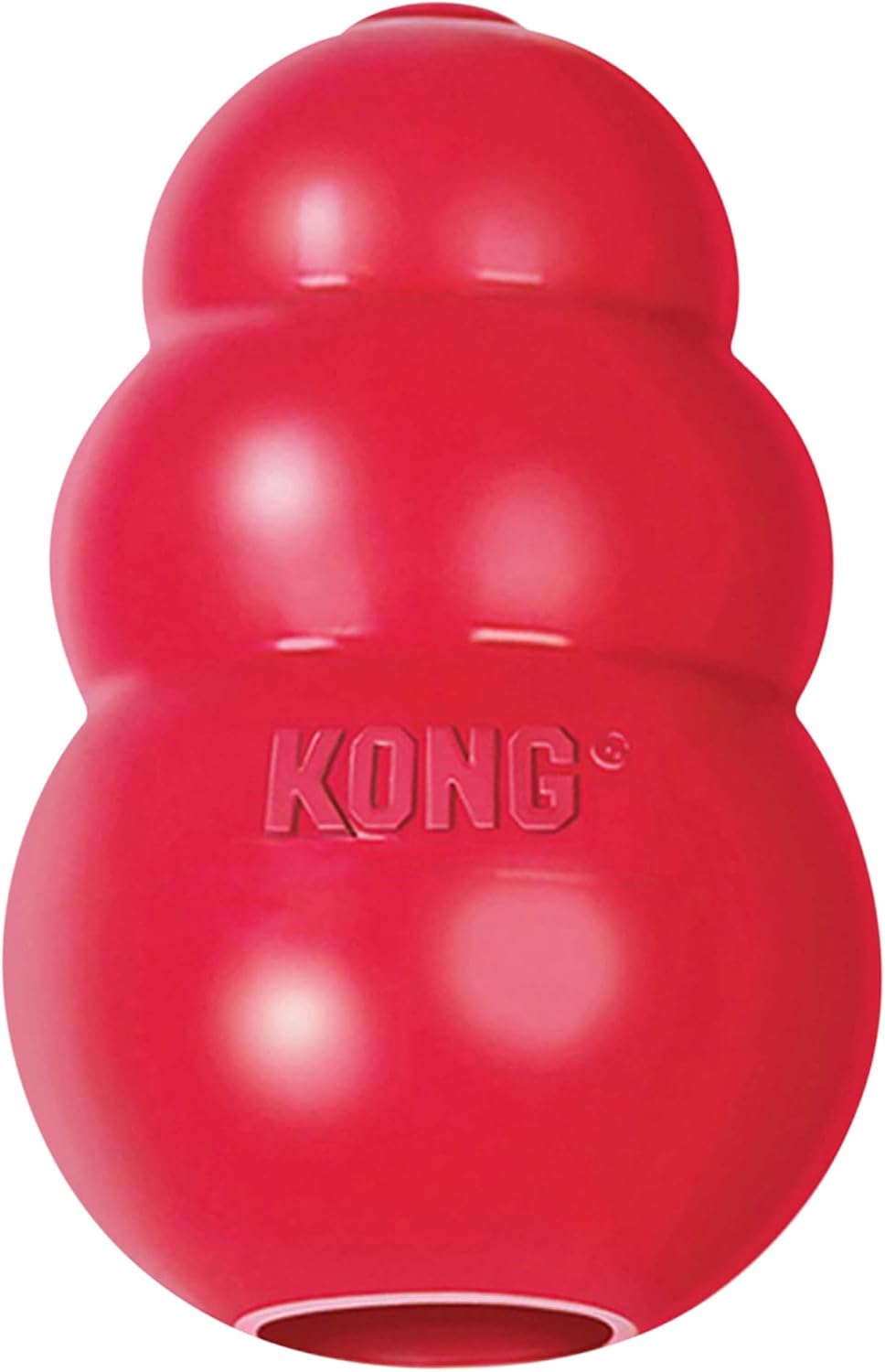
PRODUCT MENTIONED
KONG Classic Red Rubber Toy, Large
Amazon · Details on the retailer’s website
Stuff and clean without turning enrichment into a problem
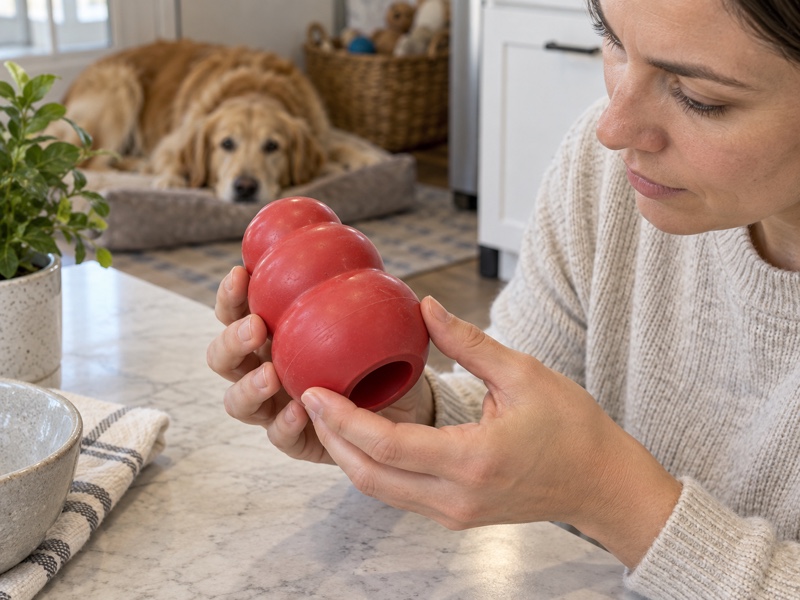
The hollow Classic can hold part of a dog’s usual meal. Starting with familiar kibble or a small amount of an already tolerated food lets you see how the dog works the toy. If you add a new ingredient, check that it is dog-safe and consider diet restrictions and the day’s total food. For simple layering ideas, see the KONG stuffing ideas guide; keep the crate activity supervised regardless of the filling.
A heavily frozen filling may extend the task, but longer is not automatically better. Some dogs become frustrated and begin biting the rubber rim instead of licking or nudging the food. Observe the first attempts and adjust difficulty to the dog rather than aiming for a maximum number of minutes. If the dog walks away and rests, remove leftovers before they spoil. Do not leave perishable food in a closed crate for an unknown period.
Food also changes how the toy is treated by other animals. In a multi-dog home, prevent another dog from approaching the crate and competing through the bars. Feed and train dogs separately. A dog that guards food in the crate needs management and training support, not a more elaborate stuffed toy. Keep hands away from a guarding dog’s mouth and seek a qualified professional if needed.
After use, empty residue from the cavity and wash it according to the product directions. The current Amazon listing describes dishwasher-safe cleanup; KONG’s FAQ offers cleaning guidance for rubber toys. Follow the actual package instructions for temperature and placement. Check the interior with good light so no old food remains; let the toy dry completely before storage or refilling.
Know when dog crate toys should stay out
Do not provide this KONG Classic if it is cut, has a missing piece, has an altered opening or no longer behaves like an intact toy. Examine the rim and the seams between lobes because those areas receive repeated pressure. Do not tape or glue a damaged toy and return it to a dog. If material may have been swallowed, contact a veterinarian.
Leave a toy out when the dog habitually disassembles rubber or fabric, attempts to gulp toys, guards objects intensely or shows distress in the crate. For a dog with panic signs, a larger safe area, a sitter, a shorter absence or a gradual behavior plan may be more appropriate than adding objects. AKC’s training article advises against crating a dog longer than its comfort or bladder capacity and against using the crate when it causes panic.
Do not use a rubber food toy to justify leaving a dog crated all day. Exercise, water, toileting and social needs still apply. Puppies and dogs with medical needs may require more frequent breaks. If the dog has been ill or is on a restricted diet, confirm that a filled toy and its ingredients are appropriate with a veterinarian. These variables matter more than ranking products by claimed toughness.
Finally, distinguish supervised crate training from an unattended departure. A dog may work a toy gently while an adult sits nearby and then start chewing harder after the person leaves. For the selected KONG Classic, the manufacturer’s warning settles the recommendation: use it under supervision. If you must leave the room or home, remove this toy rather than treating an uneventful practice session as proof that the next one will be safe.
Dog crate toys: common questions
Is a red KONG Classic safe to leave in a crate overnight?
KONG’s current Classic product page says supervised use only. Do not leave B0002AR0I8 in the crate overnight without observation. Discuss a different routine with your veterinarian or trainer if the dog needs help settling.
Can a stuffed toy cure separation anxiety?
No. A food toy can help build a pleasant association during gradual training, but persistent panic, escape attempts or prolonged distress call for a behavior and management plan. Do not label those signs simple boredom.
Is Large the right size for every medium or large dog?
No. KONG’s 30–65-pound band is a starting point. Check the actual dog’s mouth, chewing style and ability to use the hollow opening without trying to swallow the toy. Power chewers may need a different formula and still require supervision.
Should a puppy keep a plush toy in the crate?
Soft toys can comfort some puppies, but fabric, stuffing and squeakers may become accessible to a dog that tears them. Observe the individual puppy and the exact toy. Avoid treating any plush item as universally safe during unsupervised time.
What if the dog ignores the toy?
Do not force it. The crate can be a place for quiet rest. Try gradual positive training at another time, and check whether the dog is comfortable with the space itself. A toy is one optional tool, not a requirement.
Make the crate decision for this dog and this session
The red KONG Classic Large is a specific, food-stuffable option for a dog whose size and average chewing style fit it during observed crate training. Confirm B0002AR0I8, introduce it gradually, remove the dog’s collar, watch its interaction, clean and inspect the toy, and stop if either the dog or the rubber shows a problem. When supervision is unavailable, KONG’s instruction means leaving this toy out and choosing a safer management arrangement.
Comments are reviewed before they appear publicly. Please keep questions and feedback relevant to this article.