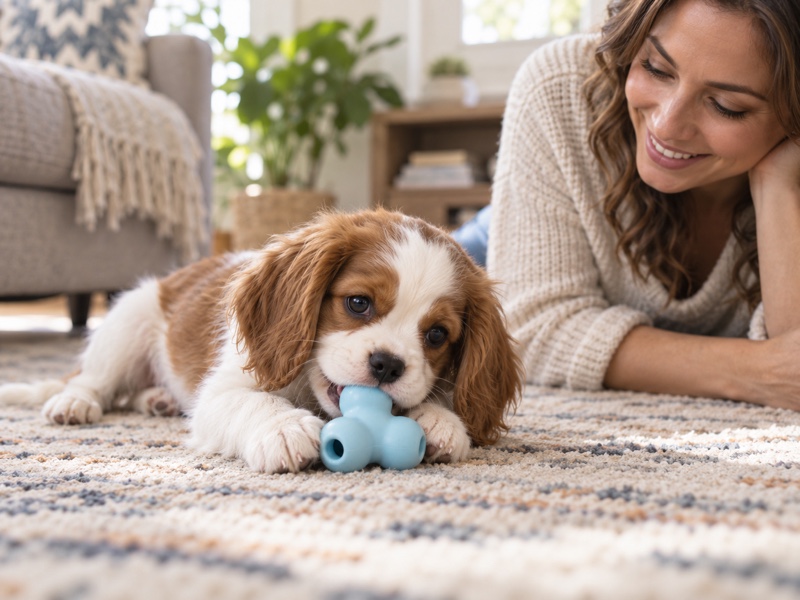
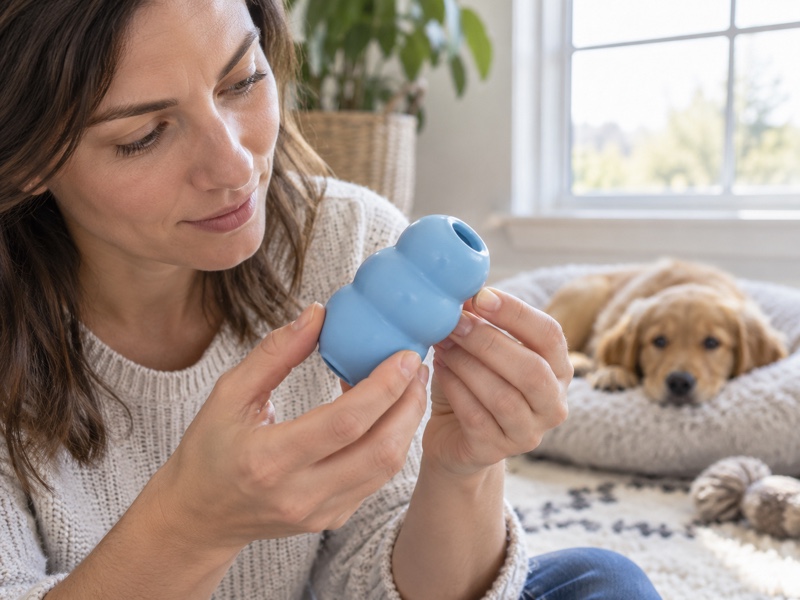
AI-created supervised puppy-play scene with a generic toy; not a KONG product photo or hands-on dental test.
Good teething toys for puppies give a young dog an appropriate object to explore while its mouth is changing. They do not diagnose oral pain, prevent every bite or replace supervision. The right choice depends on the puppy’s current mouth size, how it chews and whether the toy stays intact in use. A toy that fits at eight weeks may become too small as the puppy grows.
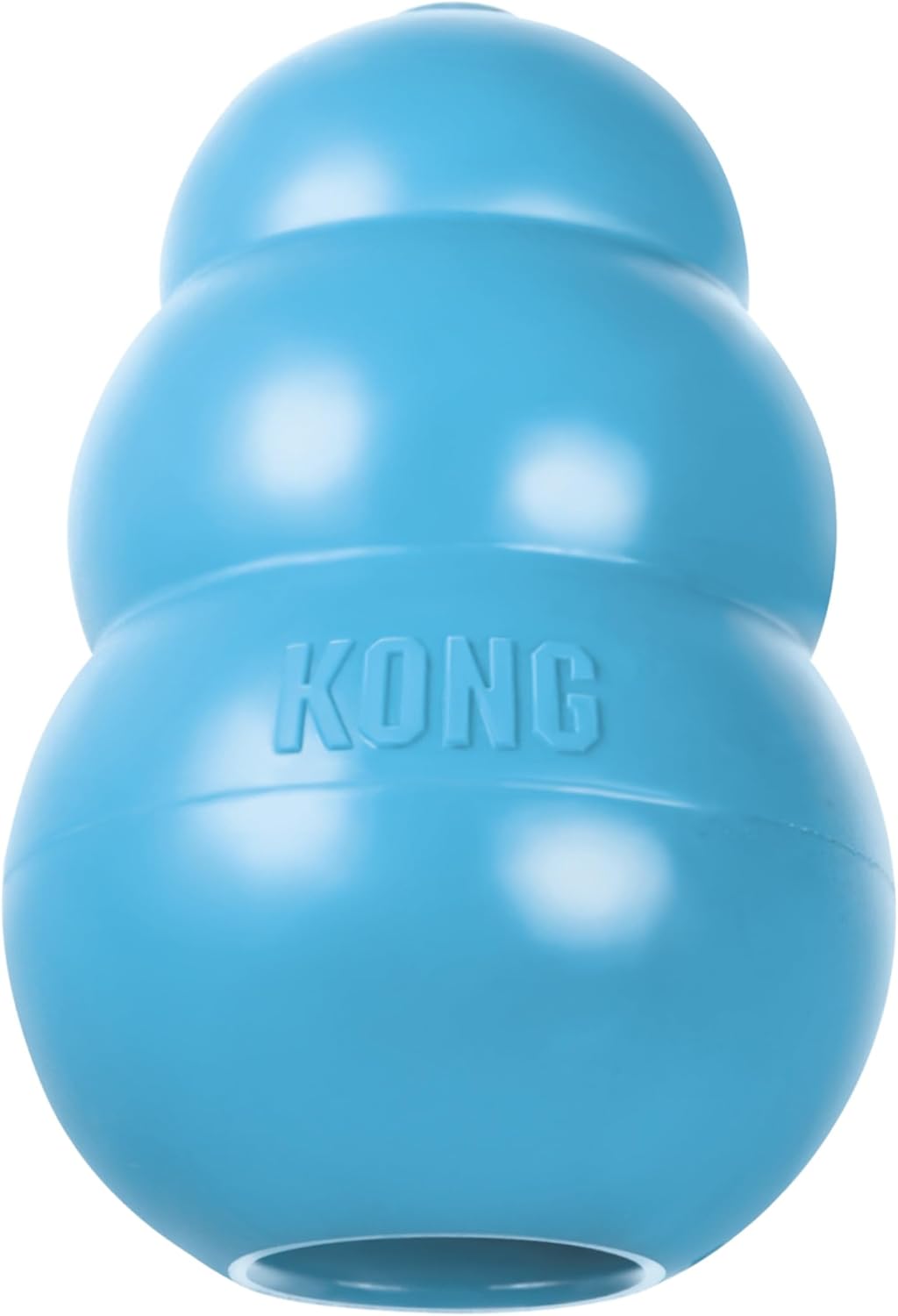
The product example is the KONG Puppy Small in blue, Amazon ASIN B0002AR18C. The retailer lists item model KP3; KONG’s own blue Small variant is labeled KP3BL. This is a softer puppy rubber formula, distinct from the red Classic for average adult chewers and the black Extreme for powerful chewers. The manufacturer’s page says it is not recommended for puppies over nine months, requires supervised use and should be removed if damaged. Treat that as the boundary for this specific product rather than assuming every puppy toy has the same age rule.
Match teething toys for puppies to the development stage
The American Kennel Club’s puppy-teething timeline explains that dogs start with baby teeth and then replace them with adult teeth over their first months. It describes the 12–16-week period as one when owners may notice shed baby teeth and should offer suitable chew toys while having a veterinarian check the mouth. The timeline is a guide, not a way to determine whether an individual puppy’s tooth or gum is healthy from a blog article.
At the start, an age-appropriate, softer rubber formula may be easier for a small mouth to explore than a rigid adult chew. KONG says its blue and pink Puppy rubber is its softest formula, intended for young puppies. That is a manufacturer comparison between its products, not a measurement of the bite force of your puppy or a promise that rubber cannot be torn. Observe whether the dog nibbles, presses and releases, or concentrates force on a rim until it begins to change shape.
Reassess as teeth and body size change. A puppy may need a larger Puppy toy before it needs a tougher adult formula. Another may outgrow the Puppy rubber’s intended use sooner because of chewing style. Do not wait for a calendar birthday if the toy becomes small enough to swallow or shows damage. Conversely, do not jump straight to the hardest object available just because a young dog chews enthusiastically.
| Stage or behavior | What to check | When to change course |
|---|---|---|
| Newly home, exploring with baby teeth | Softness, mouth fit, one-piece construction and calm supervised use | Toy is too large to grip or puppy attacks a small edge |
| Baby teeth loosening and adult teeth emerging | Daily mouth comfort, toy surface and veterinary oral checks | Persistent pain, swelling, significant bleeding or appetite change |
| Puppy growing rapidly | Whether the toy can enter the whole mouth; current manufacturer size range | Small size is becoming a gulping risk or loses its original shape |
| Older puppy with adult chewing style | Whether puppy rubber still suits age and chewing behavior | Manufacturer’s age limit is reached or repeated heavy chewing damages it |
This table is a decision aid, not a diagnosis or a substitute for the care label. Ask a veterinarian about a worrying tooth, unusual mouth pain or a retained baby tooth. A toy should be selected for normal play and enrichment, not used to mask a problem.
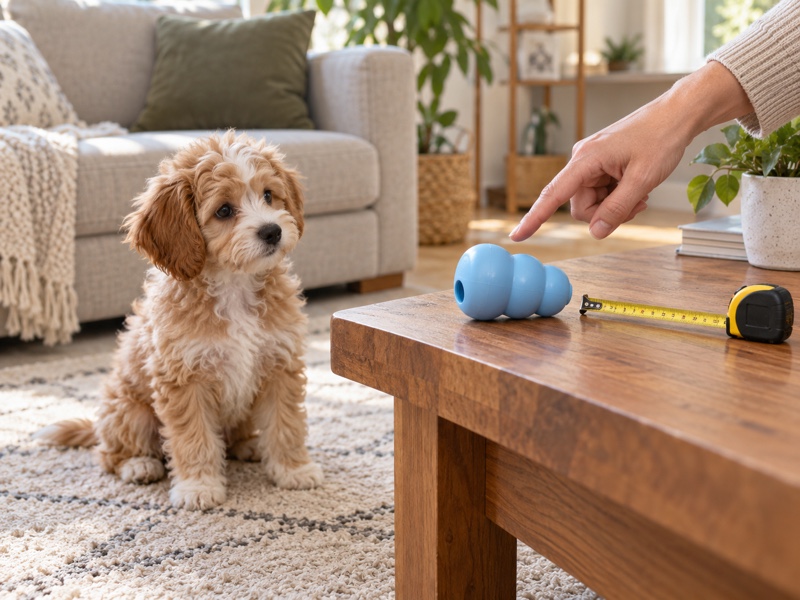
Verify the exact KONG Puppy Small blue toy
The current Amazon B0002AR18C listing names “KONG Puppy, Natural Rubber Teething Chew Toy, for Small Puppies, Blue” and shows the Small blue variant. It lists item model KP3 and dimensions about 3 × 1.75 × 1.75 inches. KONG’s blue Puppy product page identifies the Small variant as KP3BL, with dimensions 1.75 × 1.75 × 3 inches, and gives “up to 20 pounds” as its Small size band. The figures describe the same nominal dimensions in a different order, but neither substitutes for measuring the delivered toy.
Amazon’s size selector may show larger variants and other colors. Confirm Small and Blue in the final cart. The KONG Puppy line also includes pink toys, but color alone should not replace checking the exact size and model. ASIN B0002AR18C identifies the specified Small Blue KONG Puppy, not a red KONG Classic, a puppy teething stick or a multi-pack.
The 20-pound band is only the manufacturer’s starting point. A puppy with a wide mouth or a habit of trying to swallow objects may need a different size even below that weight. A small puppy may struggle with a too-large toy and start gnawing only at a thin edge. Present the real toy in an open space while watching; check the grip and the chewing pattern before deciding it belongs in the rotation.
KONG describes the puppy toy as natural rubber with a hollow center that can be filled with treats or part of a meal. It also has an unpredictable bounce for play. Those features make it more versatile than a stationary chew, but they do not certify dental benefit or unattended safety. The manufacturer specifically says supervised use only and to discontinue if damaged.
If the Small blue variant fits your puppy’s current mouth and gentle chewing style, view the exact KONG Puppy Small Blue offer on Amazon. Recheck the selected size, seller and live availability at checkout. Confirm the Small Blue model and ASIN rather than relying on the displayed color alone.
Use teething toys for puppies in observed play
Begin with a short session on a clear floor. Let the puppy sniff or pick up the toy without forcing it into its mouth. Watch whether the rubber gives enough for comfortable mouthing while remaining intact. If the puppy chews at your hands, redirect to the toy calmly rather than using it to pry the mouth open. End the game before frustration or rough biting escalates.
Keep the first food task simple
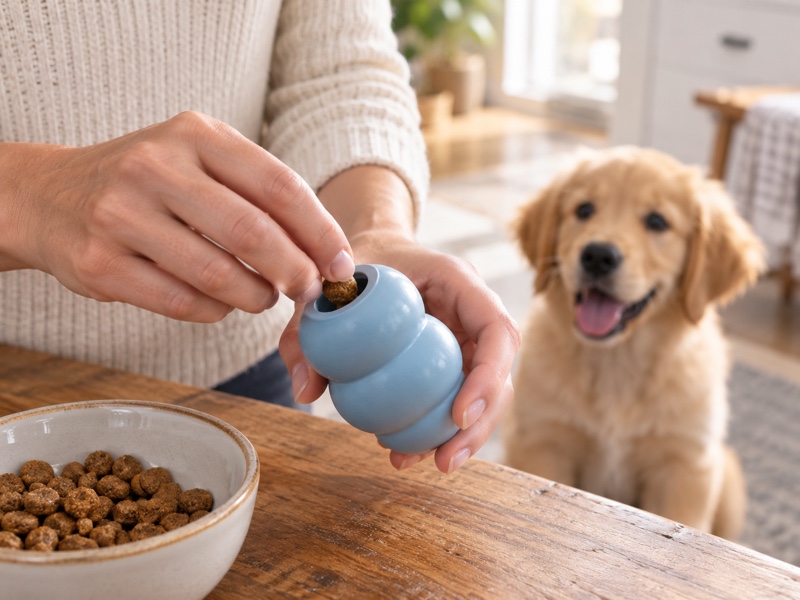
For a food task, start with a few pieces of the puppy’s familiar kibble rather than a complicated frozen recipe. Check ingredients and the day’s total food if you add pastes or other fillings. Some foods marketed for people can be unsuitable for dogs, and a puppy with a medical or dietary restriction needs veterinary guidance. The KONG stuffing ideas article discusses layering; for a puppy, keep the first attempt easy enough that it engages with food rather than tearing at the rubber opening.
Never assume that every teething material can be chilled or frozen. The checked KONG Puppy page supports stuffing and supervised play, but a specific freezing method should follow the delivered product’s instructions and the puppy’s tolerance. Do not freeze a hard object and put it directly against a sore mouth simply because “cold soothes gums” sounds plausible. If a chilled food toy is used under an appropriate maker instruction, supervise the puppy and stop if it avoids the texture or behaves as if uncomfortable.
Fetch can be brief and low impact. Toss the toy a short distance on a nonslip surface and encourage a relaxed return. A puppy does not need repeated high leaps or hard landings to benefit from play. Keep the toy out of an unsupervised crate or pen: KONG’s warning for the Puppy product says supervised use only. Positive crate associations require a training plan, not an assumption that a stuffed toy can safely occupy a puppy indefinitely.
PRODUCT MENTIONED
KONG Puppy Small Blue Rubber Toy
Amazon · Details on the retailer’s website
Inspect and retire teething toys for puppies promptly
Check the toy before and after each session, especially around its small and large openings and the ridges between the lobes. Look for new cuts, an edge that can be lifted, permanent deformation or missing rubber. If a fragment has disappeared, remove the toy and contact a veterinarian for advice about possible ingestion. Do not glue a damaged rim and give it back. The soft Puppy formula is intentionally different from the adult formulas; it is not an indestructibility claim.
Wash food from the cavity promptly, using the care instructions on the delivered package and KONG’s current rubber-toy cleaning guidance. Rinse and dry the inside, not just the outside. Old food trapped in the hollow center can make an otherwise intact toy a poor choice for the next session. Store it out of reach so supervised play does not become unsupervised chewing between uses.
Recheck size as the mouth grows
Recheck mouth fit as the puppy grows. KONG says to move to a larger Puppy or a Classic as appropriate, and says the Puppy product is not recommended beyond nine months. The transition is not simply a swap from blue to red on a fixed date; it depends on the real dog’s mouth, dentition and chewing style. The red Classic is for average chewers, while other formulas address different needs. Make a new selection rather than continuing a too-small or worn Puppy toy.
Some teething signs are beyond toy selection. The AKC’s discussion of retained puppy teeth notes that a baby tooth can remain while the adult tooth emerges. Ask a veterinarian to examine unusual crowding or a tooth that appears retained. Seek veterinary advice for notable swelling, persistent bleeding, significant reluctance to eat, a broken tooth or clear pain. Do not treat a toy’s popularity as reassurance that a mouth problem is normal.
Teething toys for puppies: common questions
Is the blue KONG Puppy softer than the red Classic?
KONG describes its blue and pink Puppy rubber as its softest formula for young puppies, while the red Classic is for average chewers. That is a product-line comparison. Choose the actual size and formula for the puppy in front of you.
What size is the linked KONG Puppy?
It is the Small Blue Amazon offer B0002AR18C, model KP3 on the retailer page; KONG’s corresponding blue Small variant is KP3BL. Its nominal dimensions are about 3 inches high and 1.75 inches wide. Verify the delivered label and mouth fit.
Can I leave it with my puppy overnight?
KONG’s product warning says supervised use only. Do not leave the selected toy overnight or use it without supervision. Build a separate, puppy-appropriate rest routine rather than depending on any chew toy without observation.
Does a teething toy replace a dental check?
No. Normal tooth replacement still deserves veterinary checks, and unusual pain, significant bleeding, swelling, retained teeth or refusal to eat should be assessed by a veterinarian.
When should I switch from Puppy rubber?
KONG does not recommend this Puppy model for puppies over nine months and advises moving to a larger Puppy or Classic as growth requires. Replace it sooner if size or chewing behavior makes it unsuitable, or if it is damaged.
Choose for the mouth you have today
The Small Blue KONG Puppy is one candidate among teething toys for puppies when a young dog’s size and gentle chewing suit it. Confirm the exact variant, begin with short supervised play, keep filling simple, inspect every surface and reassess size as the puppy grows. A toy supports play and redirection; it cannot guarantee safety, eliminate teething discomfort or explain an abnormal mouth symptom.
Comments are reviewed before they appear publicly. Please keep questions and feedback relevant to this article.