
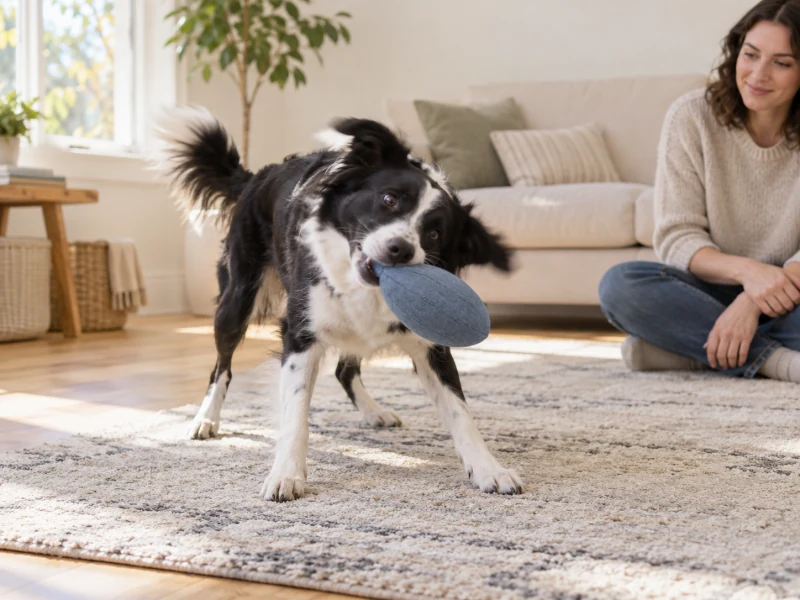
AI-created illustrative scene of supervised, gentle carrying. The generic star toy is not KONG Toughz Duck ASIN B0DD1XDFP3 or a hands-on test.
Plush dog toys can be good for carrying, gentle shaking and settling beside a person. The buying question is how your dog uses a soft toy once play becomes exciting. A dog that carries a toy home from a game places different demands on seams and squeakers from a dog that immediately opens the fabric and hunts for the sound.
Choose the construction, size and supervision plan together. A thick outer fabric may slow wear, but it cannot make stuffing, stitching or a squeaker safe to swallow. The KONG Toughz Duck Medium is one specific stuffed, double-squeaker option; it is not a universal choice for every dog or a substitute for watching the first sessions.
Match plush dog toys to what your dog actually does
Watch a familiar toy in a short, supervised session before choosing another. Does your dog carry it without biting hard, shake it and release it, hold it while resting, or work repeatedly at the same seam? Observe the behavior rather than assigning a permanent label from breed or body size. KONG’s toy-selection FAQ distinguishes light mouthing and carrying from steady gnawing and attempts to puncture or dismantle a toy within minutes.
A plush toy is easiest to evaluate when the dog is calm and another person can see the whole session. Tugging hard on a dangling limb, trying to peel an eye, or working at a squeaker opening are different from carrying the toy. If play turns into deliberate extraction, stop that session; do not wait for stuffing to scatter before changing the toy type.
The Humane World dog-toy guide notes that soft toys may suit dogs that carry them or shake them, but they do not suit every dog. It recommends choosing an appropriate size and supervising squeaky toys, since some dogs seek out the sound source and may swallow it. These are decision checks, not a claim that every supervised plush is safe.
| Observed play | What to look for | When to change course |
|---|---|---|
| Carries or cuddles | Soft shape the dog can hold without a small removable part | Fabric, eyes or stitching start to lift |
| Shakes and releases | Whole toy remains too large to swallow; limbs and seams stay intact | Repeated shaking opens a seam or loosens a part |
| Chews steadily | Close supervision and a construction intended for moderate use | Focused biting starts to puncture the shell |
| Seeks stuffing or squeaker | Consider a different toy category rather than a tougher-sounding plush label | Any inner material or sound unit becomes accessible |
Use the table as a screening tool, not a durability rating. A dog may carry one plush gently and destroy another because the shape, seams or sound changes the game. Recheck the actual dog-toy pair after each new purchase.
Compare stuffing, low-stuff construction and squeakers in plush dog toys
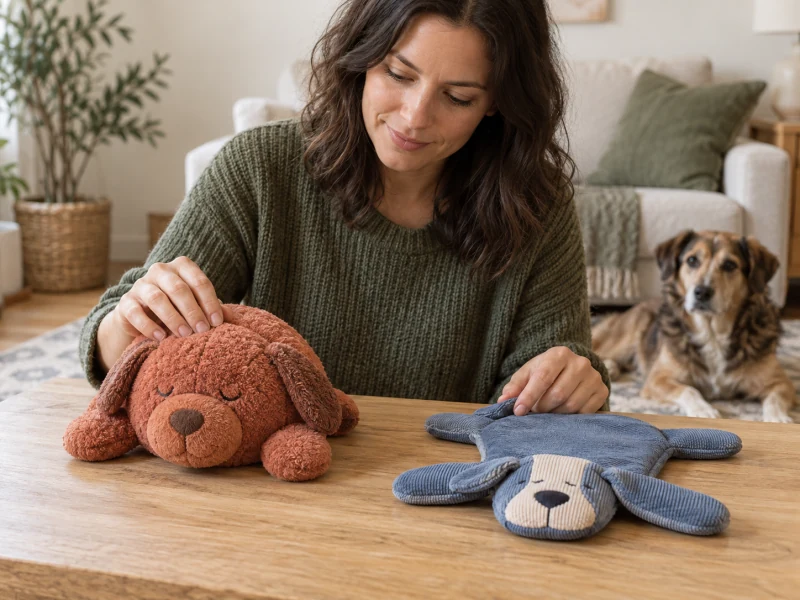
A fully stuffed shape has volume and can feel satisfying to carry or rest against. The tradeoff is that an opened seam exposes filling. A low-stuff design can leave less loose filling when damaged, but it can still contain fabric strips, rope or a squeaker that needs inspection. “Less mess” is not the same as “safe when torn.”
For a concrete construction comparison, KONG describes its Floppy Knots Fox as a low-stuff plush with an internal knotted rope and a squeaker. That is a different toy from the stuffed Toughz Duck. The point is to inspect what is inside each design; do not assume two plush toys from one brand have the same filling or wash instructions.
A toy advertised as stuffing-free still needs the same assessment of seams, fabric, sound unit and any internal or external parts. No-fill reduces one source of loose material; it does not remove every ingestion or choking concern. If the reason for buying it is that your dog has already opened several toys, a fabric shell may still be the wrong material.
Sound adds another variable. Some dogs lose interest when a squeaker stops; others become more determined to reach it. Humane World specifically recommends supervising squeaky-toy play. Choose a sound level that works for the household, but do not make “quieter” the only buying test. Ask whether the dog stays engaged without trying to expose the mechanism.
When comparing listings, record four practical facts: whether it is stuffed, whether it squeaks, its selected size and what the maker says about chewing intensity. “Durable,” “tough” and “long-lasting” are too broad on their own. A toy can withstand an ordinary shake yet fail quickly under concentrated chewing at one seam.
Read the exact KONG Toughz Duck offer carefully
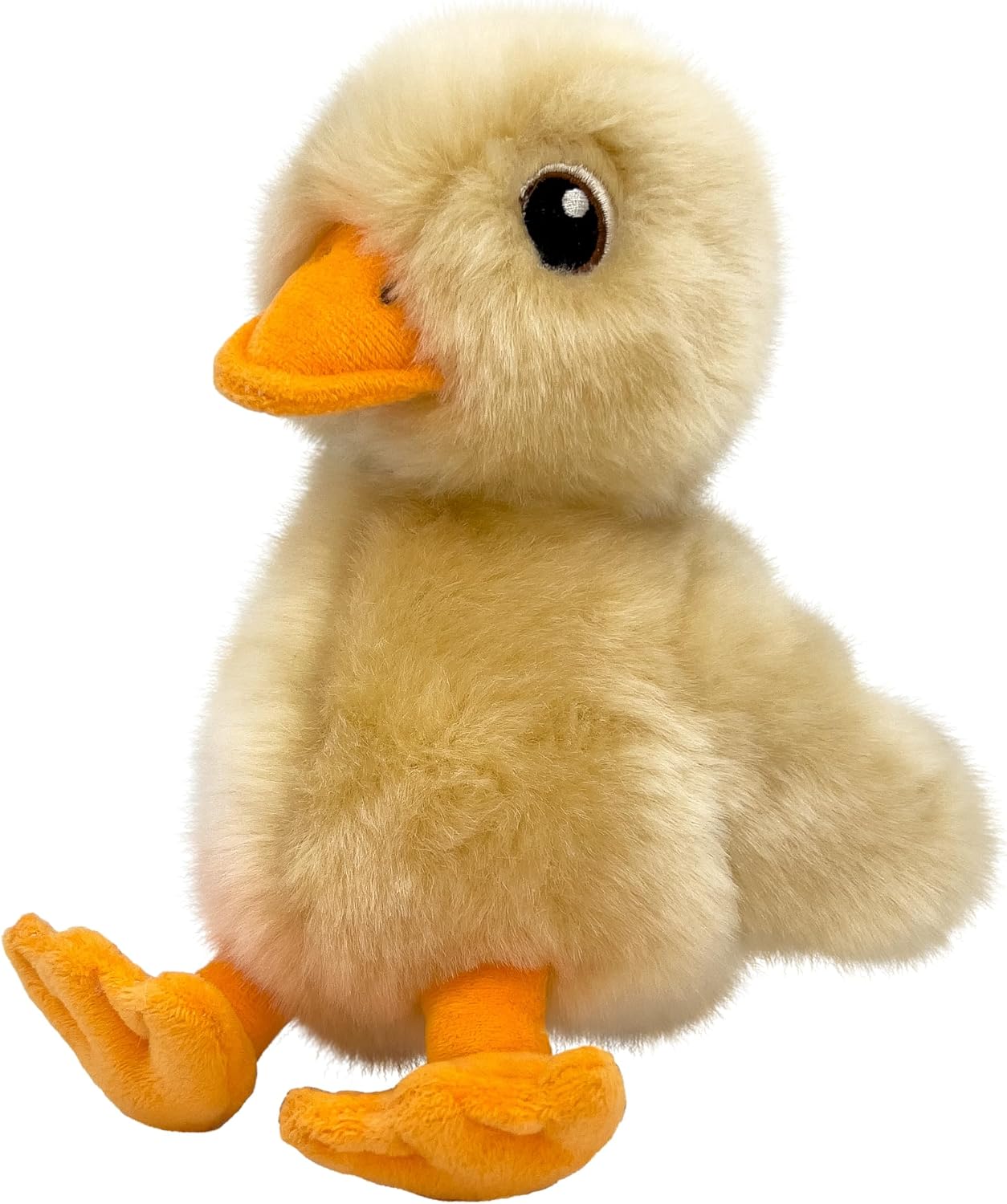
The selected example is KONG Toughz Duck Plush Dog Toy, Medium, Amazon ASIN B0DD1XDFP3. Its current listing describes thick plush, a stuffed construction and a double squeaker. The product details give approximately 5.91 × 4.13 × 7.52 inches and a model-number field of TGZ22. These are retailer details for this selected offer, not independently verified measurements or specifications for every Toughz shape.
The same detail table contains a conflicting manufacturer-part field, TGZ21. Use the ASIN, Medium size, Duck shape and current listing pictures together when checking the cart and delivered tag. Do not infer that the two codes are interchangeable or buy a different size merely because a search result repeats one code.
The listing’s warranty description is more restrictive than its “Toughz” name: it says the toy is designed for light or moderate chewing, calls for supervision, and directs tough chew sessions toward KONG rubber toys. That makes the Duck a possible plush choice for a dog whose observed play fits those limits, not a recommendation for a dog that rapidly dismantles fabric.
If that play style and construction match your dog, check the exact KONG Toughz Duck Medium offer on Amazon. Confirm the ASIN and selected size at checkout. A current product page can change its seller, images, stock or wording; none of those should be stated as permanent properties of the toy.
The product photo shows a pale yellow duck with an orange bill and feet. It does not reveal seam strength, squeaker placement or how your dog will use it. Do not judge those hidden features from a clean product photo or from the word “tough” in a title.
Choose size by mouth access, not just a Medium label
The listed Duck is a Medium retail variant. When sizing plush dog toys, that label is not a guarantee for every medium-size dog. Compare the physical toy with the dog’s mouth and chewing pattern, and make sure the whole toy is not small enough to be swallowed. Humane World warns that toys that are too small can be swallowed or lodged in the throat. A dimension listing is a starting point; the animal’s jaw, grip and habit of compressing plush matter too.
Look beyond overall length. A duck’s bill, feet and any projecting fabric may be much narrower than its body. Inspect whether the dog concentrates on those parts. A plush that cannot fit in the mouth as a whole can still shed a small piece or expose a squeaker. Do not try to make a poorly sized toy acceptable by trimming, tying or stitching on extra fabric.
KONG’s general FAQ cautions that size charts for its rubber products do not automatically apply to its other toy lines. Use the selected plush listing and the dog’s observed play, and size up or choose a different construction when a swallowing risk remains unclear. A larger toy is not automatically safer if it tempts more forceful pulling or has easy-to-remove appendages.
PRODUCT MENTIONED
KONG Toughz Duck Plush Dog Toy, Medium
Amazon · Details on the retailer’s website
Make the first squeaker session a supervised test
Remove all packaging and keep the dog in a clear play area. Let the dog investigate the new toy while you watch where the teeth land. Do not leave it in a crate or with an unsupervised dog just to see whether the material lasts. KONG’s FAQ recommends supervising any non-edible toy and removing a compromised one immediately.
Start with a short carry or retrieve game rather than rough tugging. Watch the seams around the bill, feet and body, and notice whether the dog responds to the squeaker by playing with the whole toy or by searching for the sound unit. If the dog targets one spot repeatedly, pause and inspect that area before another round.
Some dogs share a home but do not share toys comfortably. In a multi-dog household, separate the first trial so you can see each dog’s behavior and prevent a race for a squeaky item. The dog who chooses the gentlest game is not necessarily the dog who gets to the toy later. Put it away between sessions if one animal tends to dismantle fabric.
A supervised test cannot certify future safety. Seams can wear across several sessions, and a dog may play differently when more excited. Build inspection into the routine before and after play rather than treating one intact first session as proof that the toy can stay out all day.
Inspect plush dog toys for loose seams, squeakers and filling
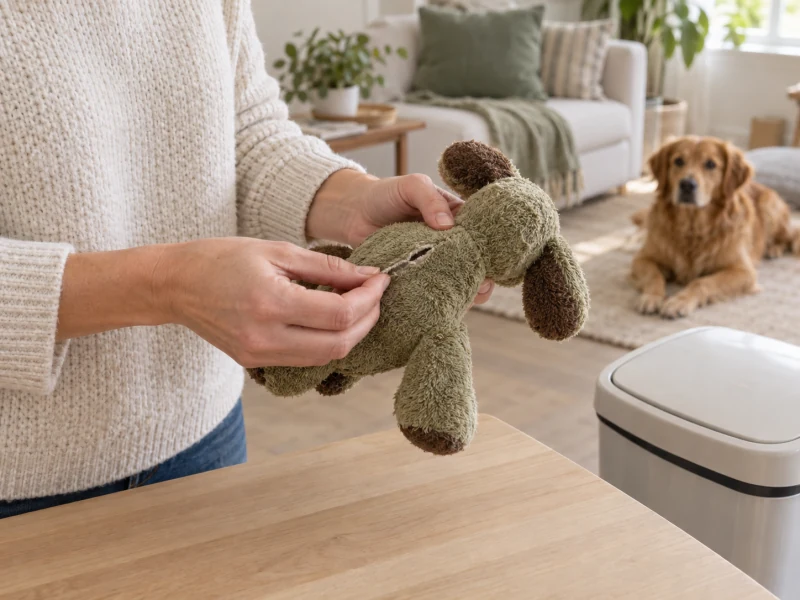
Before offering a plush toy again, feel and look along its seams, bill, feet, eyes and any other attached feature. Check for thread loops, holes, missing fabric, a squeaker you can reach through an opening, or filling that has begun to escape. Do this out of the dog’s reach so inspection does not become a tug game over a damaged object.
If stuffing or a squeaker becomes accessible, remove the toy from play and discard it. KONG’s FAQ identifies exposed stuffing, accessible squeakers and missing pieces as reasons to replace a toy; Humane World likewise advises discarding toys that tear or break apart. “Repairing” a repeatedly opened seam may conceal a weak point rather than change how the dog chews.
Do not pull a loose squeaker out and return the same torn shell as a newly “squeaker-free” toy. The exposed cavity, detached fabric and remaining components still need assessment. For a dog that consistently seeks internal parts, choose a different, appropriately sized construction instead of cycling through plush designs with similar failure points.
If you suspect your dog swallowed any toy piece, contact a veterinarian. KONG’s FAQ treats ingestion of non-food toy material as a potential health risk. Do not wait for a visible symptom, assume a small fragment is harmless or rely on product-selection advice to decide whether emergency care is needed.
Clean a plush toy without hiding wear
Cleaning plush dog toys is part of the buying decision. Dirt and saliva can make a soft toy unpleasant to handle, but a wash can also reveal loose stitching or change its shape. KONG’s general plush-care FAQ recommends surface spot cleaning with a damp cloth; it also describes cold-water, delicate-cycle machine washing for fabric pet toys and says to skip the dryer. Check the delivered Toughz Duck tag and current care instructions before applying general advice to this exact item.
Inspect the toy before washing. If a seam is already open or an inner part is accessible, retire it rather than send it through a machine and hope the damage closes. If it remains intact and the label permits washing, use the stated method, then let it dry completely before play. A damp or altered toy needs another inspection, not an automatic return to the toy basket.
A washable label is useful only when it matches your routine. If the toy needs frequent cleaning, consider how long it takes to dry and whether you have another appropriate toy for that period. Keep the dog away from a wet toy drying in reach; chewing a soggy seam is not the same activity as carrying a clean, intact plush.
Frequently asked questions
Are plush dog toys safe for aggressive chewers?
Do not assume so. KONG’s FAQ says fabric and stuffing are poor choices for dogs that quickly puncture or dismantle toys, and the selected Toughz Duck listing itself limits use to light or moderate chewing. Choose a toy category suited to the actual chewing behavior, then supervise and inspect it. If you are exploring food-filled rubber toys instead, the beginner KONG stuffing guide explains easy first sessions and food checks; it does not make a rubber toy indestructible.
Does low stuffing make a squeaky toy safe to leave out?
No. Low stuffing changes the amount of filling, not the need to check fabric, internal rope or squeakers. The dog’s response to sound and the condition of seams still decide whether the toy should remain in use.
Can I remove a squeaker if my dog is obsessed with it?
Removing a sound unit from a damaged plush does not by itself produce a safe, intact toy. If the shell has opened or the dog has begun extracting parts, stop using it and choose a different construction rather than modifying it during play.
How often should I replace a plush toy?
Replace it when it is damaged, not on a universal calendar. Check before and after play for weak seams, loose attachments, exposed filling and an accessible squeaker. Some dog-toy pairs last longer than others; that observation does not authorize unsupervised use.
Buy for the play you can supervise
The right choice among plush dog toys fits both the dog’s mouth and the way the dog plays. The KONG Toughz Duck Medium is a stuffed, double-squeaker example for light or moderate play under supervision, with a product-field discrepancy worth checking at purchase. It is a poor shortcut for a dog that actively extracts fabric or squeakers.
Choose the construction you can inspect, clean and retire promptly. The useful question after every session is whether the toy is still intact and the dog is still using it as intended.
Comments are reviewed before they appear publicly. Please keep questions and feedback relevant to this article.