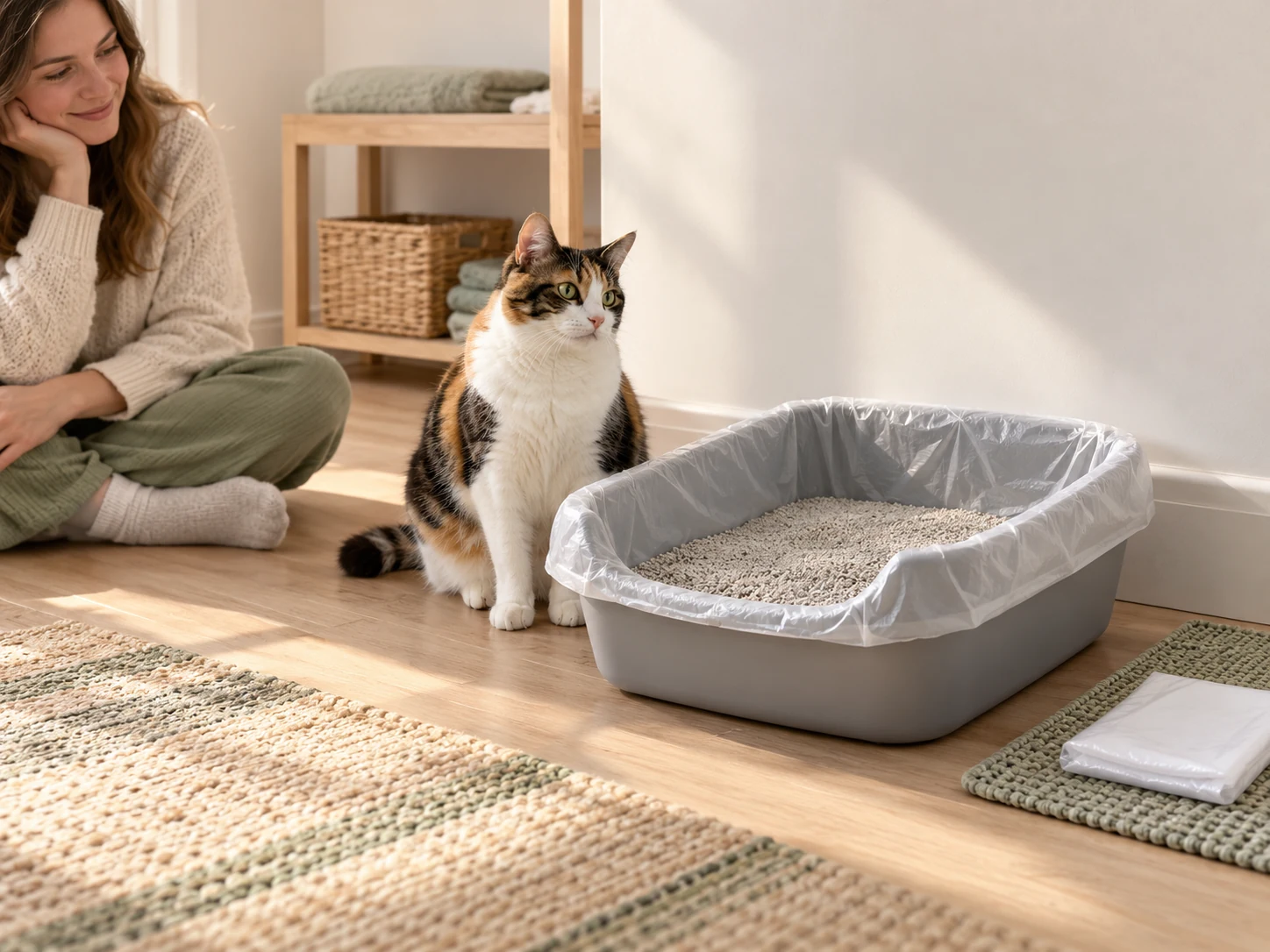
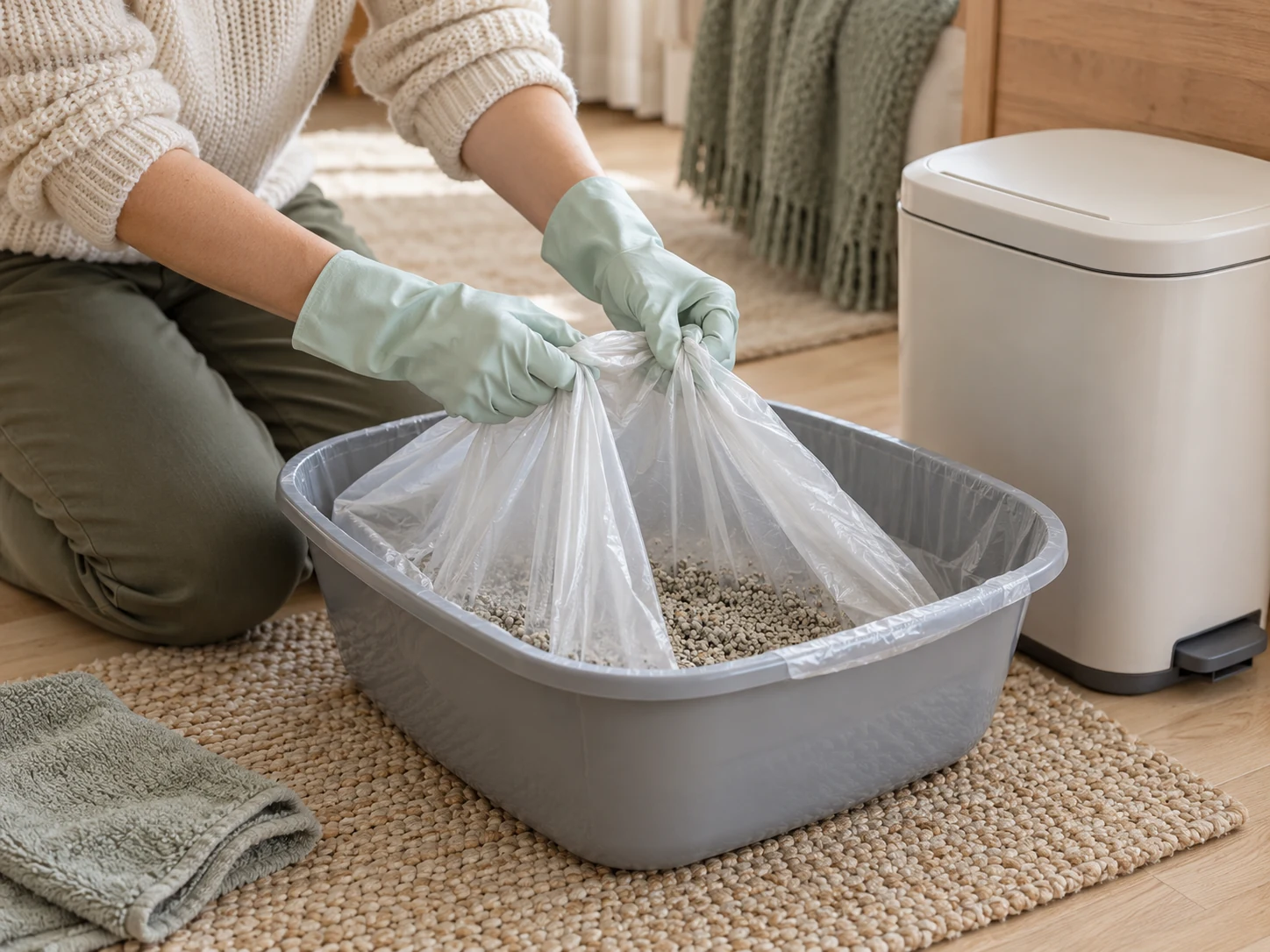
AI-created editorial scene. Liners are optional; suitable fit and the cat's acceptance matter more than adding another bag.
Litter box liners can simplify emptying a compatible pan, but they are optional. Use them only when the liner reaches the bottom without tension, stays clear of the entrance, and does not make your cat avoid the box.
For a cat that tears, chews or dislikes plastic, an unlined washable pan is usually the more practical starting point. Before buying another pack, distinguish poor fit from a cat that simply prefers a different surface.
Do litter box liners solve your cleanup problem?
A liner is a removable bag inside an ordinary litter pan. Its useful job is to help gather the old litter during a complete change. It does not remove the need to scoop, inspect the pan or wash it when necessary.
That benefit has a trade-off: another surface can bunch beneath the litter or catch a claw. The AAFP and ISFM house-soiling brochure notes that many cats dislike box liners. Convenience for the person cleaning the tray therefore needs to be weighed against the cat’s willingness to use it.
- Consider a liner: your cat already accepts it, the correct bag fits smoothly, and lifting out old litter makes a full change easier.
- Try the pan without one: plastic repeatedly tears, shifts or becomes exposed during digging.
- Pause the experiment: your cat starts avoiding the box, chewing the liner or appearing uncomfortable. Restore an accepted setup and investigate the cause.
Keep the familiar litter and location while evaluating the liner. Changing the pan, litter formula and bag together makes it harder to identify which change matters.
Check the pan’s shape before choosing a size
Match the liner to the complete pan, including its depth and rim. A bag that stretches across the top but hangs above the bottom is too tight for a usable installation. Filling that suspended bag adds stress rather than fixing the fit.
Start with the manufacturer’s fit instructions and the model of your box. Measure the pan itself, then confirm that the liner can sit against the floor and corners while leaving enough material over every edge. A deep top-entry pan needs a different shape allowance from a shallow open tray.
| Check | Acceptable result | Reason to stop |
|---|---|---|
| Bottom and corners | Bag rests against the pan after smoothing | Plastic bridges across corners or pulls taut |
| Rim and lid | Overhang stays in place with the lid properly fitted | Lid needs force or the liner slips inward |
| Entrance | Normal entry remains clear | Loose material catches paws or hangs in the opening |
| After digging | Litter stays supported and the bag remains intact | Tears, exposed folds or urine beneath the bag |
Do not treat a retail listing’s small package dimensions as the dimensions of an opened liner. Likewise, a broad claim about fitting litter boxes does not establish compatibility with every pan, corner shape or lid.
Where the Petmate top-entry liners fit
Petmate’s Top Entry Litter Box Liners, model 29248, are a specific option for a compatible deep top-entry pan. The manufacturer’s product instructions describe an eight-count box and a fit for top-entry boxes measuring up to 20 × 15 × 15 inches. Those are the stated box-fit limits, not measurements of a flat bag.
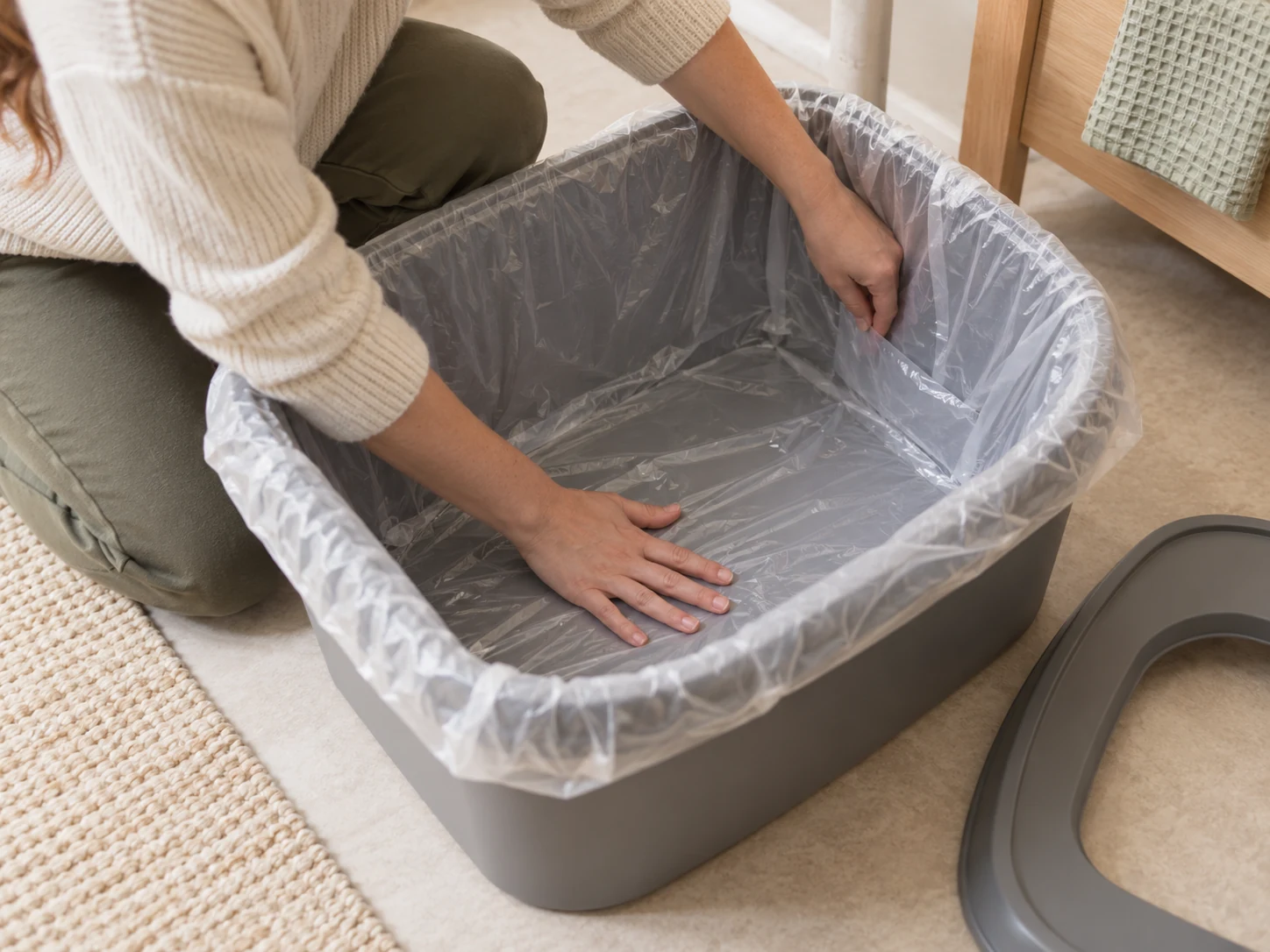
The same instructions say to drape the liner over all sides, press its center down and smooth it outward before filling. Use that procedure as the fit test. A nominally smaller box with an awkward rim can still need checking rather than an assumption.
For a matching pan and a cat that already accepts liners, check the Petmate Top Entry Litter Pan Liners, model 29248, eight-count option on Amazon. This is a targeted replacement-bag choice, rather than a recommendation to replace a working litter box.
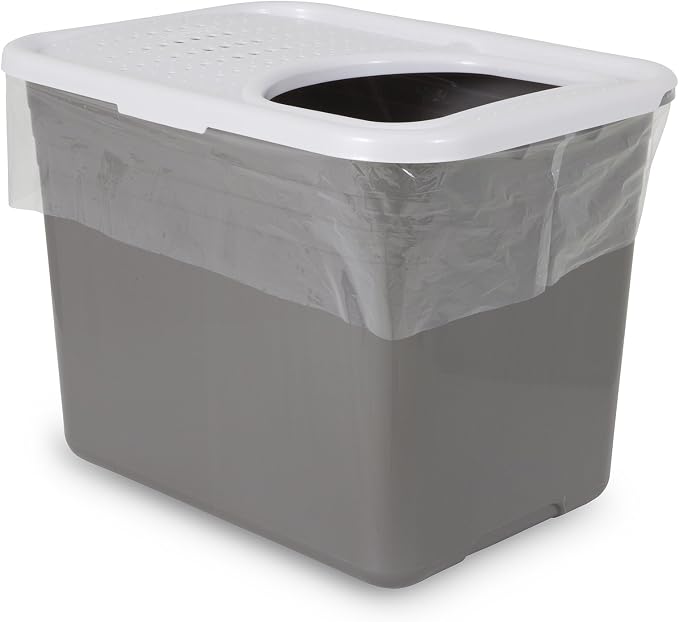
PRODUCT MENTIONED
Petmate TOP ENTRY LITTER PAN LINERS Dark Grey 8 Count (Pack of 1)
Amazon · Details on the retailer’s website
Petmate calls the plastic tear-resistant. That is a manufacturer description, not evidence of claw-proof performance or an independently verified durability result. It also should not be read as a guarantee against leaks, infection or odors.
This option does not cover a Litter-Robot globe’s reusable rubber liner. It is also not a waste-drawer bag or an approved liner for another automatic box. Automatic equipment needs its own model-specific consumables and instructions.
Install one without creating tight corners
- Empty and inspect the pan. Remove old litter and look for scratches, cracks or retained waste. Wash and dry the ordinary pan according to its care instructions.
- Open the liner fully. Spread it across the rim with material overhanging on every side.
- Seat the center. Press it onto the bottom, then smooth outward into the corners. Avoid stretching the plastic to make it reach.
- Check the lid and entrance. Refit the lid normally and confirm that it sits securely without forcing or trapping an excessive fold.
- Add the intended litter. Follow the litter package and pan instructions. Do not invent a deeper fill to hide a poor-fitting bag.
- Observe normal use. Check the bag and the cat’s access after use. Stop if the setup creates an obvious obstacle or avoidance.
Do not staple, pin or add improvised fasteners inside the pan to rescue a mismatch. A bag that only works after changing the box’s entry or assembly is a poor fit for this purpose.
If liners keep tearing, change the setup
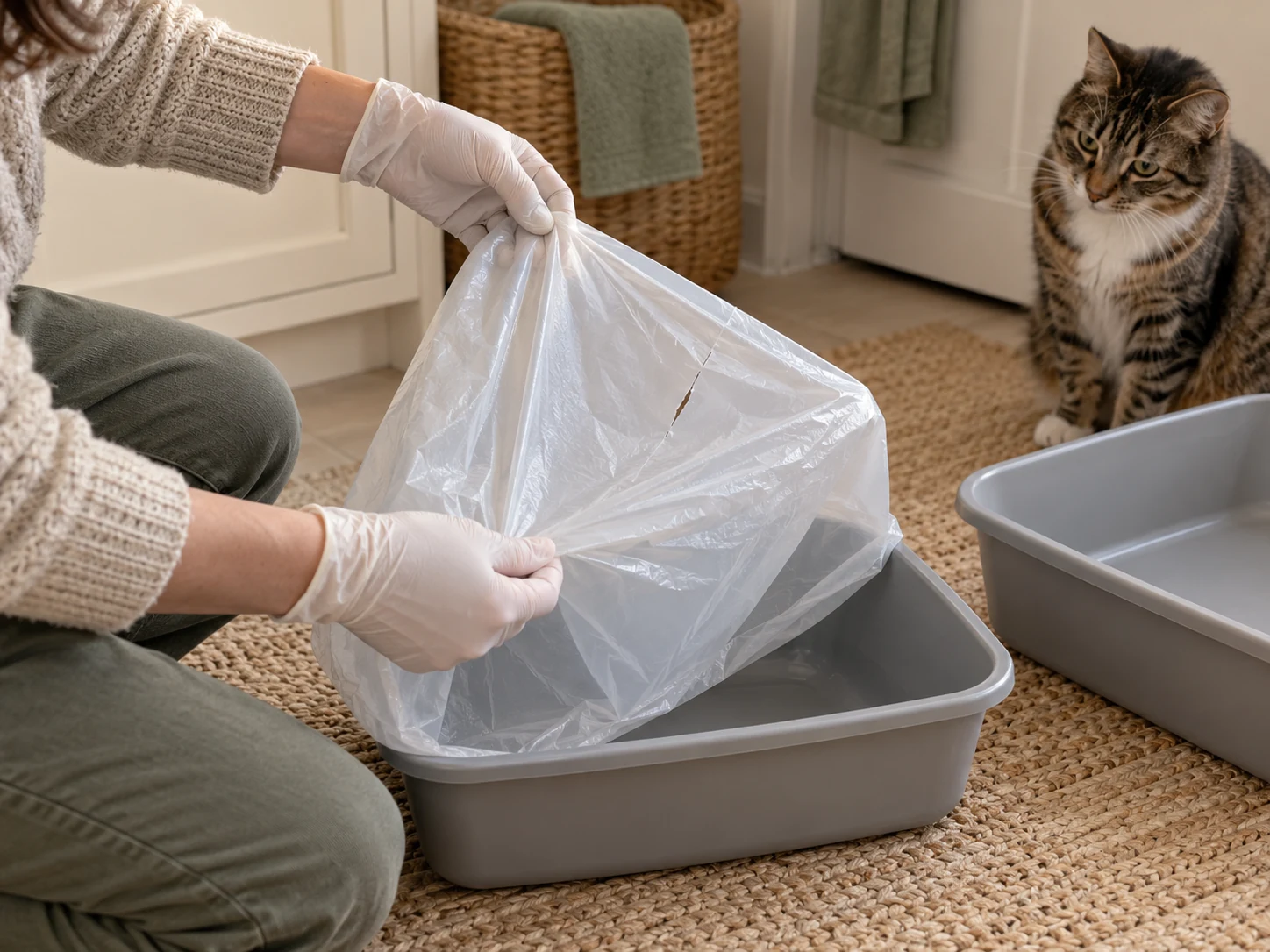
Look at where the damage starts. A split at a taut corner points toward a fit problem; repeated damage beneath the litter during digging can make liners an unsuitable choice for that cat. These observations help decide what to change, but they do not establish a tested cause for every tear.
Remove a torn liner and check underneath it. Replacing only the visible top layer of litter can leave waste between plastic and pan. Clean the affected surfaces before installing another bag, or return to the unlined pan if that arrangement worked.
Continually doubling bags adds material and cost without proving the setup will hold. It can also make fitting the rim harder. The alternative is straightforward: scoop an unlined washable pan, empty it when needed and clean the actual surface.
For cats changing litter formulas at the same time, the tofu-versus-blend litter guide treats formula choice separately. A new bag should not become a reason to change an otherwise accepted litter.
Daily care with litter box liners
With litter box liners, inspect the box and remove waste daily even when emptying is easier. Petmate specifically directs owners to sift out solid waste each day. A liner underneath the litter cannot do that job.
At a full change, gather the liner from all sides while keeping it supported over the pan, then tie it as instructed. If the bag is damaged or the load feels difficult to control, avoid carrying it unsupported across the room. Use an appropriate waste container and follow local disposal requirements.
Check the emptied pan for moisture, residue and damage before refilling. The veterinary association brochure recommends regular washing of ordinary boxes with soap and hot water, while avoiding strong chemicals and ammonia-based products. Match cleaning to the pan’s care directions; those ordinary-pan instructions do not authorize washing an electrical litter-box base.
Keep a simple record of tears, cat acceptance and liners used between changes. This shows whether the convenience is worth the recurring plastic use for your household without assuming that an eight-pack lasts a fixed number of weeks.
When a liner problem needs a different response
New house-soiling is not proof that a liner is the cause. Cornell’s guidance on feline house-soiling describes medical, litter-box and environmental causes, and recommends veterinary assessment rather than assuming a cat is being difficult.
If a cat starts eliminating outside the tray, restore access to a familiar accepted box and contact your veterinarian. Repeated discomfort, difficulty urinating or other illness signs need prompt professional attention. Buying stronger bags is not an appropriate response to an unexplained health or toileting change.
Frequently asked questions
Are litter box liners necessary?
No. They are an optional emptying aid for a compatible ordinary pan. If your cat dislikes them or an unlined pan is easy to maintain, there is no need to add plastic. Daily waste removal and suitable cleaning remain necessary with either arrangement.
Can I use these liners in any top-entry box?
Do not assume so. Petmate specifies top-entry boxes up to 20 × 15 × 15 inches for model 29248. Confirm the pan’s model, dimensions, rim and lid, then check that the bag reaches the bottom without tension. The manufacturer’s maximum dimensions are not a universal-fit guarantee.
How often should I replace a liner?
Replace it when damaged or during the relevant complete litter change, following the pan, liner and litter instructions. Check underneath after a tear. A fixed weekly rule cannot account for every litter formula, number of cats, digging pattern and actual condition of the setup.
Choose the simplest accepted setup
Litter box liners are useful when they make emptying easier without disrupting the cat’s routine. First confirm that the existing pan is accessible and accepted. Then check the bag’s bottom, corners, rim and entrance before adding litter. A correct fit should not depend on stretching plastic across empty space or forcing the lid into position.
Petmate’s model 29248 is a specific eight-count option to consider for a matching top-entry pan. If it repeatedly tears or changes how your cat uses the box, keep the familiar litter and return to an unlined setup while you investigate. The successful choice is the one you can keep clean and your cat can use comfortably.
View Petmate TOP ENTRY LITTER PAN LINERS Dark Grey 8 Count (Pack of 1) on Amazon.
Comments are reviewed before they appear publicly. Please keep questions and feedback relevant to this article.